 plumi
Deducing formulae and structures from data: Edexcel International A Level Chemistry questions
Edexcel International A Level Chemistry past-paper questions on 20.1.1 Deducing formulae and structures from data, 2019–2025, with mark schemes and examiner’s reports where available.
Paper
All papers
Exam
All years
Calculations
Q19(b)(ii)
The whole paper ↗
Q23(a)
The whole paper ↗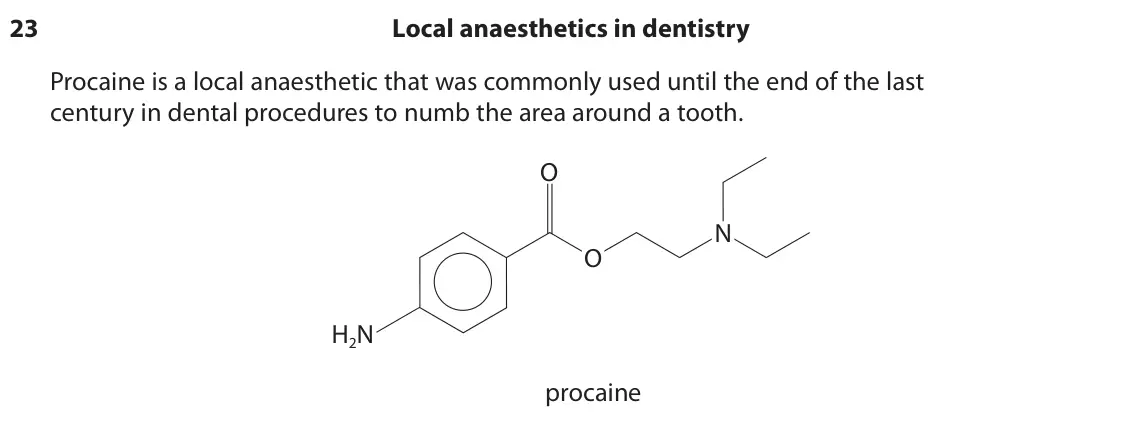
Q3(a)
The whole paper ↗
Q3(c)
The whole paper ↗Q1(c)(i)
The whole paper ↗
Q18(b)(v)
The whole paper ↗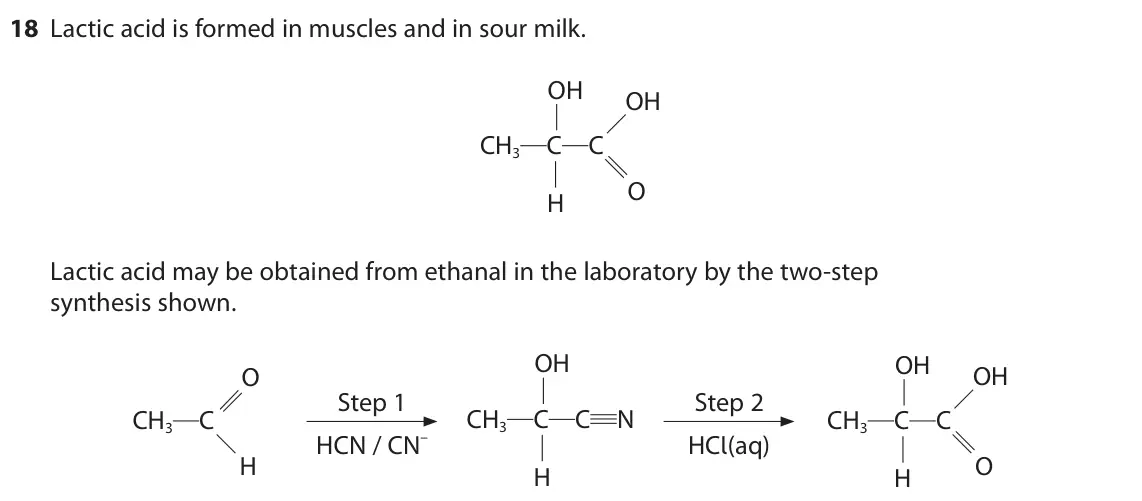
Q17(a)
The whole paper ↗
Q17(b)
The whole paper ↗Q17(c)
The whole paper ↗Q17(d)
The whole paper ↗Q17(d)
The whole paper ↗
Q21(a)(ii)
The whole paper ↗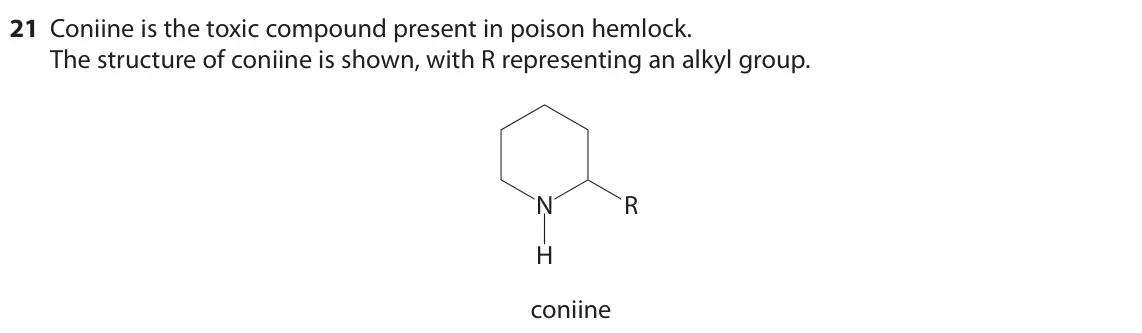
Q14(a)
The whole paper ↗
Q14(b)
The whole paper ↗Q2(c)
The whole paper ↗
Q20(b)(i)
The whole paper ↗
Q20(b)(ii)
The whole paper ↗Q20(b)(iii)
The whole paper ↗Q15(a)
The whole paper ↗
Q15(b)
The whole paper ↗
All 35 questions on Deducing formulae and structures from data, as a list
- June 2025 (A), Unit 5, Q19(b)(ii) (3 marks): Determine the molecular formula of E, using the data shown and the information in (b). (3) % carbon % hydrogen % nitrogen % oxygen 51.1 8.51 15.1
- January 2025, Unit 5, Q23(a) (1 mark): Deduce the molecular formula of procaine. (1)
- January 2025, Unit 6, Q3(a) (4 marks): Qualitative tests on X show that it • burns in air with a very smoky flame • forms an orange precipitate with 2,4-dinitrophenylhydrazine (Brady’s reagent) does
- January 2025, Unit 6, Q3(c) (1 mark): The molecular formula of X is the same as its empirical formula. Use this information, and your answers to (a) and (b), to deduce the structure of X. (1)
- June 2024, Unit 6, Q1(c)(i) (2 marks): Draw the displayed formula of the two structural isomers of A, using this information and your answers from (a) and (b). (2)
- January 2023, Unit 4, Q18(b)(v) (1 mark): Draw the structure of X using the information from (b)(ii) to (b)(iv). (1)
- January 2023, Unit 5, Q17(a) (4 marks): An organic compound A contains carbon, hydrogen and oxygen only and has a molar mass of 136 g mol–1. Complete combustion of 5.26 g of A in dry oxygen produces 1
- January 2023, Unit 5, Q17(b) (5 marks): Compound A, C9H12O, contains a benzene ring and one side-chain. A is oxidised when heated with acidified potassium dichromate(VI) to produce a compound B which
- January 2023, Unit 5, Q17(c) (2 marks): Compound F is a structural isomer of A which also has a benzene ring and one side-chain. F is not oxidised when heated with acidified potassium dichromate(VI).
- January 2023, Unit 5, Q17(d) (2 marks): Compound G is a structural isomer of A which also has a benzene ring and one side-chain. The mass spectrum of G has a peak at m / z = 107. Deduce the structure
- October 2022, Unit 4, Q17(d) (6 marks): Sodium ethanoate, CH3COONa , reacts with 2-methylpropanoyl chloride, (CH3)2CHCOCl , to form organic compound Z and sodium chloride, NaCl . The molecular ion pea
- October 2022, Unit 5, Q21(a)(ii) (2 marks): Deduce the molecular formula of the alkyl group R, using the structure of coniine and its molar mass. You must show your working. (2)
- June 2022, Unit 5, Q14(a) (4 marks): Complete combustion of 6.02 g of Q produces 18.07 g of carbon dioxide and 3.30 g of water. Determine the empirical formula of Q. (4)
- June 2022, Unit 5, Q14(b) (6 marks): Tests on samples of Q show that it • burns in air with a very sooty flame • forms an orange precipitate with Brady’s reagent (2,4-dinitrophenylhydrazine solutio
- June 2022, Unit 6, Q2(c) (2 marks): The high resolution proton NMR spectrum of E is shown. P Q 11 10 9 8 7 6 5 4 3 2 1 0 δ / ppm The relative numbers of protons responsible for the singlet peaks s
- January 2022, Unit 4, Q20(b)(i) (3 marks): Compound A is thought to be another isomer of hexanoic acid. 10 g of compound A is found to contain 6.21 g of carbon and 1.03 g of hydrogen, with the remainder
- January 2022, Unit 4, Q20(b)(ii) (1 mark): State how you might use your answer to (b)(i) and a mass spectrum of compound A to prove that compound A is an isomer of hexanoic acid. (1)
- January 2022, Unit 4, Q20(b)(iii) (6 marks): A series of tests was performed on compound A. Test Observation 1 addition of phosphorus(V) chloride misty fumes 2 addition of 2,4‑dinitrophenylhydrazine orange
- January 2022, Unit 5, Q15(a) (4 marks): Combustion analysis of 4.91 g of Q produces 14.6 g of carbon dioxide and 3.58 g of water. Show that the molecular formula of Q is C10H12O . You must show all yo
- January 2022, Unit 5, Q15(b) (7 marks): The high resolution proton NMR spectrum of Q is shown. Area under curve 5 2 2 3 10 9 8 7 6 5 4 3 2 1 0 δ (ppm) Deduce the structure of Q. Justify your answer by
- January 2022, Unit 6, Q2(e)(i) (2 marks): Z has a fruity smell. Deduce the identity of the functional group present in Z, using all the information given. Include any relevant wavenumber ranges in your
- October 2021, Unit 4, Q16(a)(i) (1 mark): Give a reason why the oxygen used must be dry. (1)
- October 2021, Unit 4, Q16(a)(ii) (5 marks): Show that the empirical formula of X is C4H6O3 . You must show your working. (5)
- October 2021, Unit 4, Q16(b)(i) (6 marks): Deduce the two possible structures of X, showing how this information supports your answer. (6)
- October 2021, Unit 6, Q2(b)(ii) (1 mark): A contains one functional group. Give the m / z value of the molecular ion and the structure of A. (1) m / z value of the molecular ion structure of A
- October 2021, Unit 6, Q2(c)(ii) (1 mark): B has a molar mass of 59 g mol−1. Suggest a structure for B. (1)
- October 2021, Unit 6, Q4(f)(i) (1 mark): Deduce the formula of the alkyl group, R. (1)
- June 2021, Unit 5, Q19(c) (6 marks): A simplified high resolution proton NMR spectrum of Y is shown. The relative peak areas are given near each peak. 9 3 TMS 1 12.0 10.0 8.0 6.0 4.0 2.0 0.0 Chemic
- June 2021, Unit 5, Q19(d) (1 mark): Draw the structure of compound X. (1)
- June 2021, Unit 6, Q3(d)(i) (2 marks): Identify, by name or formula, suitable substances for solids M and N. (2) Solid M Solid N
- June 2021, Unit 6, Q3(d)(ii) (4 marks): Calculate the empirical formula of the compound, using the data given. You must show your working. (4)
- June 2021, Unit 6, Q3(d)(iv) (1 mark): Deduce the molecular formula of the compound, using your answers to (ii) and (d)(iii). (1)
- January 2021, Unit 5, Q17 (1 mark): When a sample of a hydrocarbon is burned completely in oxygen, 2.64 g of carbon dioxide and 0.81 g of water are formed. Which of these could be the molecular fo
- January 2021, Unit 5, Q22(a) (3 marks): Determine the molecular formula of CxHy . You must show your working. (3)
- October 2020, Unit 5, Q25(e)(ii) (4 marks): The Lanthanides The lanthanides form a series in the Periodic Table comprising the elements from lanthanum, La (Z = 57) to lutetium, Lu (Z = 71). They have impo
Questions, mark schemes and examiner’s reports are © Pearson Edexcel, from their published past papers. Plumi isn’t affiliated with any exam board. Want whole papers? Edexcel International A Level Chemistry past papers.
The Plumi iPad app also offers exam-style questions with AI feedback on your handwritten working.