 plumi
Carbon-13 NMR: Edexcel International A Level Chemistry questions
Edexcel International A Level Chemistry past-paper questions on 15.E.2 Carbon-13 NMR, 2019–2025, with mark schemes and examiner’s reports where available.
Paper
All papers
Exam
All years
Calculations
Q13(a)
The whole paper ↗ Your answer
Q19(a)(iii)
The whole paper ↗
Q19(a)(iv)
The whole paper ↗Q16(b)
The whole paper ↗ Your answer
Q16(c)
The whole paper ↗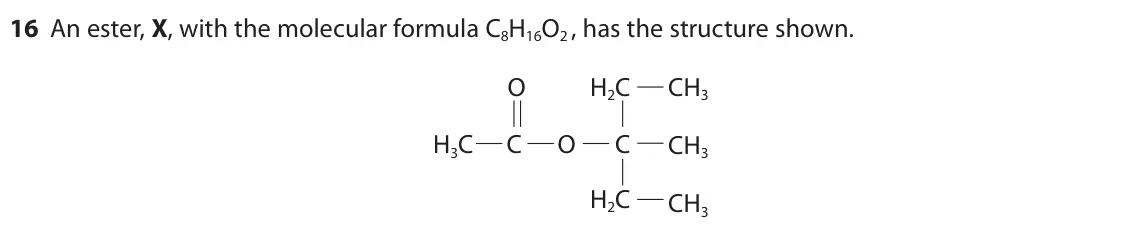
Q19(e)(iii)
The whole paper ↗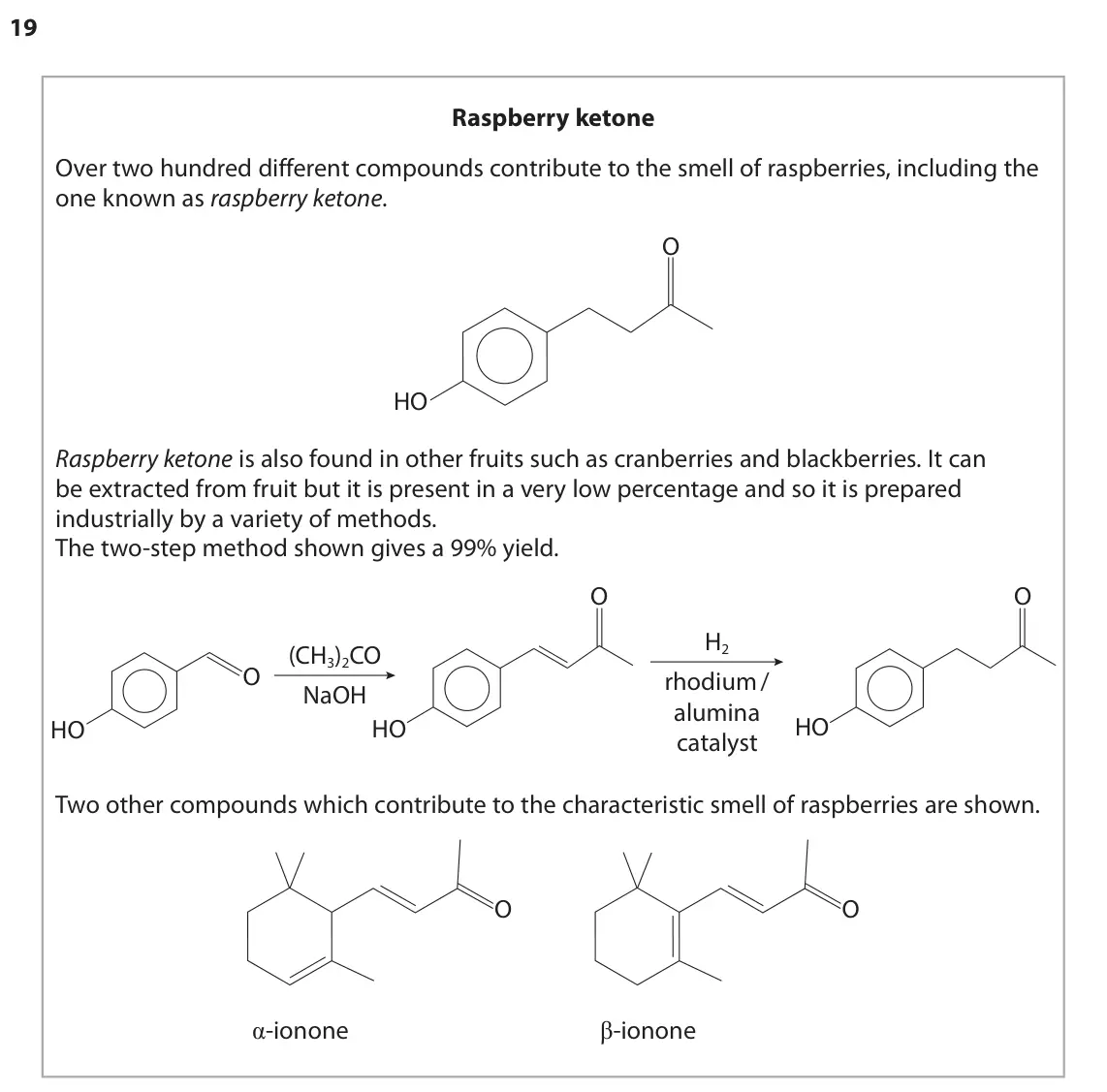
- Your answer
Q11(c)
The whole paper ↗ Your answer
Q10(a)
The whole paper ↗ Your answer
Q2(b)(ii)
The whole paper ↗
Q17(b)(i)
The whole paper ↗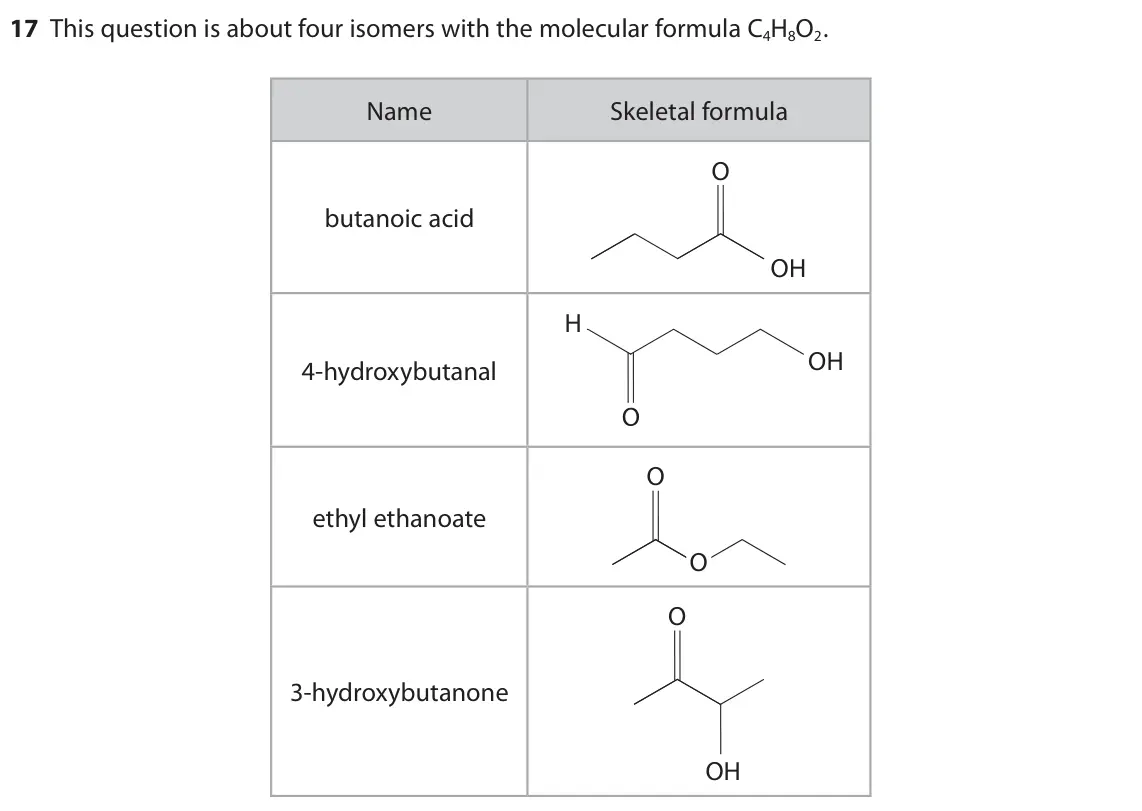
Q19(a)(i)
The whole paper ↗
Q2(b)
The whole paper ↗
Q18(b)(iv)
The whole paper ↗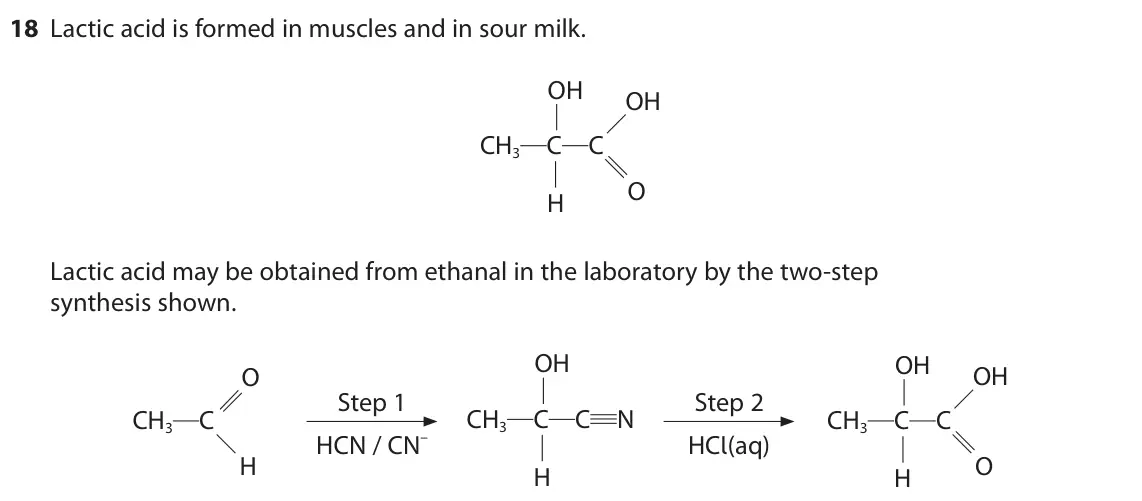
Q18(b)(v)
The whole paper ↗Q17(c)
The whole paper ↗
- Your answer
Q17(d)(i)
The whole paper ↗
Q17(d)(ii)
The whole paper ↗
All 34 questions on Carbon-13 NMR, as a list
- June 2025, Unit 5, Q13(a) (1 mark): How many peaks are there in the (1) A one B two C three D five
- June 2025 (A), Unit 5, Q19(a)(iii) (1 mark): Carbon‑13 NMR spectra usually have a peak at a chemical shift of 0. Identify the compound responsible for this peak. (1)
- June 2025 (A), Unit 5, Q19(a)(iv) (3 marks): Complete the carbon‑13 NMR spectrum of alanine showing the chemical shift values for each peak and the carbon atoms responsible for the peaks. (3) 200 150 100 5
- January 2025, Unit 5, Q16(b) (1 mark): Which compound does not have the same number of peaks in the low‑resolution proton NMR spectrum and in the 13C NMR spectrum? (1) A compound W B compound X C com
- October 2024, Unit 4, Q12 (1 mark): Which isomer has the most peaks in its 13C NMR spectrum? A B C D
- October 2024, Unit 4, Q16(c) (1 mark): An isomer of X is a carboxylic acid with five peaks in its 13C NMR spectrum. Draw a possible skeletal structure for this carboxylic acid. (1)
- October 2024, Unit 5, Q19(e)(iii) (1 mark): Predict the number of peaks in the carbon-13 NMR spectrum of β-ionone, which has the molecular formula C13H20O . Justify your answer. O β-ionone (1)
- June 2024, Unit 4, Q13 (1 mark): Which compound has most peaks in its 13C NMR spectrum? A CH3COCH3 B CH3COCH2CH3 C CH3CH2COCH2CH3 D CH3COCH2CH2COCH3 Use this space for any rough working. Anythi
- January 2024, Unit 4, Q11(c) (1 mark): How many peaks would be expected to appear in a carbon‑13 (13C) NMR spectrum of carvone? (1) A 10 B 9 C 8 D 7
- January 2024, Unit 5, Q10(a) (1 mark): Which of the esters have five peaks in their 13C NMR spectrum? (1) A P only B Q and R only C R and S only D Q, R and S only
- January 2024, Unit 6, Q2(b)(ii) (2 marks): There are only two peaks in the 13C NMR spectrum of X. Draw the displayed formula of X, labelling the carbon environments. (2)
- October 2023, Unit 4, Q17(b)(i) (1 mark): State why it is not possible to distinguish any of these isomers from the number of peaks in their 13C NMR spectra. (1)
- June 2023, Unit 4, Q19(a)(i) (3 marks): Complete the table for these three isomers. (3) Number of peaks in Isomer Skeletal formula 13C NMR spectrum 1 2 3
- June 2023, Unit 6, Q2(b) (1 mark): The 13C NMR spectrum of X has two peaks. Draw the displayed formula of X. (1)
- January 2023, Unit 4, Q18(b)(iv) (2 marks): A simplified carbon‑13 NMR spectrum of X is shown. 200 160 120 80 40 0 δ / ppm State what additional information about the structure of X is given by this spect
- January 2023, Unit 4, Q18(b)(v) (1 mark): Draw the structure of X using the information from (b)(ii) to (b)(iv). (1)
- January 2023, Unit 5, Q17(c) (2 marks): Compound F is a structural isomer of A which also has a benzene ring and one side-chain. F is not oxidised when heated with acidified potassium dichromate(VI).
- October 2022, Unit 5, Q16 (1 mark): The structure of a hydrocarbon is shown. How many peaks will there be in the 13C NMR spectrum of this compound? A four B five C six D seven
- June 2022, Unit 4, Q17(d)(i) (1 mark): Identify the chemical shift range and carbon environment of one peak you would expect to see in both spectra. (1) Chemical shift range Carbon environment
- June 2022, Unit 4, Q17(d)(ii) (1 mark): State the number of peaks you would expect to see in each 13C NMR spectrum. (1) Propanal Propanone
- June 2022, Unit 5, Q7(b) (1 mark): One of the monomers used to make PET is benzene-1,4-dicarboxylic acid. O O HO OH How many peaks are there in the 13C NMR spectrum of benzene‑1,4‑dicarboxylic ac
- January 2022, Unit 4, Q20(c) (2 marks): Compound B, another isomer with the molecular formula C6H12O2, contains a ring of six carbon atoms. The carbon‑13 NMR spectrum has only two peaks, one of which
- January 2022, Unit 5, Q6(a) (1 mark): What is the number of peaks in the 13C NMR spectrum of methylbenzene? (1) A seven B six C five D four
- January 2022, Unit 6, Q2(d)(ii) (2 marks): The 13C NMR spectrum of Y contains four peaks. Give two possible structures for Y. (2) Structure 1 Structure 2
- October 2021, Unit 5, Q19(f)(ii) (2 marks): The 13C NMR spectrum of one of these arenes, compound X, is shown. two peaks very close in chemical shift 200 180 160 140 120 100 80 60 40 20 0 δ / ppm Identify
- October 2021, Unit 6, Q4(f)(iii) (2 marks): The part of the 13C NMR spectrum of X corresponding to the R group contains only two peaks. Deduce the structure of X. (2)
- June 2021, Unit 4, Q8(b) (1 mark): Which of the carbon atoms is responsible for a peak at 72 ppm in the 13C NMR spectrum of menthol? (1) A P B Q C R D S
- June 2021, Unit 5, Q15 (1 mark): How many peaks are there in the carbon-13 (13C) NMR spectrum of methylcyclohexane? methylcyclohexane A one B three C five D seven
- June 2021, Unit 6, Q3(a)(i) (1 mark): the fewest peaks in its carbon-13 NMR spectrum. (1)
- January 2021, Unit 4, Q19(c)(iii) (2 marks): The carbon-13 (13C) NMR spectrum of F has four peaks. Identify F by drawing its displayed formula. Justify your answer by labelling the carbon atoms or groups o
- January 2021, Unit 5, Q16 (1 mark): The structure of a hydrocarbon is shown. How many peaks will there be in the 13C NMR spectrum of this compound? A four B five C seven D eight Use this space for
- October 2020, Unit 4, Q17(b)(ii) (1 mark): State the number of peaks in the carbon-13 (13C) NMR spectrum of E. (1)
- October 2020, Unit 5, Q12 (1 mark): A compound with the formula C6H14 gives a 13C NMR spectrum with four peaks. Which compound gives this spectrum? A B C D
- January 2020, Unit 4, Q16(a)(iii) (1 mark): The carbon-13 (13C) NMR spectrum of ethyl 3-oxobutanoate has six peaks. Draw the structure of an isomer of ethyl 3-oxobutanoate that contains a carboxylic acid
Questions, mark schemes and examiner’s reports are © Pearson Edexcel, from their published past papers. Plumi isn’t affiliated with any exam board. Want whole papers? Edexcel International A Level Chemistry past papers.
The Plumi iPad app also offers exam-style questions with AI feedback on your handwritten working.