 plumi
Calculating enthalpy changes from experiments: Edexcel International A Level Chemistry questions
Edexcel International A Level Chemistry past-paper questions on 6.1.3 Calculating enthalpy changes from experiments, 2019–2025, with mark schemes and examiner’s reports where available.
Paper
All papers
Exam
All years
Calculations
Q1(a)
The whole paper ↗ Your answer
Q5(b)
The whole paper ↗
Q19(b)
The whole paper ↗
Q16(b)(i)
The whole paper ↗
Q2(a)(i)
The whole paper ↗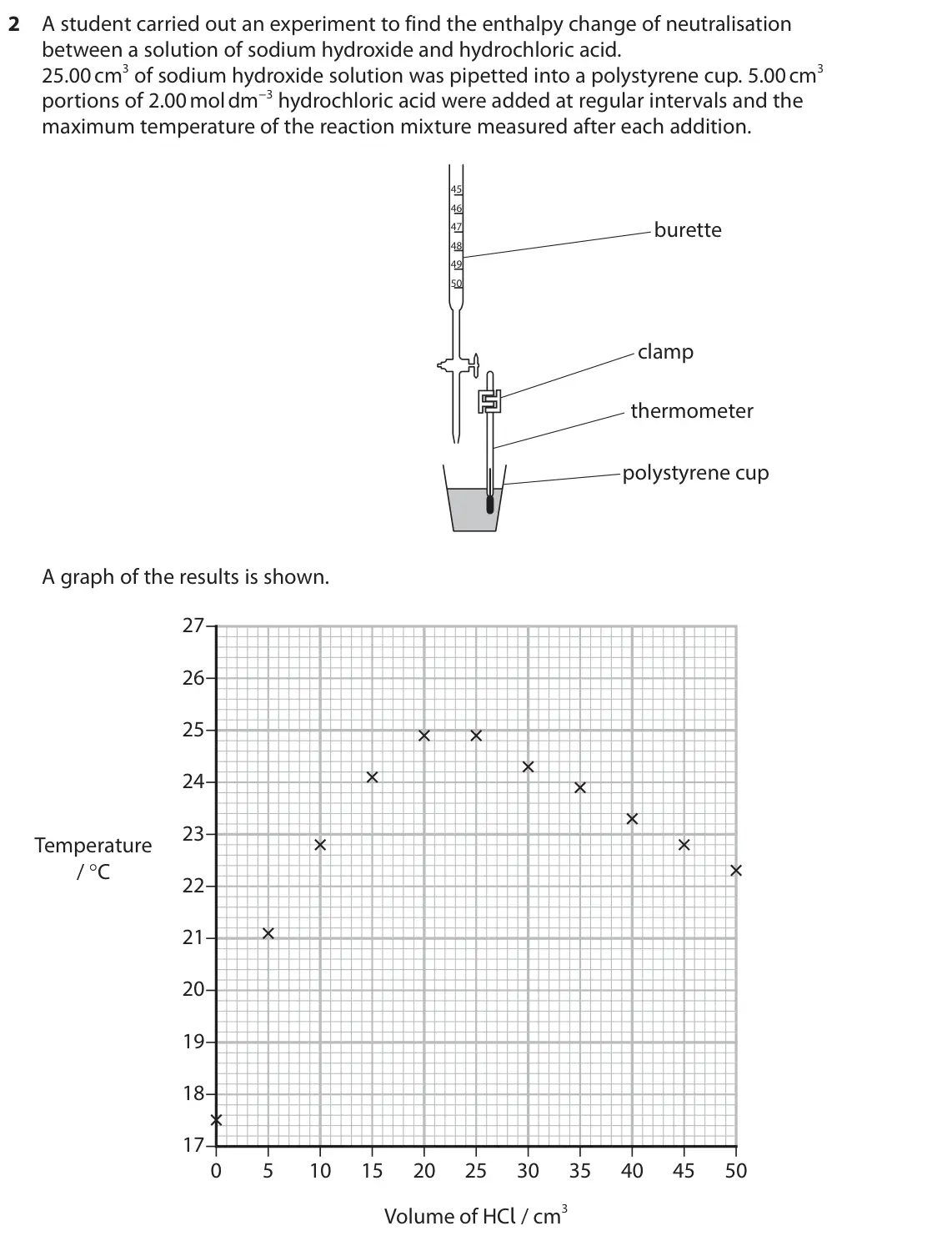
Q2(a)(ii)
The whole paper ↗Q2(a)(iii)
The whole paper ↗Q20(b)
The whole paper ↗
Q17(a)
The whole paper ↗
Q17(c)
The whole paper ↗Q4(b)
The whole paper ↗
Q4(d)(i)
The whole paper ↗Q4(d)(ii)
The whole paper ↗Q4(e)(ii)
The whole paper ↗Q6(a)
The whole paper ↗ Your answer
Q22(b)
The whole paper ↗
Q4(c)(i)
The whole paper ↗
Q4(c)(ii)
The whole paper ↗Q4(c)(iii)
The whole paper ↗Q19(a)(i)
The whole paper ↗
All 60 questions on Calculating enthalpy changes from experiments, as a list
- June 2025, AS Unit 2, Q1(a) (1 mark): What is the expression for the enthalpy change of neutralisation of sodium hydroxide and ethanoic acid, in J mol–1? [Assume: the specific heat capacity of the m
- June 2025, AS Unit 3, Q5(b) (4 marks): The student carried out the reaction. The starting temperature recorded was 19.4°C. The maximum temperature recorded was 55.2°C. Calculate the value for the ent
- June 2025, Unit 4, Q19(b) (4 marks): Hydrated copper(II) sulfate is soluble in water. A student carried out an experiment to determine its enthalpy change of solution. 100 g of distilled water was
- October 2024, AS Unit 2, Q16(b)(i) (4 marks): In the first experiment, the student determined the enthalpy change when dissolving anhydrous magnesium sulfate. MgSO4(s) + (aq) → MgSO4(aq) 100.0 g of distille
- October 2024, AS Unit 3, Q2(a)(i) (3 marks): Draw two lines of best-fit to determine the maximum temperature change at the point of neutralisation. (3) Volume of hydrochloric acid at neutralisation cm3 Max
- October 2024, AS Unit 3, Q2(a)(ii) (2 marks): Calculate the concentration of the sodium hydroxide solution, using an answer from (a)(i) and information from the procedure. (2)
- October 2024, AS Unit 3, Q2(a)(iii) (4 marks): Calculate the enthalpy change of neutralisation, in kJ mol−1. (4) Assume the value of the specific heat capacity of the solution is 4.18 J g−1 °C−1 and the dens
- October 2024, Unit 4, Q20(b) (3 marks): Magnesium chloride, MgCl2(s), is used in the manufacture of tofu from soya milk. An experiment was carried out to determine the enthalpy change of solution, Δso
- June 2024, AS Unit 2, Q17(a) (3 marks): Find the end‑point volume and the maximum temperature by adding appropriate lines of best fit to the graph. (3) End‑point volume = Maximum temperature =
- June 2024, AS Unit 2, Q17(c) (5 marks): The reaction that occurs is shown. CH3COOH(aq) + NH3(aq) → CH3COONH4(aq) Calculate the enthalpy change of neutralisation for this reaction, in kJ mol‒1. Give yo
- June 2024, AS Unit 3, Q4(b) (1 mark): State the purpose of measuring the temperature every 30 seconds for 2½ minutes in Step 2. (1)
- June 2024, AS Unit 3, Q4(d)(i) (2 marks): Determine the maximum temperature change, ∆T , for this reaction, using the graph. You must show your working on the graph. (2)
- June 2024, AS Unit 3, Q4(d)(ii) (2 marks): Explain why the temperature decreases over time after 5 minutes. (2)
- June 2024, AS Unit 3, Q4(e)(ii) (1 mark): State why the number of moles of sodium hydroxide and not the number of moles of sulfuric acid is used in the calculation for this experiment. (1)
- June 2024 (R), AS Unit 2, Q6(a) (1 mark): Which is the correct expression to calculate the enthalpy change of neutralisation for this reaction, in J mol–1 ? (1) A Δ T 4.2 50 3 5.0 10 B Δ T 4.2 25 3 2.5
- January 2024, AS Unit 2, Q22(b) (4 marks): The student carried out an experiment to determine the enthalpy change of reaction, ΔrH2 , in kJ mol–1, for Reaction 2. Reaction 2 MgO(s) + 2HCl(aq) → MgCl2(aq)
- January 2024, AS Unit 3, Q4(c)(i) (1 mark): Calculate the energy transferred to the water. (1)
- January 2024, AS Unit 3, Q4(c)(ii) (1 mark): Calculate the amount of ethanol burnt in moles. (1)
- January 2024, AS Unit 3, Q4(c)(iii) (1 mark): Calculate the enthalpy change of combustion of ethanol in kJ mol–1, using your answers to (c)(i) and (c)(ii). Give your answer to an appropriate number of signi
- October 2023, AS Unit 1, Q19(a)(i) (2 marks): Calculate the mean energy density of this E10 fuel in MJ kg–1. Give your answer to an appropriate number of significant figures. (2)
- October 2023, AS Unit 1, Q19(a)(iii) (1 mark): Calculate the energy released when 1500 cm3 of the E10 fuel is burned in excess oxygen, using your answers from (a)(i) and (a)(ii). [If you did not calculate a
- October 2023, AS Unit 2, Q18(b)(i) (2 marks): Use the graph shown to determine the maximum temperature change, ΔT, in this experiment. You must show your working on the graph. (2) ΔT 28 26 Temperature / °C
- October 2023, AS Unit 2, Q18(b)(ii) (3 marks): Calculate the enthalpy change of neutralisation using your answers to (a) and (b)(i). Give a sign and units with your answer. Assume: no energy is used to heat
- June 2023, AS Unit 2, Q20(a)(iii) (2 marks): When petrol is used to power a car, the energy available is less than the theoretical maximum. When one kilogram of petrol powers a car, the energy used to move
- January 2023, AS Unit 2, Q1(b) (1 mark): The student repeats the experiment but burns 0.30 g of methanol and uses 75.0 cm3 of water in the copper calorimeter. What is the expected temperature change in
- January 2023, AS Unit 3, Q2(b)(i) (1 mark): The student’s results are shown. Quantity Value Final water temperature / °C 29.1 Initial water temperature / °C 21.8 Temperature change / °C Mass of burner + e
- January 2023, AS Unit 3, Q2(b)(ii) (3 marks): Calculate the enthalpy change of combustion of ethanol in kJ mol–1, using the student’s results. Give your answer to an appropriate number of significant figure
- October 2022, AS Unit 2, Q20(a) (4 marks): In the first experiment, the student determines the enthalpy change when hydrated copper(II) sulfate dissolves in water. CuSO4·5H2O(s) + aq → CuSO4(aq) 10.68 g
- June 2022, AS Unit 2, Q18(a)(iv) (3 marks): Calculate the heat energy released during the complete combustion of 1 dm3 of 2,2,4-trimethylpentane. [Density of 2,2,4-trimethylpentane = 0.692 g cm−3] (3)
- June 2022, AS Unit 2, Q18(b)(i) (4 marks): Calculate the enthalpy change of combustion of ethanol. Give your answer to an appropriate number of significant figures, and include a sign and units. [Specifi
- June 2022, AS Unit 3, Q1(b)(ii) (1 mark): Calculate the energy transferred in the reaction, in joules. Assume that the specific heat capacity of the solution is 4.2 J g–1°C–1. (1)
- June 2022, AS Unit 3, Q1(b)(iii) (1 mark): State a second assumption, other than the specific heat capacity of the solution, that you have made in your calculation in (b)(ii). (1)
- June 2022, AS Unit 3, Q1(b)(iv) (2 marks): Calculate the enthalpy change of the reaction, using your answers to (b)(i) and (b)(ii). (2)
- January 2022, AS Unit 2, Q3 (1 mark): 5.20 g of sodium hydrogencarbonate is added to an excess of acid. The temperature increases and the energy change is calculated to be 1030 J. What is the enthal
- January 2022, AS Unit 2, Q21(a)(i) (1 mark): Complete the table. (1)
- January 2022, AS Unit 2, Q21(a)(ii) (4 marks): Calculate the enthalpy change of combustion, ΔcH, of 2‑methylpropan‑2‑ol. Give a sign and units in your answer. [Specific heat capacity of water = 4.18 J g−1 °C
- January 2022, AS Unit 3, Q1(b)(i) (2 marks): Give two reasons why the student stirred the solution in Steps 3 and 4. (2)
- October 2021, AS Unit 2, Q19(a)(i) (1 mark): Calculate the number of moles of ethanol in 1.19 g. [ Molar mass of ethanol = 46.0 g mol−1 ] (1)
- October 2021, AS Unit 2, Q19(a)(ii) (2 marks): Calculate the heat energy required to raise the temperature of 100 g of water from 21.6 °C to 63.9 °C. [Specific heat capacity of water = 4.18 J g−1°C−1 ] (2)
- October 2021, AS Unit 2, Q19(a)(iii) (3 marks): Use your answers to (a) (i) and (ii) to calculate a value for the enthalpy change of combustion of ethanol. Give your answer to an appropriate number of signifi
- October 2021, Unit 6, Q3(b) (3 marks): The temperature rise was 12.5 °C. Calculate the enthalpy change for the formation of this solution of lithium chloride. Include a sign and units in your answer.
- June 2021, AS Unit 2, Q19(b) (3 marks): A student carried out an experiment to determine the enthalpy change of the reaction. A sample of 0.50 g of magnesium powder was added to 25 cm3 of 0.20 mol dm−
- June 2021, AS Unit 2, Q19(d) (4 marks): Calculate the standard molar enthalpy change for the reaction, using your answers to (b) and (c)(ii). Include a sign and units in your answer. [Specific heat ca
- January 2021, AS Unit 2, Q11 (1 mark): The table shows the amount of energy released per gram when some alkanes are burned in excess oxygen under standard conditions. Energy released Alkane / kJ g−1
- January 2021, AS Unit 2, Q21(b) (5 marks): Sodium ethanoate is a component of reusable hand warmers. In use, a supersaturated solution of sodium ethanoate recrystallises to form solid hydrated sodium eth
- January 2021, AS Unit 3, Q3(c)(i) (2 marks): Calculate the enthalpy change, ΔH1 , for the reaction between MCO3 and hydrochloric acid in kJ mol−1. Include a sign with your answer. (2)
- October 2020, AS Unit 2, Q15(b)(i) (3 marks): Student A used a calorimetric method, reacting a 50.0 cm3 sample of the solution with excess powdered zinc. AgNO3(aq) + ½Zn(s) → ½Zn(NO3)2(aq) + Ag(s) ΔrH = –36
- October 2020, AS Unit 3, Q4(a)(i) (1 mark): Give a reason why an excess of sodium hydroxide was used. (1)
- October 2020, AS Unit 3, Q4(a)(ii) (1 mark): The diagram shows part of the thermometer when the temperature had reached its maximum. 30 20 Record the temperature in the table of results and then complete t
- October 2020, AS Unit 3, Q4(b) (4 marks): Calculate the enthalpy change of neutralisation of hydrochloric acid. Include a sign and units in your answer. [Assume: the density of both solutions and the mi
- January 2020, AS Unit 2, Q2 (1 mark): When 50 cm3 of hydrochloric acid of concentration 2.0 mol dm−3 is added to 50 cm3 of sodium hydroxide solution of concentration 2.0 mol dm−3, the temperature in
- January 2020, AS Unit 2, Q15(a)(i) (2 marks): State why different volumes of water are used in the two experiments. Justify your answer. (2)
- January 2020, AS Unit 2, Q15(a)(ii) (3 marks): Calculate the enthalpy change of solution, ǻsolnH, in kJ mol−1, for the anhydrous salt, CuSO4 . ⎡ Assume: heat capacity of the solution = 4.2 J g−1 °C−1 ⎣⎢ dens
- January 2020, AS Unit 3, Q2(a)(i) (2 marks): Calculate the number of moles of magnesium in the 10 cm length of ribbon used in this experiment. [Ar value: Mg = 24.3] (2)
- January 2020, AS Unit 3, Q2(a)(ii) (4 marks): Calculate the enthalpy change for this reaction including a sign and units. Give your answer to an appropriate number of significant figures. Data: Specific hea
- June 2019, AS Unit 2, Q12 (1 mark): In an experiment, 50.0 cm3 of 1.0 mol dm−3 HCl(aq) reacts with 50.0 cm3 of 1.0 mol dm−3 NaOH(aq). The energy released = 2500 J. The specific heat capacity of th
- June 2019, AS Unit 3, Q3(a)(i) (1 mark): Give a reason, other than preventing heat loss, for placing the polystyrene cup in a glass beaker. (1)
- June 2019, AS Unit 3, Q3(b)(i) (3 marks): Plot a labelled graph of mass of metal on the horizontal axis against temperature change on the vertical axis. (3)
- June 2019, AS Unit 3, Q3(b)(ii) (2 marks): Determine the mass of metal M that reacts exactly with 50.0 cm3 of 1.35 mol dm−3 copper(II) sulfate by drawing appropriate best-fit straight lines. You must sho
- June 2019, AS Unit 3, Q3(b)(iii) (3 marks): The equation for the reaction of M with copper(II) sulfate is M(s) + CuSO4(aq) → MSO4(aq) + Cu(s) Use the equation and your answer to (b)(ii) to calculate the r
Questions, mark schemes and examiner’s reports are © Pearson Edexcel, from their published past papers. Plumi isn’t affiliated with any exam board. Want whole papers? Edexcel International A Level Chemistry past papers.
The Plumi iPad app also offers exam-style questions with AI feedback on your handwritten working.