 plumi
Errors and uncertainty in enthalpy experiments: Edexcel International A Level Chemistry questions
Edexcel International A Level Chemistry past-paper questions on 6.1.5 Errors and uncertainty in enthalpy experiments, 2019–2025, with mark schemes and examiner’s reports where available.
Paper
All papers
Exam
All years
Calculations
Q1(b)
The whole paper ↗ Your answer
Q5(c)
The whole paper ↗
Q5(d)
The whole paper ↗Q2(b)
The whole paper ↗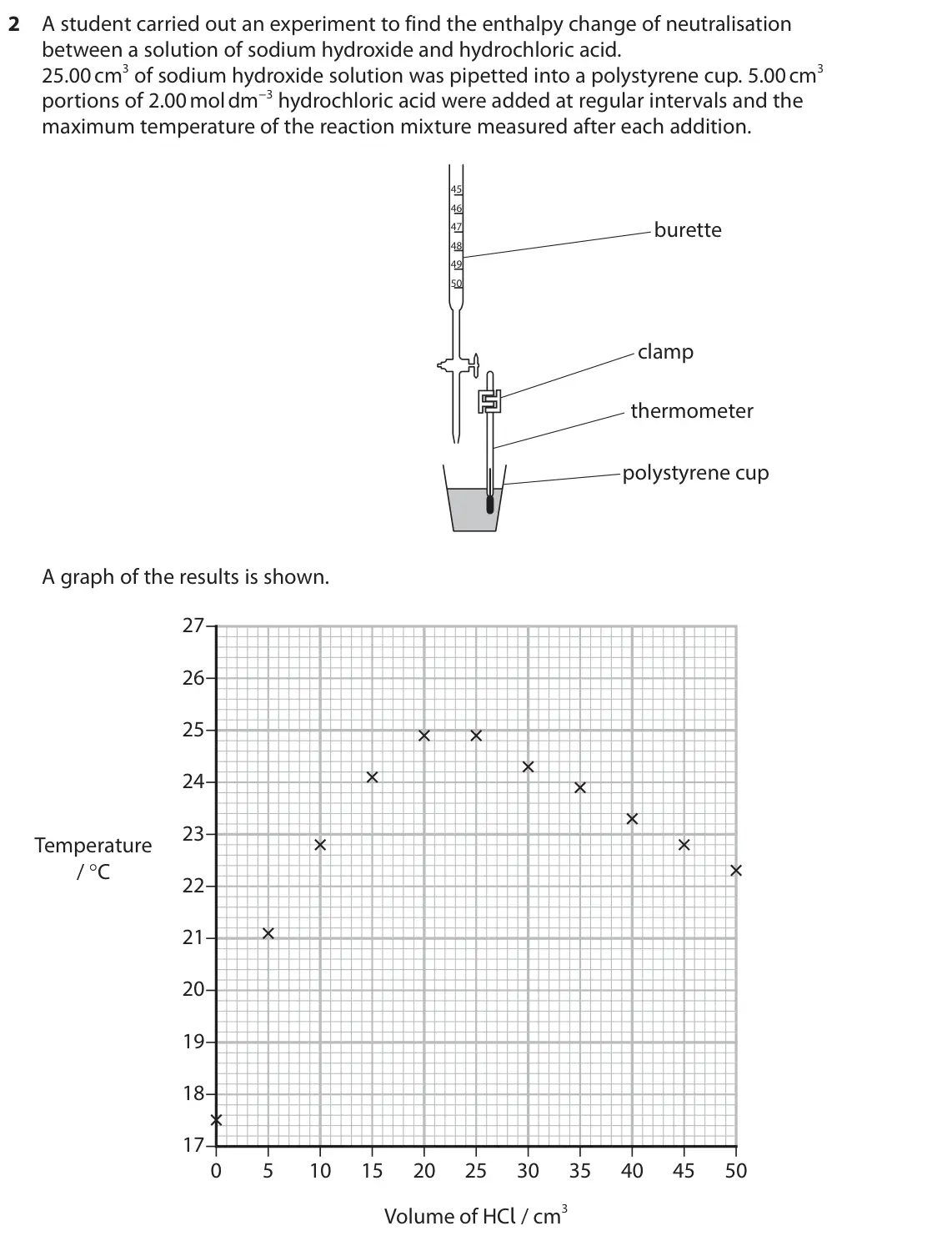
Q2(c)(ii)
The whole paper ↗Q4(a)
The whole paper ↗
Q4(c)
The whole paper ↗Q4(d)(iii)
The whole paper ↗Q4(e)(i)
The whole paper ↗Q6(b)
The whole paper ↗ Your answer
Q4(d)
The whole paper ↗
Q18(b)(iii)
The whole paper ↗
Q2(a)
The whole paper ↗ Your answer
Q2(b)
The whole paper ↗Your answerQ20(a)(iv)
The whole paper ↗
Q1(a)
The whole paper ↗ Your answer
Q1(c)
The whole paper ↗Your answerQ2(a)(i)
The whole paper ↗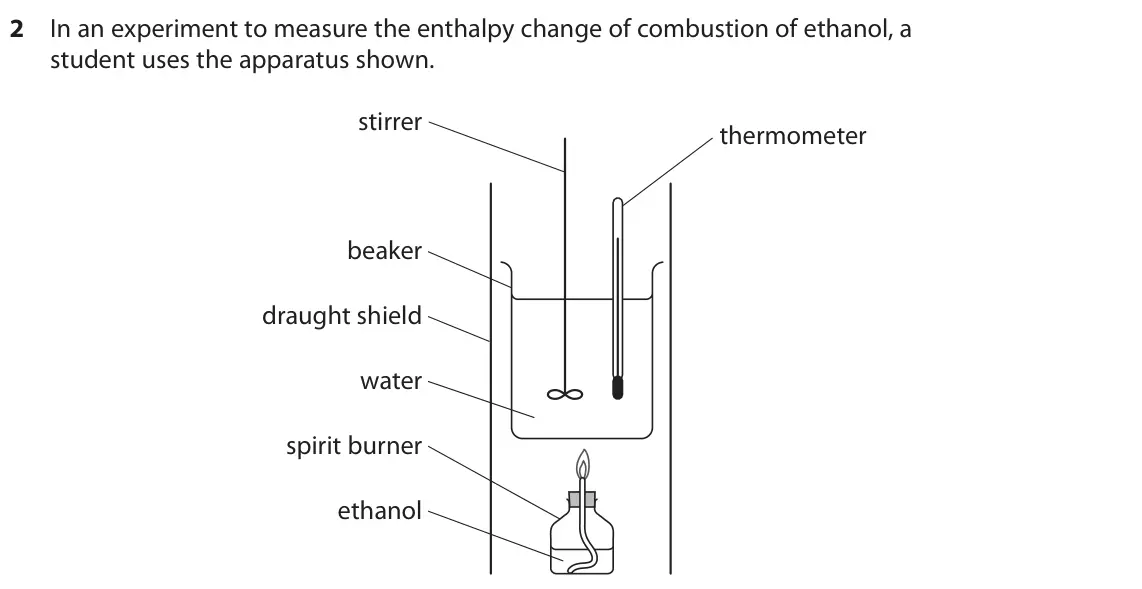
Q2(b)(iii)
The whole paper ↗Q2(b)(iv)
The whole paper ↗
All 49 questions on Errors and uncertainty in enthalpy experiments, as a list
- June 2025, AS Unit 2, Q1(b) (1 mark): The measurement uncertainty in the thermometer used in the experiment is ±0.5 °C for each reading. What is the percentage uncertainty in the temperature change
- June 2025, AS Unit 3, Q5(c) (1 mark): A second student repeated the experiment using the procedure described. The value obtained from this enthalpy change was considerably less exothermic than that
- June 2025, AS Unit 3, Q5(d) (4 marks): Justify how the equipment and the procedure could be improved to give a more accurate value for the enthalpy change of the reaction. (4)
- October 2024, AS Unit 3, Q2(b) (2 marks): The published value for the enthalpy change of neutralisation is −55.84 kJ mol−1. The student’s value is significantly different from the published value. This
- October 2024, AS Unit 3, Q2(c)(ii) (1 mark): Give an improvement to the experimental method that will increase the accuracy of the calculated enthalpy change of neutralisation. (1)
- June 2024, AS Unit 3, Q4(a) (1 mark): Give the reason why the polystyrene cup in Step 1 was placed in a beaker. (1)
- June 2024, AS Unit 3, Q4(c) (2 marks): Explain why the temperature was not measured at 3 minutes. (2)
- June 2024, AS Unit 3, Q4(d)(iii) (1 mark): Give a possible reason why the temperature does not appear to change at various times, such as 5½ to 6½ minutes. (1)
- June 2024, AS Unit 3, Q4(e)(i) (2 marks): Explain why it may or may not be valid to assume that the specific heat capacity of water is suitable to be used for this reaction. (2)
- June 2024 (R), AS Unit 2, Q6(b) (1 mark): The table below shows the measurement uncertainty of some laboratory apparatus. Measurement uncertainty Apparatus on each reading / cm3 burette +/− 0.05 25 cm3
- January 2024, AS Unit 3, Q4(d) (3 marks): Whilst evaluating the method used in (c), the student found a diagram of an alternative apparatus as shown. pump stirrer thermometer copper coil water spirit bu
- October 2023, AS Unit 2, Q18(b)(iii) (2 marks): Explain how, if at all, the enthalpy change of neutralisation obtained in (ii) would differ if the heat capacity of the calorimeter was included in the calculat
- June 2023, AS Unit 2, Q2(a) (1 mark): The percentage error in this experiment is (1) A ±7.37 % B ±8.65 % C 14.7 % D 17.3 %
- June 2023, AS Unit 2, Q2(b) (1 mark): In the calculation, the specific heat capacity of the liquid is taken to be 4.18 J g–1 °C–1 rather than the true value of 3.85 J g–1 °C–1. The use of 4.18 J g–1
- June 2023, AS Unit 2, Q20(a)(iv) (2 marks): Give two reasons why the energy used to move the car is less than the theoretical maximum. (2)
- January 2023, AS Unit 2, Q1(a) (1 mark): The measurement uncertainty in the thermometer used in the experiment is 0.5 °C for each reading. What is the percentage uncertainty in the temperature change o
- January 2023, AS Unit 2, Q1(c) (1 mark): The student’s calculated enthalpy change of combustion of methanol is more exothermic than a data book value. What is a possible reason for this? (1) A heat los
- January 2023, AS Unit 3, Q2(a)(i) (1 mark): Give a reason why it is important to shield the apparatus from draughts. (1)
- January 2023, AS Unit 3, Q2(b)(iii) (2 marks): In this procedure, after removing the burner there is a delay before the flame is extinguished. Explain the effect of this delay on the value of the enthalpy ch
- January 2023, AS Unit 3, Q2(b)(iv) (1 mark): The uncertainty in each reading of the thermometer was ±0.1°C. Calculate the percentage uncertainty in the temperature change in the student’s experiment. (1)
- January 2023, AS Unit 3, Q2(c)(i) (1 mark): State how the changes in the experiment improve the percentage uncertainties in the measurement of mass and temperature. No calculation is required. (1)
- January 2023, AS Unit 3, Q2(c)(ii) (2 marks): Explain how the difference between uncertainty and accuracy led the teacher to make this statement. (2)
- June 2022, AS Unit 2, Q18(b)(ii) (1 mark): The uncertainty in each thermometer reading is ±0.05 °C. Calculate the percentage uncertainty in the temperature rise in this experiment. (1)
- June 2022, AS Unit 2, Q18(b)(iii) (2 marks): The student looked in a data book and found the actual value for the standard enthalpy change of combustion of ethanol was more exothermic than the experimental
- June 2022, AS Unit 3, Q1(a)(i) (1 mark): Plot a graph of temperature against time on the grid. (1) 70.0 60.0 50.0 40.0 Temperature / °C 30.0 20.0 10.0 0.0 0.0 1.0 2.0 3.0 4.0 5.0 6.0 7.0 8.0 9.0 10.0 T
- June 2022, AS Unit 3, Q1(a)(ii) (3 marks): Use the graph to determine the maximum temperature change, ΔT, in this experiment. You must show your working on the graph. (3) ΔT = °C
- June 2022, AS Unit 3, Q1(a)(iii) (1 mark): State why using a series of measurements gives a more accurate temperature change than taking the initial and highest temperatures. (1)
- June 2022, AS Unit 3, Q1(c) (2 marks): Identify two improvements in the experimental procedure that would improve the accuracy of the result, other than repeating the experiment. Justify your answers
- January 2022, AS Unit 2, Q21(c) (2 marks): The value for ΔcH obtained in part (a)(ii) is much less exothermic than ΔcH d calculated in (b)(iii). Suggest two reasons for this other than non‑standard condi
- January 2022, AS Unit 3, Q1(b)(ii) (2 marks): Use the graph to determine the maximum temperature change, ΔT, in this experiment. You must show your working on the graph. (2)
- January 2022, AS Unit 3, Q1(b)(iii) (3 marks): Another student carried out the experiment using a polystyrene cup in place of the glass beaker. Explain how this student’s graph would be different. You may an
- January 2022, AS Unit 3, Q1(c)(i) (2 marks): State two assumptions made in this calculation. You do not need to justify your answers. (2)
- January 2022, AS Unit 3, Q1(c)(ii) (2 marks): The total percentage uncertainty in this experiment was 2.6 %. Show that the enthalpy change of 14.5 kJ mol–1 is consistent with a data book value of 14.8 kJ mo
- October 2021, AS Unit 2, Q19(a)(iv) (2 marks): The value of the enthalpy change of combustion from this experiment was very inaccurate. Give two reasons why this value was so inaccurate, apart from heat loss
- October 2021, AS Unit 3, Q3(a) (3 marks): Plot a graph of temperature against time on the grid. (3)
- October 2021, AS Unit 3, Q3(b) (2 marks): Determine the maximum temperature change, ΔT, using your graph. You must show your working on the graph. (2) ΔT =
- October 2021, AS Unit 3, Q3(c) (1 mark): The value of the enthalpy change from this experiment was −39.0 kJ mol−1. Give one possible reason why this value is different from a data book value of −61.4 k
- October 2021, Unit 6, Q3(a) (1 mark): Give a reason why a polystyrene cup was used instead of a glass beaker in Step 1. (1)
- October 2021, Unit 6, Q3(c) (1 mark): The thermometer used to measure the temperature change had an uncertainty of ±0.25 °C for each measurement. Calculate the percentage uncertainty in the temperat
- October 2021, Unit 6, Q3(d) (5 marks): The temperature rise in this experiment was lower than expected, due to heat loss to the surroundings. Describe changes to the procedure that would give a more
- June 2021, AS Unit 2, Q19(c)(i) (2 marks): The results obtained are given in the table. Plot the results on the grid. (2) Time Temperature / minutes / °C 0 22.2 1 22.0 2 22.0 Mg added 3 39.6 4 41.8 5 40.
- June 2021, AS Unit 2, Q19(c)(ii) (2 marks): Use your graph to determine the maximum change in temperature. You must show your working on the graph. (2) ΔT =
- October 2020, AS Unit 2, Q15(b)(iii) (2 marks): The students’ values were different from the data book value. Student A’s value was lower and student B’s value was higher. Give a possible reason for each diff
- October 2020, AS Unit 3, Q4(c) (2 marks): The experiment was repeated using a glass beaker instead of a polystyrene cup. Explain how the value obtained for the enthalpy change of neutralisation would be
- January 2020, AS Unit 3, Q2(b)(i) (1 mark): The maximum uncertainty each time the thermometer was read was ± 0.1 °C. Calculate the percentage uncertainty in measuring the temperature change in this experi
- January 2020, AS Unit 3, Q2(b)(ii) (2 marks): Suggest one way of reducing the percentage uncertainty in measuring the temperature change without changing the apparatus or just repeating the experiment. Just
- January 2020, AS Unit 3, Q2(c) (2 marks): One student carried out the same experiment but used a glass beaker instead of a polystyrene cup. State how this would affect the value of the enthalpy change o
- January 2020, AS Unit 3, Q2(d) (2 marks): Explain why the magnesium ribbon was cleaned with sandpaper before being weighed. (2)
- June 2019, AS Unit 3, Q3(a)(iii) (1 mark): Powdered metal reacts much faster than filings or granules. Suggest why this is important in this experiment. (1)
Questions, mark schemes and examiner’s reports are © Pearson Edexcel, from their published past papers. Plumi isn’t affiliated with any exam board. Want whole papers? Edexcel International A Level Chemistry past papers.
The Plumi iPad app also offers exam-style questions with AI feedback on your handwritten working.