 plumi
Hess’s law and enthalpy cycles (Core Practical 2): Edexcel International A Level Chemistry questions
Edexcel International A Level Chemistry past-paper questions on 6.1.4 Hess’s law and enthalpy cycles (Core Practical 2), 2019–2025, with mark schemes and examiner’s reports where available.
Paper
All papers
Exam
All years
Calculations
Q2(b)
The whole paper ↗Your answerQ17(b)(i)
The whole paper ↗
Q17(b)(ii)
The whole paper ↗Q17(b)(iii)
The whole paper ↗Q19(a)(i)
The whole paper ↗
Q16(a)(i)
The whole paper ↗
Q16(b)(ii)
The whole paper ↗
Q16(b)(iii)
The whole paper ↗Q18(b)(i)
The whole paper ↗
Q18(b)(ii)
The whole paper ↗Q22(c)
The whole paper ↗
- Your answer
Q16(a)(ii)
The whole paper ↗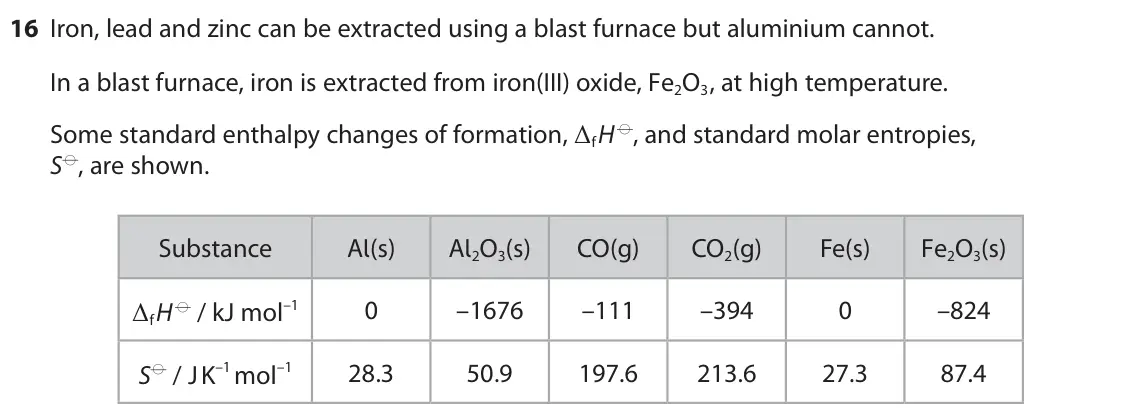
- Your answer
Q22(g)(i)
The whole paper ↗
Q22(g)(ii)
The whole paper ↗Q20(a)(ii)
The whole paper ↗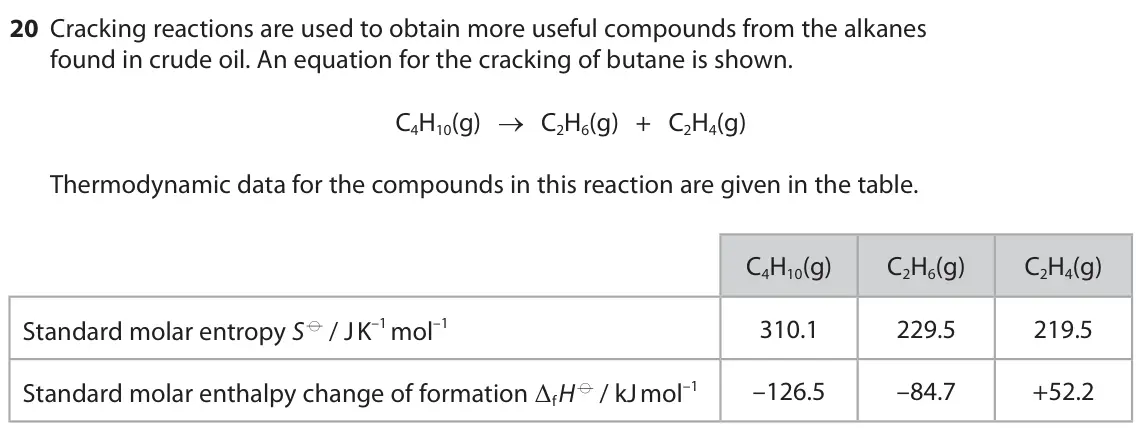
- Your answer
Q20(b)(i)
The whole paper ↗
Q20(b)(ii)
The whole paper ↗
All 38 questions on Hess’s law and enthalpy cycles (Core Practical 2), as a list
- June 2025, AS Unit 2, Q2(b) (1 mark): A data book value for the standard enthalpy change of combustion of methane is –890 kJ mol–1. What is the experimental value for the enthalpy change of vaporisa
- June 2025, AS Unit 2, Q17(b)(i) (3 marks): Calculate ΔrH1 for Reaction 1. Include a sign and units in your answer. [Assume the specific heat capacity of the solution = 4.18 J g–1 °C–1 the density of the
- June 2025, AS Unit 2, Q17(b)(ii) (3 marks): The enthalpy change of decomposition, ΔrH , of magnesium carbonate can be found using a Hess cycle. Calculate the enthalpy change of decomposition by using a co
- June 2025, AS Unit 2, Q17(b)(iii) (1 mark): Give a reason why it is not possible to measure the enthalpy change for the decomposition directly. (1)
- June 2025, Unit 4, Q19(a)(i) (2 marks): Using the data in the table, calculate the standard enthalpy change, ΔrHd, for this reaction. (2)
- June 2025, Unit 5, Q16(a)(i) (1 mark): Complete the cycle by adding balancing numbers. (1) C(g) + H(g) C6H6(g) C(s) + H2(g) C6H6(l)
- October 2024, AS Unit 2, Q16(b)(ii) (2 marks): In the second experiment, the student determined the enthalpy change when dissolving hydrated magnesium sulfate. MgSO4·7H2O(s) + (aq) → MgSO4(aq) ∆H = +15.8 kJ
- October 2024, AS Unit 2, Q16(b)(iii) (2 marks): Calculate the enthalpy change when anhydrous magnesium sulfate forms hydrated magnesium sulfate, using the completed Hess cycle and your answer in (b)(i). (2)
- June 2024 (R), AS Unit 2, Q18(b)(i) (2 marks): Complete the Hess cycle with two arrows and correct species and state symbols in the box. (2) ΔrH MgCO3(s) MgO(s) + CO2(g)
- June 2024 (R), AS Unit 2, Q18(b)(ii) (2 marks): Calculate the enthalpy change for the thermal decomposition of magnesium carbonate, ∆rH . Include a sign and units in your answer. (2)
- January 2024, AS Unit 2, Q22(c) (2 marks): Calculate the enthalpy change of reaction, ΔrH1 , for Reaction 1. Use your answer to (b), the data provided and the enthalpy cycle shown. [If you did not calcul
- October 2023, AS Unit 2, Q2 (1 mark): Which expression gives the standard enthalpy change, in kJ mol–1, for the reaction shown? BaCO3(s) → BaO(s) + CO2(g) ΔfH d values: BaCO3(s) = –1216 kJ mol–1 BaO
- October 2023, Unit 4, Q16(a)(ii) (3 marks): Calculate the standard enthalpy change for this reaction. . (3)
- June 2023, AS Unit 2, Q3 (1 mark): The enthalpy changes for two reactions are shown. 2Fe(s) + 1½O2(g) → Fe2O3(s) ΔrH = –824 kJ mol–1 + ½O2(g) → CO(g) ΔrH = –111 kJ mol–1 C(s) What is the enthalpy
- January 2023, AS Unit 2, Q22(g)(i) (2 marks): Complete the enthalpy cycle. (2) Enthalpy cycle ΔrH NH3(g) + HNO3(aq) NH4NO3(aq) –32.6 kJ mol–1 kJ mol–1 NH4NO3(s) –220.2 kJ mol–1 kJ mol–1 N2(g) + 2H2(g) + 1½O
- January 2023, AS Unit 2, Q22(g)(ii) (1 mark): Calculate the enthalpy change, ΔrH , in kJ mol–1 , for the reaction of NH3(g) with HNO3(aq). (1)
- January 2023, Unit 4, Q20(a)(ii) (2 marks): Calculate the enthalpy change of reaction, ΔrH d, for the cracking of butane. Include a sign and units with your answer. (2)
- October 2022, AS Unit 2, Q3 (1 mark): Some enthalpy changes of combustion are shown. Substance Enthalpy change of combustion / kJ mol−1 CH3CHO(l) −1167 C(s) −394 H2(g) −286 What is the enthalpy chan
- October 2022, AS Unit 2, Q20(b)(i) (2 marks): Complete the Hess cycle. (2) CuSO4(s) + 5H2O(l) CuSO4·5H2O(s)
- October 2022, AS Unit 2, Q20(b)(ii) (2 marks): Calculate the enthalpy change when anhydrous copper(II) sulfate forms hydrated copper(II) sulfate. Include a sign and units. (2)
- June 2022, Unit 4, Q21(a)(i) (2 marks): Calculate the standard enthalpy change, ∆rH , for the reduction of iron(III) oxide by carbon. (2)
- January 2022, AS Unit 2, Q21(b)(ii) (2 marks): Complete the Hess cycle. C4H10O(l) + O2(g) CO2(g) + H2O(l) 4C(s, graphite) + + (2)
- January 2022, AS Unit 2, Q21(b)(iii) (2 marks): Calculate the standard enthalpy change of combustion of 2‑methylpropan‑2‑ol using the data in the table and the completed Hess cycle. (2)
- October 2021, AS Unit 2, Q19(c) (3 marks): Enthalpy changes of combustion can be used to calculate the enthalpy change of formation of a compound. Standard enthalpy change of combustion, Substance ∆cH /
- October 2021, AS Unit 3, Q3(d)(i) (1 mark): Calculate the enthalpy change of hydration for the conversion of anhydrous copper(II) sulfate to hydrated copper(II) sulfate crystals. (1)
- October 2021, AS Unit 3, Q3(d)(ii) (1 mark): Give one possible reason why the enthalpy change of hydration in (d)(i) could not be found directly by experiment. (1)
- June 2021, AS Unit 2, Q22(b)(ii) (4 marks): The standard enthalpy change of formation for phosgene is ΔfH = –220.1 kJ mol–1. Complete the Hess cycle and determine the standard enthalpy change of formation
- January 2021, AS Unit 2, Q12 (1 mark): The enthalpy changes for two reactions are shown. H+(aq) + OH−(aq) → H2O(l) ΔrH = −57.2 kJ mol−1 CH3COOH(aq) + OH−(aq) → CH3COO−(aq) + H2O(l) ΔrH = −56.0 kJ mol
- January 2021, AS Unit 2, Q21(c) (5 marks): Ammonium ethanoate, CH3COONH4(s), is used to control the pH of foods. It can be formed by the reaction of pure ethanoic acid, CH3COOH(l), with ammonium carbonat
- January 2021, AS Unit 3, Q3(c)(ii) (1 mark): Using your answer to (c)(i), calculate the enthalpy change, ΔrH , for the thermal decomposition of this Group 2 carbonate in kJ mol−1. Include a sign with your
- October 2020, AS Unit 2, Q10(c) (1 mark): Hess’s Law can be applied to this system. Which expression is correct? (1) A v + x = u + w B w + x = u C u – w = v D u – v = x
- October 2020, AS Unit 2, Q13(a)(i) (1 mark): Add arrowheads and stoichiometric coefficients to the Hess’s Law diagram. (1) 3C(s) + 4H2(g) C3H8(g) CO2(g) + H2O(l)
- October 2020, AS Unit 2, Q13(a)(ii) (2 marks): Use the data at the start of the question and your Hess’s Law diagram to calculate the standard enthalpy change of formation of propane. Include a sign and unit
- January 2020, AS Unit 2, Q15(a)(iii) (1 mark): Complete the Hess cycle by adding two arrowheads. (1) ǻrH CuSO4(s) + 5H2O(l) CuSO4.5H2O(s) ǻsolnH(CuSO4) ǻsolnH(CuSO4.5H2O) CuSO4(aq)
- January 2020, AS Unit 2, Q15(a)(iv) (2 marks): Calculate the value for the enthalpy change ǻrH, in kJ mol−1, for the conversion of the anhydrous salt to the hydrated salt. Use the value from the table for ǻs
- January 2020, AS Unit 2, Q15(b) (2 marks): The hydration of anhydrous copper(II) sulfate is reversible. CuSO4(s) + 5H2O(l) CuSO4.5H2O(s) The forward reaction is exothermic. The temperature changes for bo
- June 2019, AS Unit 2, Q9 (1 mark): Use the data shown. ¨H = −858 kJ mol–1 CH4(g) + 2F2(g) → CF4(g) + 2H2(g) ¨H = −933 kJ mol–1 C(s) + 2F2(g) → CF4(g) What is the standard enthalpy change of forma
- June 2019, AS Unit 2, Q20(b)(ii) (2 marks): The Hess cycle and data to calculate the enthalpy change for the thermal decomposition of MgCO3 are shown. Mg(s) + C(s) + 1½O2(g) MgCO3(s) MgO(s) + CO2(g) 9 / k
Questions, mark schemes and examiner’s reports are © Pearson Edexcel, from their published past papers. Plumi isn’t affiliated with any exam board. Want whole papers? Edexcel International A Level Chemistry past papers.
The Plumi iPad app also offers exam-style questions with AI feedback on your handwritten working.