 plumi
Plant tissues, organs and systems: AQA GCSE Biology questions
Every AQA GCSE Biology exam question on 4.2.3 Plant tissues, organs and systems, 2018–2025, with its mark scheme and examiner’s report.
Find questions1,505
Calculations
Q01.4
The whole paper ↗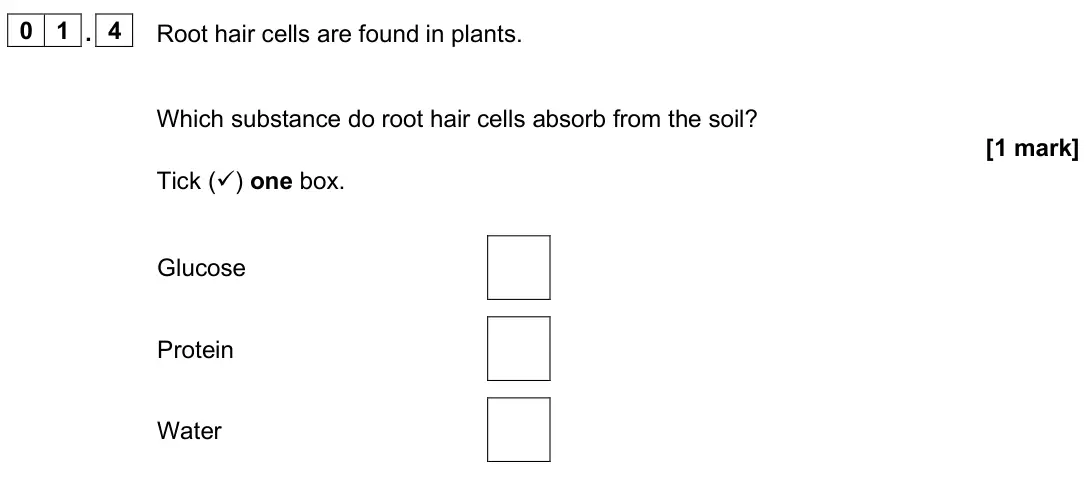
Q01.6
The whole paper ↗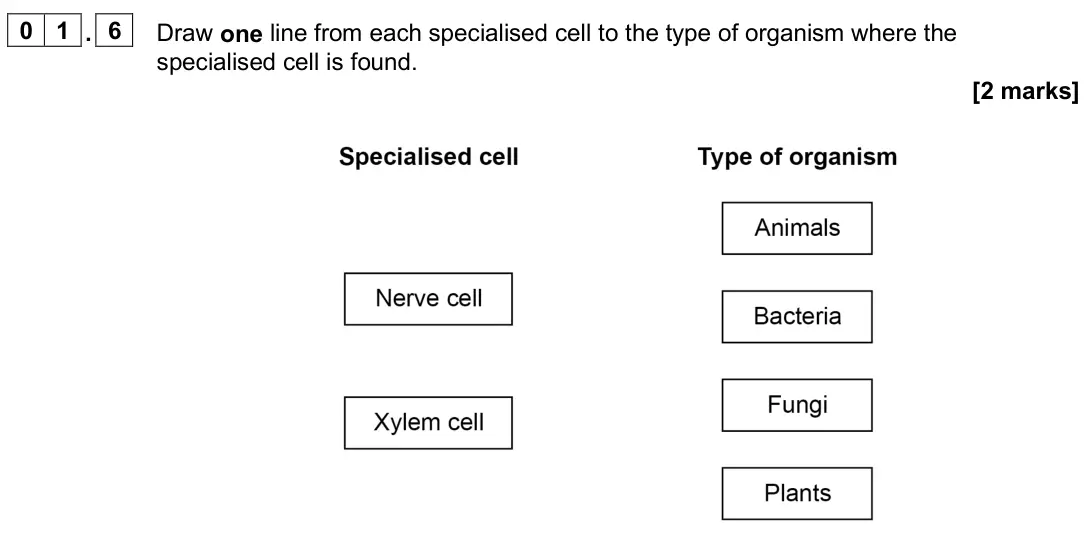
Q03.6
The whole paper ↗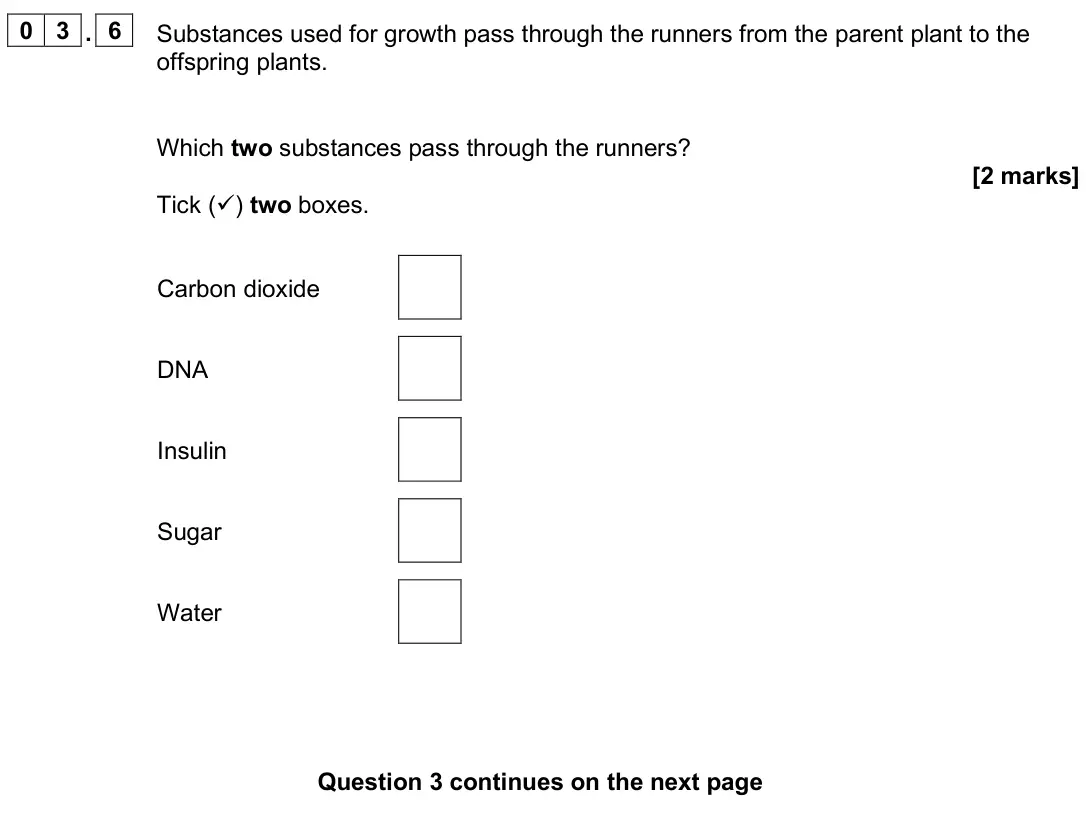
Q04.1
The whole paper ↗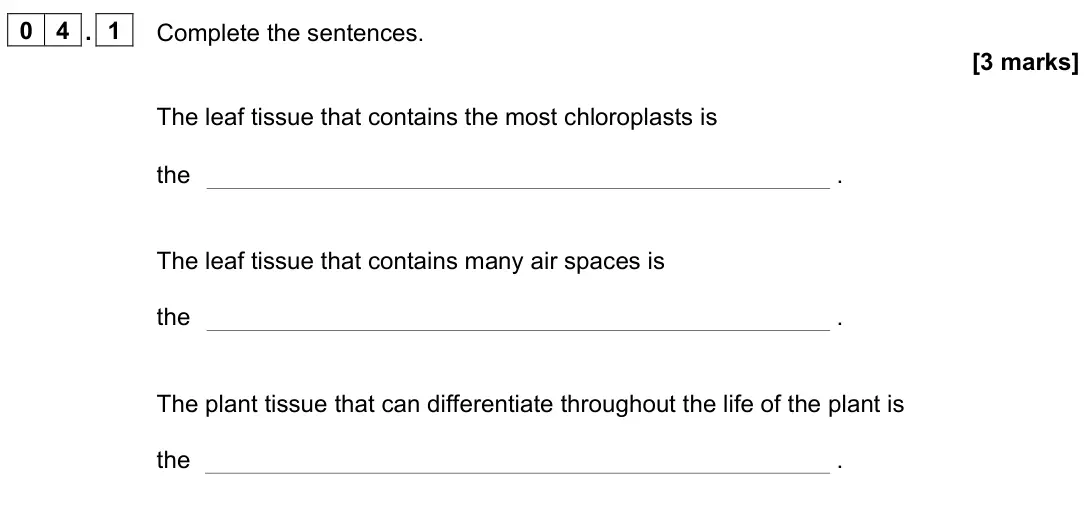
Q04.2
The whole paper ↗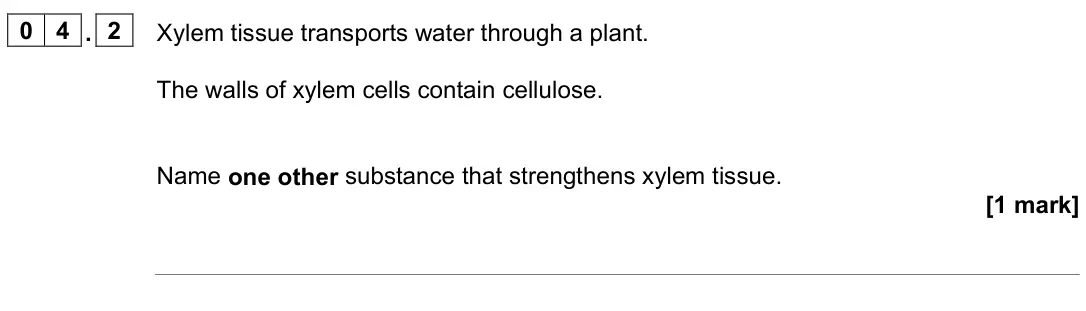
Q04.3
The whole paper ↗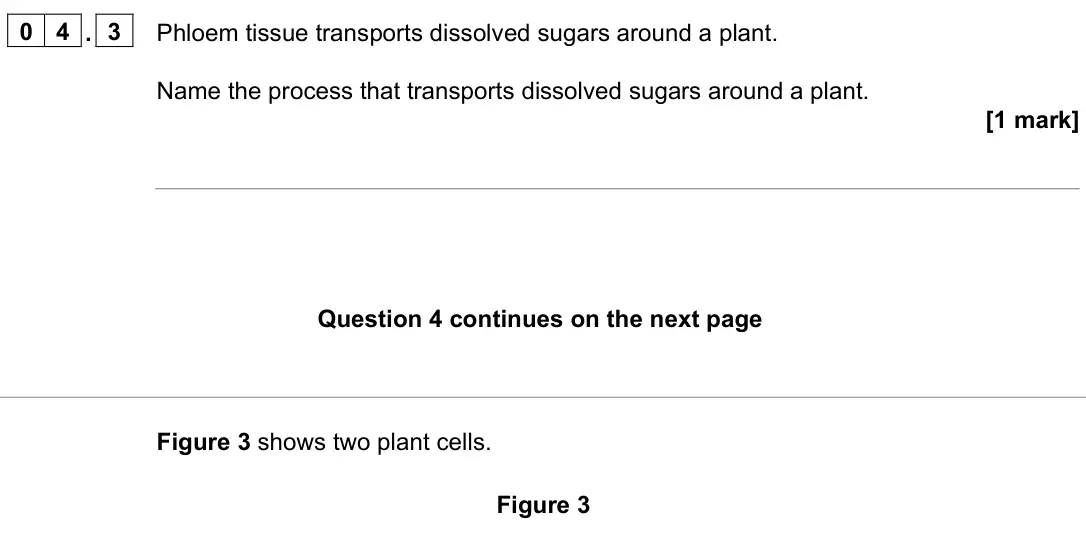
Q01.2
The whole paper ↗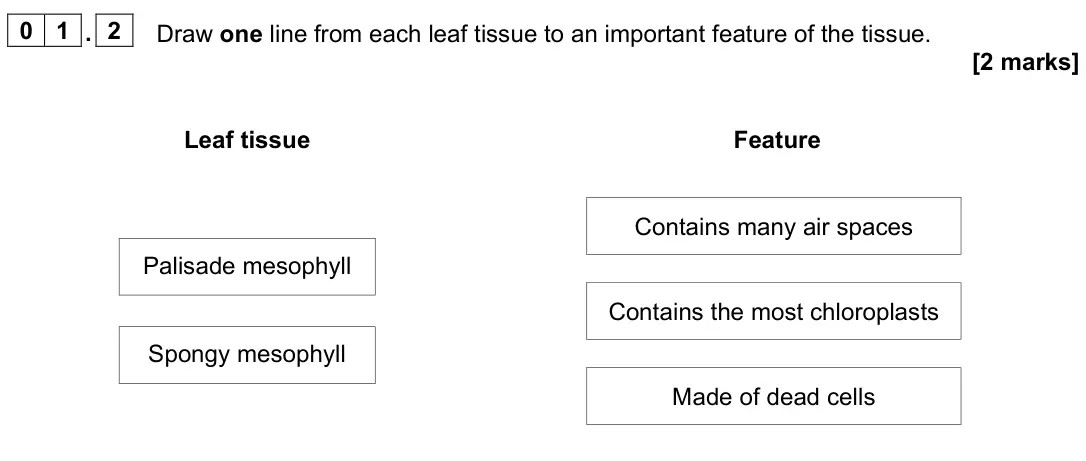
Q01.3
The whole paper ↗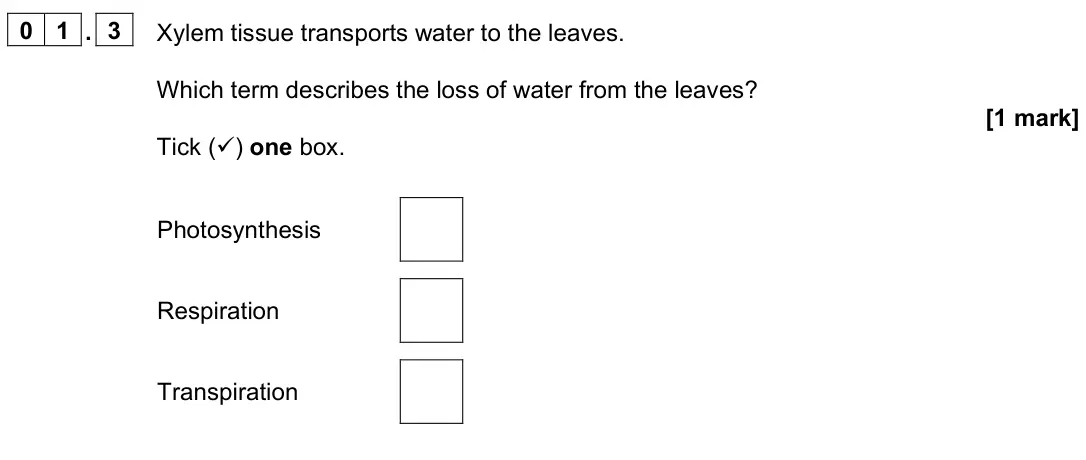
Q01.4
The whole paper ↗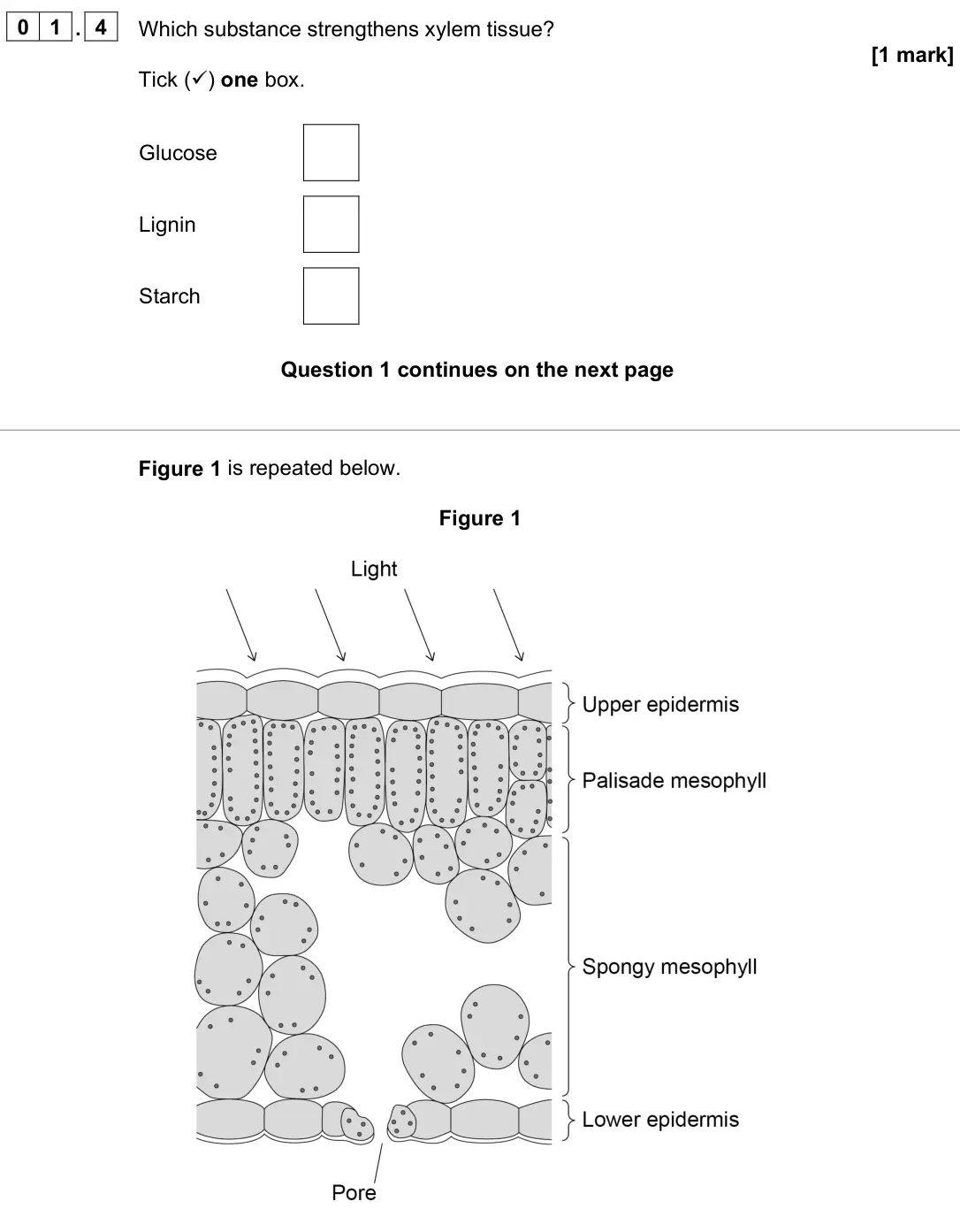
Q01.5
The whole paper ↗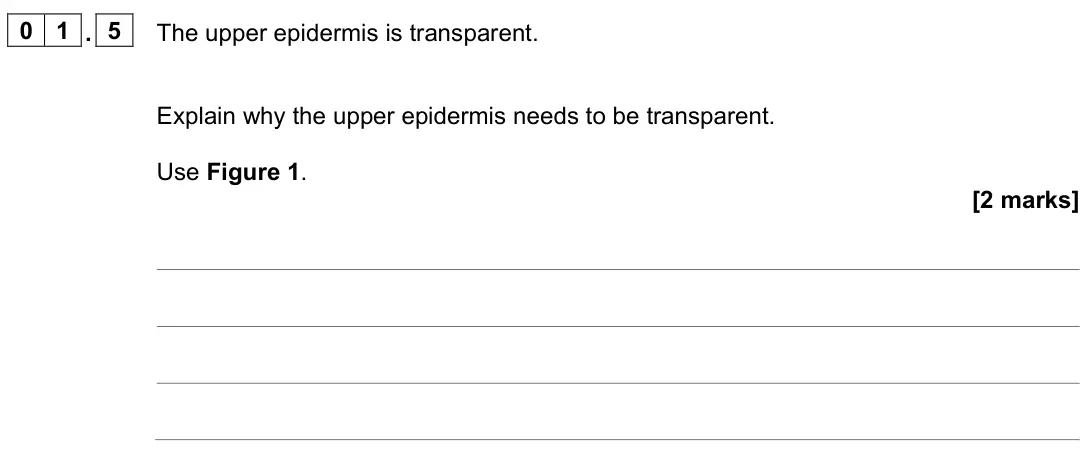
Q01.6
The whole paper ↗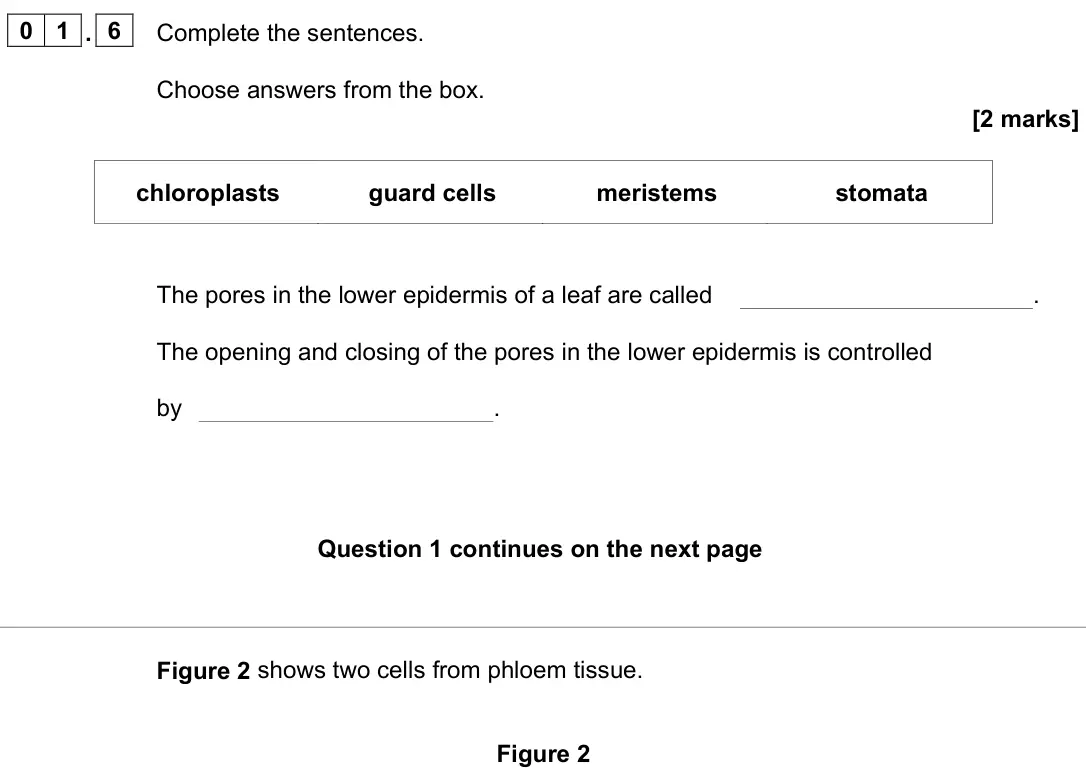
Q09.1
The whole paper ↗
Q06.3
The whole paper ↗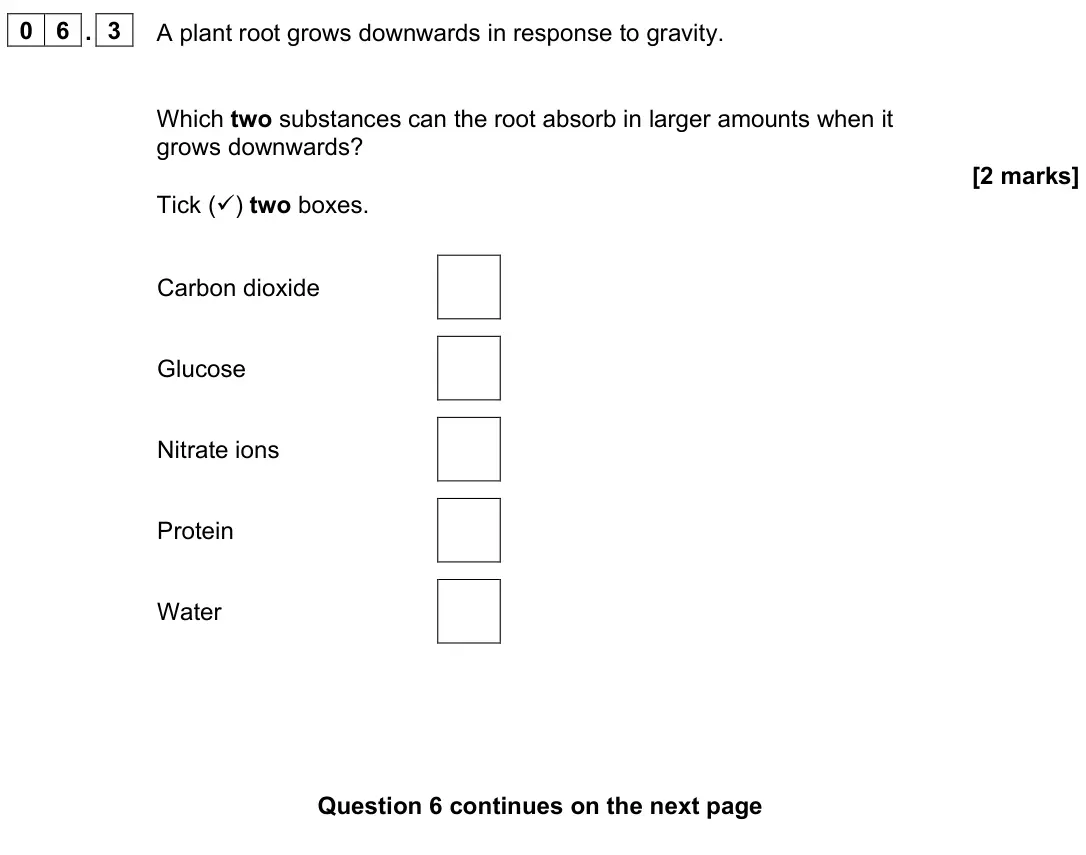
Q01.4
The whole paper ↗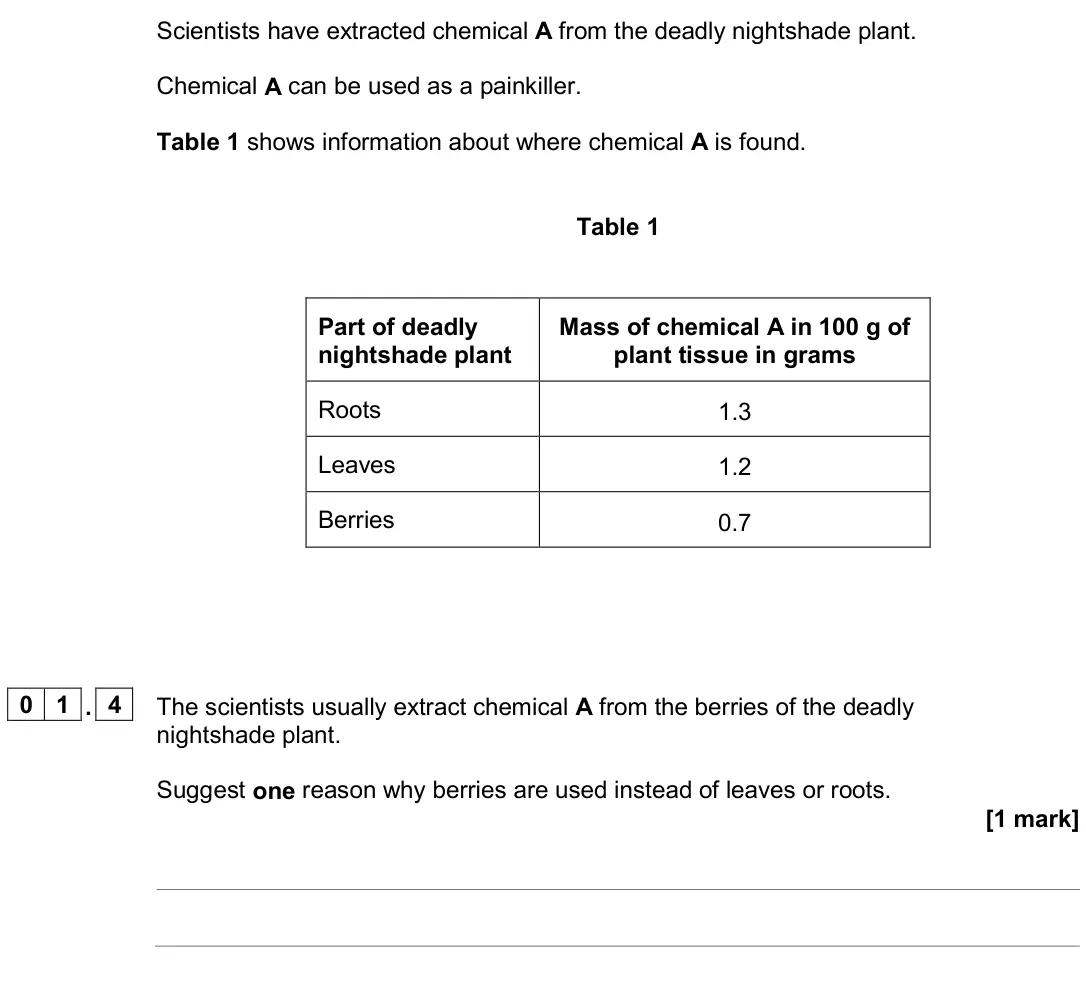
Q01.1
The whole paper ↗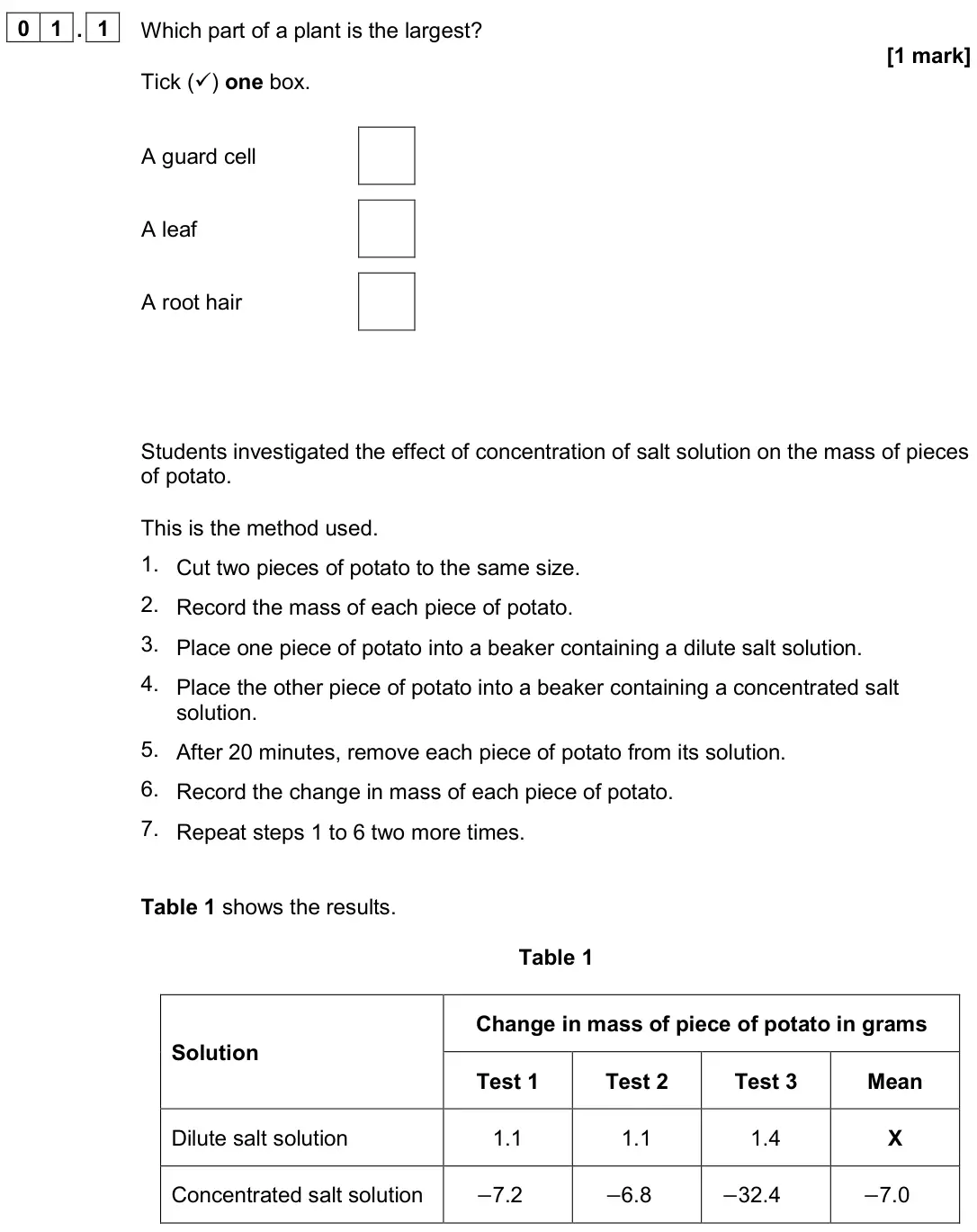
Q06.4
The whole paper ↗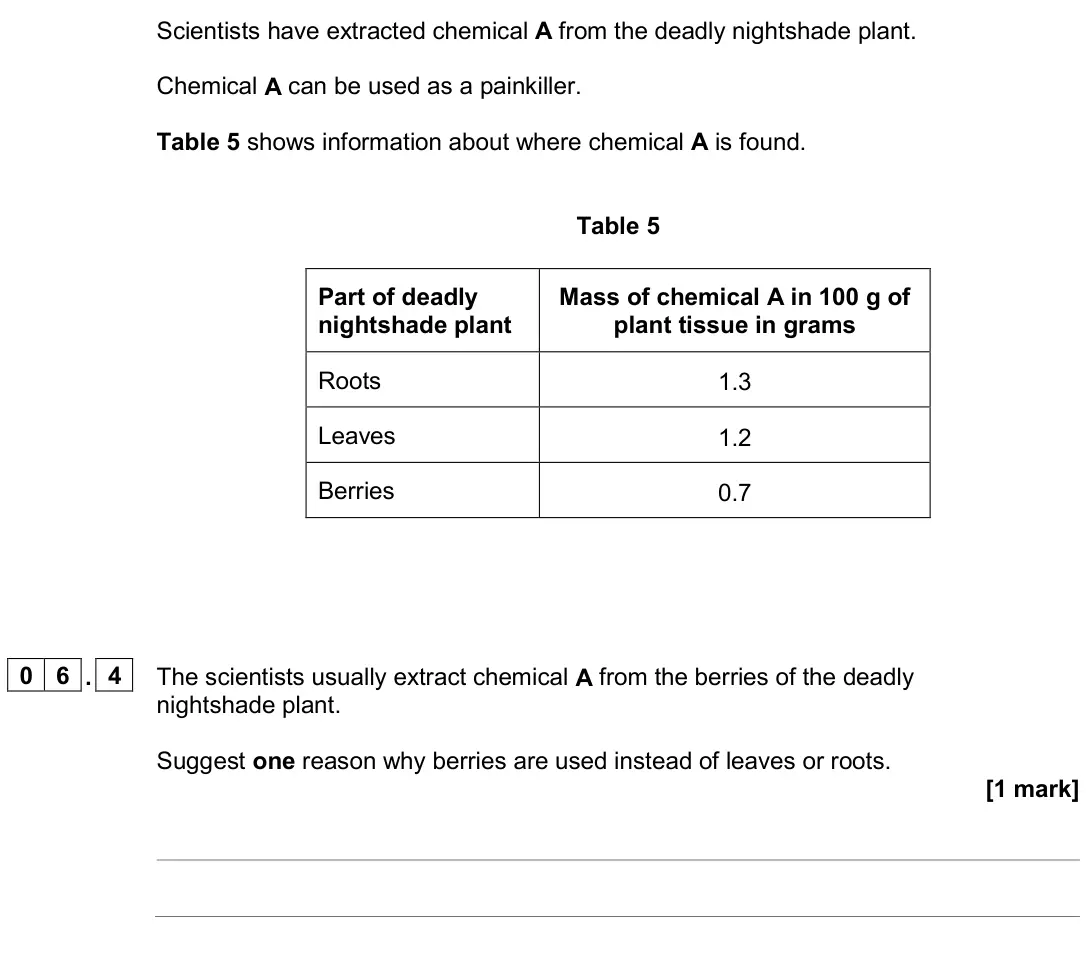
Q04.1
The whole paper ↗
Q01.3
The whole paper ↗
Q04.3
The whole paper ↗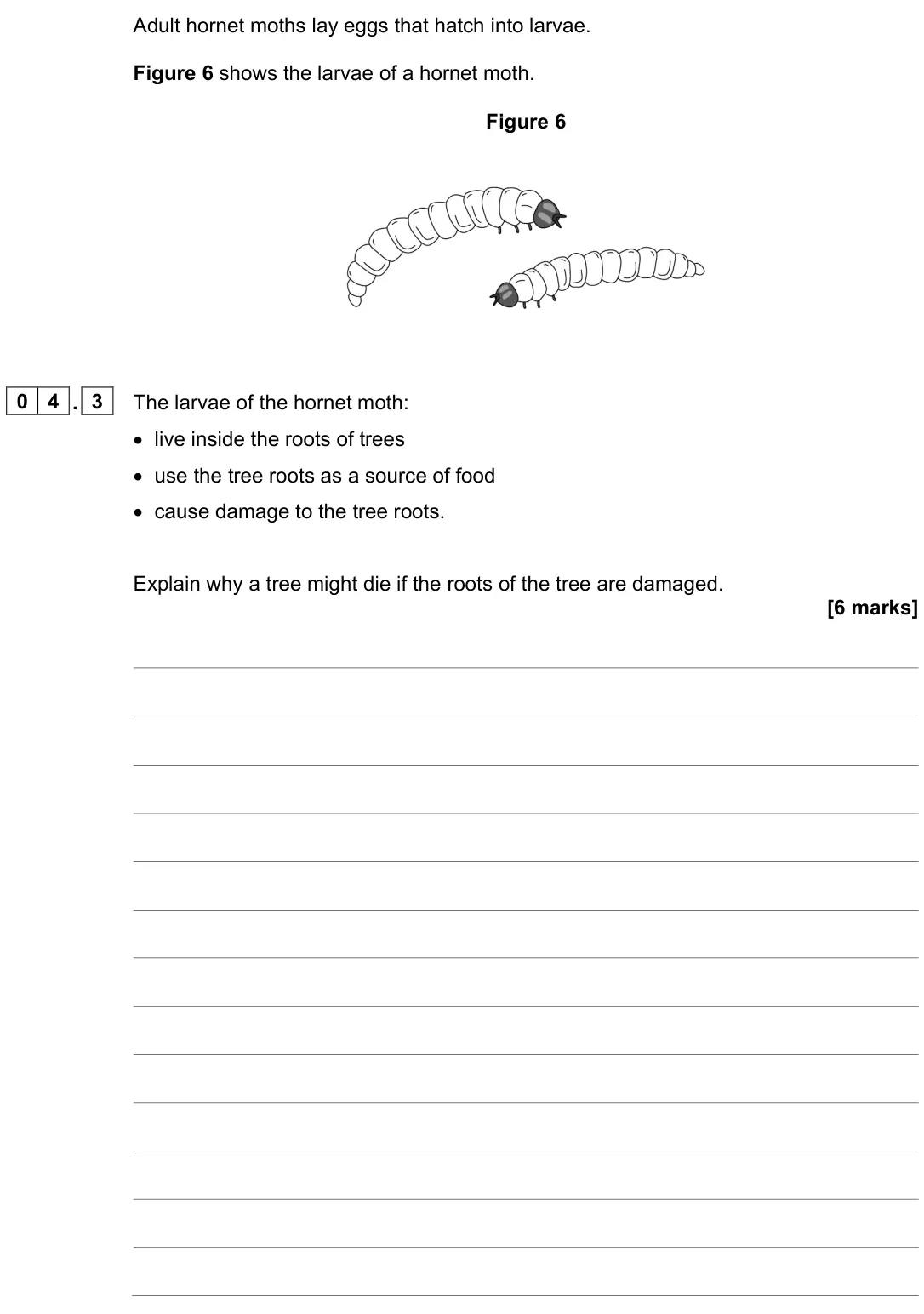
All 65 questions on Plant tissues, organs and systems, as a list
- June 2025, Paper 1 Foundation, Q01.4 (1 mark): Root hair cells are found in plants. Which substance do root hair cells absorb from the soil? [1 mark] Tick () one box. Glucose Protein Water
- June 2025, Paper 1 Foundation, Q01.6 (2 marks): Draw one line from each specialised cell to the type of organism where the specialised cell is found. [2 marks]
- June 2025, Paper 2 Foundation, Q03.6 (2 marks): Substances used for growth pass through the runners from the parent plant to the offspring plants. Which two substances pass through the runners? [2 marks] Tick
- June 2024, Paper 1 Higher, Q04.1 (3 marks): Complete the sentences. [3 marks] The leaf tissue that contains the most chloroplasts is the . The leaf tissue that contains many air spaces is the . The plant
- June 2024, Paper 1 Higher, Q04.2 (1 mark): Xylem tissue transports water through a plant. The walls of xylem cells contain cellulose. Name one other substance that strengthens xylem tissue. [1 mark]
- June 2024, Paper 1 Higher, Q04.3 (1 mark): Phloem tissue transports dissolved sugars around a plant. Name the process that transports dissolved sugars around a plant. [1 mark] Figure 3 shows two plant ce
- June 2024, Paper 1 Foundation, Q01.2 (2 marks): Draw one line from each leaf tissue to an important feature of the tissue. [2 marks] Leaf tissue Feature Palisade mesophyll Spongy mesophyll Contains many air s
- June 2024, Paper 1 Foundation, Q01.3 (1 mark): Xylem tissue transports water to the leaves. Which term describes the loss of water from the leaves? [1 mark] Tick () one box. Photosynthesis Respiration Trans
- June 2024, Paper 1 Foundation, Q01.4 (1 mark): Which substance strengthens xylem tissue? [1 mark] Tick () one box. Glucose Lignin Starch Figure 1 is repeated below. Figure 1
- June 2024, Paper 1 Foundation, Q01.5 (2 marks): The upper epidermis is transparent. Explain why the upper epidermis needs to be transparent. Use Figure 1. [2 marks]
- June 2024, Paper 1 Foundation, Q01.6 (2 marks): Complete the sentences. Choose answers from the box. [2 marks] chloroplasts guard cells meristems stomata The pores in the lower epidermis of a leaf are called
- June 2024, Paper 2 Higher, Q09.1 (6 marks): Explain how the use of GM soya bean plants and glyphosate can increase the yield of soya beans. [6 marks]
- June 2024, Paper 2 Foundation, Q06.3 (2 marks): A plant root grows downwards in response to gravity. Which two substances can the root absorb in larger amounts when it grows downwards? [2 marks] Tick () two
- June 2023, Paper 1 Higher, Q01.4 (1 mark): The scientists usually extract chemical A from the berries of the deadly nightshade plant. Suggest one reason why berries are used instead of leaves or roots. [
- June 2023, Paper 1 Foundation, Q01.1 (1 mark): Which part of a plant is the largest? [1 mark] Tick () one box. A guard cell A leaf A root hair Students investigated the effect of concentration of salt solut
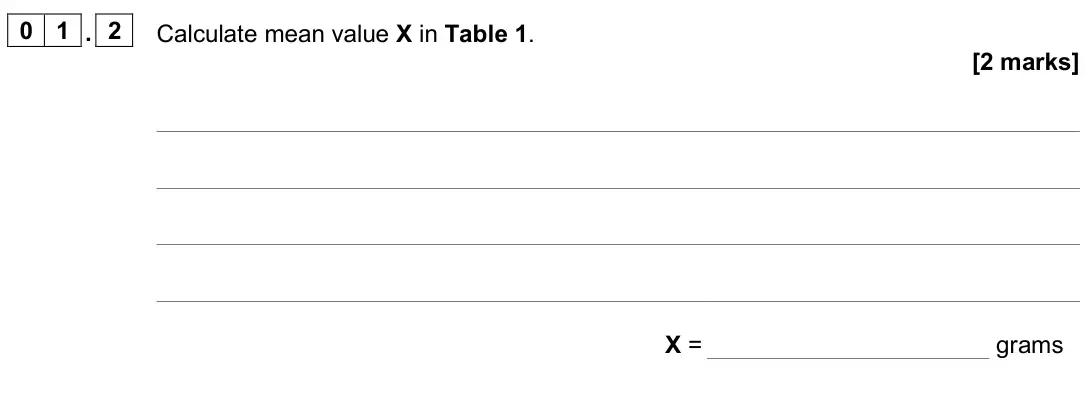
- June 2023, Paper 1 Foundation, Q01.2 (2 marks): Calculate mean value X in Table 1. [2 marks] X = grams
- June 2023, Paper 1 Foundation, Q06.4 (1 mark): The scientists usually extract chemical A from the berries of the deadly nightshade plant. Suggest one reason why berries are used instead of leaves or roots. [
- June 2023, Paper 2 Higher, Q04.1 (6 marks): The leaves fall off many trees in autumn. The dead leaves contain carbon compounds and nitrogen compounds. Describe how carbon and nitrogen in compounds in the
- June 2022, Paper 1 Higher, Q01.3 (1 mark): Name one type of cell in a potato plant that does not contain chloroplasts. [1 mark]
- June 2022, Paper 1 Higher, Q04.3 (6 marks): The larvae of the hornet moth: • live inside the roots of trees • use the tree roots as a source of food • cause damage to the tree roots. Explain why a tree mi
- June 2022, Paper 1 Higher, Q05.1 (1 mark): Name the cells that control the opening and closing of the stomata. [1 mark]
- June 2022, Paper 1 Higher, Q05.2 (2 marks): Describe two differences between the transpiration stream and translocation. [2 marks] 1 2
- June 2022, Paper 1 Higher, Q05.3 (1 mark): Which environmental conditions would cause the rate of transpiration to be greatest in a plant? [1 mark] Tick () one box. Cold with low humidity Cold with high
- June 2022, Paper 1 Higher, Q05.4 (4 marks): The changes in the mean width of the stomata in normal conditions are an advantage to the plant. Explain how. [4 marks]
- June 2022, Paper 1 Higher, Q05.5 (2 marks): The changes in the mean width of the stomata in low atmospheric carbon dioxide are different from the changes in normal conditions. Explain how the difference h
- June 2022, Paper 1 Foundation, Q05.2 (3 marks): Water and dissolved substances are transported through a plant. Complete the sentences. Choose answers from the box. [3 marks] epidermis guard cells palisade ce
- June 2022, Paper 1 Foundation, Q05.3 (3 marks): Calculate how many times greater the rate of transpiration of species A is than the rate of transpiration of species B. Give your answer to 2 significant figure
- June 2022, Paper 1 Foundation, Q05.4 (1 mark): Which factor could cause species A to have a higher rate of transpiration than species B? [1 mark] Tick () one box. Each flower of species A has more petals. E
- June 2022, Paper 1 Foundation, Q05.5 (1 mark): Which environmental change would cause an increase in the rate of transpiration? [1 mark] Tick () one box. Decreased light intensity Decreased wind speed Incre
- June 2022, Paper 1 Foundation, Q05.6 (1 mark): Which plant species in Table 3 is most likely to live in a dry desert? [1 mark] Tick () one box. A B C D
- June 2022, Paper 1 Foundation, Q07.3 (1 mark): Name one type of cell in a potato plant that does not contain chloroplasts. [1 mark]
- June 2022, Paper 2 Higher, Q06.2 (1 mark): Name the process by which water is absorbed into plant roots. [1 mark]
- November 2021, Paper 1 Higher, Q06.1 (1 mark): Which cell is most transparent? [1 mark] Tick () one box. A B C D
- November 2021, Paper 1 Higher, Q06.2 (1 mark): Which cell structure in a leaf mesophyll cell is not found in a root hair cell? [1 mark]
- November 2021, Paper 1 Higher, Q06.3 (1 mark): Name the cells in a leaf that control the rate of water loss. [1 mark]
- November 2021, Paper 1 Higher, Q06.4 (1 mark): Water is taken in by the roots, transported up the plant and lost from the leaves. Which scientific term describes this movement of water? [1 mark]
- November 2021, Paper 1 Higher, Q06.5 (1 mark): Which change would decrease the rate of water loss from a plant’s leaves? [1 mark] Tick () one box. Increased humidity Increased light intensity Increased dens
- November 2021, Paper 1 Higher, Q06.6 (6 marks): Compare the structure and function of xylem tissue and phloem tissue. [6 marks] DO NOT WRITE ON THIS PAGE ANSWER IN THE SPACES PROVIDED
- November 2021, Paper 1 Higher, Q06.7 (4 marks): Determine the rate of water loss at 12:00 Use the tangent on Figure 10. Give your answer: • in cm3 per minute • in standard form. [4 marks] Rate of water loss =
- November 2021, Paper 1 Higher, Q06.8 (2 marks): The rate of water loss at midnight was much lower than at 12:00 Explain why. [2 marks]
- November 2021, Paper 1 Foundation, Q01.2 (3 marks): Complete the sentences. [3 marks] Choose answers from the box. carbon dioxide chlorophyll energy light mineral ions water Plant cells absorb substances from the
- November 2021, Paper 1 Foundation, Q01.3 (1 mark): Name the type of specialised cell in Figure 1. [1 mark]
- November 2021, Paper 1 Foundation, Q01.4 (1 mark): Describe how the cell in Figure 1 is adapted to increase the absorption of substances from the soil. [1 mark]
- November 2021, Paper 1 Foundation, Q03.3 (1 mark): Some desert plants only grow leaves after it has rained. As soon as the soil dries out, the leaves fall off. How could the leaves falling off the plant be an ad
- November 2021, Paper 1 Foundation, Q03.7 (1 mark): Name one substance transported through the xylem in the stem of the cactus. [1 mark]
- November 2021, Paper 1 Foundation, Q03.8 (1 mark): Name the tissue that transports dissolved sugars through the stem of the cactus. [1 mark]
- November 2020, Paper 1 Higher, Q02.2 (2 marks): Figure 2 shows part of a leaf. Figure 2 Molecules of carbon dioxide diffuse from the air into the mesophyll cells. Which two changes will increase the rate at w
- November 2020, Paper 1 Higher, Q02.4 (1 mark): Name the process by which water molecules enter the root hair cell. [1 mark]
- November 2020, Paper 1 Higher, Q02.5 (3 marks): Nitrate ions need a different method of transport into the root hair cell. Explain how the nitrate ions in Figure 4 are transported into the root hair cell. Use
- November 2020, Paper 1 Higher, Q05.5 (2 marks): Suggest how the nodules benefit the bacteria. [2 marks]
- November 2020, Paper 1 Foundation, Q01.3 (1 mark): The algal cell is green. Which part of the algal cell makes it green in colour? [1 mark] Tick () one box. Cellulose Chloroplast Cytoplasm Nucleus
- November 2020, Paper 1 Foundation, Q08.2 (2 marks): Figure 11 shows part of a leaf. Figure 11 Molecules of carbon dioxide diffuse from the air into the mesophyll cells. Which two changes will increase the rate at
- November 2020, Paper 1 Foundation, Q08.4 (1 mark): Name the process by which water molecules enter the root hair cell. [1 mark]
- November 2020, Paper 1 Foundation, Q08.5 (3 marks): Nitrate ions need a different method of transport into the root hair cell. Explain how the nitrate ions in Figure 13 are transported into the root hair cell. Us
- June 2018, Paper 1 Higher, Q05.1 (1 mark): An aphid feeds by inserting its sharp mouthpiece into the stem of a plant. Give the reason why the mouthpiece of an aphid contains a high concentration of disso
- Specimen, Paper 1 Higher, Q01.2 (2 marks): Describe how water moves from roots to the leaves. [2 marks
- Specimen, Paper 1 Higher, Q01.3: Describe how the student might have collected the data in Table 1. [3 mar 5
- Specimen, Paper 1 Higher, Q01.4 (1 mark): What is the median number of stomata on the upper surface of the leaf? [1 mark
- Specimen, Paper 1 Higher, Q01.5 (2 marks): Calculate the value of X in Table 1. Give your answer to 2 significant figures. [2 marks Mean number of stomata on lower surface of leaf =
- Specimen, Paper 1 Higher, Q01.6 (2 marks): The plant used in this investigation has very few stomata on the upper surface of the leaf. Explain why this is an advantage to the plant. [2 marks 6
- Specimen, Paper 1 Foundation, Q09.2 (2 marks): Describe how water moves from roots to the leaves. [2 marks 3
- Specimen, Paper 1 Foundation, Q09.3: Describe how the student might have collected the data in Table 5. [3 mar 35
- Specimen, Paper 1 Foundation, Q09.4 (1 mark): What is the median number of stomata on the upper surface of the leaf? [1 mark
- Specimen, Paper 1 Foundation, Q09.5 (2 marks): Calculate the value of X in Table 5. Give your answer to 2 significant figures. [2 marks Mean number of stomata on lower surface of leaf =
- Specimen, Paper 1 Foundation, Q09.6 (2 marks): The plant used in this investigation has very few stomata on the upper surface of the leaf. Explain why this is an advantage to the plant. [2 marks 36
Questions, mark schemes and examiner’s reports are © AQA, from their published past papers. Plumi isn’t affiliated with any exam board. Want whole papers? Every AQA GCSE Biology paper.
Rather write your answers by hand on iPad? Plumi marks them against the same mark schemes.