 plumi
Organisation of an ecosystem: AQA GCSE Biology questions
Every AQA GCSE Biology exam question on 4.7.2 Organisation of an ecosystem, 2018–2025, with its mark scheme and examiner’s report.
Find questions1,505
Calculations
Q02.1
The whole paper ↗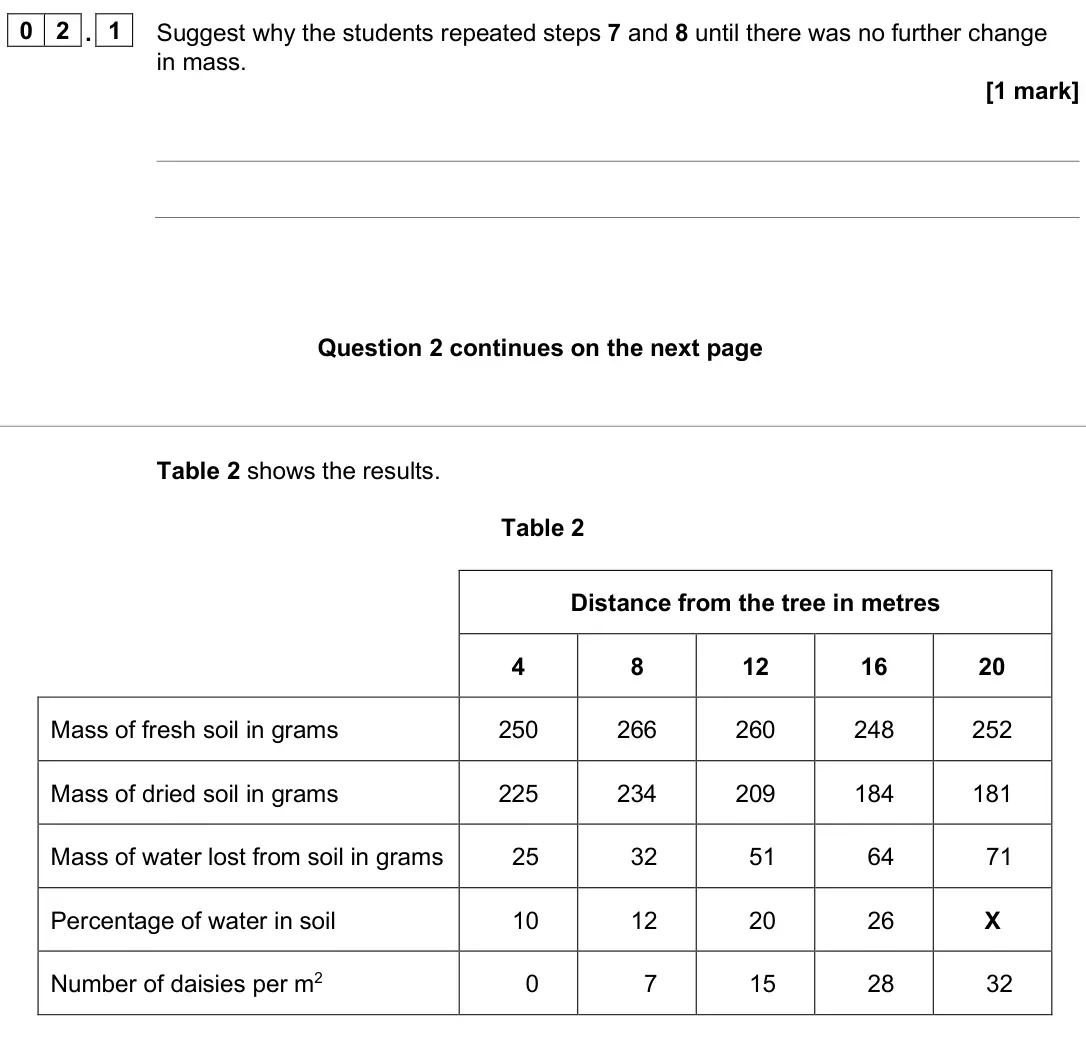
Q02.3
The whole paper ↗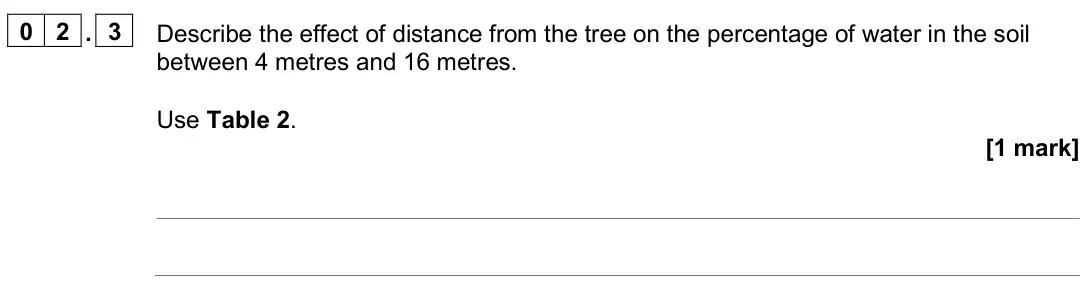
Q02.4
The whole paper ↗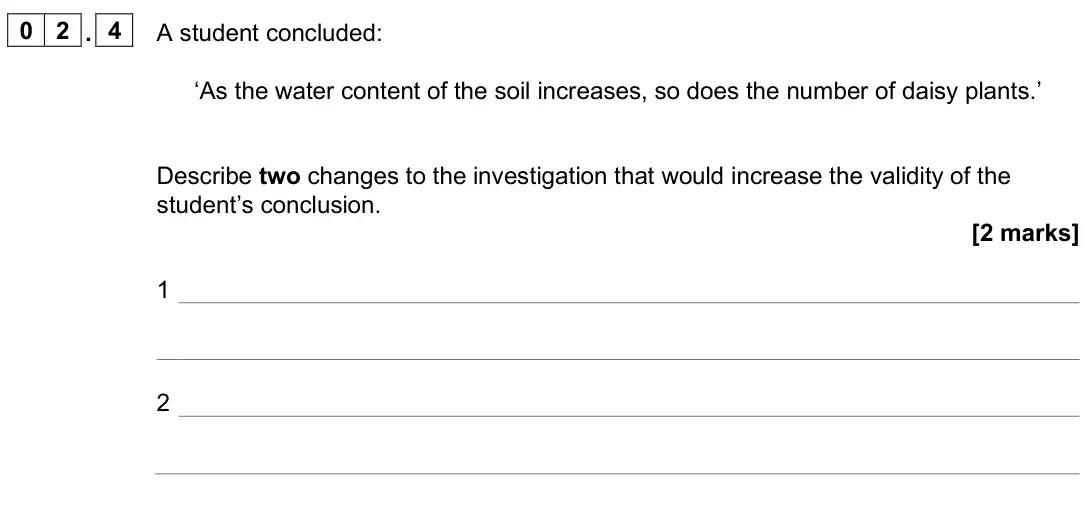
Q02.5
The whole paper ↗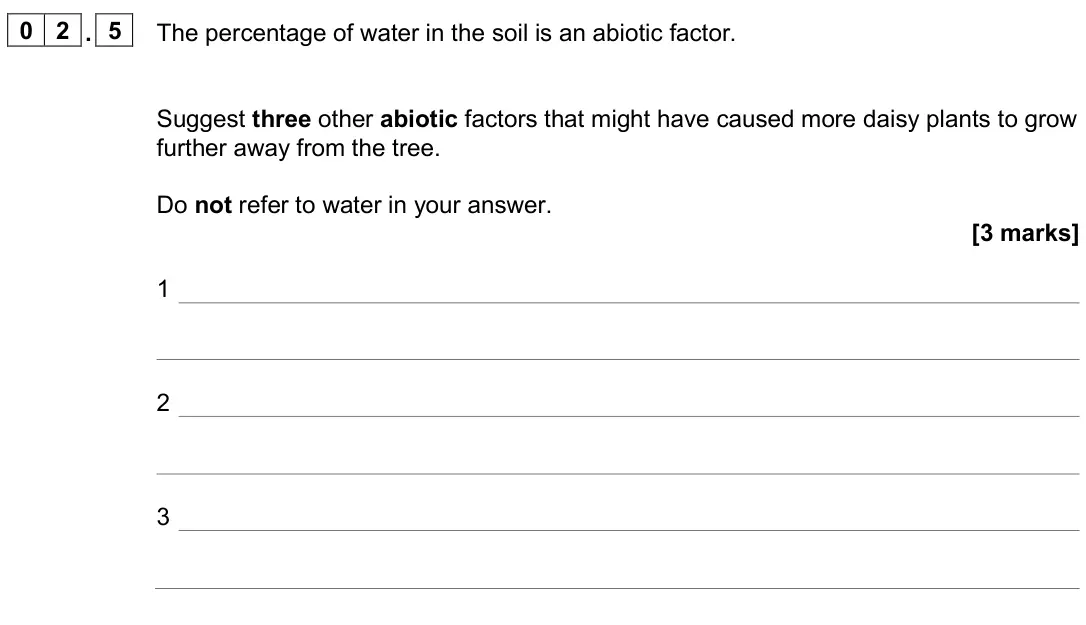
Q05.3
The whole paper ↗
Q06.6
The whole paper ↗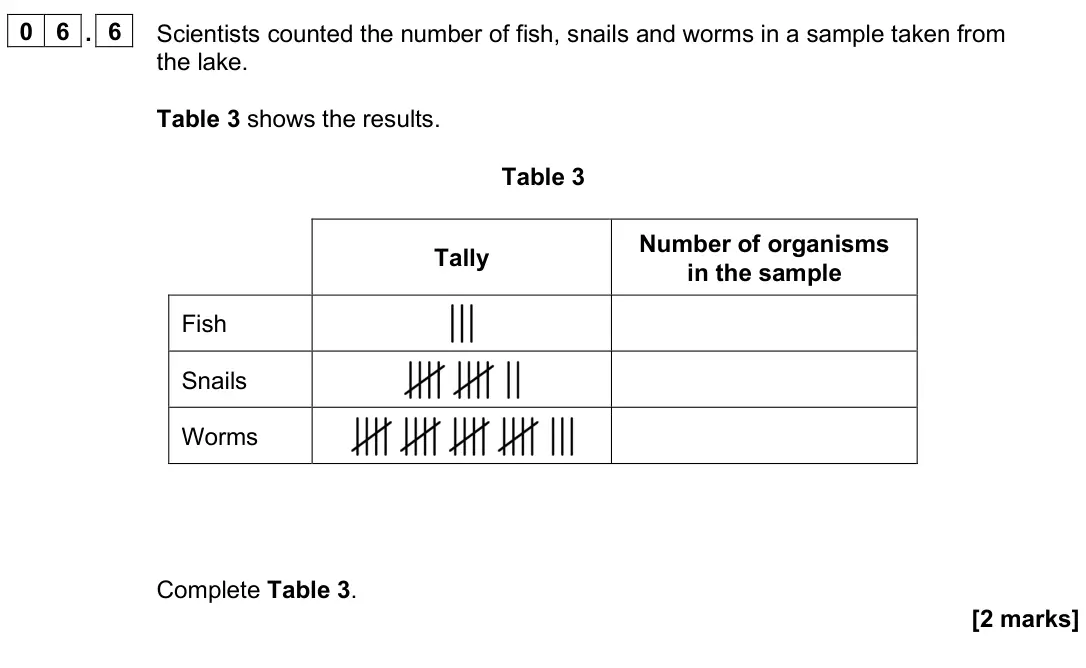
Q07.1
The whole paper ↗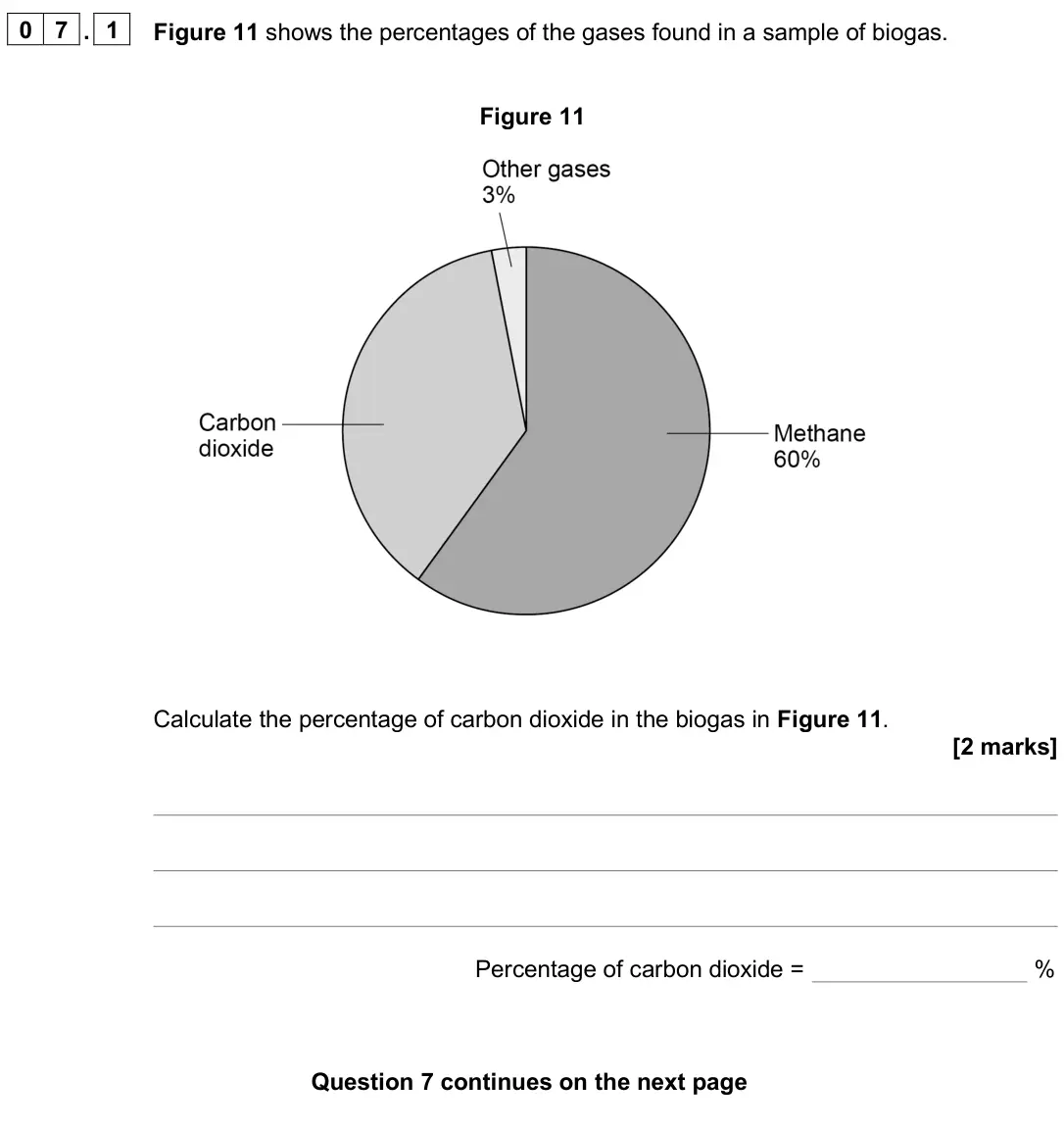
Q07.2
The whole paper ↗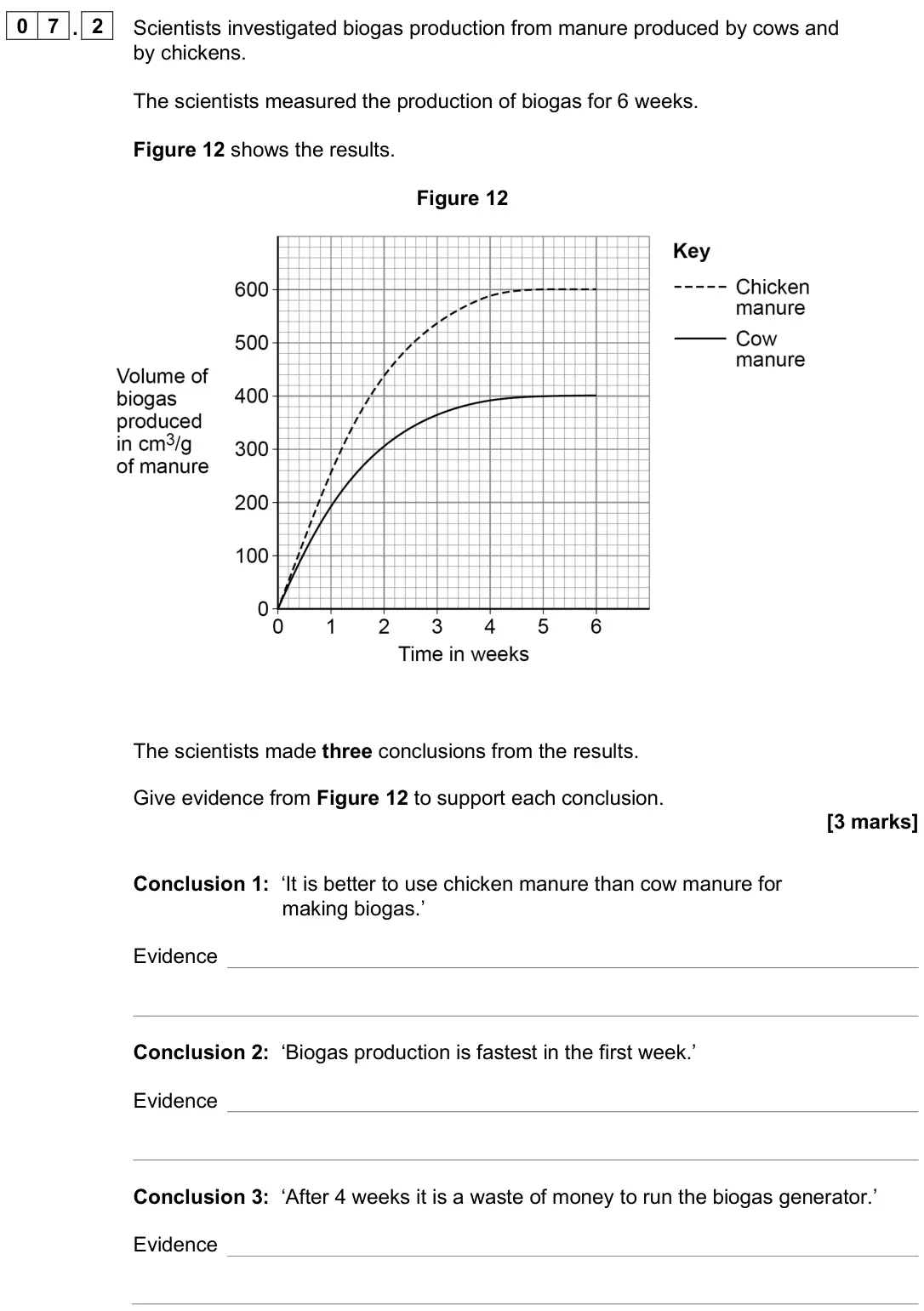
Q07.3
The whole paper ↗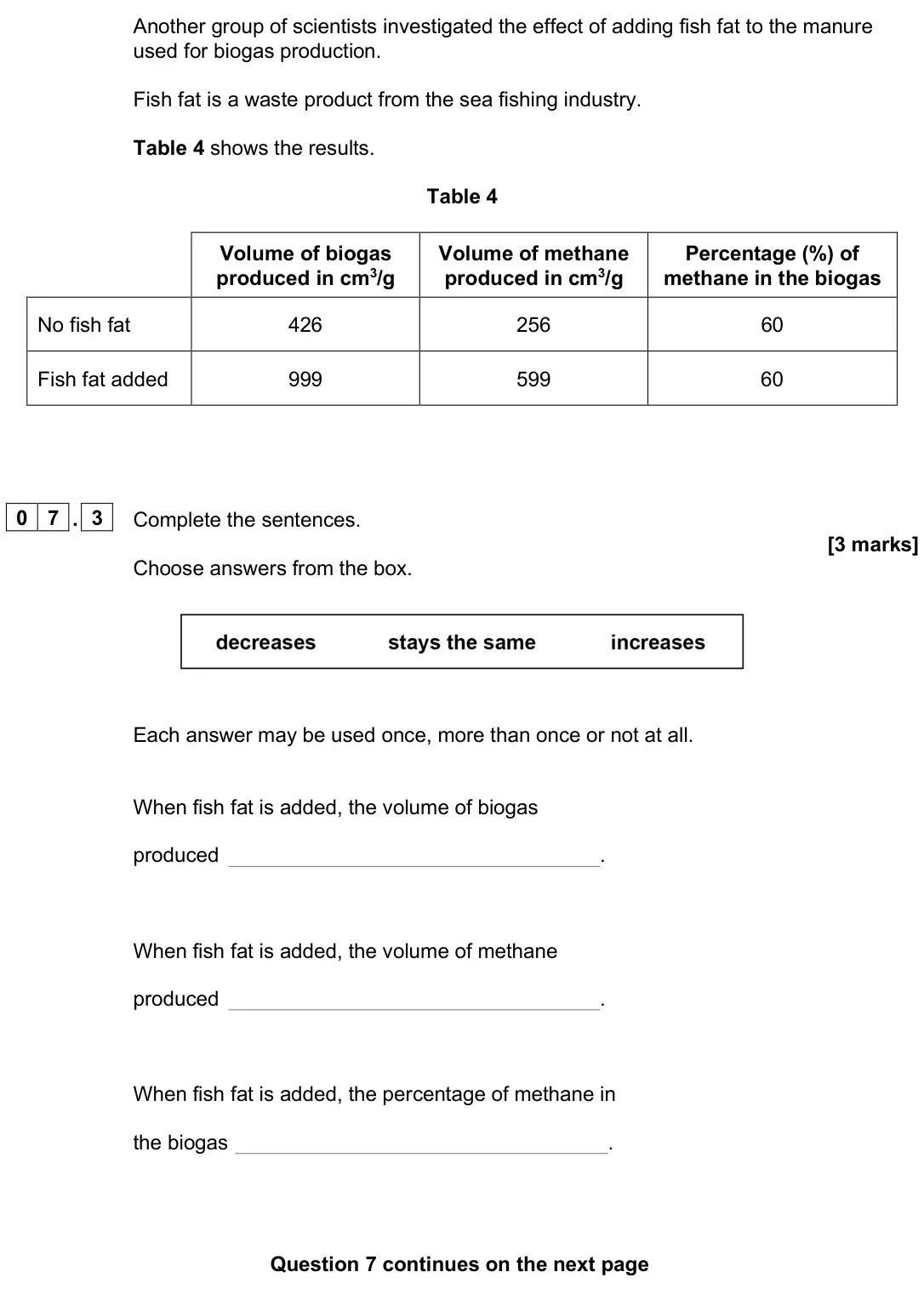
Q07.4
The whole paper ↗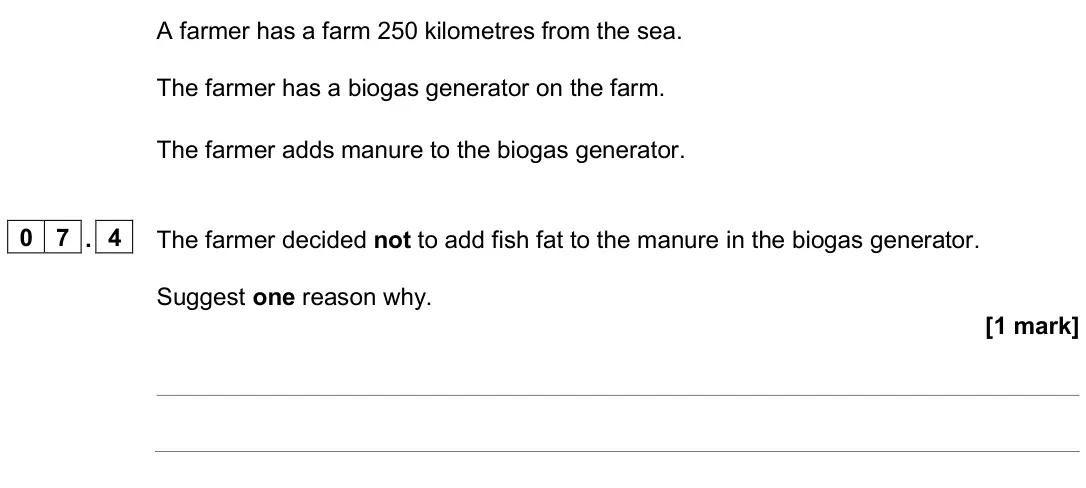
Q07.5
The whole paper ↗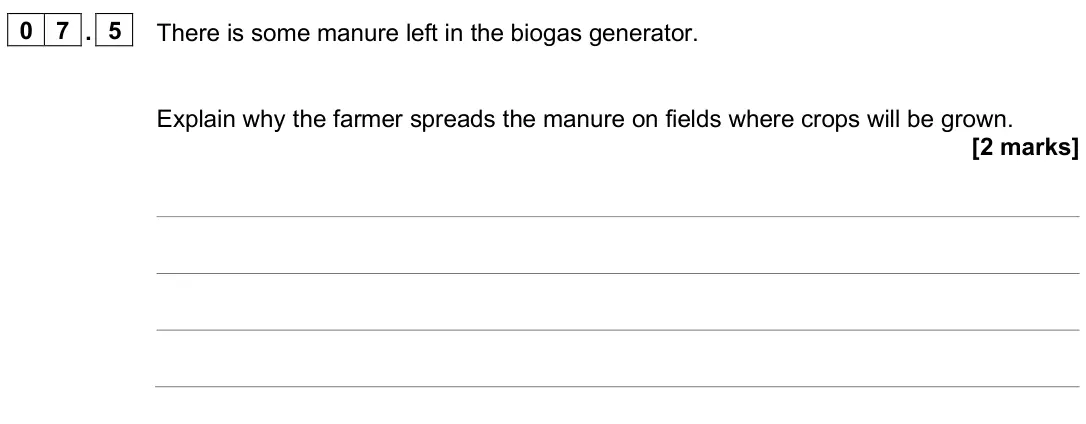
Q09.1
The whole paper ↗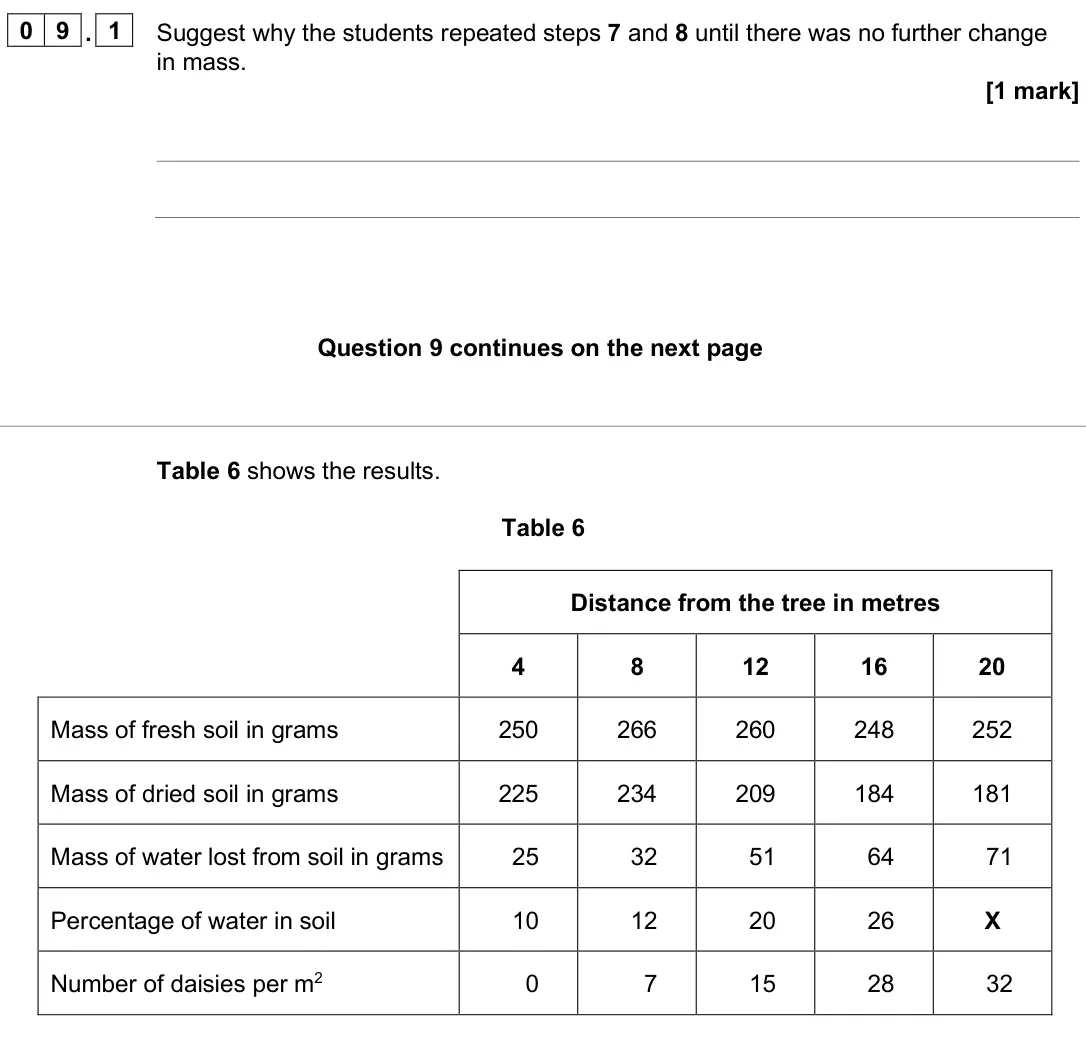
Q09.3
The whole paper ↗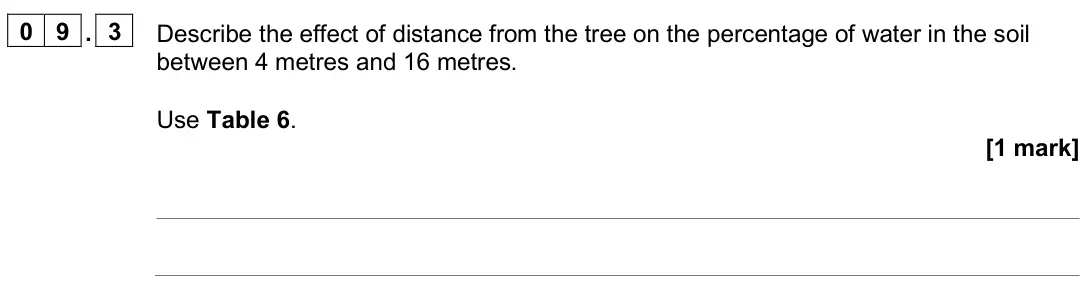
Q09.4
The whole paper ↗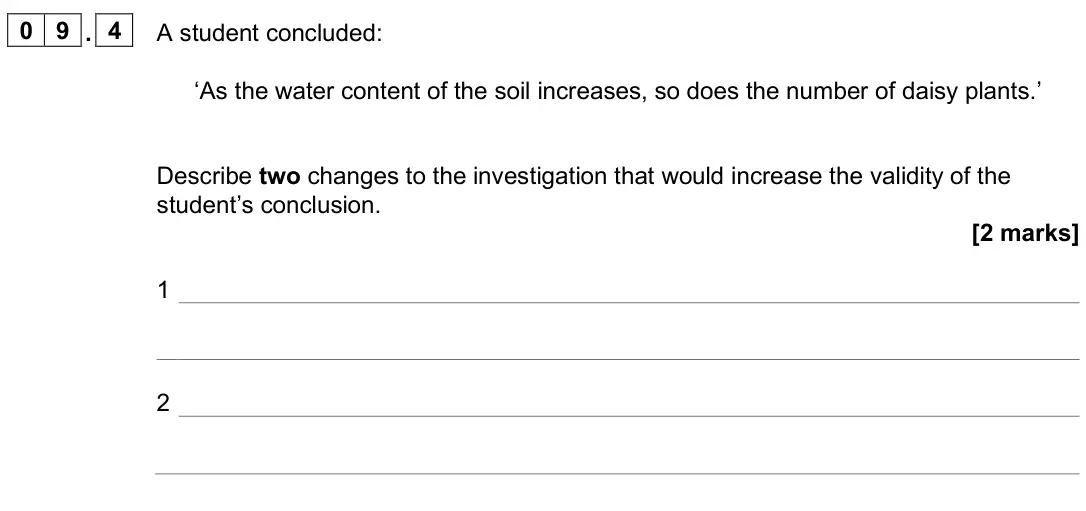
Q09.5
The whole paper ↗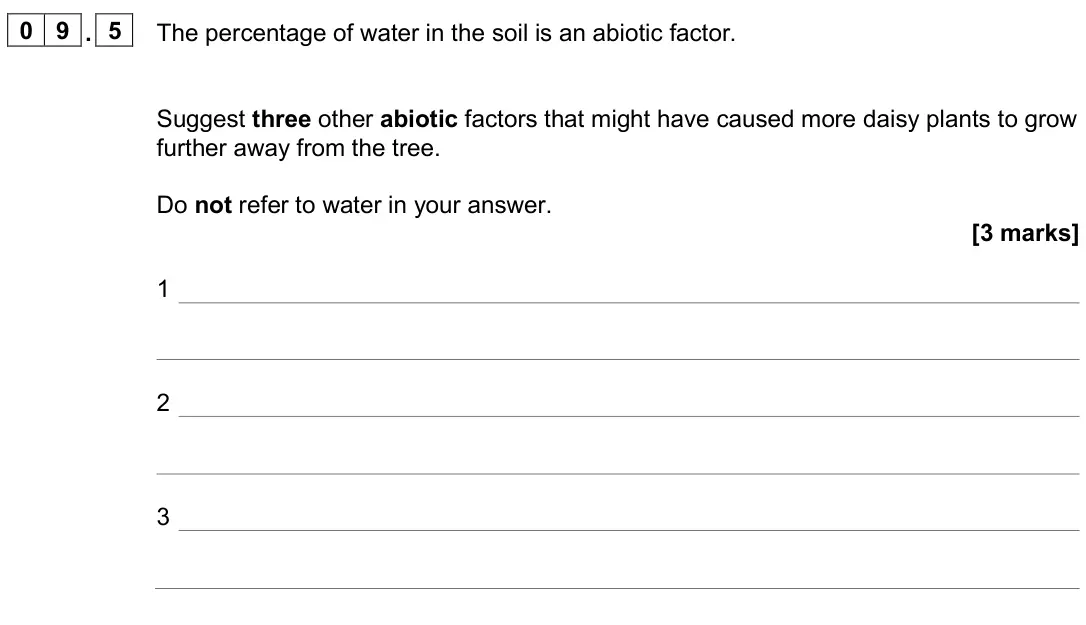
Q02.5
The whole paper ↗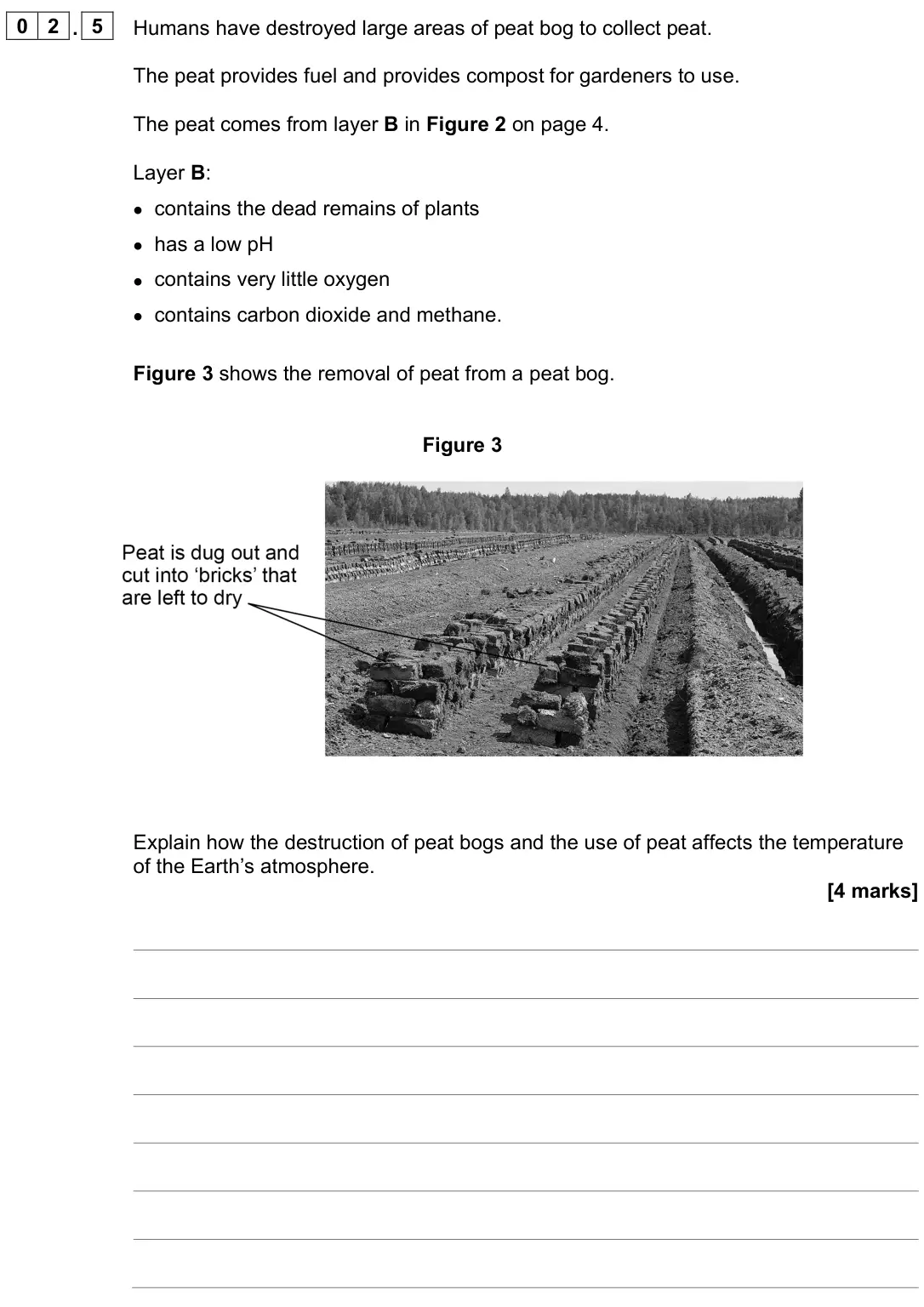
Q03.1
The whole paper ↗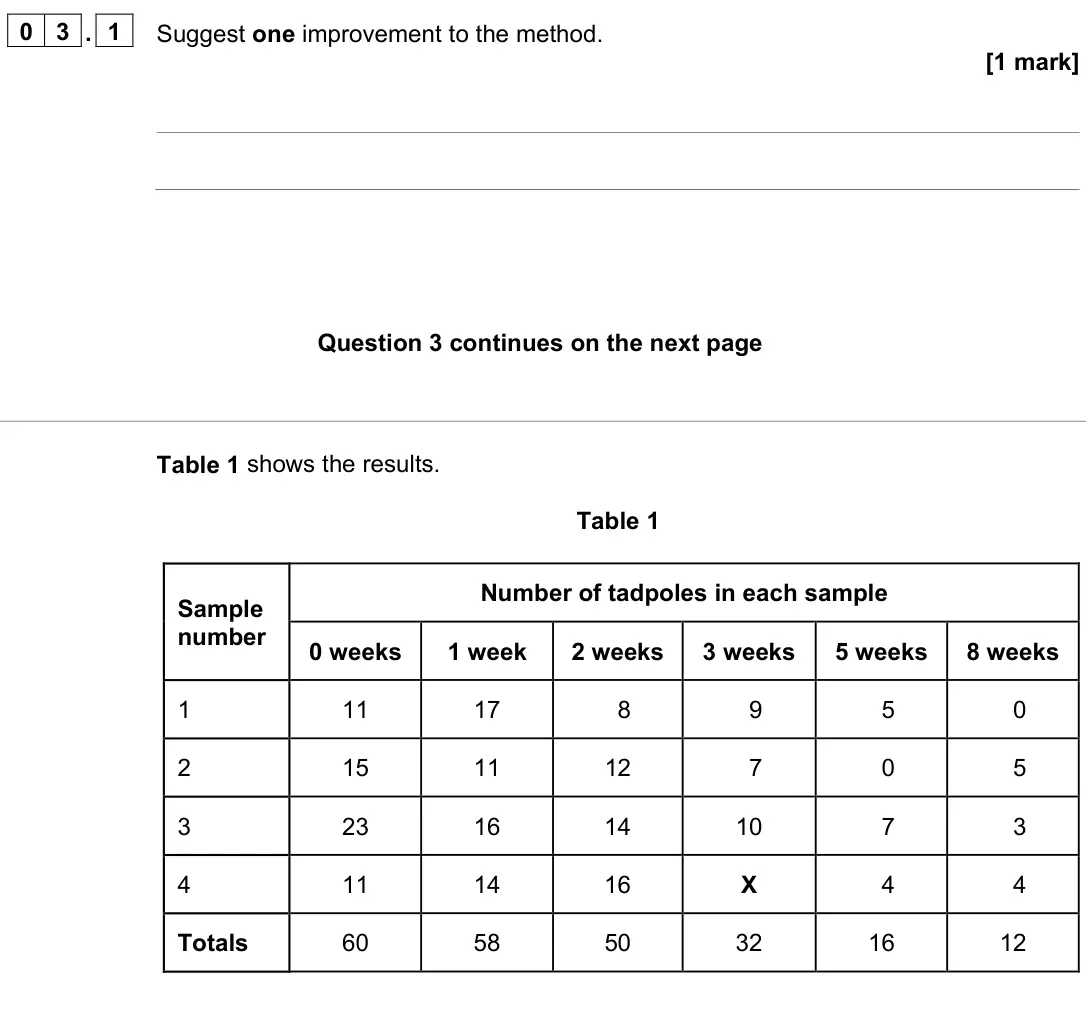
All 128 questions on Organisation of an ecosystem, as a list
- June 2025, Paper 2 Higher, Q02.1 (1 mark): Suggest why the students repeated steps 7 and 8 until there was no further change in mass. [1 mark] Table 2 shows the results. Table 2 Distance from the tree in
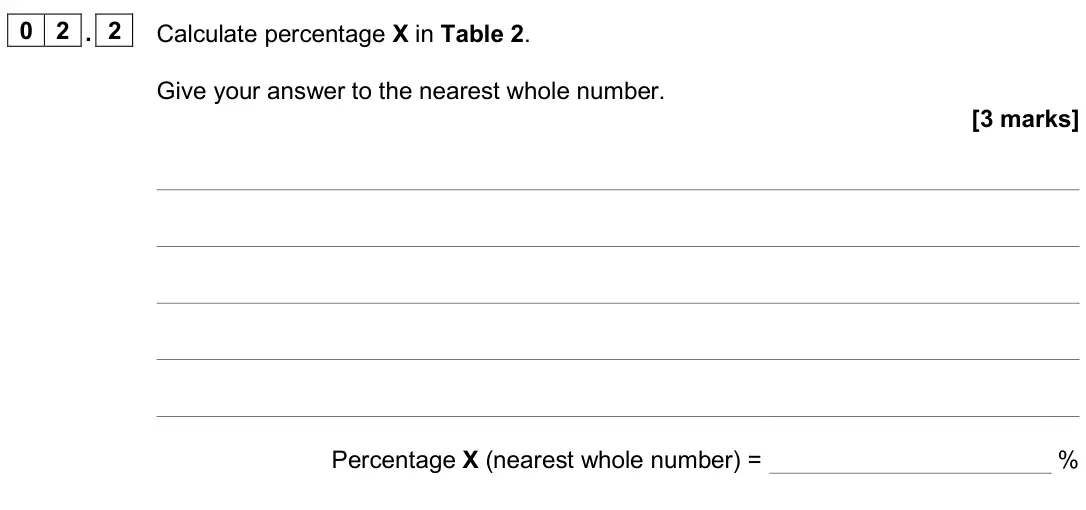
- June 2025, Paper 2 Higher, Q02.2 (3 marks): Calculate percentage X in Table 2. Give your answer to the nearest whole number. [3 marks] Percentage X (nearest whole number) = %
- June 2025, Paper 2 Higher, Q02.3 (1 mark): Describe the effect of distance from the tree on the percentage of water in the soil between 4 metres and 16 metres. Use Table 2. [1 mark]
- June 2025, Paper 2 Higher, Q02.4 (2 marks): A student concluded: ‘As the water content of the soil increases, so does the number of daisy plants.’ Describe two changes to the investigation that would incr
- June 2025, Paper 2 Higher, Q02.5 (3 marks): The percentage of water in the soil is an abiotic factor. Suggest three other abiotic factors that might have caused more daisy plants to grow further away from
- June 2025, Paper 2 Higher, Q05.3 (6 marks): Explain how the destruction of peat bogs can affect biodiversity: • in the local area • globally. [6 marks]
- June 2025, Paper 2 Foundation, Q06.6 (2 marks): Scientists counted the number of fish, snails and worms in a sample taken from the lake. Table 3 shows the results. Table 3 Tally Number of organisms in the sam
- June 2025, Paper 2 Foundation, Q07.1 (2 marks): Figure 11 shows the percentages of the gases found in a sample of biogas. Figure 11 Calculate the percentage of carbon dioxide in the biogas in Figure 11. [2 ma
- June 2025, Paper 2 Foundation, Q07.2 (3 marks): Scientists investigated biogas production from manure produced by cows and by chickens. The scientists measured the production of biogas for 6 weeks. Figure 12
- June 2025, Paper 2 Foundation, Q07.3 (3 marks): Complete the sentences. [3 marks] Choose answers from the box. Each answer may be used once, more than once or not at all. When fish fat is added, the volume of
- June 2025, Paper 2 Foundation, Q07.4 (1 mark): The farmer decided not to add fish fat to the manure in the biogas generator. Suggest one reason why. [1 mark]
- June 2025, Paper 2 Foundation, Q07.5 (2 marks): There is some manure left in the biogas generator. Explain why the farmer spreads the manure on fields where crops will be grown. [2 marks]
- June 2025, Paper 2 Foundation, Q09.1 (1 mark): Suggest why the students repeated steps 7 and 8 until there was no further change in mass. [1 mark] Table 6 shows the results. Table 6 Distance from the tree in
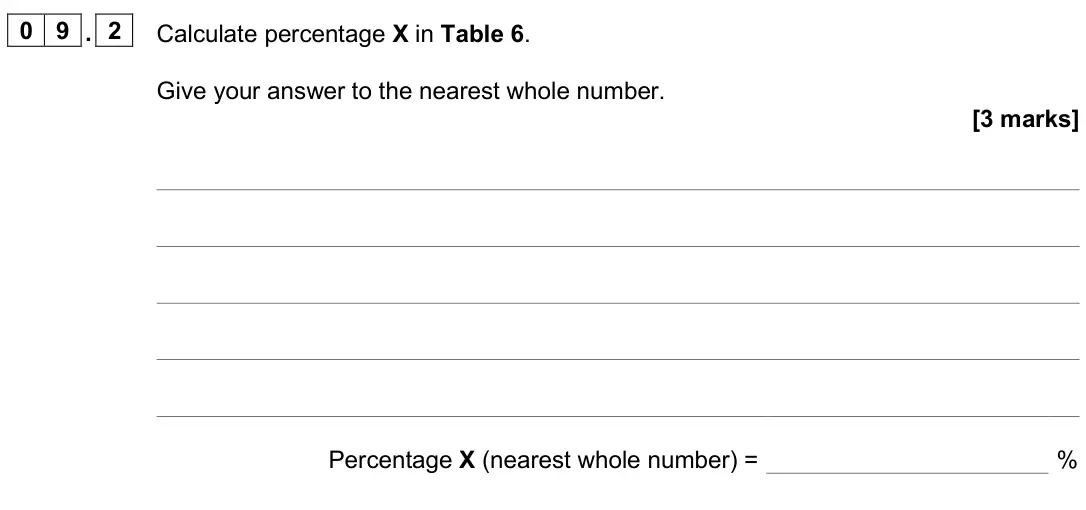
- June 2025, Paper 2 Foundation, Q09.2 (3 marks): Calculate percentage X in Table 6. Give your answer to the nearest whole number. [3 marks] Percentage X (nearest whole number) = %
- June 2025, Paper 2 Foundation, Q09.3 (1 mark): Describe the effect of distance from the tree on the percentage of water in the soil between 4 metres and 16 metres. Use Table 6. [1 mark]
- June 2025, Paper 2 Foundation, Q09.4 (2 marks): A student concluded: ‘As the water content of the soil increases, so does the number of daisy plants.’ Describe two changes to the investigation that would incr
- June 2025, Paper 2 Foundation, Q09.5 (3 marks): The percentage of water in the soil is an abiotic factor. Suggest three other abiotic factors that might have caused more daisy plants to grow further away from
- June 2024, Paper 2 Higher, Q02.5 (4 marks): Humans have destroyed large areas of peat bog to collect peat. The peat provides fuel and provides compost for gardeners to use. The peat comes from layer B in
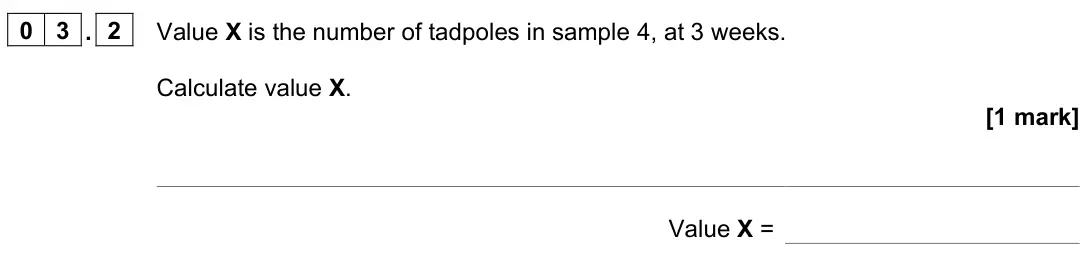
- June 2024, Paper 2 Higher, Q03.1 (1 mark): Suggest one improvement to the method. [1 mark] Table 1 shows the results. Table 1 Sample number Number of tadpoles in each sample 0 weeks 1 week 2 weeks 3 week
- June 2024, Paper 2 Higher, Q03.2 (1 mark): Value X is the number of tadpoles in sample 4, at 3 weeks. Calculate value X. [1 mark] Value X =
- June 2024, Paper 2 Higher, Q03.3 (4 marks): Complete Figure 4 to show how the total number of tadpoles changed over the 8 weeks. [4 marks] You should: • label the x-axis • use a suitable scale for the x-a
- June 2024, Paper 2 Higher, Q03.4 (3 marks): After 0 weeks, no more tadpoles hatched in the pond. Calculate the percentage of the tadpoles that would still be found in the pond at 4 weeks compared with 0 w
- June 2024, Paper 2 Foundation, Q10.5 (4 marks): Humans have destroyed large areas of peat bog to collect peat. The peat provides fuel and provides compost for gardeners to use. The peat comes from layer B in
- June 2024, Paper 2 Foundation, Q11.1 (1 mark): Suggest one improvement to the method. [1 mark] Table 1 shows the results. Table 1 Sample number Number of tadpoles in each sample 0 weeks 1 week 2 weeks 3 week
- June 2024, Paper 2 Foundation, Q11.2 (1 mark): Value X is the number of tadpoles in sample 4, at 3 weeks. Calculate value X. [1 mark] Value X =
- June 2024, Paper 2 Foundation, Q11.3 (4 marks): Complete Figure 15 to show how the total number of tadpoles changed over the 8 weeks. [4 marks] You should: • label the x-axis • use a suitable scale for the x-
- June 2024, Paper 2 Foundation, Q11.4 (3 marks): After 0 weeks, no more tadpoles hatched in the pond. Calculate the percentage of the tadpoles that would still be found in the pond at 4 weeks compared with 0 w
- June 2023, Paper 2 Higher, Q04.1 (6 marks): The leaves fall off many trees in autumn. The dead leaves contain carbon compounds and nitrogen compounds. Describe how carbon and nitrogen in compounds in the
- June 2023, Paper 2 Higher, Q04.2 (1 mark): Suggest one improvement the students could have made to the method. [1 mark]
- June 2023, Paper 2 Higher, Q04.3 (3 marks): Complete Figure 6. You should: • plot the data for 25 °C from Table 1 • draw a line of best fit. [3 marks]
- June 2023, Paper 2 Higher, Q04.4 (4 marks): The rate of pH change increases with an increase in temperature. The rate of pH change at 5 °C is 0.3 pH units per day. Calculate how many times faster the rate
- June 2023, Paper 2 Higher, Q04.5 (3 marks): Milk contains lipids. The lipids are broken down when the milk decays. Explain why the pH changes more quickly when the temperature is higher. [3 marks]
- June 2023, Paper 2 Higher, Q06.1 (4 marks): Explain what causes the changes in the carbon dioxide concentration in the air: • from 0 to 6 hours • from 8 to 12 hours. Use information from Figure 9. [4 mark
- June 2023, Paper 2 Higher, Q06.2 (2 marks): An area of rainforest is cut down and replaced with a field of maize plants. Only one crop of maize is grown each year. Figure 10 shows the changes in the carbo
- June 2023, Paper 2 Higher, Q06.3 (2 marks): The values plotted in Figure 11 are percentages of the results for the control areas. Explain why the scientists presented their results as percentages. [2 mark
- June 2023, Paper 2 Higher, Q06.4 (1 mark): Give one other conclusion you can make from Figure 11. [1 mark]
- June 2023, Paper 2 Higher, Q06.5 (2 marks): Give two reasons why an increase in the diversity of trees in the rainforest leads to an increase in animal diversity. [2 marks] 1 2
- June 2023, Paper 2 Foundation, Q02.1 (2 marks): Complete the sentences. Choose answers from the box. [2 marks] 15 cm ruler 30 m tape measure balance quadrat transect The length and width of the lawn should be
- June 2023, Paper 2 Foundation, Q02.2 (1 mark): How should the students choose the five locations to sample? [1 mark] Tick () one box. Choose locations at random. Choose locations at the corners of the lawn.
- June 2023, Paper 2 Foundation, Q02.3 (2 marks): Complete the sentences. Choose answers from the box. [2 marks] area mean median perimeter volume Multiply the length of the lawn by the width of the lawn to giv
- June 2023, Paper 2 Foundation, Q02.4 (1 mark): The students calculated that the population of buttercup plants on the lawn was 300. How did the students use the results in Table 1 to calculate the population
- June 2023, Paper 2 Foundation, Q02.5 (1 mark): How could the students improve the accuracy of the estimate? [1 mark] Tick () one box. Count and record more samples. Select locations in the middle of the law
- June 2023, Paper 2 Foundation, Q03.1 (1 mark): The grass needs energy to grow. What is the source of energy for the grass? [1 mark]
- June 2023, Paper 2 Foundation, Q03.2 (3 marks): Table 2 lists different types of feeding relationship. Table 2 Feeding relationship Organism Secondary consumer Lynx Primary consumer Producer Herbivore Carnivo
- June 2023, Paper 2 Foundation, Q03.3 (3 marks): Figure 4 shows the appearance of the snowshoe hare in the summer and in the winter. Figure 4 Snowshoe hare in summer Snowshoe hare in winter The snowshoe hare h
- June 2023, Paper 2 Foundation, Q03.4 (2 marks): Figure 5 shows that the number of snowshoe hares and the number of lynx increase and decrease several times. Suggest two reasons why the number of snowshoe hare
- June 2023, Paper 2 Foundation, Q03.5 (1 mark): The number of snowshoe hares increased and decreased four times between 1900 and 1935. What effect does an increase in the number of snowshoe hares have on the
- June 2023, Paper 2 Foundation, Q03.6 (1 mark): Suggest one reason why the number of lynx decreased from 1915 to 1919. Use information from Figure 5. [1 mark]
- June 2023, Paper 2 Foundation, Q03.7 (2 marks): When the snowshoe hare eats grass, about 90% of the biomass of the grass is lost. Give two ways the biomass is lost. [2 marks] 1 2
- June 2023, Paper 2 Foundation, Q05.1 (1 mark): Which other type of organism causes decay? [1 mark] Tick () one box. Fungi Plants Viruses Students investigated the effect of temperature on the decay of milk.
- June 2023, Paper 2 Foundation, Q05.2 (1 mark): What was the dependent variable in the investigation? [1 mark] Tick () one box. The pH of the milk The type of milk The volume of the milk
- June 2023, Paper 2 Foundation, Q05.3 (1 mark): How could the students keep the milk at 30 °C for 7 days? [1 mark] Tick () one box. Put a lid on the beaker. Put the beaker in a water bath. Stir the milk cont
- June 2023, Paper 2 Foundation, Q05.4 (1 mark): As the milk decays, the bacteria digest fats in the milk. What type of acid is produced by digestion of fats in the milk? [1 mark] Tick () one box. Amino acid
- June 2023, Paper 2 Foundation, Q05.5 (1 mark): Why did the pH not fall below pH 4.5 at 20 °C? [1 mark] Tick () one box. All the fat had been digested. The reaction was too fast. The temperature was too low.
- June 2023, Paper 2 Foundation, Q05.6 (1 mark): Give one reason why the rate of digestion was faster at 30 °C than at 5 °C. [1 mark]
- June 2023, Paper 2 Foundation, Q05.7 (2 marks): Calculate the rate of digestion at 30 °C from day 2 to day 3. Complete the following calculation. Use data from Figure 9. [2 marks] At 30 °C, the pH at day 2 =
- June 2023, Paper 2 Foundation, Q05.8: The rate of digestion at 5°C from day 2 to day 3 is 0.1 pH units/day. How many times faster is the rate of digestion at 30°C than the rate of digestion at 5°C f
- June 2022, Paper 2 Higher, Q02.2 (6 marks): Students investigated the populations of earthworms in the soil in two different areas: • Area A: a grass lawn • Area B: a farmer’s field. Chemical X can be mix
- June 2022, Paper 2 Higher, Q06.1 (1 mark): Name process X. [1 mark]
- June 2022, Paper 2 Higher, Q06.2 (1 mark): Name the process by which water is absorbed into plant roots. [1 mark]
- June 2022, Paper 2 Higher, Q06.3 (2 marks): Give two uses of water in plants. [2 marks] 1 2
- June 2022, Paper 2 Higher, Q07.2 (1 mark): How many algal cells are in the 0.2 mm × 0.2 mm square in Figure 9? Use the following procedure: • Count all cells that are completely within the 0.2 mm × 0.2 m
- June 2022, Paper 2 Higher, Q07.3 (6 marks): One week later the scientist repeated the test and counted 14 cells on the 0.2 mm × 0.2 mm counting grid. Calculate the number of algal cells in 1.0 mm3 of undi
- June 2022, Paper 2 Higher, Q07.4 (1 mark): Suggest why the scientist diluted the pond water before placing it on the special slide. [1 mark]
- June 2022, Paper 2 Higher, Q07.5 (2 marks): A student repeated the scientist’s method. The student used a thin coverslip over the diluted pond water instead of the thick coverslip. The liquid pulled the t
- June 2022, Paper 2 Foundation, Q09.2 (6 marks): Students investigated the populations of earthworms in the soil in two different areas: • Area A: a grass lawn • Area B: a farmer’s field. Chemical X can be mix
- November 2021, Paper 1 Higher, Q04.8 (3 marks): On day 10, the pond snail died. Explain why the death of the pond snail caused the concentration of carbon dioxide to increase after day 10. [3 marks]
- November 2021, Paper 2 Higher, Q02.1 (1 mark): How could the student keep the milk at a constant temperature for 5 days? [1 mark]
- November 2021, Paper 2 Higher, Q02.2 (1 mark): Give one variable the student should keep constant. Do not refer to temperature in your answer. [1 mark]
- November 2021, Paper 2 Higher, Q02.3 (4 marks): Complete Figure 4. [4 marks] You should: • label the x-axis • use a suitable scale for the x-axis • plot the data from Table 1 • draw a line of best fit. Figure
- November 2021, Paper 2 Higher, Q02.4 (2 marks): The data you plotted in Question 02.3 were obtained at 20 °C. Sketch a line on Figure 4 to show the results you would expect at 25 °C. Label this line ‘25 °C’.
- November 2021, Paper 2 Higher, Q04 (6 marks): Decay occurs in a compost heap. Figure 7 shows a compost heap. Figure 7 Describe: • how microorganisms in the layers of soil help to recycle chemicals in the de
- November 2021, Paper 2 Higher, Q05.2 (2 marks): How should the student decide where to place the quadrat? Give the reason for your answer. [2 marks]
- November 2021, Paper 2 Higher, Q05.3 (6 marks): The mean number of daisy plants in each quadrat is 6. Calculate the number of daisy plants on the lawn. Give your answer to 3 significant figures. [6 marks] Num
- November 2021, Paper 2 Higher, Q05.4 (2 marks): Using the mean from this investigation to calculate the number of daisy plants on the lawn may not be accurate. Give two reasons why. [2 marks] 1 2
- November 2021, Paper 2 Higher, Q07.1 (2 marks): The animals in Figure 9 get their energy by eating other organisms. Describe how the algae get energy. [2 marks]
- November 2021, Paper 2 Higher, Q07.2 (1 mark): Name one primary consumer in Figure 9. [1 mark]
- November 2021, Paper 2 Higher, Q07.3 (1 mark): Name one producer in Figure 9. [1 mark]
- November 2021, Paper 2 Higher, Q07.4 (1 mark): The different food chains in Figure 9 have different numbers of organisms. Complete Figure 10 to show a food chain in Figure 9 with five organisms, including th
- November 2021, Paper 2 Foundation, Q03.1 (2 marks): The algae make glucose by photosynthesis. Which two substances do the algae need for photosynthesis? [2 marks] Tick () two boxes. Carbon dioxide Nitrogen Oxyge
- November 2021, Paper 2 Foundation, Q06.1 (1 mark): What method should the student have used for placing the quadrat? [1 mark] Tick () one box. Place the quadrat where there are many buttercup plants. Place the
- November 2021, Paper 2 Foundation, Q06.2 (2 marks): Calculate mean value X in Table 1. [2 marks] X = %
- November 2021, Paper 2 Foundation, Q06.3 (1 mark): The student’s method of estimating the percentage cover of buttercup plants is not accurate. How does Figure 11 show this? [1 mark] Tick () one box. Quadrat 1
- November 2021, Paper 2 Foundation, Q06.4 (2 marks): The student wanted to get a more valid estimate of the percentage cover of buttercup plants in the field. Suggest two improvements to the method to make the res
- November 2021, Paper 2 Foundation, Q07.2 (2 marks): Give two human activities that affect the concentration of carbon dioxide in the atmosphere. [2 marks] 1 2
- November 2021, Paper 2 Foundation, Q09.1 (1 mark): How could the student keep the milk at a constant temperature for 5 days? [1 mark]
- November 2021, Paper 2 Foundation, Q09.2 (1 mark): Give one variable the student should keep constant. Do not refer to temperature in your answer. [1 mark]
- November 2021, Paper 2 Foundation, Q09.3 (4 marks): Complete Figure 16. [4 marks] You should: • label the x-axis • use a suitable scale for the x-axis • plot the data from Table 2 • draw a line of best fit. Figur
- November 2021, Paper 2 Foundation, Q09.4 (2 marks): The data you plotted in Question 09.3 were obtained at 20 °C. Sketch a line on Figure 16 to show the results you would expect at 25 °C. Label this line ‘25 °C’.
- November 2021, Paper 2 Foundation, Q11 (6 marks): Decay occurs in a compost heap. Figure 19 shows a compost heap. Figure 19 Describe: • how microorganisms in the layers of soil help to recycle chemicals in the
- November 2020, Paper 2 Higher, Q01.1 (2 marks): Name two types of microorganism that cause decay. [2 marks] 1 2
- November 2020, Paper 2 Higher, Q01.2 (1 mark): Cows’ milk is pH 6.6. As milk decays, lipids in the milk are broken down. One of the products of the breakdown of lipids causes the pH of milk to decrease. Name
- November 2020, Paper 2 Higher, Q01.3 (1 mark): Give one way the pH can be measured. [1 mark]
- November 2020, Paper 2 Higher, Q01.4 (2 marks): Give two control variables the student should have used in this investigation. [2 marks] 1 2
- November 2020, Paper 2 Higher, Q01.5 (1 mark): Which type of milk stays fresh the longest at 10 °C? [1 mark]
- November 2020, Paper 2 Higher, Q01.6 (2 marks): Describe the effect of temperature on the time taken for goats’ milk to reach pH 5. Use data from Figure 1 in your answer. [2 marks]
- November 2020, Paper 2 Higher, Q01.7 (1 mark): The time taken for cows’ milk to reach pH 5 at 10 °C is less than the time taken for cows’ milk to reach pH 5 at 5 °C. Suggest one reason why. [1 mark]
- November 2020, Paper 2 Higher, Q01.8 (2 marks): Suggest two reasons why the different types of milk took different lengths of time to reach pH 5. [2 marks] 1 2
- November 2020, Paper 2 Higher, Q01.9 (1 mark): The student said: ‘The temperature milk is stored at affects how likely the milk is to cause food poisoning.’ How can the investigation be developed to find out
- November 2020, Paper 2 Foundation, Q01.3 (1 mark): Name the process wheat plants use to make glucose. [1 mark]
- November 2020, Paper 2 Foundation, Q08.1 (2 marks): Name two types of microorganism that cause decay. [2 marks] 1 2
- November 2020, Paper 2 Foundation, Q08.2 (1 mark): Cows’ milk is pH 6.6. As milk decays, lipids in the milk are broken down. One of the products of the breakdown of lipids causes the pH of milk to decrease. Name
- November 2020, Paper 2 Foundation, Q08.3 (1 mark): Give one way the pH can be measured. [1 mark]
- November 2020, Paper 2 Foundation, Q08.4 (2 marks): Give two control variables the student should have used in this investigation. [2 marks] 1 2
- November 2020, Paper 2 Foundation, Q08.5 (1 mark): Which type of milk stays fresh the longest at 10 °C? [1 mark]
- November 2020, Paper 2 Foundation, Q08.6 (2 marks): Describe the effect of temperature on the time taken for goats’ milk to reach pH 5. Use data from Figure 11 in your answer. [2 marks]
- November 2020, Paper 2 Foundation, Q08.7 (1 mark): The time taken for cows’ milk to reach pH 5 at 10 °C is less than the time taken for cows’ milk to reach pH 5 at 5 °C. Suggest one reason why. [1 mark]
- November 2020, Paper 2 Foundation, Q08.8 (2 marks): Suggest two reasons why the different types of milk took different lengths of time to reach pH 5. [2 marks] 1 2
- November 2020, Paper 2 Foundation, Q08.9 (1 mark): The student said: ‘The temperature milk is stored at affects how likely the milk is to cause food poisoning.’ How can the investigation be developed to find out
- Specimen, Paper 2 Higher, Q02.1: An airtight compost heap causes anaerobic decay. Explain why the gardener might be against producing compost using this method. [2 mar The gardener finds this r
- Specimen, Paper 2 Higher, Q02.3 (1 mark): Which type of material in Table 2 would be best for the gardener to use to make his compost? Justify your answer. [1 mark 8
- Specimen, Paper 2 Higher, Q02.5 (3 marks): Figure 2 shows two strawberries. • Both strawberries were picked from the same strawberry plant. • Both strawberries were picked 3 days ago. • The strawberries
- Specimen, Paper 2 Higher, Q04.1 (1 mark): Mould spores are hazardous. Give one safety precaution the student should take when doing this investigation. [1 mark A student made the following hypothesis ab
- Specimen, Paper 2 Higher, Q04.2 (4 marks): Describe how the materials and equipment could be used to test the hypothesis. [4 marks
- Specimen, Paper 2 Higher, Q04.3: Give one variable the student should control in the investigation. [1 ma Another student did a similar investigation. Figure 3 shows the results. Figure 3
- Specimen, Paper 2 Higher, Q04.4: Determine the rate of mould growth at 42 °C between day 2 and day 7. [2 mar Rate of mould growth = units per 5
- Specimen, Paper 2 Higher, Q04.5 (1 mark): The growth of mould shows decomposition of the bread. Give a conclusion about decomposition from the results in Figure 3. [1 mark 6
- Specimen, Paper 2 Foundation, Q02.1: Name one consumer shown in Figure 3. [1 ma
- Specimen, Paper 2 Foundation, Q02.2: Name one carnivore shown in Figure 3. [1 ma
- Specimen, Paper 2 Foundation, Q03.1: What is the tape in Figure 4 used for in this investigation? [1 ma 9
- Specimen, Paper 2 Foundation, Q03.2 (1 mark): The teacher told the student that throwing the quadrat over his shoulder was not random. The method could be improved to make sure the quadrats were placed rand
- Specimen, Paper 2 Foundation, Q03.3 (2 marks): How could the student improve the investigation so that a valid estimate can be made? [2 marks Tick two boxes. Weigh the clover plants Compare their results wit
- Specimen, Paper 2 Foundation, Q03.4: The area of the school field was 500 m2. The quadrat used in Table 1 had an area of 0.25 m2. Calculate the estimated number of clover plants in the school field
- Specimen, Paper 2 Foundation, Q03.5 (1 mark): What was the mode for the results in Table 1? [1 mark Tick one box. 1 8 11 40
- Specimen, Paper 2 Foundation, Q03.6 (1 mark): Suggest which quadrat could have been placed under the shade of a large tree. Give one reason for your answer. [1 mark Quadrat number Reason
- Specimen, Paper 2 Foundation, Q11.1: An airtight compost heap causes anaerobic decay. Explain why the gardener might be against producing compost using this method. [2 mar The gardener finds this r
- Specimen, Paper 2 Foundation, Q11.3 (1 mark): Which type of material in Table 7 would be best for the gardener to use to make his compost? Justify your answer. [1 mark
- Specimen, Paper 2 Foundation, Q11.5 (3 marks): Figure 15 shows two strawberries. • Both strawberries were picked from the same strawberry plant. • Both strawberries were picked 3 days ago. • The strawberries
Questions, mark schemes and examiner’s reports are © AQA, from their published past papers. Plumi isn’t affiliated with any exam board. Want whole papers? Every AQA GCSE Biology paper.
Rather write your answers by hand on iPad? Plumi marks them against the same mark schemes.