 plumi
Transport in cells: AQA GCSE Biology questions
Every AQA GCSE Biology exam question on 4.1.3 Transport in cells, 2018–2025, with its mark scheme and examiner’s report.
Find questions1,505
Calculations
Q03.1
The whole paper ↗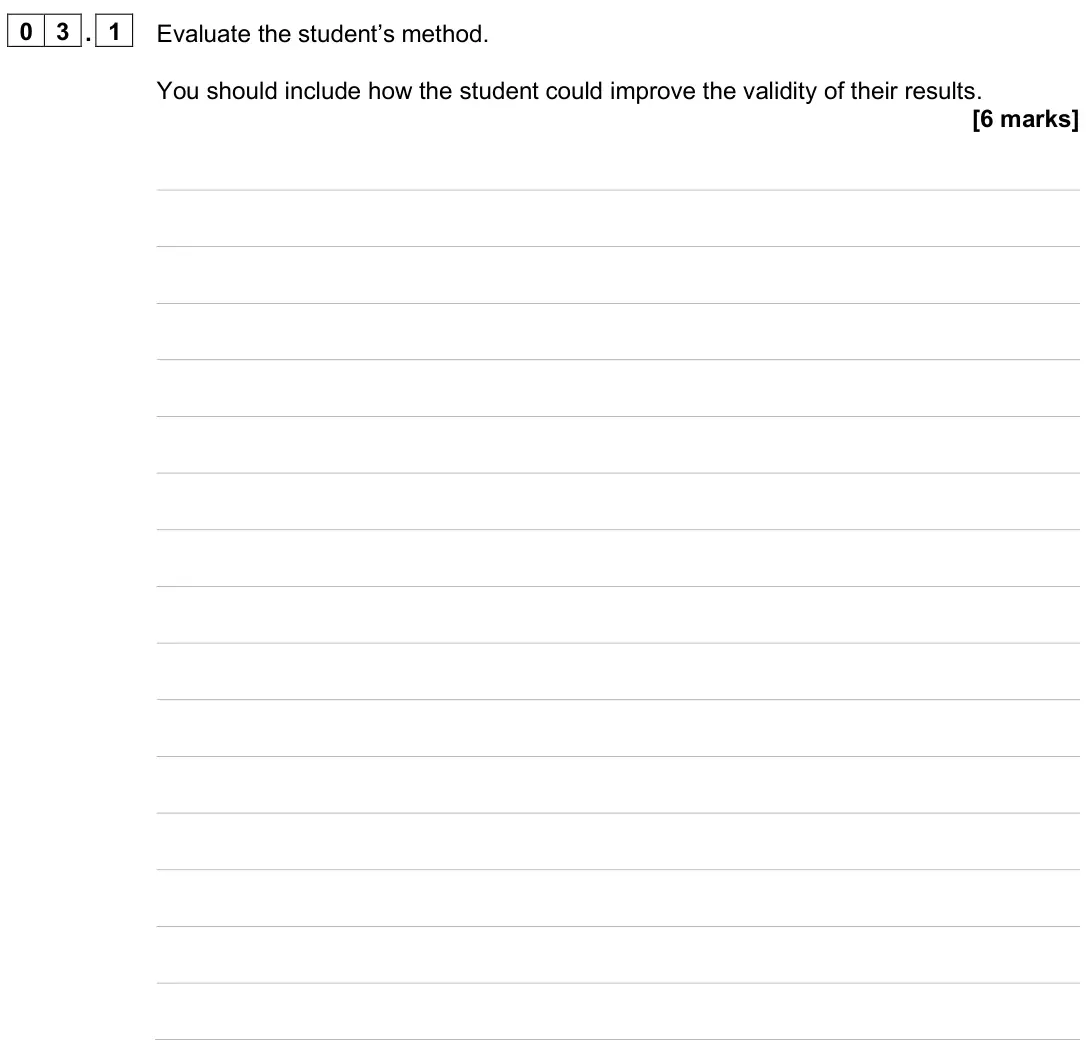
Q03.2
The whole paper ↗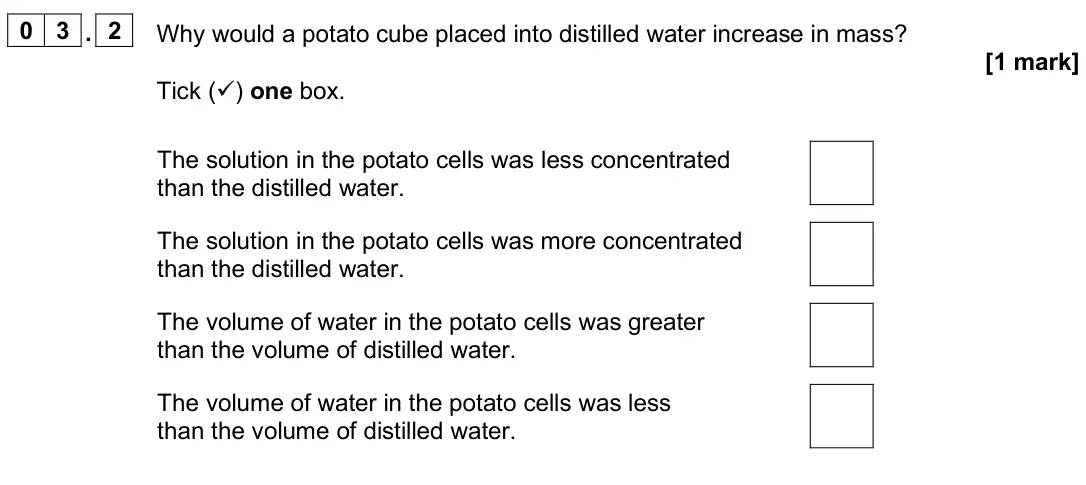
Q03.3
The whole paper ↗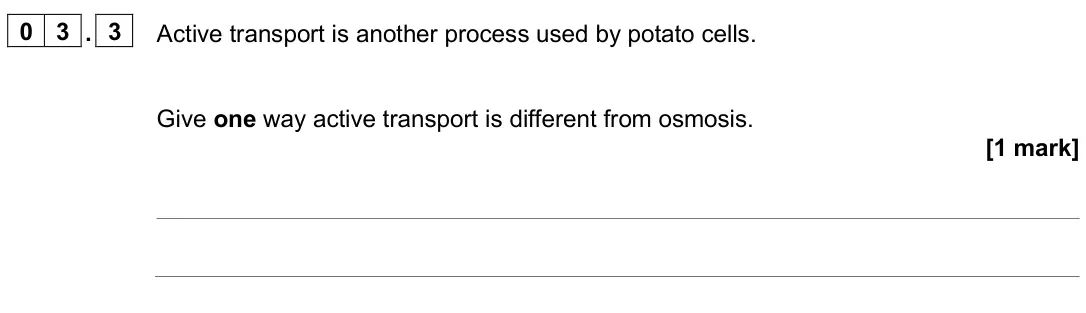
Q06.1
The whole paper ↗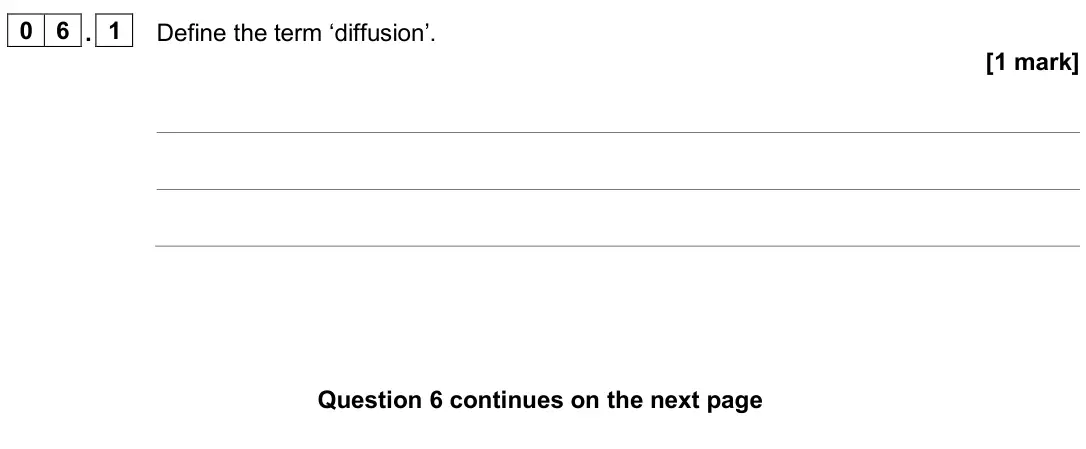
Q06.2
The whole paper ↗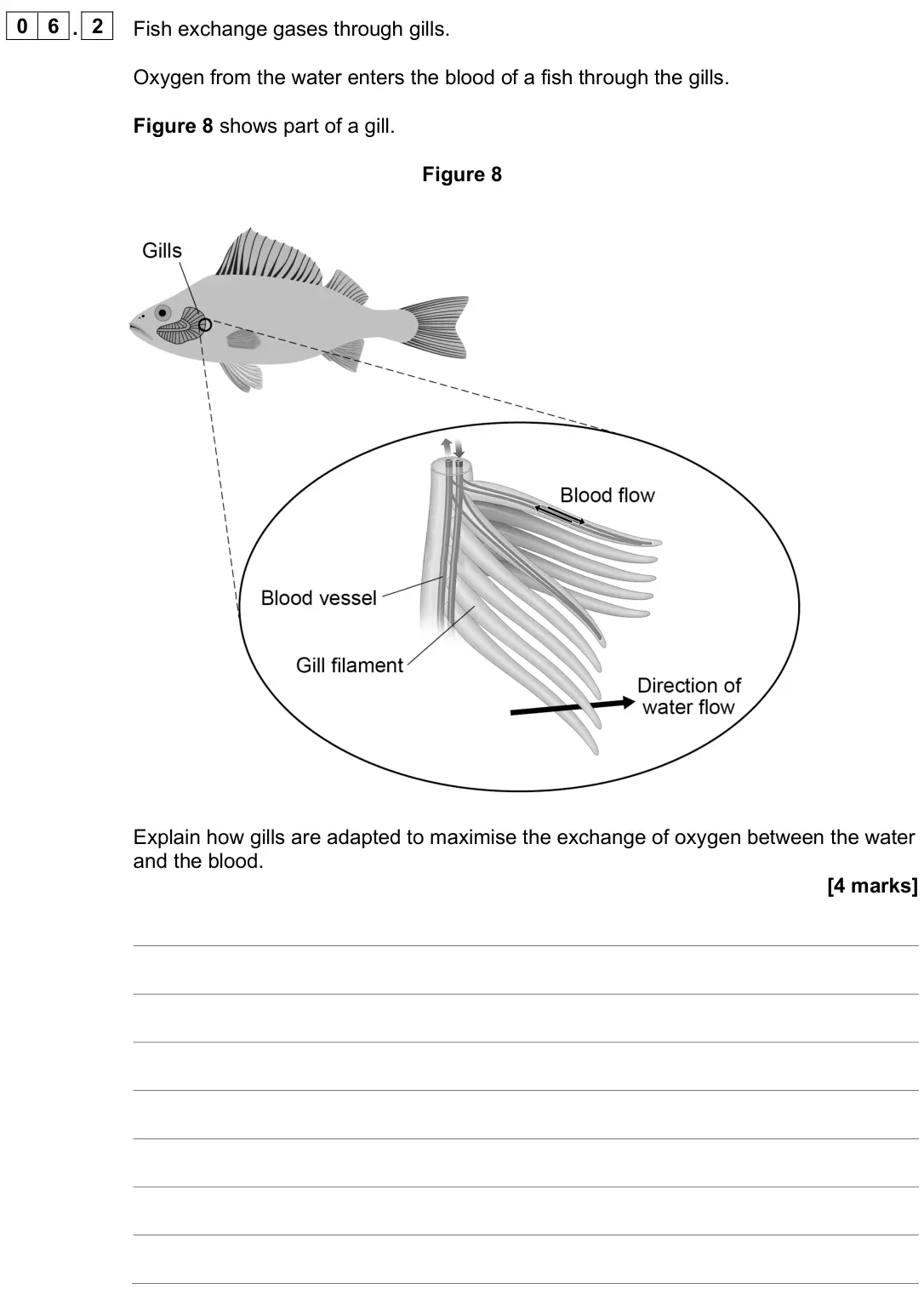
Q07.1
The whole paper ↗
Q07.2
The whole paper ↗
Q01.4
The whole paper ↗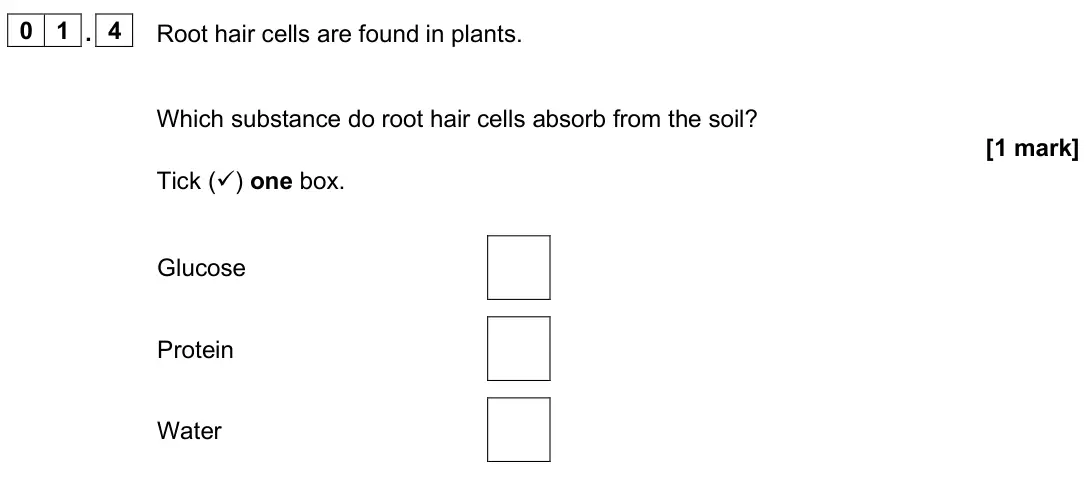
Q01.7
The whole paper ↗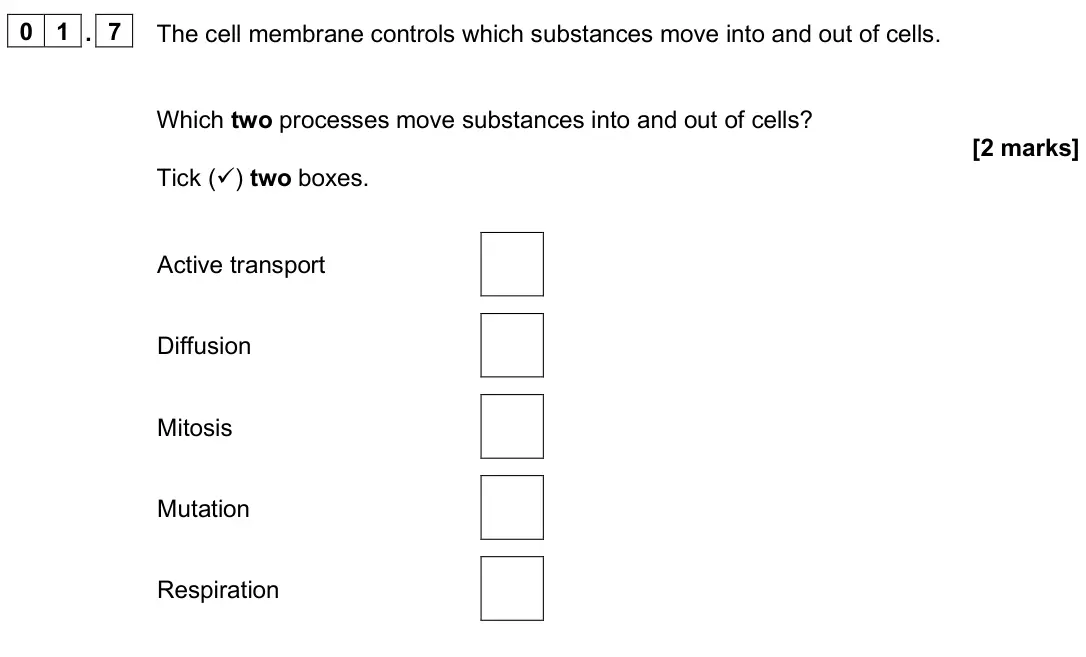
Q01.8
The whole paper ↗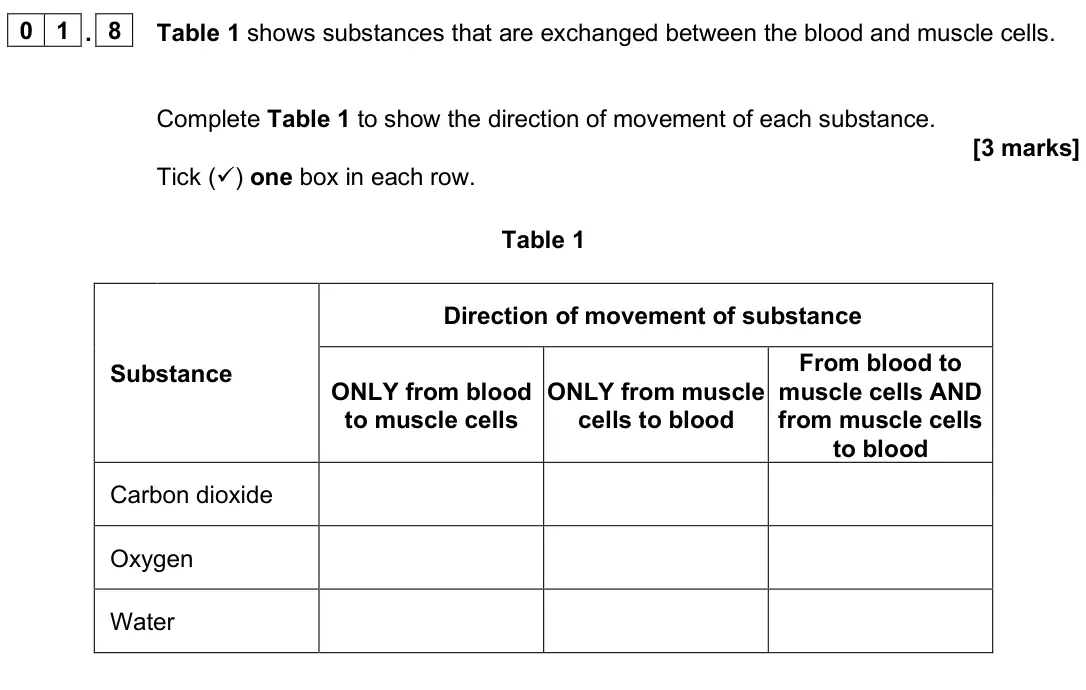
Q05.2
The whole paper ↗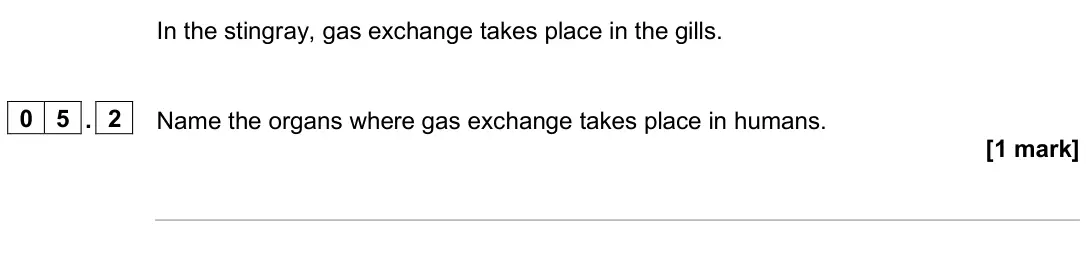
Q05.3
The whole paper ↗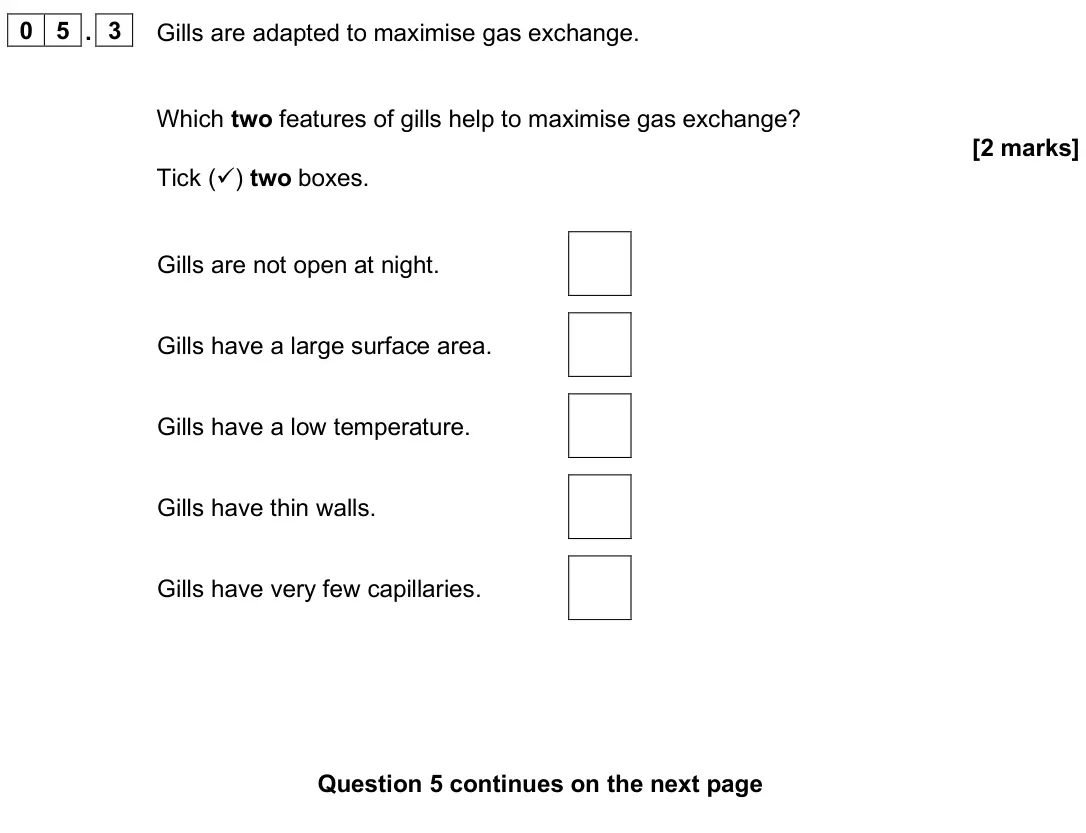
Q08.1
The whole paper ↗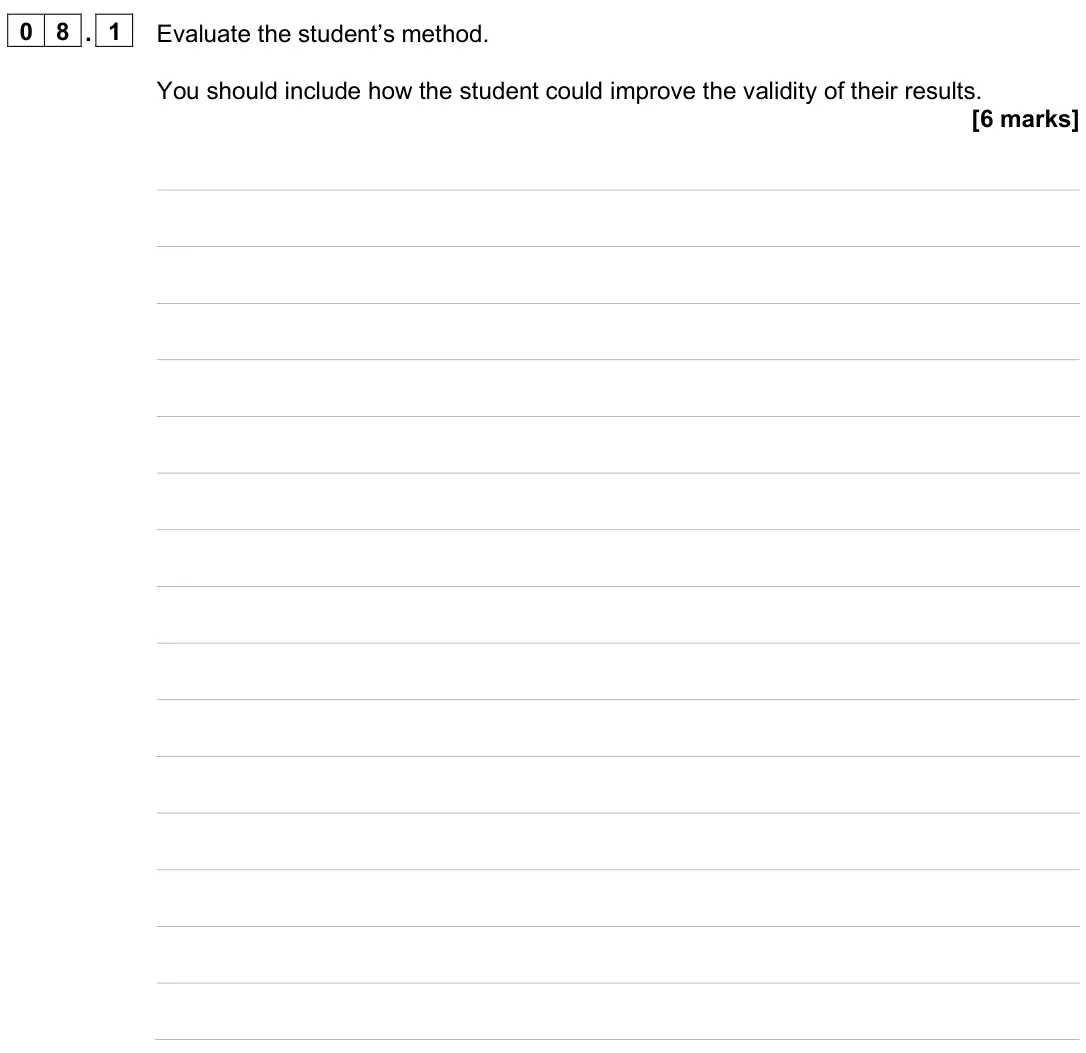
Q08.2
The whole paper ↗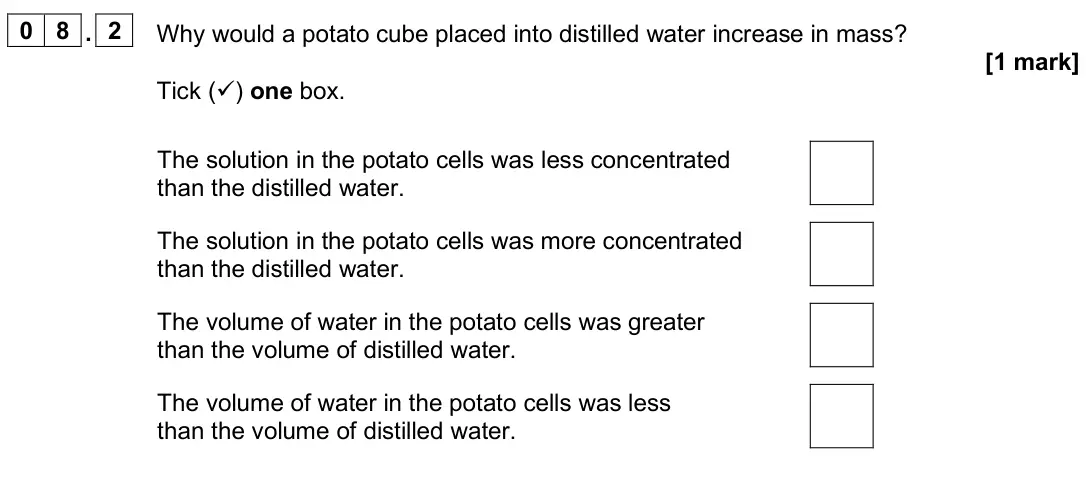
Q08.3
The whole paper ↗
Q02.4
The whole paper ↗
Q04.5
The whole paper ↗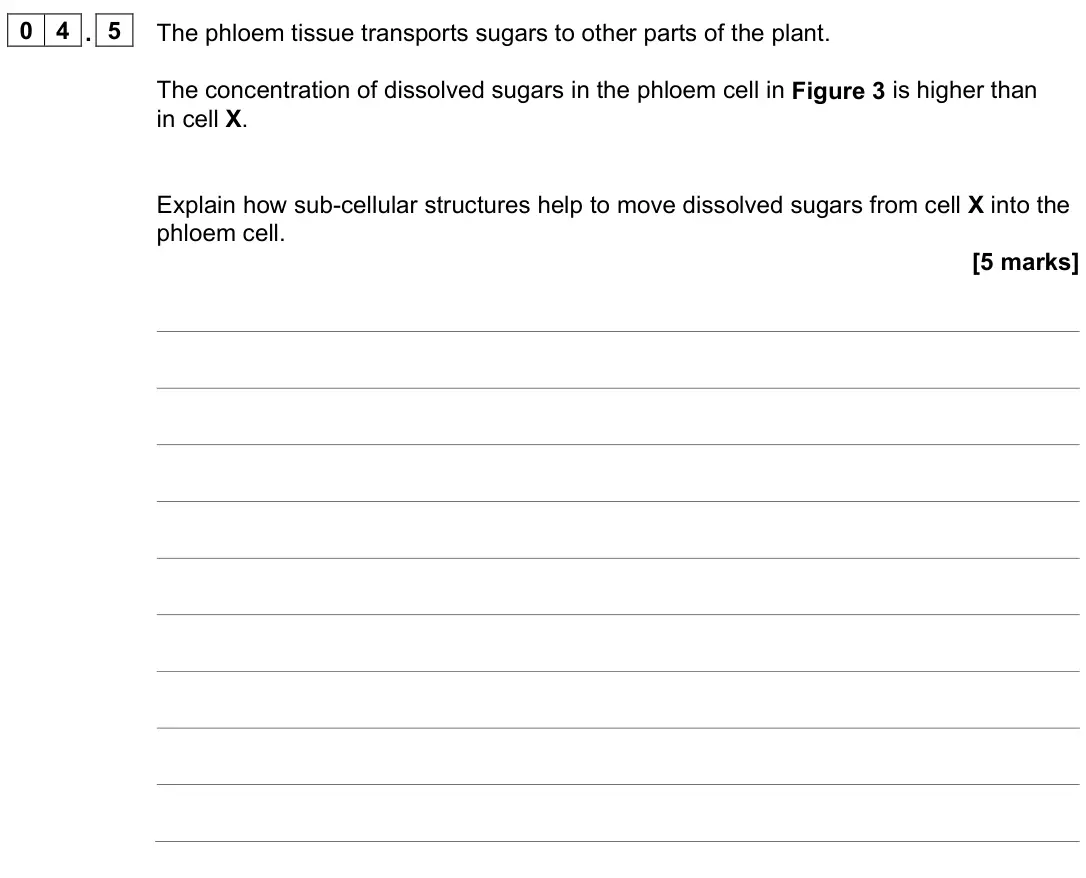
Q05.1
The whole paper ↗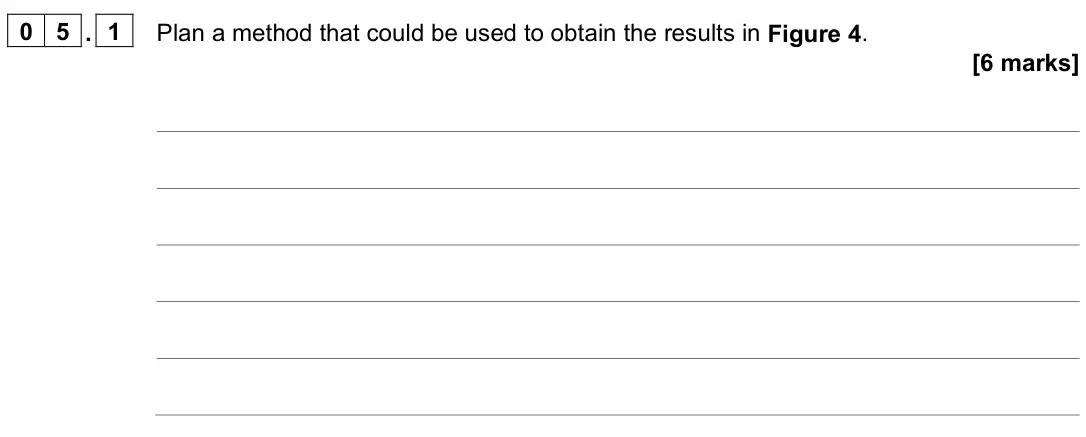
Q05.2
The whole paper ↗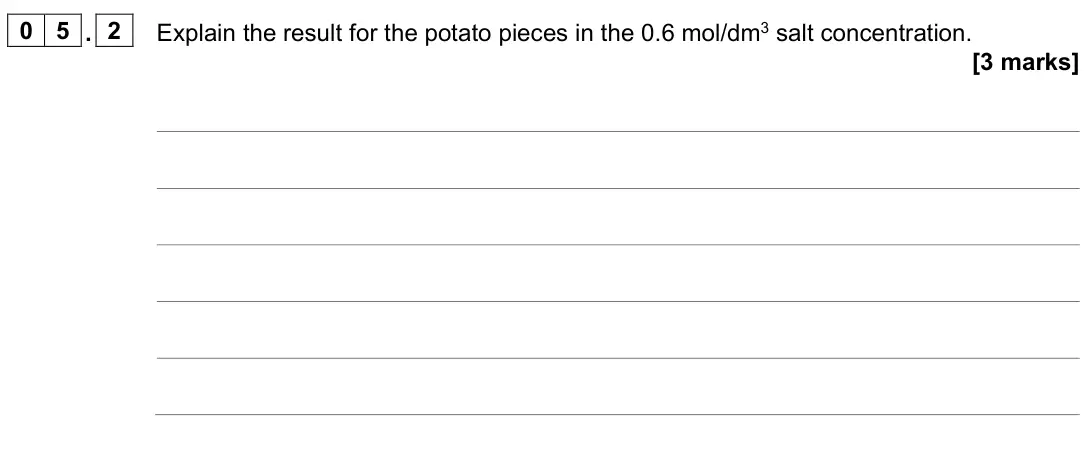
Q05.3
The whole paper ↗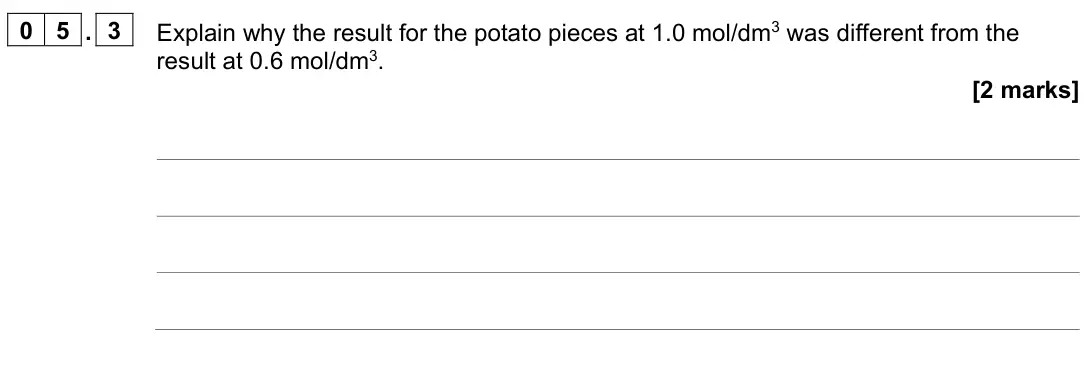
All 96 questions on Transport in cells, as a list
- June 2025, Paper 1 Higher, Q03.1 (6 marks): Evaluate the student’s method. You should include how the student could improve the validity of their results. [6 marks]
- June 2025, Paper 1 Higher, Q03.2 (1 mark): Why would a potato cube placed into distilled water increase in mass? [1 mark] Tick () one box. The solution in the potato cells was less concentrated than the
- June 2025, Paper 1 Higher, Q03.3 (1 mark): Active transport is another process used by potato cells. Give one way active transport is different from osmosis. [1 mark]
- June 2025, Paper 1 Higher, Q06.1 (1 mark): Define the term ‘diffusion’. [1 mark]
- June 2025, Paper 1 Higher, Q06.2 (4 marks): Fish exchange gases through gills. Oxygen from the water enters the blood of a fish through the gills. Figure 8 shows part of a gill. Figure 8 Explain how gills
- June 2025, Paper 1 Higher, Q07.1 (1 mark): What property of embryonic stem cells makes them suitable to treat liver disease? [1 mark]
- June 2025, Paper 1 Higher, Q07.2 (1 mark): Suggest one ethical reason why a person may not want an injection of embryonic stem cells. [1 mark] DO NOT WRITE ON THIS PAGE ANSWER IN THE SPACES PROVIDED
- June 2025, Paper 1 Foundation, Q01.4 (1 mark): Root hair cells are found in plants. Which substance do root hair cells absorb from the soil? [1 mark] Tick () one box. Glucose Protein Water
- June 2025, Paper 1 Foundation, Q01.7 (2 marks): The cell membrane controls which substances move into and out of cells. Which two processes move substances into and out of cells? [2 marks] Tick () two boxes.
- June 2025, Paper 1 Foundation, Q01.8 (3 marks): Table 1 shows substances that are exchanged between the blood and muscle cells. Complete Table 1 to show the direction of movement of each substance. [3 marks]
- June 2025, Paper 1 Foundation, Q05.2 (1 mark): Name the organs where gas exchange takes place in humans. [1 mark]
- June 2025, Paper 1 Foundation, Q05.3 (2 marks): Gills are adapted to maximise gas exchange. Which two features of gills help to maximise gas exchange? [2 marks] Tick () two boxes. Gills are not open at night
- June 2025, Paper 1 Foundation, Q08.1 (6 marks): Evaluate the student’s method. You should include how the student could improve the validity of their results. [6 marks]
- June 2025, Paper 1 Foundation, Q08.2 (1 mark): Why would a potato cube placed into distilled water increase in mass? [1 mark] Tick () one box. The solution in the potato cells was less concentrated than the
- June 2025, Paper 1 Foundation, Q08.3 (1 mark): Active transport is another process used by potato cells. Give one way active transport is different from osmosis. [1 mark]
- June 2024, Paper 1 Higher, Q02.4 (3 marks): Gas exchange happens in the alveoli in the lungs. Describe three features of the alveoli that help maximise gas exchange. [3 marks] 1 2 3
- June 2024, Paper 1 Higher, Q04.5 (5 marks): The phloem tissue transports sugars to other parts of the plant. The concentration of dissolved sugars in the phloem cell in Figure 3 is higher than in cell X.
- June 2024, Paper 1 Higher, Q05.1 (6 marks): Plan a method that could be used to obtain the results in Figure 4. [6 marks]
- June 2024, Paper 1 Higher, Q05.2 (3 marks): Explain the result for the potato pieces in the 0.6 mol/dm3 salt concentration. [3 marks]
- June 2024, Paper 1 Higher, Q05.3 (2 marks): Explain why the result for the potato pieces at 1.0 mol/dm3 was different from the result at 0.6 mol/dm3. [2 marks]
- June 2024, Paper 1 Foundation, Q01.8 (1 mark): Which process moves sugars against the concentration gradient? [1 mark] Tick () one box. Active transport Diffusion Osmosis
- June 2024, Paper 1 Foundation, Q01.9 (1 mark): Which cell structures are needed to provide energy to move sugars? [1 mark] Tick () one box. Chloroplasts Chromosomes Mitochondria
- June 2024, Paper 1 Foundation, Q06.1 (2 marks): Give two control variables the student used in the investigation. [2 marks] 1 2
- June 2024, Paper 1 Foundation, Q06.2 (1 mark): The student needed to be sure the measurements were as accurate as possible. What should be done to each piece of potato after removing from the solution and be
- June 2024, Paper 1 Foundation, Q06.3 (1 mark): Name the piece of apparatus the student could use to measure the mass of the pieces of potato. [1 mark] Table 4 shows the results. Table 4 Piece of potato Conce
- June 2024, Paper 1 Foundation, Q06.4 (1 mark): What was the resolution of the apparatus used for measuring mass? Use Table 4. [1 mark] Tick () one box. 0.01 g 0.1 g 1.0 g 1.1 g
- June 2024, Paper 1 Foundation, Q06.5 (1 mark): Which piece of potato had the greatest change in mass in the investigation? [1 mark] Tick () one box. A B C D
- June 2024, Paper 1 Foundation, Q06.6 (3 marks): Calculate value X in Table 4. Use the equation: percentage change in mass = change in mass in grams mass at start in grams × 100 Give your answer to 1 decimal p
- June 2024, Paper 1 Foundation, Q06.7 (1 mark): What is the best way to present the data in Table 4? [1 mark] Tick () one box. Bar chart Line graph Pie chart
- June 2024, Paper 1 Foundation, Q06.8 (3 marks): Complete the sentences. [3 marks] Some of the pieces of potato decreased in mass because the potato cells lost . The decrease in mass was due to a process calle
- June 2024, Paper 1 Foundation, Q06.9 (1 mark): Table 4 is repeated below. Table 4 Piece of potato Concentration of salt solution in mol/dm3 Mass of piece of potato in grams Percentage (%) change in mass of p
- June 2024, Paper 1 Foundation, Q08.4 (3 marks): Gas exchange happens in the alveoli in the lungs. Describe three features of the alveoli that help maximise gas exchange. [3 marks] 1 2 3
- June 2023, Paper 1 Higher, Q03.9 (3 marks): Antibiotics treat food poisoning because they kill Salmonella bacteria inside the human body. Some antibiotics work because they damage the bacterial cell wall.
- June 2023, Paper 1 Foundation, Q01.3 (1 mark): Draw a ring around the anomalous result in Table 1. [1 mark]
- June 2023, Paper 1 Foundation, Q01.4 (1 mark): What did the students do with the anomalous result when calculating the mean in Table 1? [1 mark]
- June 2023, Paper 1 Foundation, Q01.5 (1 mark): What name is given to a variable that is kept the same during an investigation? [1 mark] Tick () one box. Control variable Dependent variable Independent varia
- June 2023, Paper 1 Foundation, Q01.6 (1 mark): One variable the students kept the same during the investigation was the size of the pieces of potato. Which other variable did the students keep the same? [1 m
- June 2023, Paper 1 Foundation, Q01.7 (1 mark): The pieces of potato in the concentrated salt solution decreased in mass. Complete the sentence. Choose the answer from the box. [1 mark] excretion osmosis resp
- June 2023, Paper 1 Foundation, Q01.8 (1 mark): The potato cells have a partially permeable membrane. Which particles can pass through a partially permeable membrane? [1 mark] Tick () one box. No particles S
- June 2023, Paper 1 Foundation, Q01.9 (1 mark): How could the students improve their investigation? [1 mark] Tick () one box. Boil the pieces of potato at the start. Leave the skin on some pieces of potato.
- June 2022, Paper 1 Higher, Q01.4 (1 mark): What is the independent variable in the investigation? [1 mark] Tick () one box. Concentration of salt solution Mass of potato piece Time potato is left in sal
- June 2022, Paper 1 Higher, Q01.5 (1 mark): Why did the student dry the surface of each potato piece with a paper towel in step 5? [1 mark]
- June 2022, Paper 1 Higher, Q01.6 (2 marks): For one potato piece: • the starting mass was 2.5 g • the end mass was 2.7 g. Calculate the percentage increase in mass of the potato piece. [2 marks] Use the e
- June 2022, Paper 1 Higher, Q01.7 (4 marks): Complete Figure 1. You should: • label the x-axis • use a suitable scale for the x-axis • plot the data from Table 2 • draw a line of best fit. [4 marks] Figure
- June 2022, Paper 1 Higher, Q01.8 (1 mark): What concentration of salt solution was equal to the concentration of the solution inside the potato pieces? Use Figure 1. [1 mark] Concentration = mol/dm3
- June 2022, Paper 1 Higher, Q01.9 (3 marks): Explain why the potato pieces in the 0.4 mol/dm3 salt solution decreased in mass. [3 marks]
- June 2022, Paper 1 Higher, Q06.1 (3 marks): Calculate value X in Table 6. Give your answer to the nearest whole number. [3 marks] X (nearest whole number) =
- June 2022, Paper 1 Higher, Q06.2 (1 mark): What is the relationship between the size of an organism and its surface area to volume ratio? Use Table 6. [1 mark]
- June 2022, Paper 1 Higher, Q06.3 (2 marks): Organism B exchanges gases with the environment directly through its skin. Organism D exchanges gases with the environment using its respiratory system. Explain
- June 2022, Paper 1 Higher, Q06.4 (4 marks): Organisms D and E both keep a constant body temperature (warm-blooded). Explain why the metabolic rate of organism D is greater than the metabolic rate of organ
- June 2022, Paper 1 Higher, Q06.5 (4 marks): Organism D and organism E both have alveoli in the lungs and villi in the small intestine. Figure 8 shows some alveoli and some villi. Figure 8 Describe how the
- June 2022, Paper 1 Foundation, Q06.1 (2 marks): Calculate value X in Table 4. [2 marks] X =
- June 2022, Paper 1 Foundation, Q06.2 (1 mark): Describe the relationship between the size of a jellyfish and its surface area to volume ratio. Use Table 4. [1 mark]
- June 2022, Paper 1 Foundation, Q06.3 (1 mark): Name one other substance that enters cells by diffusion. Do not refer to oxygen in your answer. [1 mark]
- June 2022, Paper 1 Foundation, Q06.4 (2 marks): Suggest two factors that affect the rate of diffusion of oxygen into a jellyfish. [2 marks] 1 2
- June 2022, Paper 1 Foundation, Q06.5 (1 mark): Some organisms take in oxygen using a respiratory system. In humans, gas exchange takes place in the lungs. Name the organs where gas exchange takes place in fi
- June 2022, Paper 1 Foundation, Q06.6 (6 marks): Figure 8 shows parts of the human breathing system. Figure 8 Explain how the human breathing system is adapted to maximise the rate of gas exchange. [6 marks]
- June 2022, Paper 1 Foundation, Q07.4 (1 mark): What is the independent variable in the investigation? [1 mark] Tick () one box. Concentration of salt solution Mass of potato piece Time potato is left in sal
- June 2022, Paper 1 Foundation, Q07.5 (1 mark): Why did the student dry the surface of each potato piece with a paper towel in step 5? [1 mark]
- June 2022, Paper 1 Foundation, Q07.6 (2 marks): For one potato piece: • the starting mass was 2.5 g • the end mass was 2.7 g. Calculate the percentage increase in mass of the potato piece. [2 marks] Use the e
- June 2022, Paper 1 Foundation, Q07.7 (4 marks): Complete Figure 9. You should: • label the x-axis • use a suitable scale for the x-axis • plot the data from Table 6 • draw a line of best fit. [4 marks] Figure
- June 2022, Paper 1 Foundation, Q07.8 (1 mark): What concentration of salt solution was equal to the concentration of the solution inside the potato pieces? Use Figure 9. [1 mark] Concentration = mol/dm3
- June 2022, Paper 1 Foundation, Q07.9 (3 marks): Explain why the potato pieces in the 0.4 mol/dm3 salt solution decreased in mass. [3 marks]
- June 2022, Paper 2 Higher, Q05.4 (3 marks): Explain why the blood of a person with MSUD will have a high concentration of toxic substance P. Use information from Figure 5. [3 marks]
- June 2022, Paper 2 Foundation, Q06.5 (1 mark): Most mammals use a lot of energy to evaporate sweat. The echidna does not sweat. Suggest one use of energy in the echidna’s body. [1 mark]
- November 2021, Paper 1 Higher, Q01.6 (2 marks): When placed into a beaker of water: • a red blood cell bursts • a plant cell does not burst. Explain why the red blood cell bursts but the plant cell does not b
- November 2021, Paper 1 Foundation, Q01.1 (1 mark): Which diagram shows oxygen moving by diffusion? [1 mark] Tick () one box.
- November 2021, Paper 1 Foundation, Q01.2 (3 marks): Complete the sentences. [3 marks] Choose answers from the box. carbon dioxide chlorophyll energy light mineral ions water Plant cells absorb substances from the
- November 2021, Paper 1 Foundation, Q07.6 (2 marks): When placed into a beaker of water: • a red blood cell bursts • a plant cell does not burst. Explain why the red blood cell bursts but the plant cell does not b
- November 2020, Paper 1 Higher, Q02.1 (2 marks): What is meant by the term diffusion? [2 marks]
- November 2020, Paper 1 Higher, Q02.2 (2 marks): Figure 2 shows part of a leaf. Figure 2 Molecules of carbon dioxide diffuse from the air into the mesophyll cells. Which two changes will increase the rate at w
- November 2020, Paper 1 Higher, Q02.3 (6 marks): Diffusion also happens in the human lungs. Figure 3 shows the human breathing system. Figure 3 Explain how the human lungs are adapted for efficient exchange of
- November 2020, Paper 1 Higher, Q02.4 (1 mark): Name the process by which water molecules enter the root hair cell. [1 mark]
- November 2020, Paper 1 Higher, Q05.6 (2 marks): Explain how the nodules benefit the gorse plant. [2 marks]
- November 2020, Paper 1 Foundation, Q01.4 (3 marks): Cells contain sub-cellular structures. Draw one line from each structure to its function. [3 marks] Structure Function Cell membrane Mitochondria Ribosomes Cont
- November 2020, Paper 1 Foundation, Q05.6 (2 marks): The roots of the gorse plant have bacteria that turn nitrogen gas into nitrate ions. Explain why nitrate ions are needed by the gorse plant. [2 marks]
- November 2020, Paper 1 Foundation, Q08.1 (2 marks): What is meant by the term diffusion? [2 marks]
- November 2020, Paper 1 Foundation, Q08.2 (2 marks): Figure 11 shows part of a leaf. Figure 11 Molecules of carbon dioxide diffuse from the air into the mesophyll cells. Which two changes will increase the rate at
- November 2020, Paper 1 Foundation, Q08.3 (6 marks): Diffusion also happens in the human lungs. Figure 12 shows the human breathing system. Figure 12 Explain how the human lungs are adapted for efficient exchange
- November 2020, Paper 1 Foundation, Q08.4 (1 mark): Name the process by which water molecules enter the root hair cell. [1 mark]
- June 2018, Paper 1 Higher, Q04.1 (1 mark): Another student suggested that the result for egg 4 was anomalous. Do you agree with the student? Give a reason for your answer. [1 mark]
- June 2018, Paper 1 Higher, Q04.2 (2 marks): Calculate the percentage change in mass of egg 3. [2 marks] Percentage change in mass =
- June 2018, Paper 1 Higher, Q04.3 (3 marks): Explain why the masses of the eggs increased. [3 marks]
- June 2018, Paper 1 Higher, Q04.4 (3 marks): Explain how the student could modify the investigation to determine the concentration of the solution inside each egg. [3 marks]
- June 2018, Paper 1 Higher, Q04.5 (3 marks): Explain how calcium ions are moved from the shell into the cytoplasm of the egg. [3 marks]
- Specimen, Paper 1 Higher, Q01.1 (1 mark): Plants move mineral ions: • from a low concentration in the soil • to a high concentration in the root cells. What process do plants use to move these minerals
- Specimen, Paper 1 Higher, Q04.1 (2 marks): Respiration transfers energy from glucose for muscle contraction. Describe how glucose from the small intestine is moved to a muscle cell. [2 marks
- Specimen, Paper 1 Higher, Q05.1: Calculate the value of X in Table 2. [2 mar Percentage change in mass =
- Specimen, Paper 1 Higher, Q05.2 (1 mark): Why did the student calculate the percentage change in mass as well as the change in grams? [1 mark
- Specimen, Paper 1 Higher, Q05.3 (4 marks): Complete Figure 3 using data from Table 2. • Choose a suitable scale and label for the x-axis. • Plot the percentage (%) change in mass. • Draw a line of best f
- Specimen, Paper 1 Higher, Q05.4: Use your graph in Figure 3 to estimate the concentration of the solution inside the potato cells. [1 ma Concentration = mol d
- Specimen, Paper 1 Higher, Q05.5: The results in Table 2 show the percentage change in mass of the potato cylinders. Explain why the percentage change results are positive and negative. [3 mar
- Specimen, Paper 1 Higher, Q05.6: Suggest two possible sources of error in the method given on page 16. [2 mar 1 2 9
- Specimen, Paper 1 Higher, Q10: Explain how the human circulatory system is adapted to: • supply oxygen to the tissues • remove waste products from tissues. [6 mar 33 3
- Specimen, Paper 1 Foundation, Q07.5 (3 marks): Explain why the concentration of glucose in the small intestine changes between 300 cm and 700 cm. [3 marks 30
- Specimen, Paper 1 Foundation, Q09.1 (1 mark): Plants move mineral ions: • from a low concentration in the soil • to a high concentration in the root cells. What process do plants use to move these minerals
Questions, mark schemes and examiner’s reports are © AQA, from their published past papers. Plumi isn’t affiliated with any exam board. Want whole papers? Every AQA GCSE Biology paper.
Rather write your answers by hand on iPad? Plumi marks them against the same mark schemes.