 plumi
Photosynthesis: AQA GCSE Biology questions
Every AQA GCSE Biology exam question on 4.4.1 Photosynthesis, 2018–2025, with its mark scheme and examiner’s report.
Find questions1,505
Calculations
Q04.1
The whole paper ↗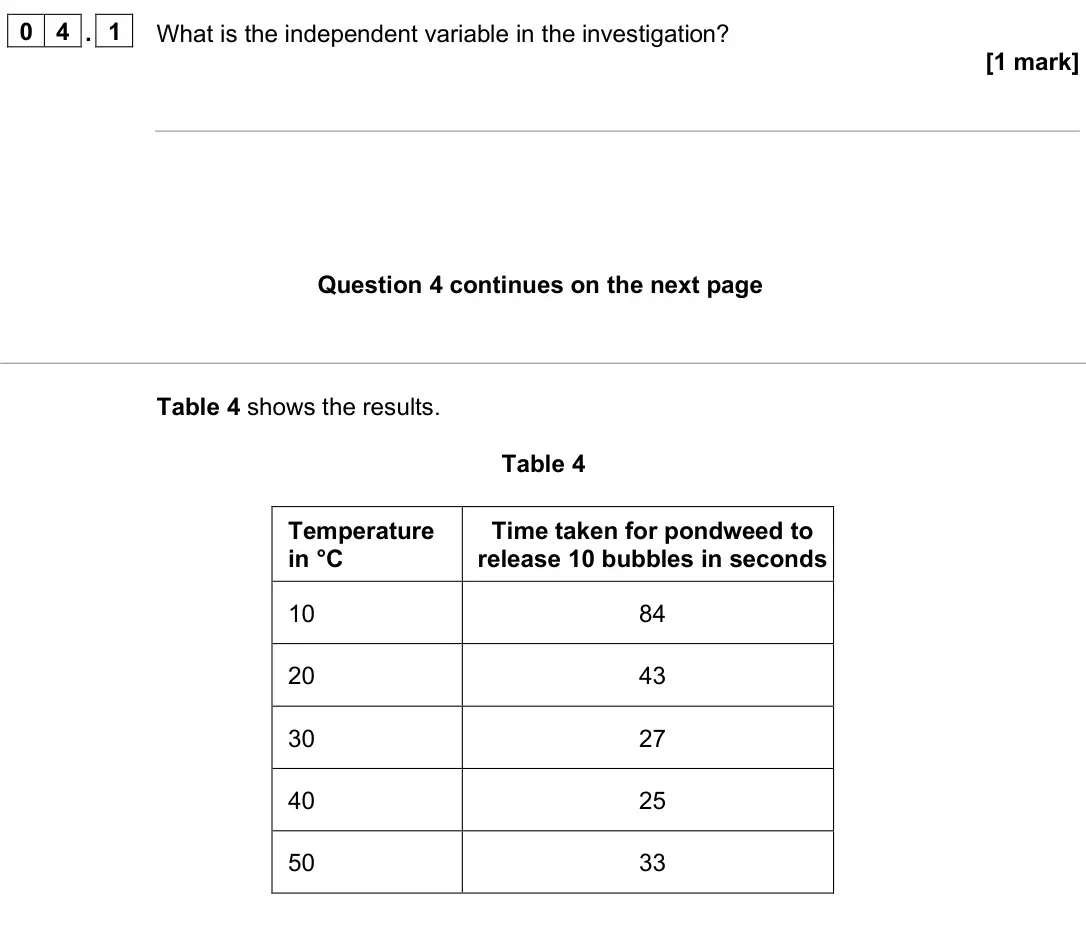
Q04.2
The whole paper ↗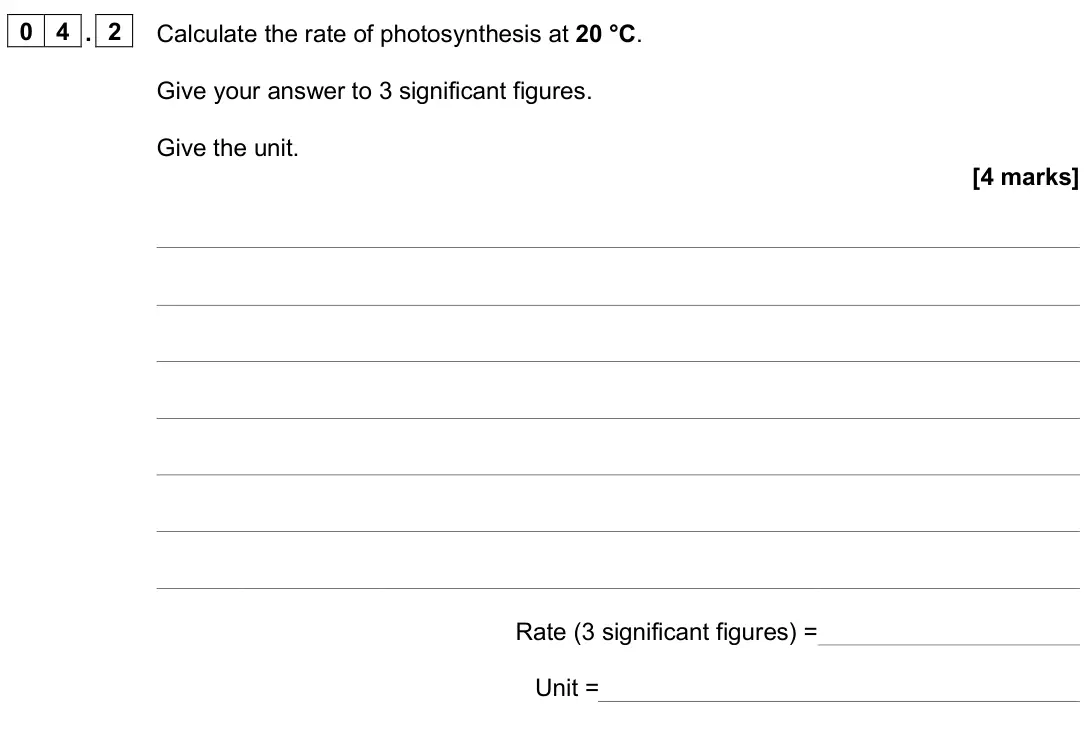
Q04.3
The whole paper ↗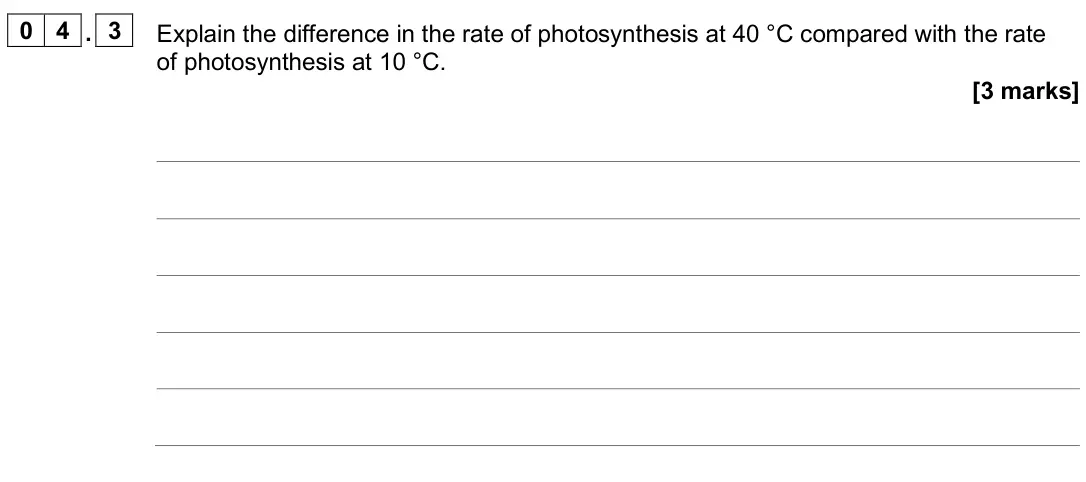
Q04.4
The whole paper ↗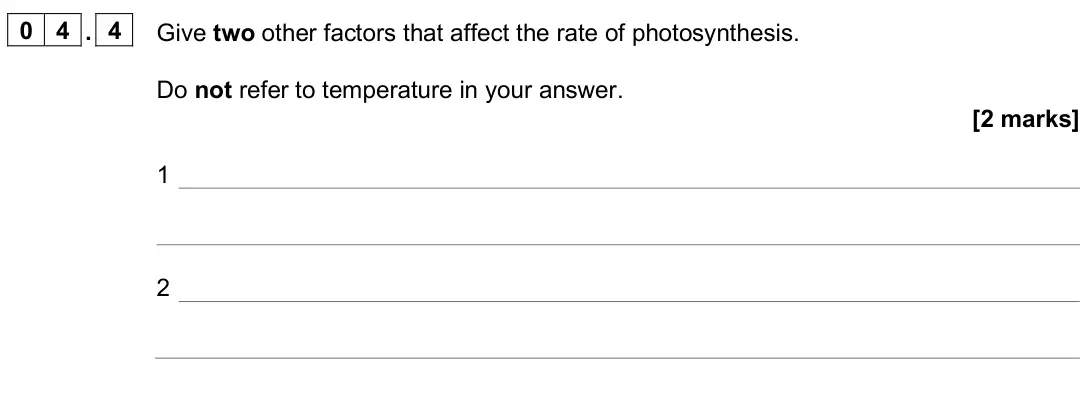
Q04.5
The whole paper ↗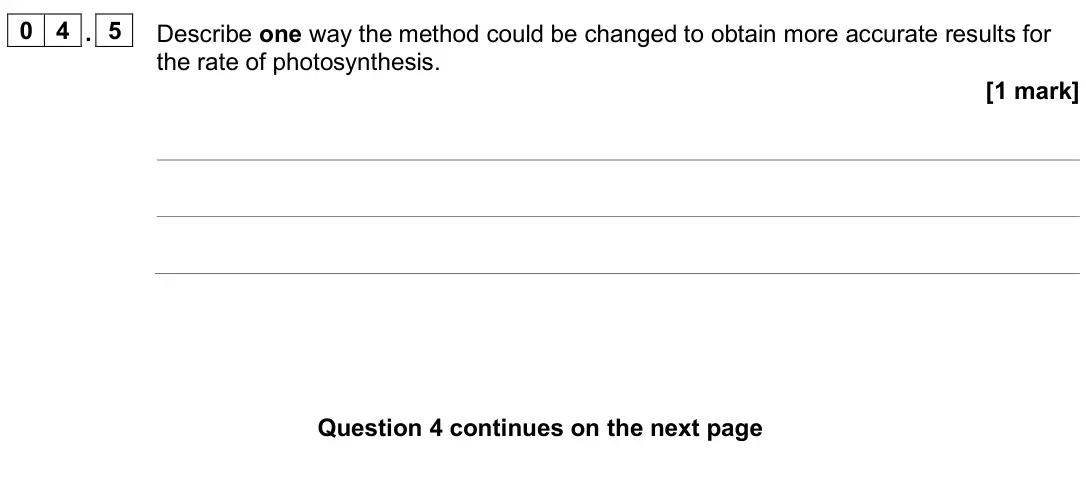
Q02.1
The whole paper ↗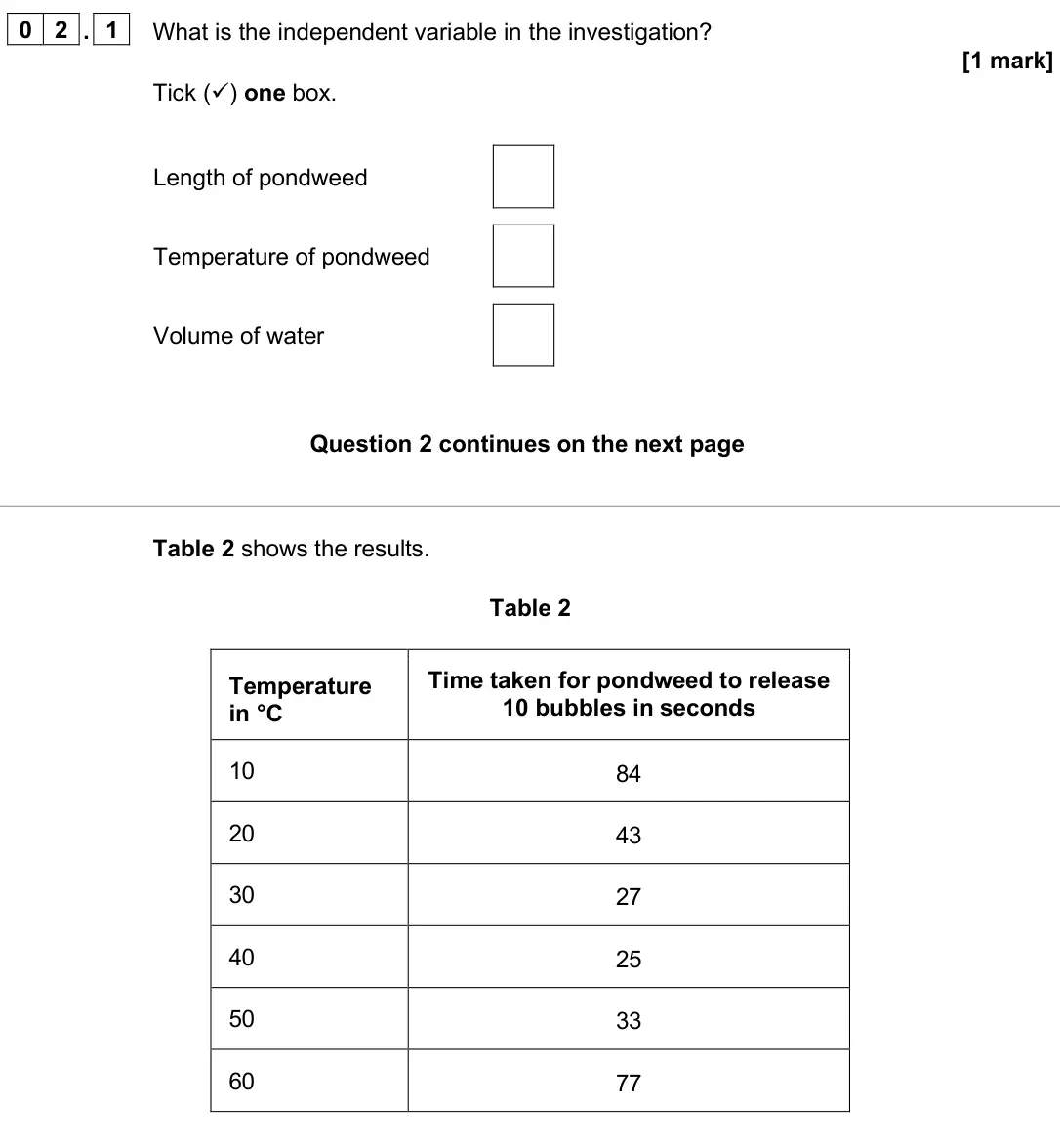
Q02.2
The whole paper ↗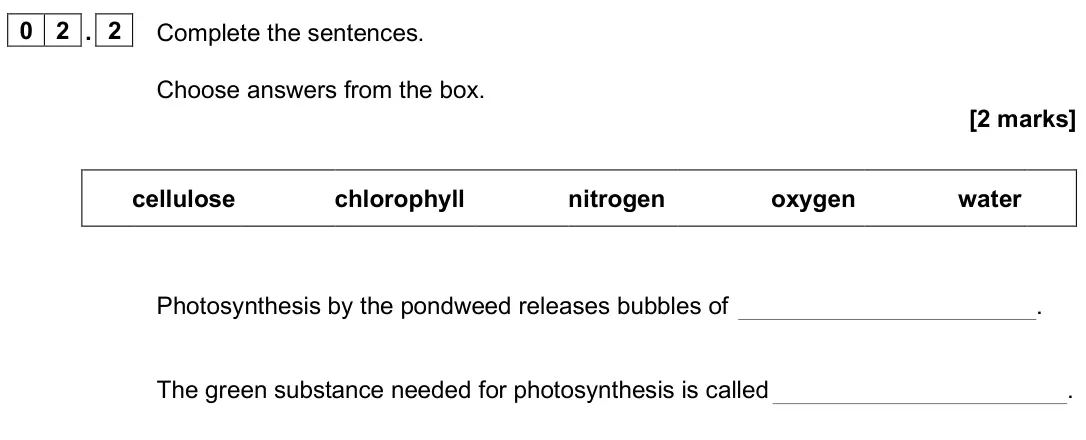
Q02.3
The whole paper ↗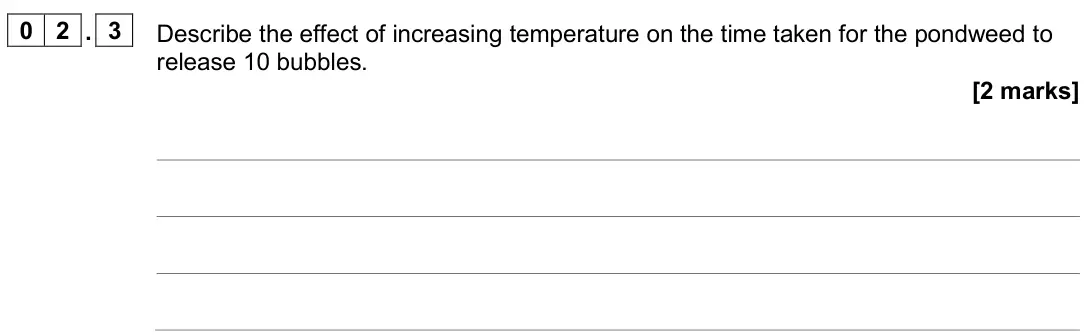
Q02.5
The whole paper ↗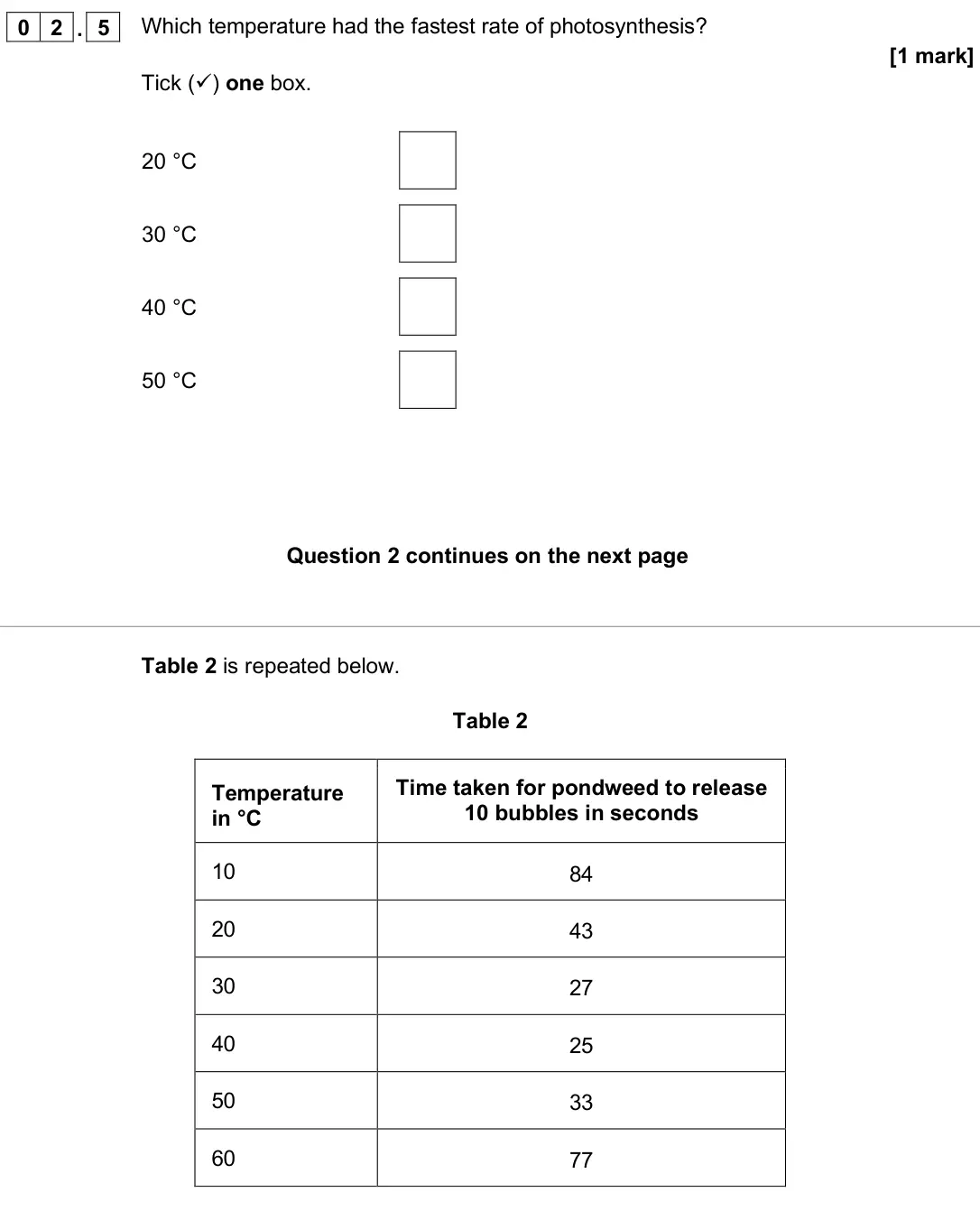
Q02.6
The whole paper ↗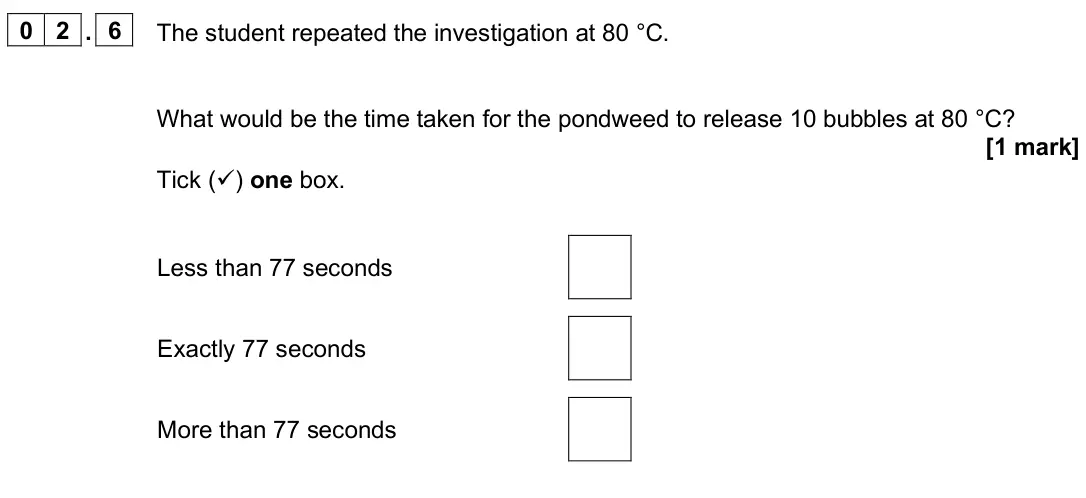
Q02.7
The whole paper ↗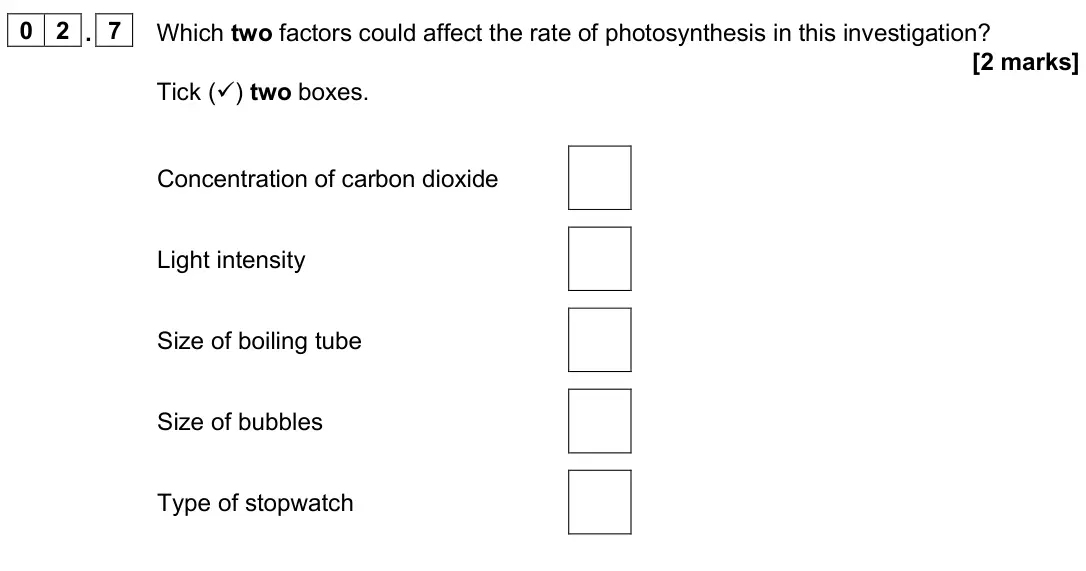
Q03.5
The whole paper ↗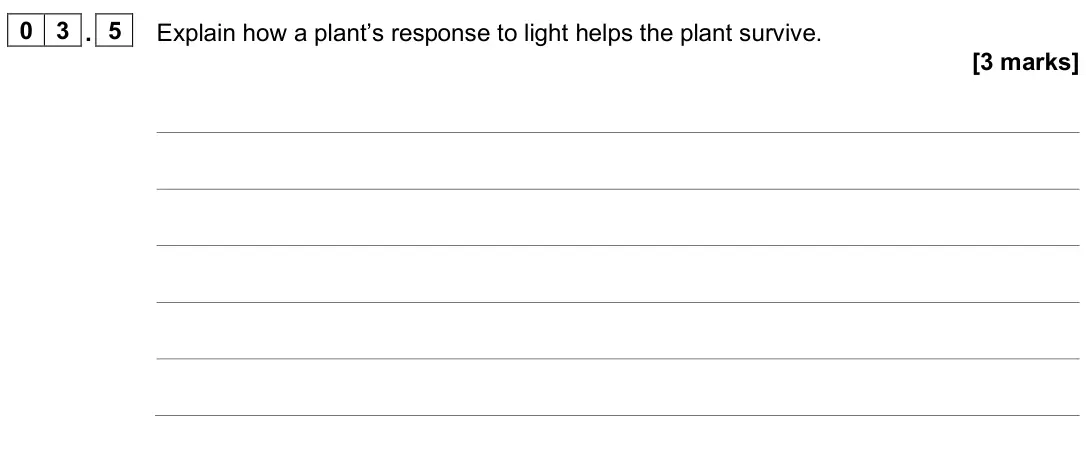
Q03.6
The whole paper ↗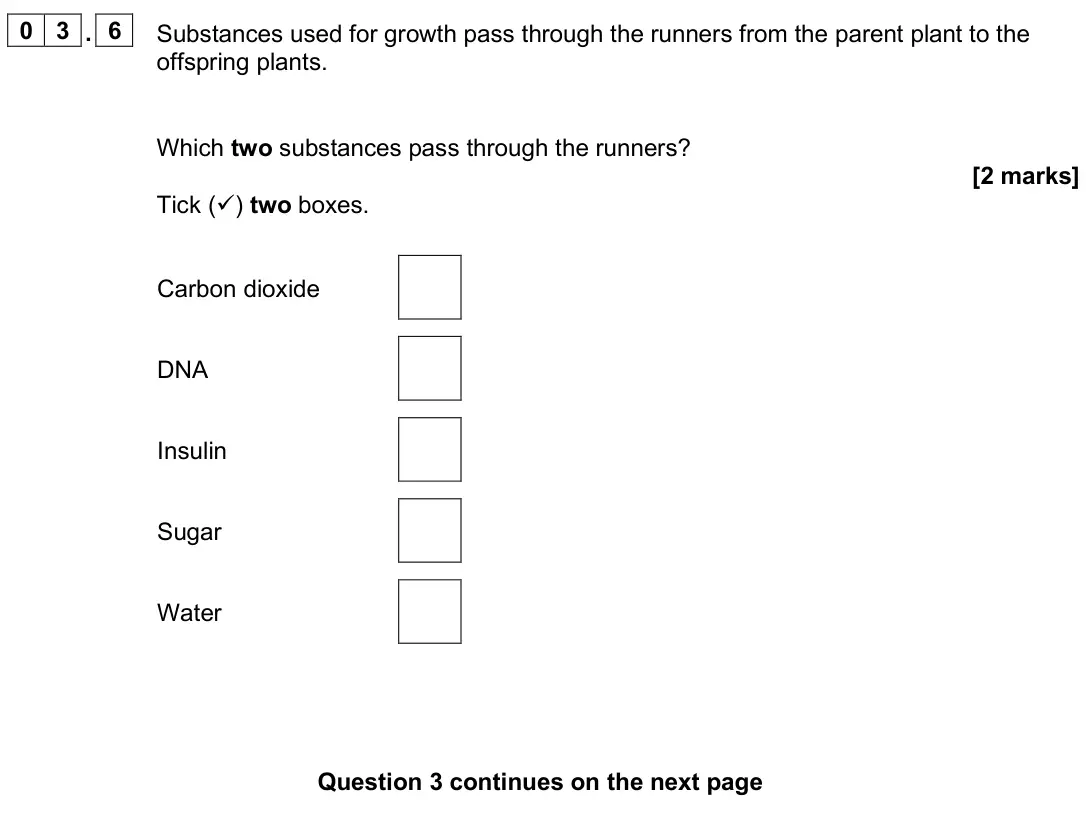
Q10.5
The whole paper ↗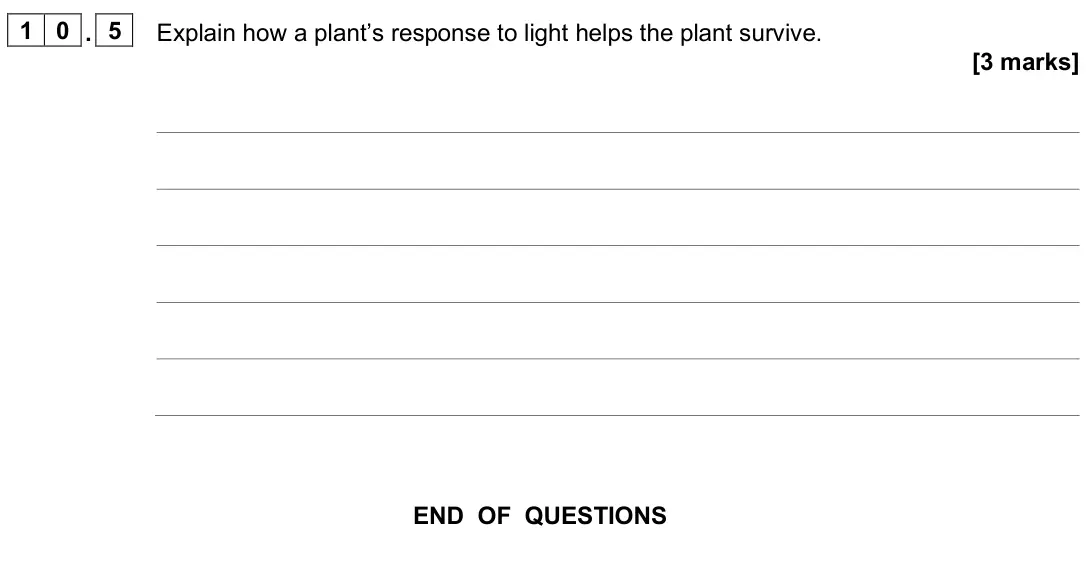
Q07.1
The whole paper ↗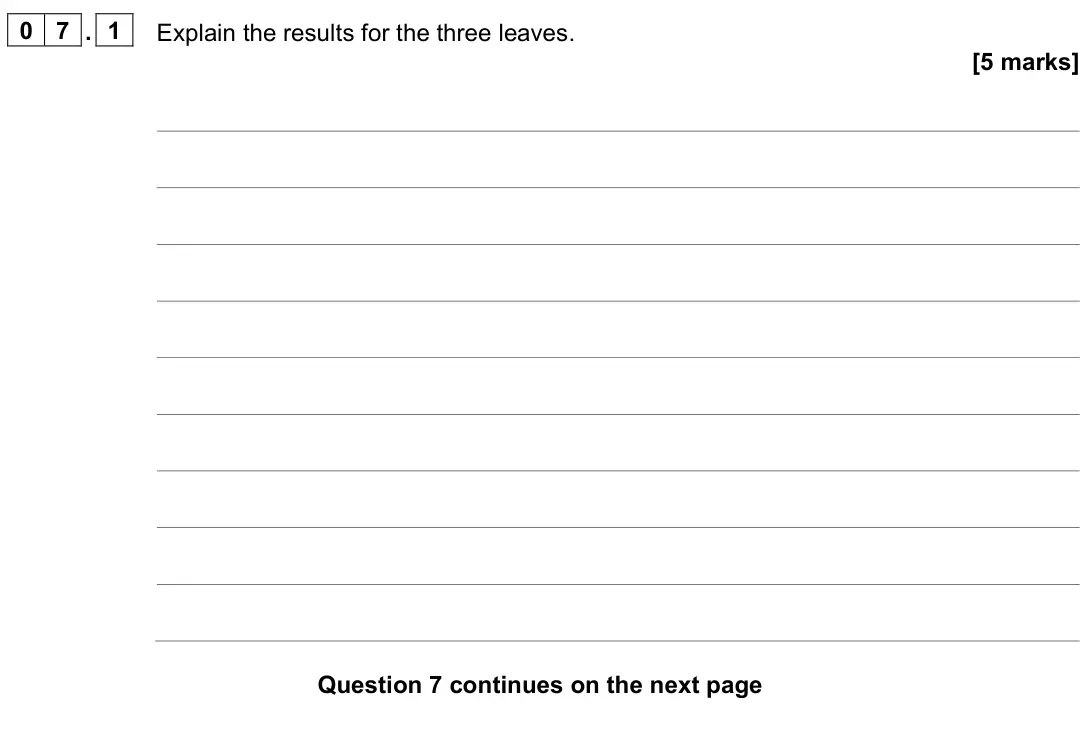
Q07.2
The whole paper ↗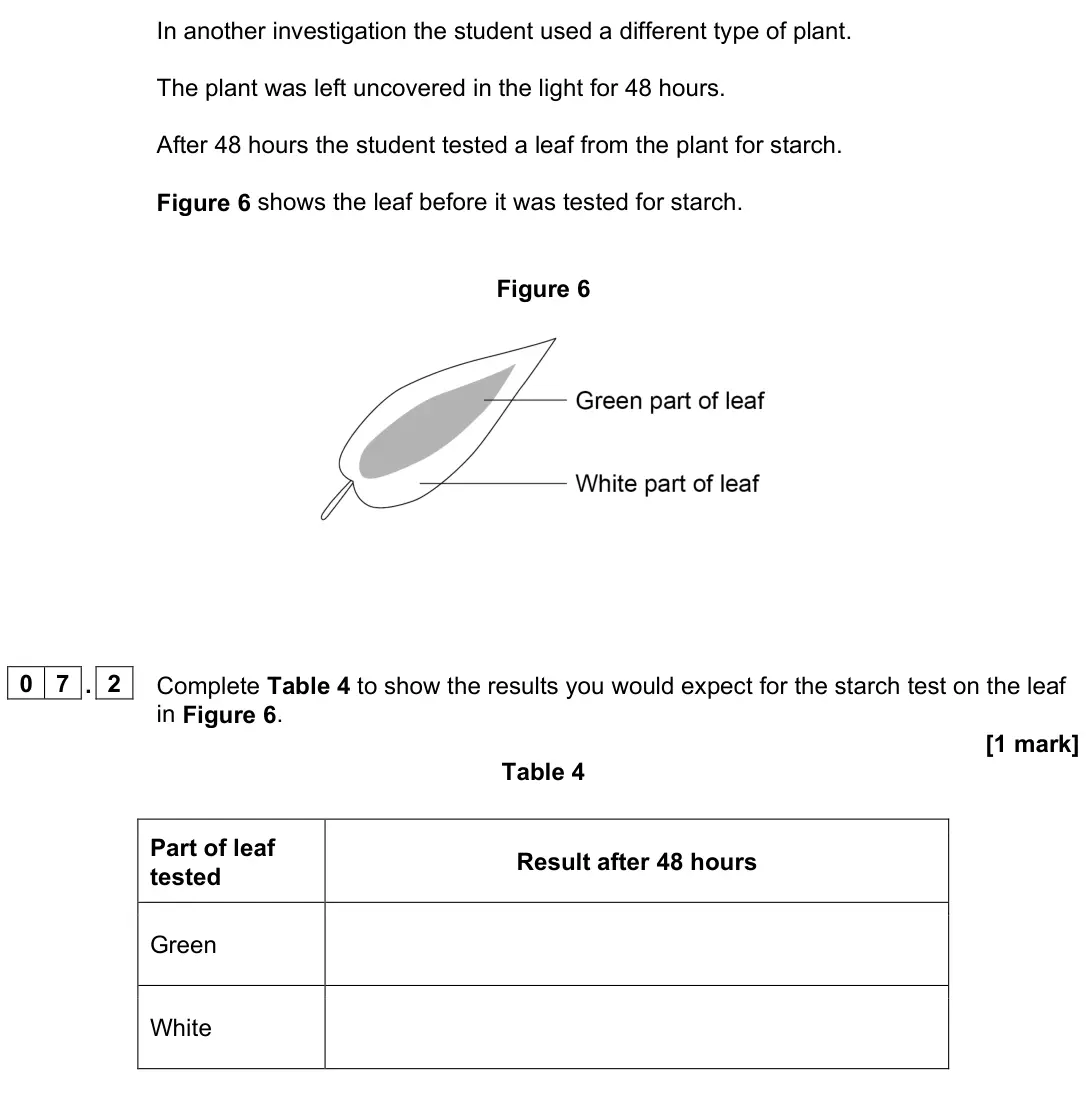
Q07.3
The whole paper ↗
Q07.6
The whole paper ↗
Q07.7
The whole paper ↗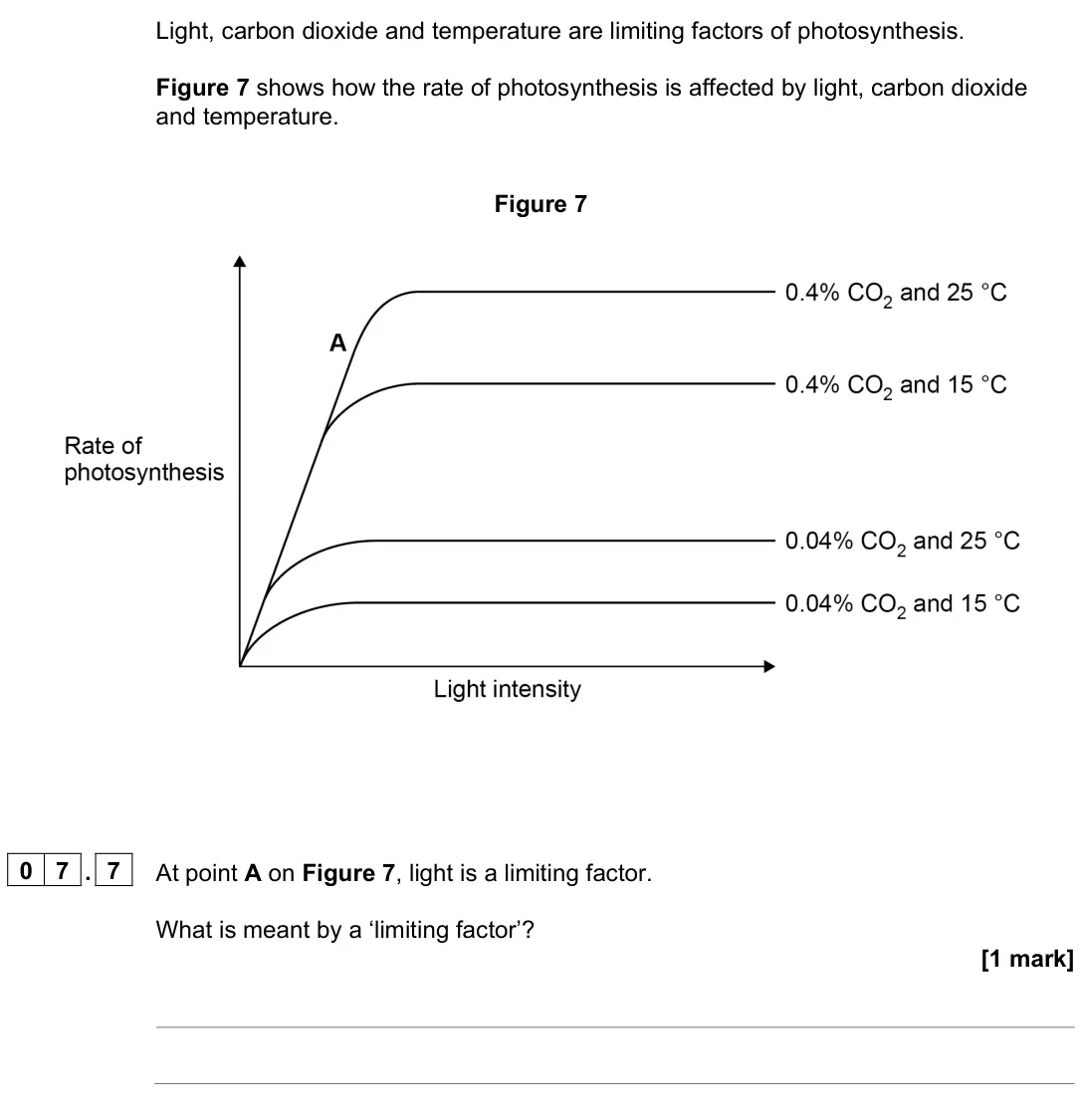
All 97 questions on Photosynthesis, as a list
- June 2025, Paper 1 Higher, Q04.1 (1 mark): What is the independent variable in the investigation? [1 mark] Table 4 shows the results. Table 4 Temperature in °C Time taken for pondweed to release 10 bubbl
- June 2025, Paper 1 Higher, Q04.2 (4 marks): Calculate the rate of photosynthesis at 20 °C. Give your answer to 3 significant figures. Give the unit. [4 marks] Rate (3 significant figures) = Unit =
- June 2025, Paper 1 Higher, Q04.3 (3 marks): Explain the difference in the rate of photosynthesis at 40 °C compared with the rate of photosynthesis at 10 °C. [3 marks]
- June 2025, Paper 1 Higher, Q04.4 (2 marks): Give two other factors that affect the rate of photosynthesis. Do not refer to temperature in your answer. [2 marks] 1 2
- June 2025, Paper 1 Higher, Q04.5 (1 mark): Describe one way the method could be changed to obtain more accurate results for the rate of photosynthesis. [1 mark]
- June 2025, Paper 1 Foundation, Q02.1 (1 mark): What is the independent variable in the investigation? [1 mark] Tick () one box. Length of pondweed Temperature of pondweed Volume of water Table 2 shows the r
- June 2025, Paper 1 Foundation, Q02.2 (2 marks): Complete the sentences. Choose answers from the box. [2 marks] cellulose chlorophyll nitrogen oxygen water Photosynthesis by the pondweed releases bubbles of .
- June 2025, Paper 1 Foundation, Q02.3 (2 marks): Describe the effect of increasing temperature on the time taken for the pondweed to release 10 bubbles. [2 marks]
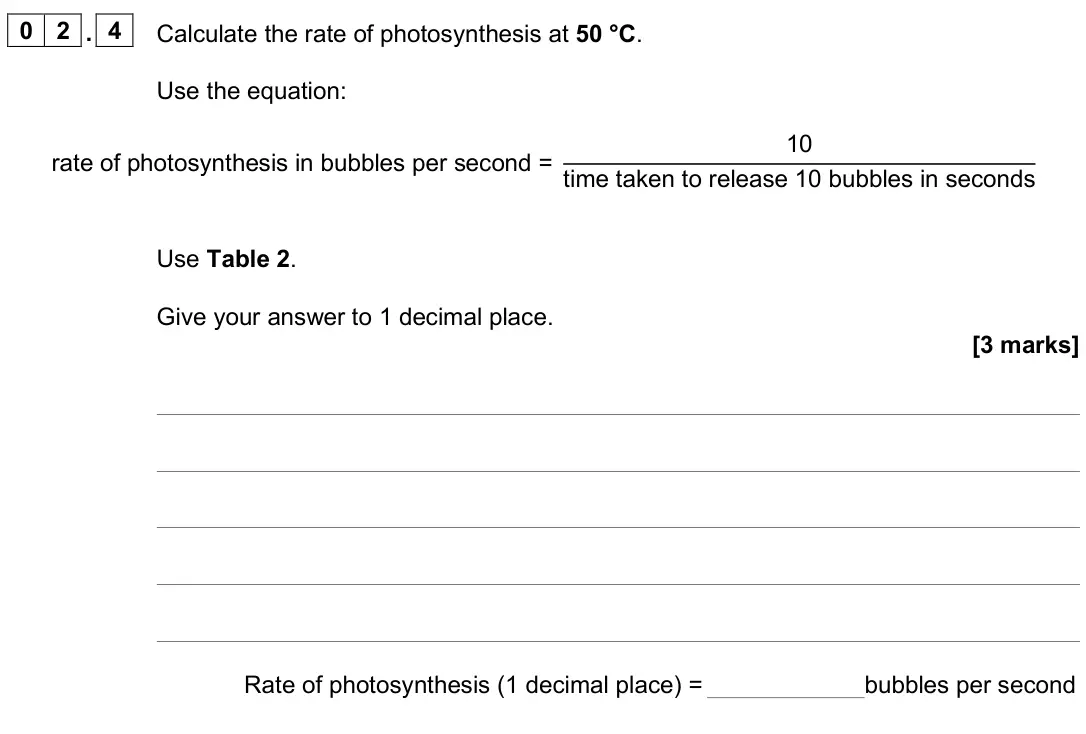
- June 2025, Paper 1 Foundation, Q02.4 (3 marks): Calculate the rate of photosynthesis at 50 °C. Use the equation: rate of photosynthesis in bubbles per second = 10 time taken to release 10 bubbles in seconds U
- June 2025, Paper 1 Foundation, Q02.5 (1 mark): Which temperature had the fastest rate of photosynthesis? [1 mark] Tick () one box. 20 °C 30 °C 40 °C 50 °C Table 2 is repeated below. Table 2 Temperature in °
- June 2025, Paper 1 Foundation, Q02.6 (1 mark): The student repeated the investigation at 80 °C. What would be the time taken for the pondweed to release 10 bubbles at 80 °C? [1 mark] Tick () one box. Less t
- June 2025, Paper 1 Foundation, Q02.7 (2 marks): Which two factors could affect the rate of photosynthesis in this investigation? [2 marks] Tick () two boxes. Concentration of carbon dioxide Light intensity S
- June 2025, Paper 2 Higher, Q03.5 (3 marks): Explain how a plant’s response to light helps the plant survive. [3 marks]
- June 2025, Paper 2 Foundation, Q03.6 (2 marks): Substances used for growth pass through the runners from the parent plant to the offspring plants. Which two substances pass through the runners? [2 marks] Tick
- June 2025, Paper 2 Foundation, Q10.5 (3 marks): Explain how a plant’s response to light helps the plant survive. [3 marks]
- June 2024, Paper 1 Higher, Q07.1 (5 marks): Explain the results for the three leaves. [5 marks]
- June 2024, Paper 1 Higher, Q07.2 (1 mark): Complete Table 4 to show the results you would expect for the starch test on the leaf in Figure 6. [1 mark] Table 4 Part of leaf tested Result after 48 hours Gr
- June 2024, Paper 1 Higher, Q07.3 (2 marks): Explain the results you gave in Question 07.2. [2 marks]
- June 2024, Paper 1 Higher, Q07.6 (1 mark): The rate of photosynthesis is affected by different factors. How could the oxygen produced during photosynthesis be used to measure the rate of photosynthesis?
- June 2024, Paper 1 Higher, Q07.7 (1 mark): At point A on Figure 7, light is a limiting factor. What is meant by a ‘limiting factor’? [1 mark]
- June 2024, Paper 1 Higher, Q07.8 (4 marks): Explain the effect of increasing temperature and increasing carbon dioxide concentration on the rate of photosynthesis shown in Figure 7. [4 marks]
- June 2024, Paper 1 Higher, Q07.9 (1 mark): Photosynthesis investigations often use a light source. The spreading out of light from a source obeys the inverse square law. The inverse square law links ligh
- June 2024, Paper 1 Foundation, Q01.5 (2 marks): The upper epidermis is transparent. Explain why the upper epidermis needs to be transparent. Use Figure 1. [2 marks]
- June 2024, Paper 2 Higher, Q02.4 (1 mark): What substance can the sundew plant make using the nitrogen? [1 mark] Tick () one box. Fatty acid Glucose Lactic acid Protein
- June 2024, Paper 2 Higher, Q09.1 (6 marks): Explain how the use of GM soya bean plants and glyphosate can increase the yield of soya beans. [6 marks]
- June 2024, Paper 2 Foundation, Q10.4 (1 mark): What substance can the sundew plant make using the nitrogen? [1 mark] Tick () one box. Fatty acid Glucose Lactic acid Protein
- June 2023, Paper 1 Higher, Q06.1 (1 mark): Complete the symbol equation for photosynthesis. [1 mark] 6 + 6 → C6H12O6 + 6
- June 2023, Paper 1 Higher, Q06.2 (1 mark): Which part of the graph could be represented by the equation y = mx + c ? [1 mark] Tick () one box. From 0 to 5 000 lux From 10 000 to 15 000 lux From 15 000 t
- June 2023, Paper 1 Higher, Q06.3 (1 mark): Give one way the student could change the colour of the light shining on the leaf discs. [1 mark]
- June 2023, Paper 1 Higher, Q06.4 (2 marks): Give the independent variable and the dependent variable in this investigation. [2 marks] Independent variable Dependent variable
- June 2023, Paper 1 Higher, Q06.5 (1 mark): All of the air had to be removed from the leaf discs before placing them in the beaker. Suggest one reason why. [1 mark]
- June 2023, Paper 1 Higher, Q06.6 (2 marks): The leaf discs were placed in a beaker of sodium hydrogencarbonate (NaHCO3) solution. Explain why sodium hydrogencarbonate solution was used instead of water. [
- June 2023, Paper 1 Higher, Q06.7 (2 marks): Explain why the leaf discs moved to the surface of the solution during the investigation. [2 marks]
- June 2023, Paper 1 Higher, Q06.8 (1 mark): Suggest the advantage to a plant of having two types of chlorophyll. [1 mark]
- June 2023, Paper 1 Higher, Q06.9 (4 marks): Table 5 is repeated below. Table 5 Colour of light Time taken for 10 leaf discs to reach the surface of the solution in seconds Blue 115 Green 831 Red 397 The l
- June 2023, Paper 1 Foundation, Q03.1 (3 marks): Complete the word equation for photosynthesis. Choose answers from the box. [3 marks] carbon dioxide fat glucose nitrogen protein water _____________________ +
- June 2023, Paper 1 Foundation, Q03.2 (2 marks): Explain how oxygen is used in cells. [2 marks]
- June 2023, Paper 1 Foundation, Q03.3 (2 marks): Give one hazard the student would need to consider when using the apparatus in this investigation. Give the risk the hazard would cause. [2 marks] Hazard Risk
- June 2023, Paper 1 Foundation, Q03.4 (1 mark): The student needed to keep the temperature of the water in the beaker the same throughout the investigation. Describe how the student could keep the temperature
- June 2023, Paper 1 Foundation, Q03.5 (2 marks): The beaker of water contained the pondweed. Explain why the temperature of the water in the beaker needed to be kept the same throughout the investigation. [2 m
- June 2023, Paper 1 Foundation, Q03.6 (1 mark): Which colour of light caused the highest rate of photosynthesis in the pondweed? [1 mark] Tick () one box. Blue Green Red Yellow
- June 2023, Paper 1 Foundation, Q03.7 (1 mark): What is the best way to display the data in Table 3? [1 mark] Tick () one box. Bar graph Line graph Scatter graph
- June 2023, Paper 1 Foundation, Q03.8 (1 mark): The student wanted to measure the volume of oxygen the pondweed produced in 2 minutes. Name one piece of apparatus the student could use to measure the volume o
- June 2023, Paper 1 Foundation, Q03.9 (2 marks): Another student investigated the effect of light intensity on the rate of photosynthesis. Figure 1 shows the results. Figure 1 Describe what Figure 1 shows abou
- June 2022, Paper 1 Higher, Q01.2 (1 mark): What is the function of chloroplasts? [1 mark]
- June 2022, Paper 1 Higher, Q04.3 (6 marks): The larvae of the hornet moth: • live inside the roots of trees • use the tree roots as a source of food • cause damage to the tree roots. Explain why a tree mi
- June 2022, Paper 1 Higher, Q05.4 (4 marks): The changes in the mean width of the stomata in normal conditions are an advantage to the plant. Explain how. [4 marks]
- June 2022, Paper 1 Higher, Q05.5 (2 marks): The changes in the mean width of the stomata in low atmospheric carbon dioxide are different from the changes in normal conditions. Explain how the difference h
- June 2022, Paper 1 Foundation, Q03.1 (2 marks): Give two control variables the scientist should have used in the investigation. [2 marks] 1 2
- June 2022, Paper 1 Foundation, Q03.2 (1 mark): Which range of carbon dioxide concentrations caused the rate of photosynthesis to change the most? [1 mark] Tick () one box. From 0.00% to 0.02% From 0.02% to
- June 2022, Paper 1 Foundation, Q03.3 (1 mark): How could the scientist have improved the validity of the results? [1 mark] Tick () one box. Repeat each reading three times and calculate a mean. Use concentr
- June 2022, Paper 1 Foundation, Q03.4 (2 marks): Explain the change in the rate of photosynthesis when the concentration of carbon dioxide increased between 0.00% to 0.08%. [2 marks]
- June 2022, Paper 1 Foundation, Q03.5 (2 marks): A farmer decided not to use a concentration of carbon dioxide higher than 0.08% to grow tomato plants. Suggest two reasons for the farmer’s decision. Use inform
- June 2022, Paper 1 Foundation, Q05.1 (2 marks): Plants take up water from the soil through their roots. Some of the water is used for photosynthesis. Complete the word equation for photosynthesis. Choose answ
- June 2022, Paper 1 Foundation, Q07.2 (1 mark): What is the function of chloroplasts? [1 mark]
- June 2022, Paper 2 Higher, Q04.3 (6 marks): Describe how substances that pollute air and water could be harmful to humans and other living organisms. [6 marks]
- June 2022, Paper 2 Foundation, Q04.4 (2 marks): As the numbers of green algae in the river increase, the concentration of dissolved oxygen increases. Explain why the concentration of dissolved oxygen increase
- June 2022, Paper 2 Foundation, Q06.4 (1 mark): During hibernation: • the echidna sleeps • the echidna’s body temperature decreases to below 5 °C • the echidna uses food stored in its body cells to provide en
- November 2021, Paper 1 Higher, Q04.6 (2 marks): Explain why the concentration of carbon dioxide in the tube stayed the same between day 0 and day 5. [2 marks]
- November 2021, Paper 1 Higher, Q04.7 (1 mark): Suggest why the concentration of carbon dioxide increased between day 5 and day 10. [1 mark]
- November 2021, Paper 1 Foundation, Q02.7 (5 marks): Complete Figure 5. You should: • label the y-axis • add the correct scale to the y-axis • plot the data from Table 1 • label each bar. [5 marks] Figure 5
- November 2021, Paper 1 Foundation, Q02.8 (1 mark): What conclusion can be made from the data in Table 1? [1 mark]
- November 2021, Paper 1 Foundation, Q02.9 (2 marks): Explain why a high level of TMV infection reduces growth in a plant. [2 marks]
- November 2021, Paper 1 Foundation, Q03.5 (1 mark): What is the advantage to the cactus of having a green stem? [1 mark]
- November 2021, Paper 1 Foundation, Q04.1 (1 mark): Which formula shows glucose? [1 mark] Tick () one box. C6H12O6 CO2 H2O O2
- November 2021, Paper 2 Higher, Q05.1 (3 marks): Table 2 shows six factors. Tick () one box in each row to show whether the factor is biotic or abiotic. [3 marks] Table 2 Factor Biotic Abiotic Nitrates in the
- November 2021, Paper 2 Foundation, Q03.1 (2 marks): The algae make glucose by photosynthesis. Which two substances do the algae need for photosynthesis? [2 marks] Tick () two boxes. Carbon dioxide Nitrogen Oxyge
- November 2021, Paper 2 Foundation, Q03.2 (1 mark): What is the source of energy for photosynthesis? [1 mark] Tick () one box. Light Mineral ions Protein Water
- November 2020, Paper 1 Higher, Q01.1 (2 marks): Complete the word equation for photosynthesis. [2 marks] + → + oxygen
- November 2020, Paper 1 Higher, Q01.2 (2 marks): Describe how energy for the photosynthesis reaction is gained by plants. [2 marks] Students investigated the effect of temperature on the rate of photosynthesis
- November 2020, Paper 1 Higher, Q01.3 (2 marks): Calculate mean value X. [2 marks] X = cm3/hour
- November 2020, Paper 1 Higher, Q01.4 (1 mark): Draw a ring around the anomalous result in Table 1. [1 mark]
- November 2020, Paper 1 Higher, Q01.5 (1 mark): Suggest one possible cause of the anomalous result. [1 mark]
- November 2020, Paper 1 Higher, Q01.6 (1 mark): How did the students deal with the anomalous result? [1 mark]
- November 2020, Paper 1 Higher, Q01.7 (1 mark): Give one factor the students should have kept constant in this investigation. [1 mark] Table 1 is repeated below. Table 1 Temperature in °C Rate of photosynthes
- November 2020, Paper 1 Higher, Q01.9 (5 marks): Complete Figure 1 using data from Table 1. You should: • label the y-axis • use a suitable scale for the y-axis • plot the mean data from Table 1 for temperatur
- November 2020, Paper 1 Higher, Q04.6 (2 marks): Explain why the leaf in the light for four days contained both glucose and starch. [2 marks]
- November 2020, Paper 1 Higher, Q04.7 (3 marks): Explain why the leaf left in a cupboard with no light for two days did contain glucose but did not contain starch. [3 marks]
- November 2020, Paper 1 Higher, Q04.8 (1 mark): Suggest one way the students could develop the investigation to find out more about glucose and starch production in plants. [1 mark]
- November 2020, Paper 1 Higher, Q05.5 (2 marks): Suggest how the nodules benefit the bacteria. [2 marks]
- November 2020, Paper 1 Foundation, Q05.4 (2 marks): The green leaves of the gorse plant make glucose for the plant to use. What are two uses of glucose in the gorse plant? [2 marks] Tick () two boxes. For defenc
- November 2020, Paper 1 Foundation, Q05.6 (2 marks): The roots of the gorse plant have bacteria that turn nitrogen gas into nitrate ions. Explain why nitrate ions are needed by the gorse plant. [2 marks]
- November 2020, Paper 1 Foundation, Q07.1 (2 marks): Complete the word equation for photosynthesis. [2 marks] + → + oxygen
- November 2020, Paper 1 Foundation, Q07.2 (2 marks): Describe how energy for the photosynthesis reaction is gained by plants. [2 marks] Students investigated the effect of temperature on the rate of photosynthesis
- November 2020, Paper 1 Foundation, Q07.3 (2 marks): Calculate mean value X. [2 marks] X = cm3/hour
- November 2020, Paper 1 Foundation, Q07.4 (1 mark): Draw a ring around the anomalous result in Table 3. [1 mark]
- November 2020, Paper 1 Foundation, Q07.5 (1 mark): Suggest one possible cause of the anomalous result. [1 mark]
- November 2020, Paper 1 Foundation, Q07.6 (1 mark): How did the students deal with the anomalous result? [1 mark]
- November 2020, Paper 1 Foundation, Q07.7 (1 mark): Give one factor the students should have kept constant in this investigation. [1 mark] Table 3 is repeated below. Table 3 Temperature in °C Rate of photosynthes
- November 2020, Paper 1 Foundation, Q07.9 (5 marks): Complete Figure 10 using data from Table 3. You should: • label the y-axis • use a suitable scale for the y-axis • plot the mean data from Table 3 for temperatu
- June 2018, Paper 1 Higher, Q05.2 (5 marks): Plants infected with aphids may show symptoms of magnesium deficiency. Magnesium deficiency symptoms include: • yellow leaves • stunted growth. Explain how a de
- Specimen, Paper 1 Higher, Q02.3 (2 marks): Some plants produce fruits which contain glucose. Describe how you would test for the presence of glucose in fruit. [2 marks
- Specimen, Paper 1 Foundation, Q10.3 (2 marks): Some plants produce fruits which contain glucose. Describe how you would test for the presence of glucose in fruit. [2 marks
- Specimen, Paper 2 Higher, Q02.2 (1 mark): Determine the ratio X in Table 2. [1 mark Ratio
- Specimen, Paper 2 Higher, Q02.4: Some of the leaves from the gardener’s strawberry plant die. The dead leaves fall off the strawberry plant onto the ground. The carbon in the dead leaves is rec
- Specimen, Paper 2 Foundation, Q11.2 (1 mark): Determine the ratio X in Table 7. [1 mark Ratio
- Specimen, Paper 2 Foundation, Q11.4: Some of the leaves from the gardener’s strawberry plant die. The dead leaves fall off the strawberry plant onto the ground. The carbon in the dead leaves is rec
Questions, mark schemes and examiner’s reports are © AQA, from their published past papers. Plumi isn’t affiliated with any exam board. Want whole papers? Every AQA GCSE Biology paper.
Rather write your answers by hand on iPad? Plumi marks them against the same mark schemes.