 plumi
The photoelectric effect: AQA A‑Level Physics questions
AQA A-Level Physics past-paper questions on 3.2.2.1 The photoelectric effect, 2008–2025, with mark schemes and examiner’s reports where available.
Paper
All papers
Exam
All years
Calculations
Q07.1
The whole paper ↗Q07.2
The whole paper ↗Q07.3
The whole paper ↗Q07.4
The whole paper ↗Q04.1
The whole paper ↗
Q04.2
The whole paper ↗Q02.1
The whole paper ↗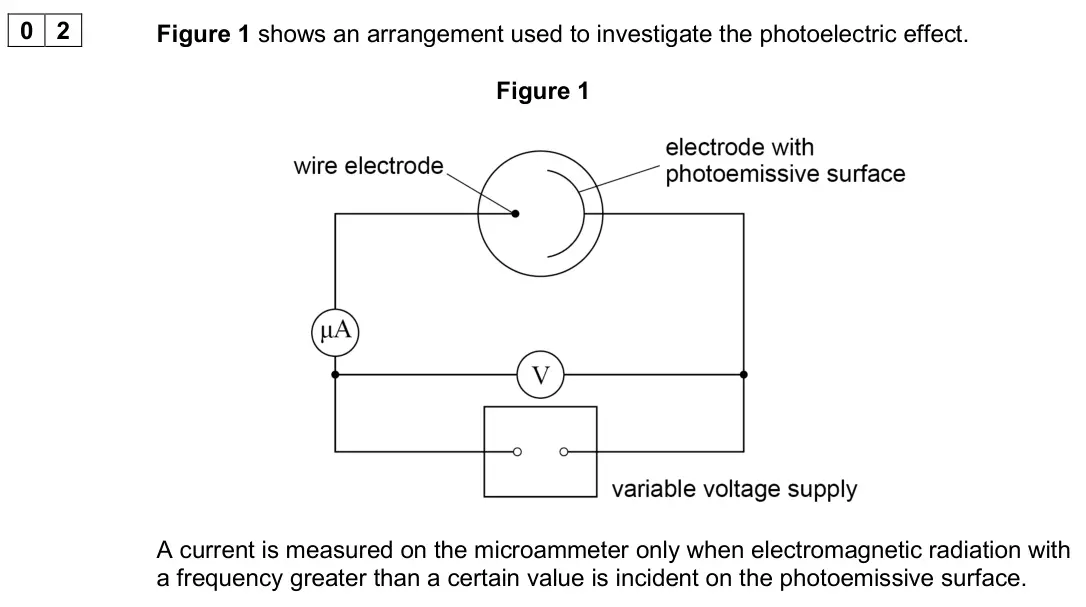
Q02.2
The whole paper ↗Q02.3
The whole paper ↗
All 89 questions on The photoelectric effect, as a list
- June 2025, Paper 1, Q12 (1 mark): In a photoelectric effect experiment, monochromatic light is incident on a metal surface and the stopping potential is measured. Which change results in a great
- June 2025, Paper 1, Q22 (1 mark): The work function of a metal is . A photon with an energy of 3.8 × 10⁻¹⁹ J is incident on the metal surface. Electrons are emitted from the surface with a maxim
- June 2025, Paper 1, Q30 (1 mark): In a photoelectric experiment, the maximum kinetic energy Ek(max) of the emitted electrons and the frequency f of the incident radiation are measured. A graph o
- June 2025, AS Paper 1, Q07.1 (2 marks): State what is meant by the threshold frequency of radiation in the photoelectric effect. [2 marks]
- June 2025, AS Paper 1, Q07.2 (1 mark): Calculate Vs. [1 mark] Vs = V
- June 2025, AS Paper 1, Q07.3 (2 marks): The radiation incident on the magnesium has a frequency of 1710 THz. Calculate the work function of the magnesium. [2 marks] work function = J
- June 2025, AS Paper 1, Q07.4 (3 marks): The frequency f of the electromagnetic radiation is varied. Figure 11 shows the variation of Ek(max) with f for magnesium. Figure 11 Metal X and metal Y are ill
- June 2024, Paper 1, Q09 (1 mark): In two separate experiments, electromagnetic radiation of variable frequency f is incident on the surfaces of plates made from metals X and Y. The work function
- June 2024, Paper 1, Q10 (1 mark): Monochromatic light is incident on a metal surface in a vacuum and photoelectrons are emitted from the surface. The photoelectric current I is the rate of flow
- June 2024, AS Paper 2, Q14 (1 mark): Monochromatic radiation from light source P is incident on a metal surface and photoelectrons are emitted. When monochromatic radiation from light source Q is u
- June 2023, Paper 1, Q12 (1 mark): Photoelectrons are released when monochromatic light with a photon energy of 4.2 × 10⁻¹⁹ J is incident on a metal surface. The work function of the surface is 2
- June 2023, AS Paper 2, Q13 (1 mark): Monochromatic light of frequency f is incident on a metal surface in a vacuum. Photoelectrons are emitted from the surface. The photoelectric current I is measu
- June 2022, Paper 1, Q14 (1 mark): In photoelectricity, Vs is the stopping potential. What quantity is eVs? [1 mark] A energy of an incident photon B maximum kinetic energy of a photoelectron C t
- June 2022, AS Paper 1, Q04.1 (6 marks): Discuss how the rate of loss of charge from the plate depends on the frequency and intensity of the incident radiation. In your answer you should explain why: •
- June 2022, AS Paper 1, Q04.2 (3 marks): Charged particles are emitted from the metal plate with a maximum kinetic energy of 1.1 eV when radiation of frequency 1.2 × 10¹⁵ Hz is incident on the plate. C
- November 2021, Paper 1, Q13 (1 mark): Monochromatic light with a photon energy of 4.1 × 10⁻¹⁹ J is incident on a metal surface. The maximum speed of the photoelectrons released is 4.2 × 10⁵ m s−1. W
- November 2021, AS Paper 2, Q21 (1 mark): The graph shows how the maximum kinetic energy Ek(max) of photoelectrons emitted from a metal surface varies with the frequency f of the incident radiation. P i
- November 2020, Paper 1, Q02.1 (2 marks): Explain why the frequency of the electromagnetic radiation must be greater than a certain value. [2 marks]
- November 2020, Paper 1, Q02.2 (2 marks): Determine the number of photoelectrons per second leaving the photoemissive surface when the current is a maximum. [2 marks] number of photoelectrons per second
- November 2020, Paper 1, Q02.3 (2 marks): Explain why I reaches a constant value for positive values of V. [2 marks]
- November 2020, Paper 1, Q02.4 (3 marks): Explain why I decreases as the value of V becomes more negative. [3 marks]
- November 2020, Paper 1, Q02.5 (3 marks): The investigation is repeated with a different photoemissive surface that has a smaller value of the work function. The source of electromagnetic radiation is u
- November 2020, AS Paper 2, Q04.2 (2 marks): A photon of light from the scintillation material enters the PMT, as shown in Figure 7. The front of the PMT contains a thin photocathode. The photon strikes th
- June 2019, Paper 1, Q10 (1 mark): Light of frequency 2.0 × 10¹⁵ Hz is incident on a metal surface. The work function of the metal is 4.6 × 10⁻¹⁹ J. Which statement is correct? [1 mark] A No phot
- June 2019, AS Paper 2, Q11 (1 mark): Photons of energy 1.0 × 10⁻¹⁸ J are incident on a metal surface and cause the emission of electrons from the metal surface. Which statement about the emitted el
- June 2018, Paper 1, Q14 (1 mark): Photons of wavelength 290 nm are incident on a metal plate. The work function of the metal is 4.1 eV What is the maximum kinetic energy of the emitted electrons
- June 2018, AS Paper 1, Q03.3 (3 marks): The surface of a sample of caesium is exposed to photons emitted in each of the three transitions shown in Figure 3. The threshold frequency of caesium is 5.1 ×
- June 2018, AS Paper 1, Q03.4 (3 marks): Photons each with energy 12.1 eV are incident on the surface of the caesium sample. Calculate the maximum speed of electrons emitted from the caesium. [3 marks]
- June 2018, AS Paper 2, Q09 (1 mark): The graph shows how the maximum kinetic energy Ek of photoelectrons emitted from a metal surface varies with the reciprocal of the wavelength λ of the incident
- June 2017, Paper 1, Q10 (1 mark): A beam of light of wavelength λ is incident on a clean metal surface and photoelectrons are emitted. The wavelength of the light is halved but energy incident p
- June 2017, AS Paper 2, Q20 (1 mark): When light of a certain frequency greater than the threshold frequency of a metal is directed at the metal, photoelectrons are emitted from the surface. The pow
- June 2017, AS Paper 2, Q21 (1 mark): Line X on the graphs below shows how the maximum kinetic energy of emitted photoelectrons varies with the frequency of incident radiation for a particular metal
- June 2016, AS Paper 1, Q05.1 (3 marks): Electromagnetic radiation is incident on the photoemissive surface. Explain why there is a current only if the frequency of the electromagnetic radiation is abo
- June 2016, AS Paper 1, Q05.2 (2 marks): State and explain the effect on the current when the intensity of the electromagnetic radiation is increased. [2 marks]
- June 2016, AS Paper 1, Q05.3 (3 marks): A student investigates the properties of the photocell. The student uses a source of electromagnetic radiation of fixed frequency and observes that there is a c
- June 2016, AS Paper 1, Q05.4 (1 mark): Use your answer from Question 5.3 to calculate the stopping potential for the photoemissive surface. [1 mark] stopping potential = ____________________ V
- June 2016, AS Paper 1, Q05.5 (3 marks): The student increases the frequency of the electromagnetic radiation. Explain the effect this has on the stopping potential. [3 marks]
- Specimen, Paper 1, Q09 (1 mark): Monochromatic radiation from a source of light (source A) is shone on to a metallic surface and electrons are emitted from the surface. When a second source (so
- Specimen, Paper 1, Q14 (1 mark): In a photoelectric experiment, light is incident on the metal surface of a photocell. Increasing the intensity of the illumination at the surface leads to an in
- June 2016, PHYA5 Turning points (old spec), Q2(a) (6 marks): The arrangement shown in Figure 2 is used by a student in a photoelectric effect experiment. Figure 2 Monochromatic light falls on the photocathode. A current i
- June 2016, PHYA5 Turning points (old spec), Q2(b)(i) (3 marks): Calculate the work function of the surface material. [3 marks] work function = ____________________________ J
- June 2016, PHYA5 Turning points (old spec), Q2(b)(ii) (2 marks): The polarity of the battery in Figure 2 is now reversed and light of 490 nm is incident on the photocathode. The energy of the light falling on the surface of t
- June 2015, PHYA1 (old spec), Q4(a)(i) (2 marks): State what is meant by work function. [2 marks]
- June 2015, PHYA1 (old spec), Q4(c) (3 marks): Electromagnetic radiation with the frequency calculated in part (b) is incident on the surface of a piece of sodium. Calculate the maximum possible kinetic ener
- June 2014, PHYA5 Turning points (old spec), Q2(a) (3 marks): The potential of the metal surface may be changed by adjusting the potential divider. Explain why the microammeter reading decreases when the metal surface is m
- June 2014, PHYA5 Turning points (old spec), Q2(b)(i) (2 marks): Draw a graph on the axes below to show how Vs varies with the frequency f of the incident light. [2 marks] Vs 0 0 f
- June 2014, PHYA5 Turning points (old spec), Q2(b)(ii) (3 marks): Use the photoelectric equation hf = φ + Ek to explain your graph. [3 marks]
- June 2014, PHYA5 Turning points (old spec), Q2(c) (4 marks): Using the circuit in Figure 2, the stopping potential was 1.92 V for light of wavelength 418 nm. Use this information to calculate the work function of the meta
- June 2013, PHYA1 (old spec), Q4(a) (3 marks): Explain why the emitted electrons have a range of kinetic energies up to a maximum value.
- June 2013, PHYA1 (old spec), Q4(b)(i) (3 marks): Show that the work function of the metal is 1.8eV. (3 marks)
- June 2013, PHYA1 (old spec), Q4(b)(ii) (3 marks): Calculate the threshold frequency of the metal. Give your answer to an appropriate number of significant figures. threshold frequency Hz (3 marks)
- June 2013, PHYA1 (old spec), Q4(c)(i) (2 marks): State and explain the effect on the emitted electrons of decreasing the frequency of the incident radiation whilst keeping the intensity constant. (2 marks)
- June 2013, PHYA1 (old spec), Q4(c)(ii) (2 marks): State and explain the effect on the emitted electrons of doubling the intensity of the incident radiation whilst keeping the frequency constant. (2 marks)
- June 2012, PHYA1 (old spec), Q4(a)(i) (2 marks): State what is meant by work function. (2 marks)
- June 2012, PHYA1 (old spec), Q4(a)(ii) (4 marks): Explain why the emitted electrons have a range of kinetic energies up to a maximum value.
- June 2012, PHYA1 (old spec), Q4(a)(iii) (4 marks): Calculate the frequency of the light. Give your answer to an appropriate number of significant figures. answer = Hz (4 marks)
- June 2012, PHYA1 (old spec), Q4(b) (2 marks): In order to explain the photoelectric effect the wave model of electromagnetic radiation was replaced by the photon model. Explain what must happen in order for
- January 2011, PHYA1 (old spec), Q4(a) (6 marks): The photoelectric effect suggests that electromagnetic waves can exhibit particle - like behaviour. Explain what is meant by threshold frequency and why the exi
- June 2010, PHYA5 Turning points (old spec), Q2(a)(i) (2 marks): Calculate the maximum kinetic energy of a photoelectron emitted from the surface when the metal surface is uncharged. answer = J (2 marks)
- June 2010, PHYA5 Turning points (old spec), Q2(a)(ii) (3 marks): Calculate the work function of the metal surface, in J. answer = J (3 marks)
- June 2010, PHYA5 Turning points (old spec), Q2(b)(i) (2 marks): Explain this observation. (2 marks)
- June 2010, PHYA5 Turning points (old spec), Q2(b)(ii) (2 marks): How did this observation contribute to the failure of the wave theory of light?
- June 2010, PHYA1 (old spec), Q3(a)(i) (2 marks): Explain why the kinetic energy of the emitted electrons has a maximum value. (2 marks)
- June 2010, PHYA1 (old spec), Q3(a)(ii) (2 marks): Explain with reference to the work function why, if the frequency of the radiation is below a certain value, electrons are not emitted. (2 marks)
- June 2010, PHYA1 (old spec), Q3(a)(iii) (1 mark): State a unit for work function. (1 mark)
- June 2010, PHYA1 (old spec), Q3(b)(i) (2 marks): Calculate the energy of an incident photon. answer = J (2 marks)
- June 2010, PHYA1 (old spec), Q3(b)(ii) (2 marks): Calculate the number of photons incident per second on each square millimetre of the metal surface. answer = (2 marks)
- June 2010, PHYA1 (old spec), Q3(c)(i) (1 mark): The light striking the surface delivers energy to this small area at a rate of 3.0 × 10⁻²²Js–1. The minimum energy required to liberate the electron is 6.8 × 10
- June 2010, PHYA1 (old spec), Q3(c)(ii) (2 marks): In practice the time delay calculated in part c (i) does not occur. Explain how this experimental evidence was used to develop the particle model for the behavi
- January 2010, PHYA1 (old spec), Q4(a)(i) (1 mark): State what is meant by the threshold frequency of the incident light. (1 mark)
- January 2010, PHYA1 (old spec), Q4(a)(ii) (2 marks): Explain why the photoelectric effect is not observed below the threshold frequency. (2 marks)
- January 2010, PHYA1 (old spec), Q4(b)(i) (2 marks): Calculate the energy of a single photon of this light. answer = J (2 marks)
- January 2010, PHYA1 (old spec), Q4(b)(ii) (2 marks): Calculate the maximum kinetic energy of an electron emitted from the surface. answer = J (2 marks)
- January 2010, PHYA1 (old spec), Q4(b)(iii) (2 marks): Calculate the maximum speed of the emitted electron. answer = ms–1 (2 marks)
- June 2009, PHYA1 (old spec), Q4(a)(i) (2 marks): increasing the frequency of the light, (2 marks)
- June 2009, PHYA1 (old spec), Q4(a)(ii) (2 marks): increasing the intensity of the light. (2 marks)
- June 2009, PHYA1 (old spec), Q4(b) (2 marks): The wave model was once an accepted explanation for the nature of light. It was rejected when validated evidence was used to support a particle model of the nat
- June 2009, PHYA1 (old spec), Q4(c)(i) (3 marks): Calculate the work function of lithium, stating an appropriate unit, answer (3 marks)
- June 2009, PHYA1 (old spec), Q4(c)(ii) (3 marks): Calculate the maximum kinetic energy of the emitted electrons when light of frequency 6.2 × 10 14 HZ is incident on the surface of a sample of lithium.
- January 2009, PHYA1 (old spec), Q2(a) (6 marks): Explain • in terms of photons why electrons are released from the metal surface, and • why the kinetic energy of the emitted electrons varies upto a maximum val
- January 2009, PHYA1 (old spec), Q2(b)(i) (1 mark): On the graph mark the threshold frequency and label it f0. (1 mark)
- January 2009, PHYA1 (old spec), Q2(b)(ii) (2 marks): On the graph draw a line for a metal which has a higher threshold frequency. (2 marks)
- January 2009, PHYA1 (old spec), Q2(b)(iii) (1 mark): State what is represented by the gradient of the graph. (1 mark)
- January 2009, PHYA1 (old spec), Q2(c) (3 marks): The threshold frequency of a particular metal surface is 5.6 × 10 14 Hz. Calculate the maximum kinetic energy of emitted electrons if the frequency of the light
- January 2009, PA01 (2008 spec), Q3(a) (3 marks): 3 (a) When electromagnetic radiation is incident on a particular metal plate, photoelectrons are emitted only when the wavelength of the electromagnetic radiati
- January 2009, PA01 (2008 spec), Q3(b) (5 marks): 3 (b) A sodium metal plate is illuminated with electromagnetic radiation of wavelength 4.90 × 10 –7 m. The work function of sodium is 3.94 × 10 –19 J 3 (b) (i)
- January 2008, PA01 (2008 spec), Q2(a) (2 marks): (a) State what is meant by the work function of the metal. (2 marks)
- January 2008, PA01 (2008 spec), Q2(b) (4 marks): (b) (i) Show that the work function of the metal is 1.2 × 10 –18 J. (ii) Calculate the threshold frequency for the metal. (4 marks)
- January 2008, PA01 (2008 spec), Q2(c) (4 marks): (c) The wavelength of the incident electromagnetic radiation remains at 1.50 ×10 –7 m but its intensity is doubled. State and explain what changes occur, if any
Questions, mark schemes and examiner’s reports are © AQA, from their published past papers. Plumi isn’t affiliated with any exam board. Want whole papers? AQA A-Level Physics past papers.
The Plumi iPad app also offers exam-style questions with AI feedback on your handwritten working.