 plumi
Supernovae, neutron stars and black holes: AQA A‑Level Physics questions
AQA A-Level Physics past-paper questions on 3.9.2.6 Supernovae, neutron stars and black holes, 2008–2025, with mark schemes and examiner’s reports where available.
Paper
All papers
Exam
All years
Calculations
Q03.3
The whole paper ↗Q04.2
The whole paper ↗
Q01.5
The whole paper ↗Q03.1
The whole paper ↗Q03.2
The whole paper ↗Q05.2
The whole paper ↗
Q02.6
The whole paper ↗
Q03.4
The whole paper ↗
Q02.1
The whole paper ↗Q02.5
The whole paper ↗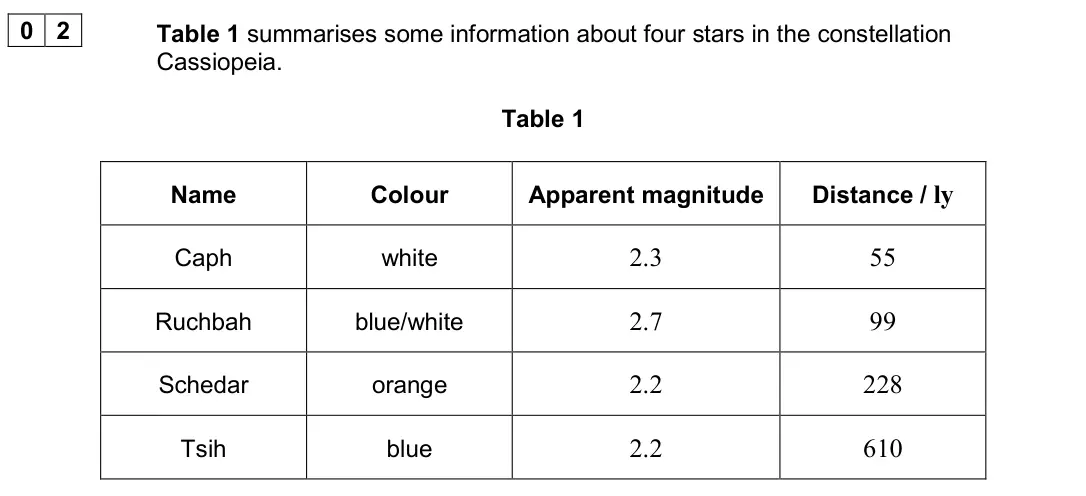
Q03.1
The whole paper ↗
Q03.2
The whole paper ↗Q04.2
The whole paper ↗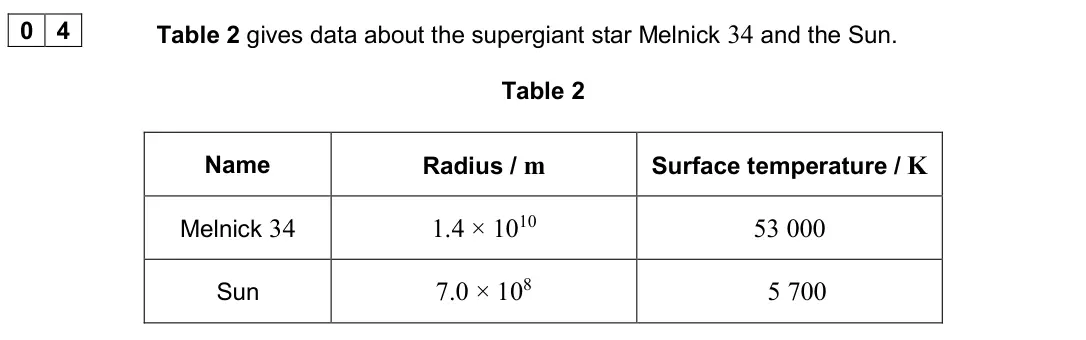
Q03.5
The whole paper ↗
Q04.1
The whole paper ↗Q04.2
The whole paper ↗Q04.3
The whole paper ↗Q03.1
The whole paper ↗
Q03.2
The whole paper ↗Q03.3
The whole paper ↗
All 37 questions on Supernovae, neutron stars and black holes, as a list
- June 2025, Paper 3 Astrophysics, Q03.3 (1 mark): Which provides evidence for the existence of dark energy? Tick () one box. [1 mark]
- June 2024, Paper 3 Astrophysics, Q04.2 (3 marks): There is a supermassive black hole at the centre of the Andromeda Galaxy. The mass of this black hole is 1.60 × 10⁸ solar masses. Calculate the radius of the ev
- June 2023, Paper 3 Astrophysics, Q01.5 (2 marks): One stage in the evolution of Rigel includes the emission of a gamma ray burst. Outline the circumstances during which a gamma ray burst will be emitted by Rige
- June 2023, Paper 3 Astrophysics, Q03.1 (1 mark): State the defining property of a black hole. [1 mark]
- June 2023, Paper 3 Astrophysics, Q03.2 (4 marks): In 2019, astronomers linked several radio telescopes to produce a single telescope called the EHT. The resolution of the EHT is the same as the resolution that
- June 2023, Paper 3 Astrophysics, Q05.2 (2 marks): The estimate in Question 05.1 assumes that the Universe has expanded at a constant rate. Measurements involving type 1a supernovae that are at large distances f
- June 2022, Paper 3 Astrophysics, Q02.6 (2 marks): A different eclipsing binary star system is thought to consist of a white dwarf star and a neutron star. Discuss how astronomers could confirm this. [2 marks]
- June 2022, Paper 3 Astrophysics, Q03.4 (3 marks): The black hole at the centre of IC 1101 has a mass of 7.1 × 10¹¹ MS where MS is the mass of the Sun. Calculate the average density within the event horizon of t
- November 2021, Paper 3 Astrophysics, Q02.1 (1 mark): Which graph shows the light curve for a typical type 1a supernova? Tick () one box. [1 mark] A B C D A B C D
- November 2020, Paper 3 Astrophysics, Q02.5 (2 marks): Tsih has a mass over 15 times the mass of the Sun. Tsih may eventually collapse to form a black hole. Calculate the radius of the event horizon for a black hole
- November 2020, Paper 3 Astrophysics, Q03.1 (1 mark): State what is meant by a standard candle. [1 mark]
- November 2020, Paper 3 Astrophysics, Q03.2 (3 marks): Sketch on Figure 2 the light curve for a type 1a supernova. Annotate your graph with suitable scales and a unit for time. [3 marks] Figure 2
- November 2020, Paper 3 Astrophysics, Q04.2 (2 marks): Discuss why the evolution of a supergiant star in the local part of our galaxy could be dangerous for life on Earth. [2 marks]
- June 2019, Paper 3 Astrophysics, Q03.5 (3 marks): A star much more massive than the Sun may become a supernova and then a black hole. Discuss whether supernovae and black holes can be placed on the HR diagram i
- June 2017, Paper 3 Astrophysics, Q04.1 (3 marks): Sketch, on the axes in Figure 1, the light curve for a typical type 1a supernova. Label the axes with suitable scales. [3 marks
- June 2017, Paper 3 Astrophysics, Q04.2 (1 mark): Type 1a supernovae can be used as standard candles. Explain what is meant by a standard candle. [1 mark
- June 2017, Paper 3 Astrophysics, Q04.3 (3 marks): Measurements of type 1a supernovae in 1999 led to a controversy concerning the behaviour of the Universe. Describe this controversy and how the measurements led
- Specimen, Paper 3 Astrophysics, Q03.1 (1 mark): State what is meant by a supernova. [1 mark] 0 3 . 1
- Specimen, Paper 3 Astrophysics, Q03.2 (2 marks): Antares is a red supergiant star in the constellation of Scorpio. It has a mass about 18 times that of the Sun. Eventually the star will become a supernova, lea
- Specimen, Paper 3 Astrophysics, Q03.3 (2 marks): Antares is a red supergiant star in the constellation of Scorpio. It has a mass about 18 times that of the Sun. Eventually the star will become a supernova, lea
- Specimen, Paper 3 Astrophysics, Q03.4 (2 marks): Antares is a red supergiant star in the constellation of Scorpio. It has a mass about 18 times that of the Sun. Eventually the star will become a supernova, lea
- June 2015, PHYA5 Astrophysics (old spec), Q4(a) (1 mark): State what is meant by a black hole. [1 mark]
- June 2015, PHYA5 Astrophysics (old spec), Q4(b) (2 marks): The mass of the black hole in NGC 3842 is believed to be 1.0 × 10¹⁰ times greater than that of the Sun. Calculate the radius of its event horizon. [2 marks] rad
- June 2014, PHYA5 Astrophysics (old spec), Q2(b)(i) (1 mark): State what is meant by a standard candle. [1 mark]
- June 2014, PHYA5 Astrophysics (old spec), Q2(b)(ii) (3 marks): Explain how measurements of a type 1a supernova can be used to determine how far away it is from the Earth. [3 marks]
- June 2013, PHYA5 Astrophysics (old spec), Q2(b) (3 marks): The supermassive black hole at the centre of the Milky Way galaxy has a mass equal to 4.1 million solar masses. Calculate the Schwarzschild radius, Rs, for this
- June 2011, PHYA5 Astrophysics (old spec), Q3(b)(i) (2 marks): With reference to Figure 1, explain why type 1a supernovae can be used as standard candles to determine distances. (2 marks)
- June 2011, PHYA5 Astrophysics (old spec), Q3(b)(ii) (2 marks): The peak value for the apparent magnitude of this supernova was 12.9. Using this measurement and information from Figure 1, calculate the distance to the Antenn
- June 2011, PHYA5 Astrophysics (old spec), Q3(c) (1 mark): Why is it important for astronomers to have several independent methods of determining the distance to galaxies? (1 mark)
- June 2011, PHYA5 Astrophysics (old spec), Q4(a) (1 mark): Explain what is meant by the event horizon of a black hole. (1 mark)
- June 2011, PHYA5 Astrophysics (old spec), Q4(b)(i) (2 marks): The mass of the black hole is 60 million times the mass of the Sun. Calculate the radius of its event horizon. answer = m (2 marks)
- June 2011, PHYA5 Astrophysics (old spec), Q4(b)(ii) (2 marks): Calculate the average density of the matter within its event horizon. answer = kg m–3 (2 marks)
- June 2010, PHYA5 Astrophysics (old spec), Q3(b)(i) (1 mark): Explain what is meant by a black hole. (1 mark)
- June 2010, PHYA5 Astrophysics (old spec), Q3(b)(ii) (2 marks): The black hole is believed to have a mass 7 times that of the Sun. Calculate the radius of its event horizon. mass of the Sun = 2.0 × 1030kg radius = m (2 marks
- June 2010, PHYA5 Astrophysics (old spec), Q4(a) (6 marks): In 1997 a type 1a supernova was observed which contributed to the controversial conclusion that the expansion of the Universe is accelerating. Explain why obser
- June 2008, PHA5W (2008 spec), Q5(a) (3 marks): 5 (a) Explain what is meant by 5 (a) (i) a quasar, 5 (a) (ii) a black hole. (3 marks)
- June 2008, PHA5W (2008 spec), Q5(c) (2 marks): 5 (c) The black hole at the centre of IZW 1 could have a mass 100 million times greater than the Sun. Calculate the radius of the event horizon of a black hole
Questions, mark schemes and examiner’s reports are © AQA, from their published past papers. Plumi isn’t affiliated with any exam board. Want whole papers? AQA A-Level Physics past papers.
The Plumi iPad app also offers exam-style questions with AI feedback on your handwritten working.