 plumi
The Hertzsprung-Russell (HR) diagram: AQA A‑Level Physics questions
AQA A-Level Physics past-paper questions on 3.9.2.5 The Hertzsprung-Russell (HR) diagram, 2008–2025, with mark schemes and examiner’s reports where available.
Paper
All papers
Exam
All years
Calculations
Q03.3
The whole paper ↗Q01.4
The whole paper ↗Q01.1
The whole paper ↗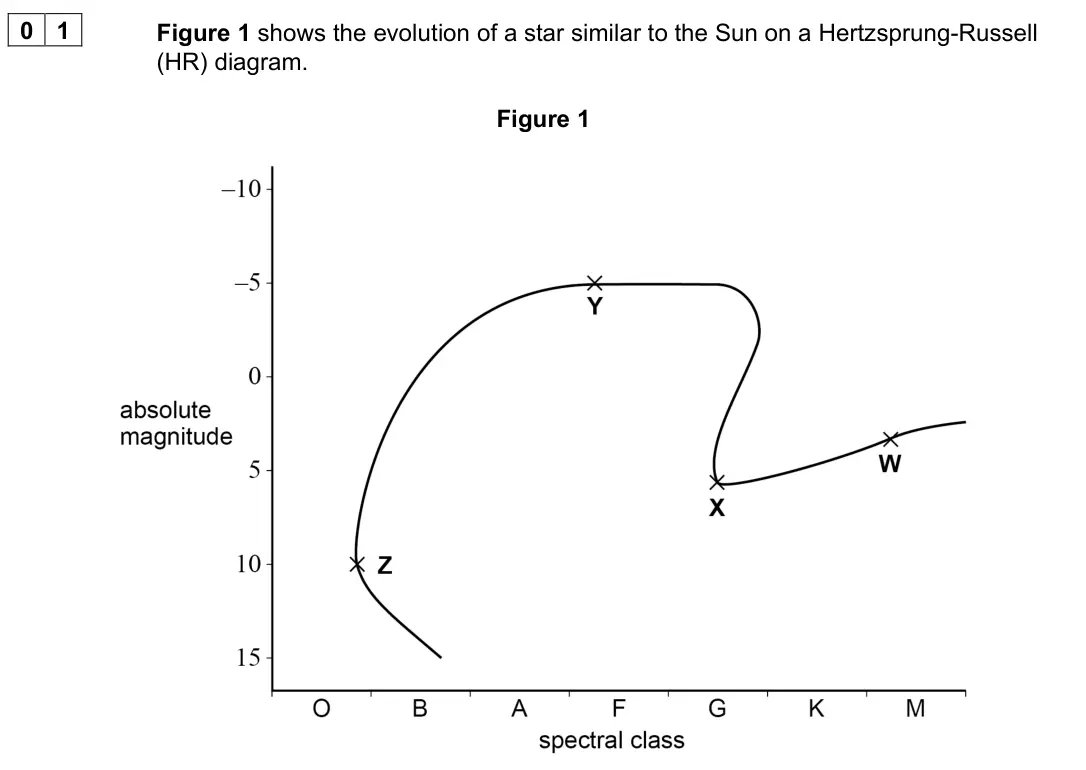
Q01.2
The whole paper ↗Q03.1
The whole paper ↗
Q03.2
The whole paper ↗Q03.3
The whole paper ↗Q03.4
The whole paper ↗Q03.5
The whole paper ↗Q2(a)(i)
The whole paper ↗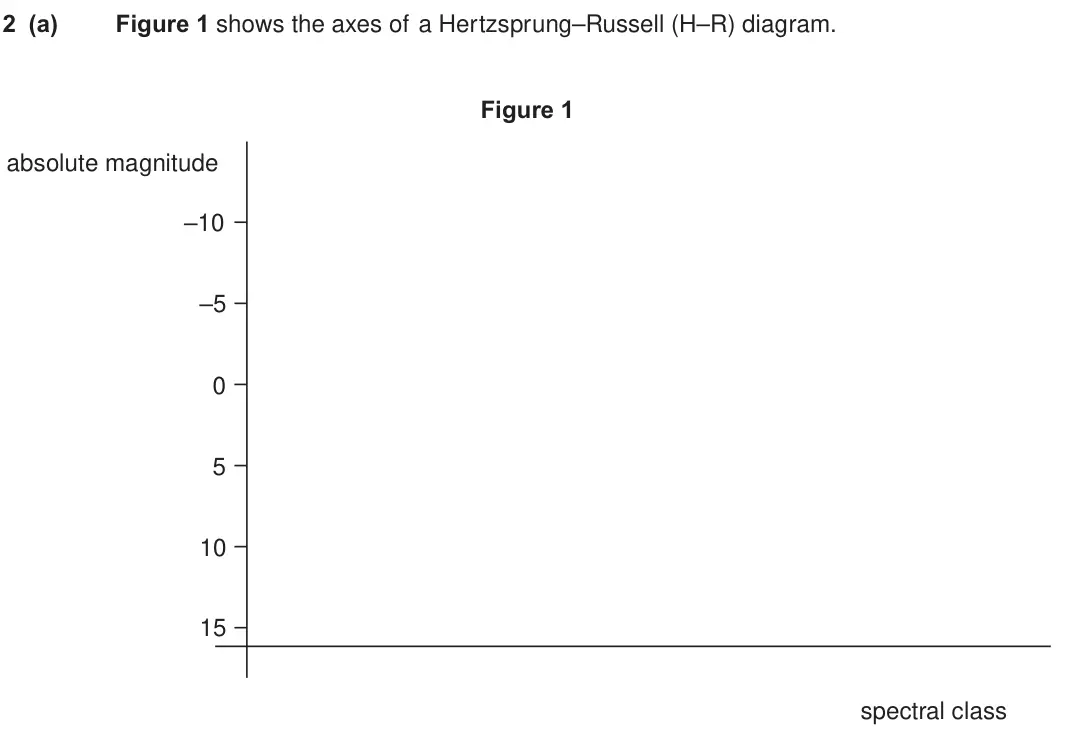
Q2(a)(ii)
The whole paper ↗Q3(b)(i)
The whole paper ↗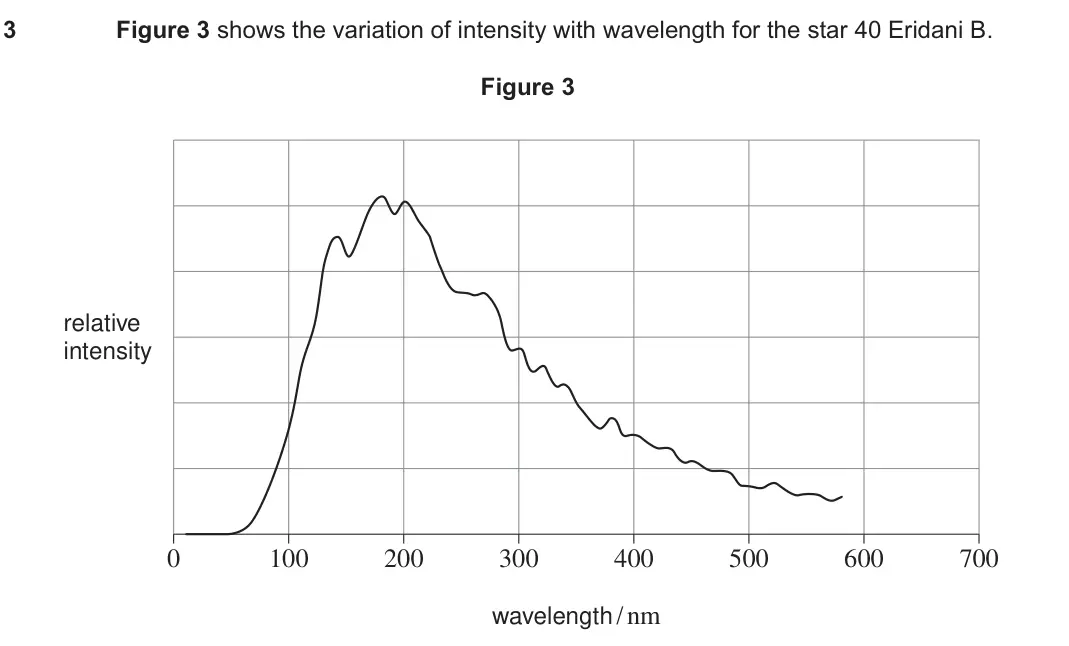
Q3(b)(ii)
The whole paper ↗Q3(b)
The whole paper ↗Q3(c)(i)
The whole paper ↗
Q3(c)(ii)
The whole paper ↗Q3(c)(iii)
The whole paper ↗Q3(c)(iv)
The whole paper ↗Q2(a)
The whole paper ↗Q4(a)
The whole paper ↗
All 21 questions on The Hertzsprung-Russell (HR) diagram, as a list
- June 2024, Paper 3 Astrophysics, Q03.3 (1 mark): Which row gives the type and spectral class of the star? Tick () one box. [1 mark] Type of star Spectral class white dwarf F main sequence G red giant K main s
- June 2023, Paper 3 Astrophysics, Q01.4 (1 mark): Figure 1 shows a Hertzsprung–Russell (HR) diagram. Figure 1 Draw a line on Figure 1 to show the evolution of the Sun from formation to white dwarf. [1 mark]
- November 2021, Paper 3 Astrophysics, Q01.1 (3 marks): State the evolutionary stage of the star at each of the points W, X, Y and Z. [3 marks] W X Y Z
- November 2021, Paper 3 Astrophysics, Q01.2 (1 mark): Annotate Figure 1 with a T to show the position of Theta Carinae. [1 mark]
- June 2019, Paper 3 Astrophysics, Q03.1 (1 mark): Label the absolute magnitude axis with a suitable scale. [1 mark]
- June 2019, Paper 3 Astrophysics, Q03.2 (2 marks): Label with an S the position of the Sun on the HR diagram. [2 marks]
- June 2019, Paper 3 Astrophysics, Q03.3 (2 marks): Draw a line on the HR diagram to show the evolution of a star similar to the Sun from formation to white dwarf. [2 marks]
- June 2019, Paper 3 Astrophysics, Q03.4 (1 mark): Label with a P the position on the HR diagram of a star much redder, and with a greater power output, than the Sun. [1 mark]
- June 2019, Paper 3 Astrophysics, Q03.5 (3 marks): A star much more massive than the Sun may become a supernova and then a black hole. Discuss whether supernovae and black holes can be placed on the HR diagram i
- June 2016, PHYA5 Astrophysics (old spec), Q2(a)(i) (1 mark): Label the spectral class axis with a suitable scale. [1 mark]
- June 2016, PHYA5 Astrophysics (old spec), Q2(a)(ii) (2 marks): Complete the H–R diagram by marking the positions of the main sequence, dwarf star and giant star regions. [2 marks]
- June 2015, PHYA5 Astrophysics (old spec), Q3(b)(i) (1 mark): Which of the following regions of the Hertzsprung-Russell diagram does 40 Eridani B belong to? Tick () the correct answer. [1 mark] main sequence dwarf star gi
- June 2015, PHYA5 Astrophysics (old spec), Q3(b)(ii) (2 marks): Give reasons for your answer to part (b)(i). [2 marks]
- June 2014, PHYA5 Astrophysics (old spec), Q3(b) (2 marks): Figure 1 shows the axes of a Hertzsprung-Russell diagram. Mark suitable scales on the absolute magnitude and temperature axes. [2 marks] Figure 1 absolute magni
- June 2014, PHYA5 Astrophysics (old spec), Q3(c)(i) (1 mark): the Sun [1 mark]
- June 2014, PHYA5 Astrophysics (old spec), Q3(c)(ii) (1 mark): star W, which has the same intrinsic brightness as the Sun, but has a significantly higher temperature [1 mark]
- June 2014, PHYA5 Astrophysics (old spec), Q3(c)(iii) (1 mark): star X, which has a similar spectrum to the Sun, but is significantly larger [1 mark]
- June 2014, PHYA5 Astrophysics (old spec), Q3(c)(iv) (1 mark): star Y, which is significantly larger than the Sun and has prominent absorption lines of neutral atoms and titanium oxide (TiO) in its spectrum. [1 mark]
- June 2011, PHYA5 Astrophysics (old spec), Q2(a) (3 marks): On the axes below draw the Hertzsprung-Russell (H-R) diagram, labelling the main sequence stars, giant stars and white dwarf stars. Complete the vertical axis b
- June 2008, PHA5W (2008 spec), Q4(a) (3 marks): 4 (a) Sketch a Hertzsprung–Russell (H–R) diagram on the axes below. Label the position of the main sequence, dwarf and giant stars. Complete the spectral class
- June 2008, PHA5W (2008 spec), Q4(b) (3 marks): 4 (b) Beta Hydri is a star with the same black body temperature as the Sun, but is approximately 3.5 times brighter. 4 (b) (i) Label with the letter X the posit
Questions, mark schemes and examiner’s reports are © AQA, from their published past papers. Plumi isn’t affiliated with any exam board. Want whole papers? AQA A-Level Physics past papers.
The Plumi iPad app also offers exam-style questions with AI feedback on your handwritten working.