 plumi
Principles of the use of stellar spectral classes: AQA A‑Level Physics questions
AQA A-Level Physics past-paper questions on 3.9.2.4 Principles of the use of stellar spectral classes, 2008–2025, with mark schemes and examiner’s reports where available.
Paper
All papers
Exam
All years
Calculations
Q04.2
The whole paper ↗
Q04.3
The whole paper ↗Q03.3
The whole paper ↗Q01.2
The whole paper ↗Q02.5
The whole paper ↗
Q02.1
The whole paper ↗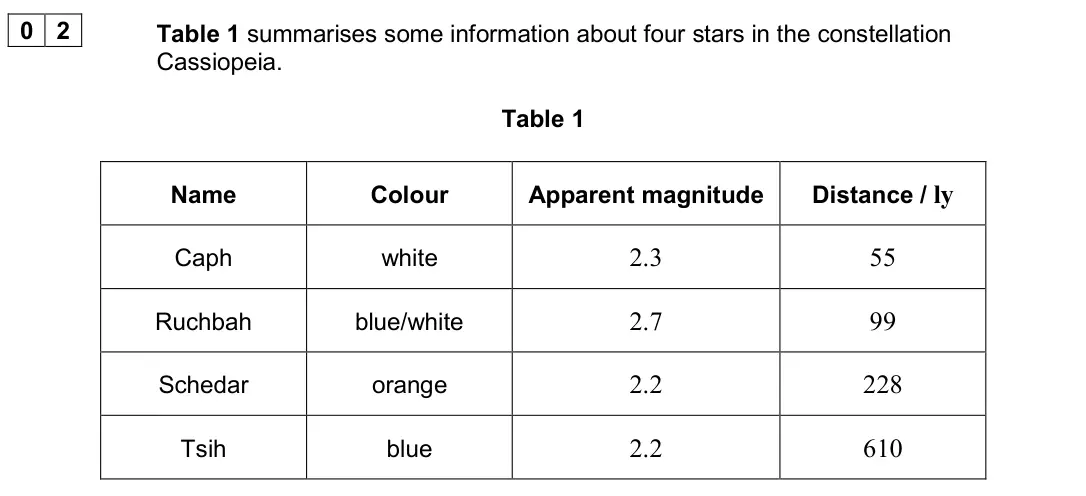
Q02.2
The whole paper ↗
Q02.4
The whole paper ↗Q03.4
The whole paper ↗
Q02.1
The whole paper ↗
Q2(b)
The whole paper ↗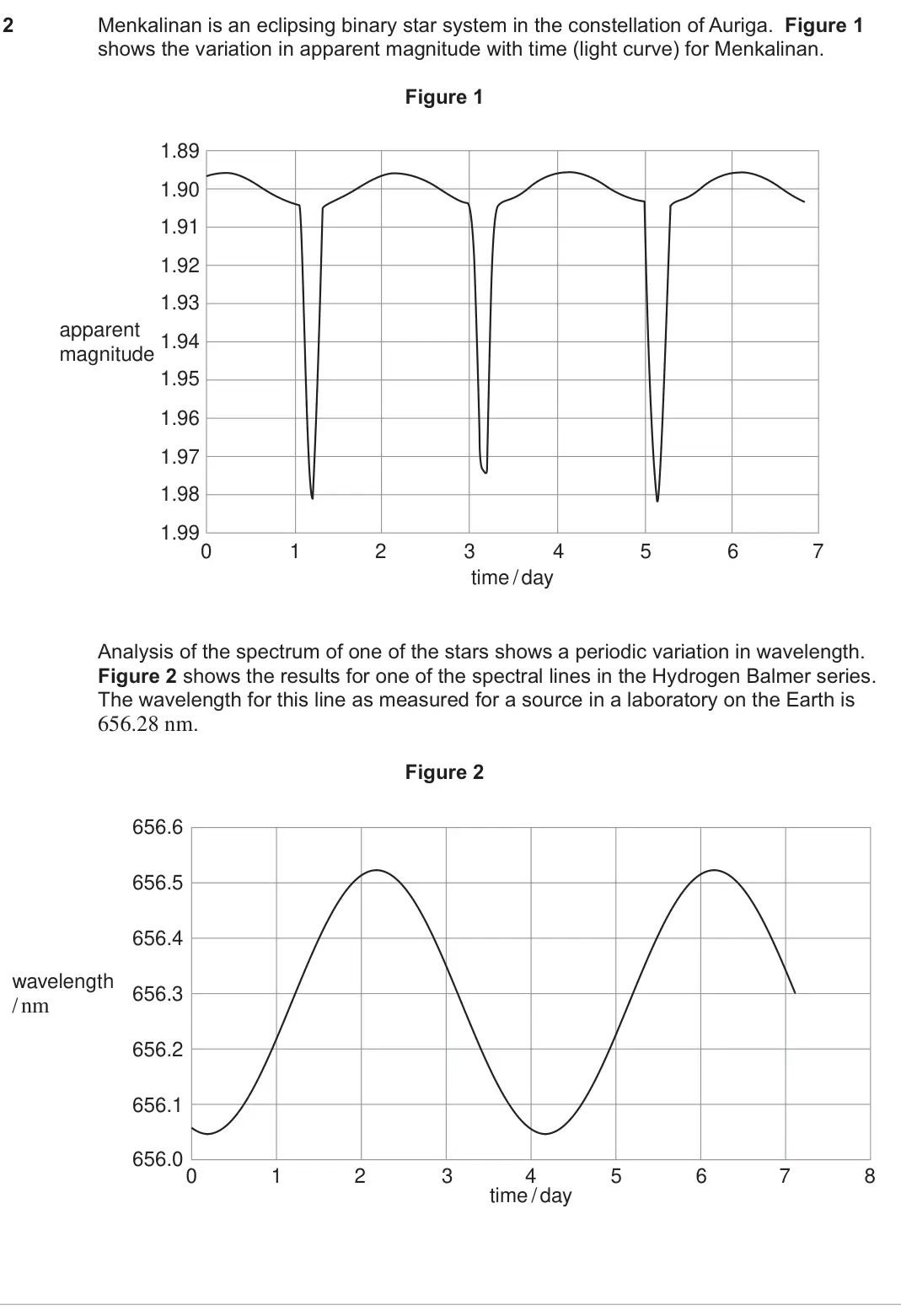
Q3(c)(iv)
The whole paper ↗
Q4(a)(i)
The whole paper ↗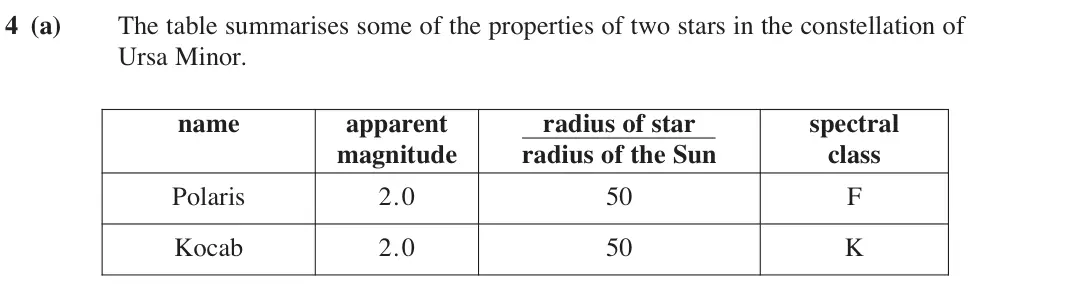
Q3(c)(i)
The whole paper ↗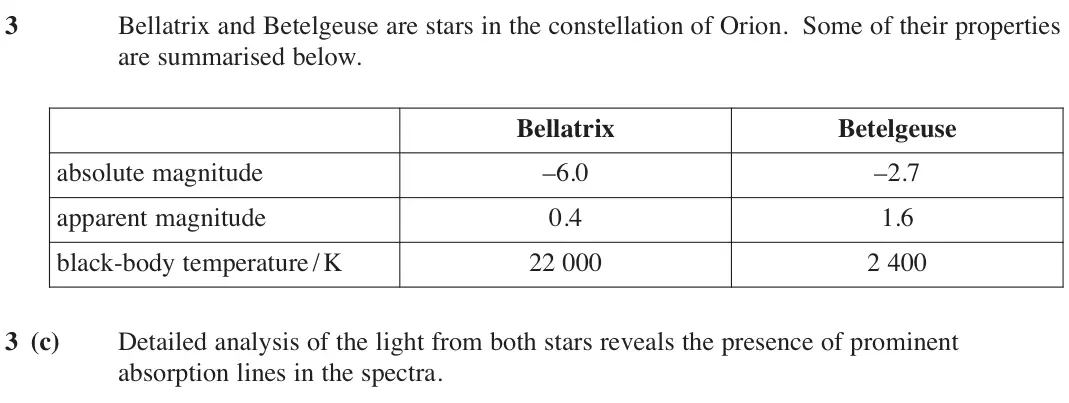
Q3(c)(ii)
The whole paper ↗Q3(c)(iii)
The whole paper ↗Q2(c)
The whole paper ↗Q4(a)
The whole paper ↗
All 19 questions on Principles of the use of stellar spectral classes, as a list
- June 2025, Paper 3 Astrophysics, Q04.2 (1 mark): State the most prominent absorption lines in the spectrum of Mintaka Aa2. [1 mark]
- June 2025, Paper 3 Astrophysics, Q04.3 (1 mark): Explain which star in Table 2 has the greater temperature. [1 mark]
- June 2024, Paper 3 Astrophysics, Q03.3 (1 mark): Which row gives the type and spectral class of the star? Tick () one box. [1 mark] Type of star Spectral class white dwarf F main sequence G red giant K main s
- June 2023, Paper 3 Astrophysics, Q01.2 (1 mark): State the spectral class of Rigel. [1 mark]
- June 2022, Paper 3 Astrophysics, Q02.5 (1 mark): Which absorption lines would be most prominent in the spectrum of the primary star? Tick () one box. [1 mark] hydrogen hydrogen and helium ionised metals neutr
- November 2021, Paper 3 Astrophysics, Q03 (6 marks): Miaplacidus and Avior are two stars in the constellation Carina. Miaplacidus is a class A star. Avior is a class K star. Figure 2 shows how the intensity of rad
- November 2020, Paper 3 Astrophysics, Q02.1 (1 mark): Which star has the highest surface temperature? Tick () one box. [1 mark] Caph Ruchbah Schedar Tsih
- June 2019, Paper 3 Astrophysics, Q02.2 (2 marks): State and explain which star in Table 2 has the most prominent Hydrogen Balmer absorption lines. [2 marks]
- June 2018, Paper 3 Astrophysics, Q02.4 (1 mark): What is the spectral class of 61 Cygnus A? Tick () the correct box. [1 mark] A F G K
- June 2017, Paper 3 Astrophysics, Q03.4 (2 marks): Explain which star produced the black-body radiation curve described in question 03.3. [2 marks
- Specimen, Paper 3 Astrophysics, Q02.1 (2 marks): The Summer Triangle consists of three stars, Altair, Deneb and Vega. Some of the properties of the three stars are summarised in Table 2. Table 2 Altair Deneb V
- June 2015, PHYA5 Astrophysics (old spec), Q2(b) (2 marks): The black body temperature of each star is approximately 9200 K. Explain why a Hydrogen Balmer line was chosen for the analysis of wavelength variation. [2 mark
- June 2014, PHYA5 Astrophysics (old spec), Q3(c)(iv) (1 mark): star Y, which is significantly larger than the Sun and has prominent absorption lines of neutral atoms and titanium oxide (TiO) in its spectrum. [1 mark]
- June 2013, PHYA5 Astrophysics (old spec), Q4(a)(i) (2 marks): Using these data, describe and explain one similarity and one difference in the appearance of the two stars as seen with the unaided eye by an observer on the E
- June 2012, PHYA5 Astrophysics (old spec), Q3(c)(i) (1 mark): To which spectral class does Bellatrix belong? (1 mark)
- June 2012, PHYA5 Astrophysics (old spec), Q3(c)(ii) (1 mark): Prominent features in the Bellatrix spectrum are the Balmer absorption lines due to hydrogen. State the other element responsible for the prominent absorption l
- June 2012, PHYA5 Astrophysics (old spec), Q3(c)(iii) (1 mark): Why does the spectrum of Betelgeuse not contain prominent Hydrogen Balmer absorption lines? (1 mark)
- June 2011, PHYA5 Astrophysics (old spec), Q2(c) (6 marks): The spectrum of Deneb contains Hydrogen Balmer absorption lines. Describe how Hydrogen Balmer absorption lines are produced in the spectrum of a star. The quali
- June 2008, PHA5W (2008 spec), Q4(a) (3 marks): 4 (a) Sketch a Hertzsprung–Russell (H–R) diagram on the axes below. Label the position of the main sequence, dwarf and giant stars. Complete the spectral class
Questions, mark schemes and examiner’s reports are © AQA, from their published past papers. Plumi isn’t affiliated with any exam board. Want whole papers? AQA A-Level Physics past papers.
The Plumi iPad app also offers exam-style questions with AI feedback on your handwritten working.