 plumi
Classification by temperature, black-body radiation: AQA A‑Level Physics questions
AQA A-Level Physics past-paper questions on 3.9.2.3 Classification by temperature, black-body radiation, 2008–2025, with mark schemes and examiner’s reports where available.
Paper
All papers
Exam
All years
Calculations
Q01.1
The whole paper ↗
Q03.1
The whole paper ↗Q03.2
The whole paper ↗Q03.4
The whole paper ↗Q01.4
The whole paper ↗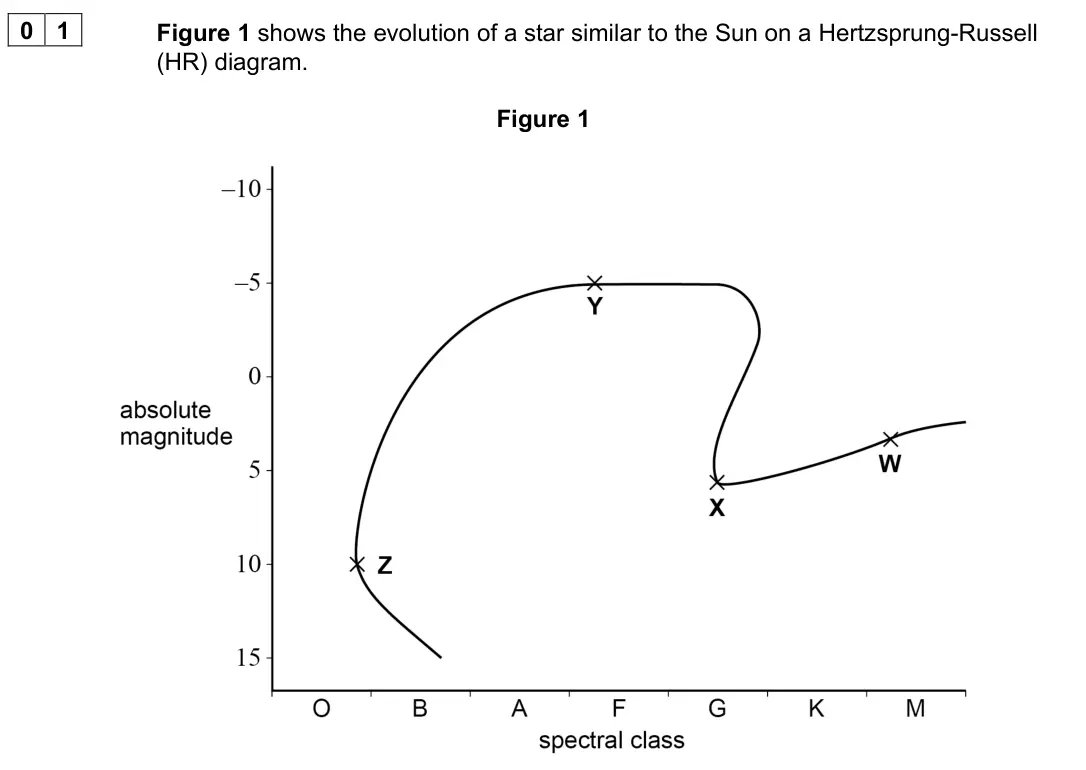
Q02.2
The whole paper ↗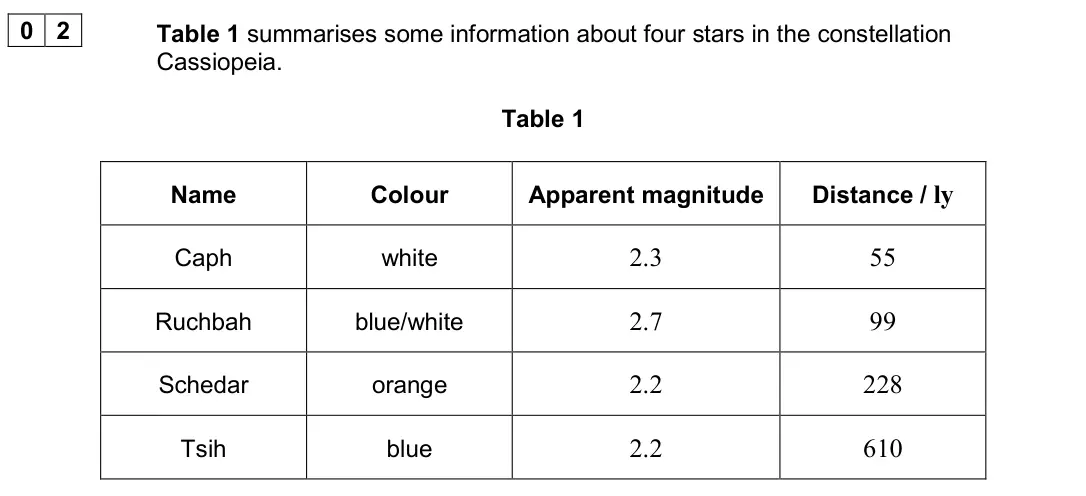
Q04.1
The whole paper ↗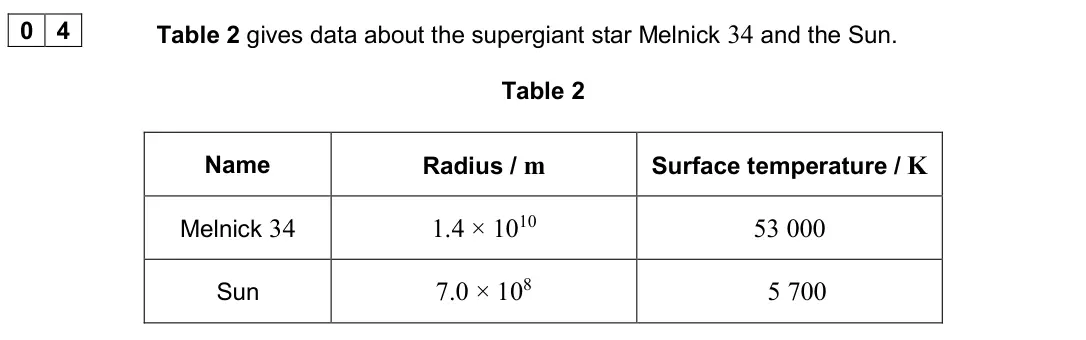
Q02.3
The whole paper ↗
Q02.1
The whole paper ↗Q02.2
The whole paper ↗Q02.3
The whole paper ↗Q03.2
The whole paper ↗
Q03.3
The whole paper ↗Q02.4
The whole paper ↗
Q02.5
The whole paper ↗Q2(b)(i)
The whole paper ↗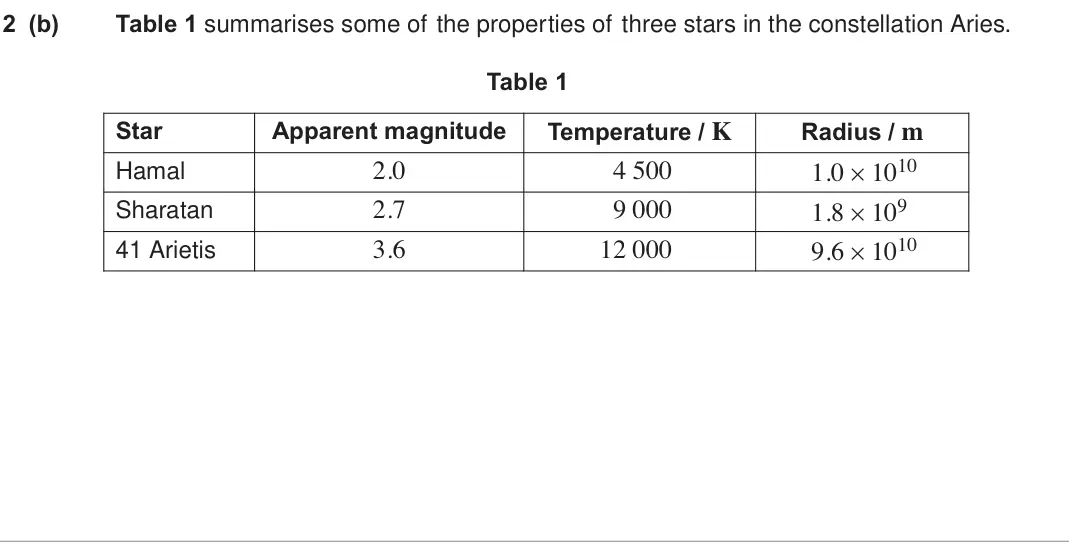
Q2(b)(iii)
The whole paper ↗
All 31 questions on Classification by temperature, black-body radiation, as a list
- June 2025, Paper 3 Astrophysics, Q01.1 (3 marks): Sketch, on Figure 1, the black-body curve for HIP 56948. Label the wavelength axis with a suitable scale and unit. [3 marks] Figure 1
- June 2025, Paper 3 Astrophysics, Q05 (5 marks): Early observations of the star Betelgeuse indicated that: radius r of Betelgeuse = 700 × radius of the Sun distance d of Betelgeuse from the Earth = 548 ly inte
- June 2024, Paper 3 Astrophysics, Q03.1 (2 marks): Figure 3 shows the variation of intensity with wavelength for a star. Figure 3 Show that Figure 3 is consistent with a black-body temperature of about 6.0 × 10³
- June 2024, Paper 3 Astrophysics, Q03.2 (2 marks): The radius of the star is 9.6 × 10⁶ m. Calculate the power output of the star. [2 marks] power output = W
- June 2024, Paper 3 Astrophysics, Q03.4 (2 marks): The light from the star passes through an interstellar dust cloud before reaching Earth. The reduction in intensity when light passes through a dust cloud is as
- June 2023, Paper 3 Astrophysics, Q04 (6 marks): M40 A and M40 B are two stars that appear very close to each other when viewed from Earth. There are two possible reasons for this: • they are an orbiting binar
- November 2021, Paper 3 Astrophysics, Q01.4 (5 marks): The astronomer suggests that the Earth-sized planet receives a similar amount of power from Theta Carinae as the Earth does from the Sun. The average power outp
- November 2021, Paper 3 Astrophysics, Q03 (6 marks): Miaplacidus and Avior are two stars in the constellation Carina. Miaplacidus is a class A star. Avior is a class K star. Figure 2 shows how the intensity of rad
- November 2020, Paper 3 Astrophysics, Q02.2 (4 marks): Figure 1 shows the intensity received at Earth from two of the stars, plotted against wavelength. The effect of absorption by the Earth’s atmosphere is not show
- November 2020, Paper 3 Astrophysics, Q04.1 (2 marks): Calculate 34 power output of Melnick power output of the Sun . [2 marks] answer =
- June 2019, Paper 3 Astrophysics, Q02.3 (3 marks): Deduce which star, Gamma A or HD 66141, has the larger diameter. [3 marks]
- June 2018, Paper 3 Astrophysics, Q02.1 (2 marks): Sketch, on the axes in Figure 1, the black-body radiation curve for a typical star. [2 marks] Figure 1
- June 2018, Paper 3 Astrophysics, Q02.2 (3 marks): Explain, with reference to the SI units involved, how the curve you have drawn can be used to determine the black-body temperature of the star. [3 marks]
- June 2018, Paper 3 Astrophysics, Q02.3 (6 marks): Two stars, 61 Cygnus A and 61 Cygnus B, can be seen very close together in the constellation Cygnus. Early astronomers were unsure whether the two stars form a
- June 2017, Paper 3 Astrophysics, Q03.2 (3 marks): Deduce which star is larger, Kornephoros or Rutilicus. [3 marks
- June 2017, Paper 3 Astrophysics, Q03.3 (2 marks): One of the four stars has the peak in its black-body radiation curve at a wavelength of 1.0 µm. Calculate the corresponding temperature for this curve. [2 marks
- Specimen, Paper 3 Astrophysics, Q02.4 (3 marks): The Summer Triangle consists of three stars, Altair, Deneb and Vega. Some of the properties of the three stars are summarised in Table 2. Table 2 Altair Deneb V
- Specimen, Paper 3 Astrophysics, Q02.5 (2 marks): The Summer Triangle consists of three stars, Altair, Deneb and Vega. Some of the properties of the three stars are summarised in Table 2. Table 2 Altair Deneb V
- June 2016, PHYA5 Astrophysics (old spec), Q2(b)(i) (6 marks): With reference to the data in Table 1, compare the three stars. Your answer should include a discussion of: the appearance to the naked eye of the three stars
- June 2016, PHYA5 Astrophysics (old spec), Q2(b)(iii) (3 marks): Identify which star is the greatest distance from Earth. Explain your answer. [3 marks] ________________________________________________________________________
- June 2015, PHYA5 Astrophysics (old spec), Q3(a)(i) (3 marks): Calculate the black body temperature of 40 Eridani B. State an appropriate unit for your answer. [3 marks] temperature = unit
- June 2015, PHYA5 Astrophysics (old spec), Q3(a)(ii) (2 marks): 40 Eridani B has a total power output of 4.2 × 1024 W. Calculate its radius. [2 marks] radius = m
- June 2014, PHYA5 Astrophysics (old spec), Q3(d) (3 marks): How does the diameter of star W, in part 3(c)(ii), compare with the diameter of the Sun? Explain your answer. [3 marks]
- June 2013, PHYA5 Astrophysics (old spec), Q4(a)(ii) (3 marks): Deduce which of the two stars is further from the Earth.
- June 2012, PHYA5 Astrophysics (old spec), Q3(b)(i) (2 marks): Calculate the wavelength of the peak intensity in the black-body radiation curve of Bellatrix. answer = m (2 marks)
- June 2012, PHYA5 Astrophysics (old spec), Q3(b)(ii) (3 marks): Sketch the black-body radiation curve for Bellatrix. Label the wavelength axis with a suitable scale. (3 marks) 0 0 wavelength/nm relative intensity
- June 2011, PHYA5 Astrophysics (old spec), Q2(b)(i) (3 marks): The black-body radiation curve for Deneb shows a peak at a wavelength of 3.4 × 10 –7m. Calculate the black-body temperature of Deneb. Give your answer to an app
- June 2011, PHYA5 Astrophysics (old spec), Q2(b)(ii) (3 marks): The power output of Deneb is 70000 times greater than the Sun. Calculate the radius of Deneb. surface temperature of the Sun = 5700K answer = m (3 marks)
- June 2010, PHYA5 Astrophysics (old spec), Q2(b)(i) (2 marks): Calculate the ratio ratio = (2 marks) power output of Sirius A power output of Sirius B
- June 2010, PHYA5 Astrophysics (old spec), Q2(b)(iii) (3 marks): With reference to the spectra of the two stars, explain why the value in part b (ii) is much greater than the answer to part b (i).
- June 2008, PHA5W (2008 spec), Q4(b) (3 marks): 4 (b) Beta Hydri is a star with the same black body temperature as the Sun, but is approximately 3.5 times brighter. 4 (b) (i) Label with the letter X the posit
Questions, mark schemes and examiner’s reports are © AQA, from their published past papers. Plumi isn’t affiliated with any exam board. Want whole papers? AQA A-Level Physics past papers.
The Plumi iPad app also offers exam-style questions with AI feedback on your handwritten working.