 plumi
Absolute magnitude, M: AQA A‑Level Physics questions
AQA A-Level Physics past-paper questions on 3.9.2.2 Absolute magnitude, M, 2008–2025, with mark schemes and examiner’s reports where available.
Paper
All papers
Exam
All years
Calculations
Q01.2
The whole paper ↗
Q04.1
The whole paper ↗
Q02.1
The whole paper ↗
Q02.2
The whole paper ↗Q01.1
The whole paper ↗Q01.3
The whole paper ↗Q03.2
The whole paper ↗
Q03.3
The whole paper ↗Q02.2
The whole paper ↗Q02.3
The whole paper ↗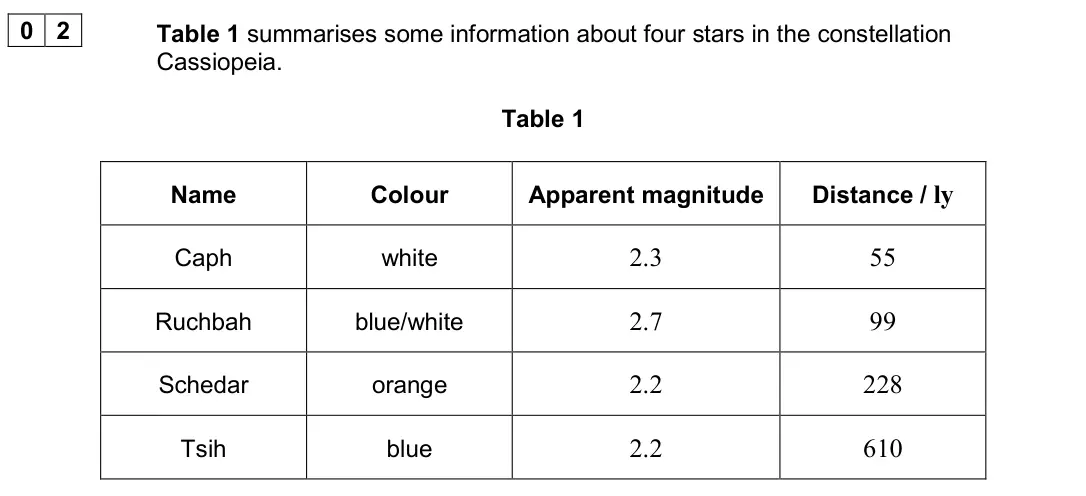
Q02.4
The whole paper ↗Q02.3
The whole paper ↗
Q02.5
The whole paper ↗Q03.1
The whole paper ↗
Q03.5
The whole paper ↗Q03.6
The whole paper ↗Q02.3
The whole paper ↗
Q02.4
The whole paper ↗Q2(b)(ii)
The whole paper ↗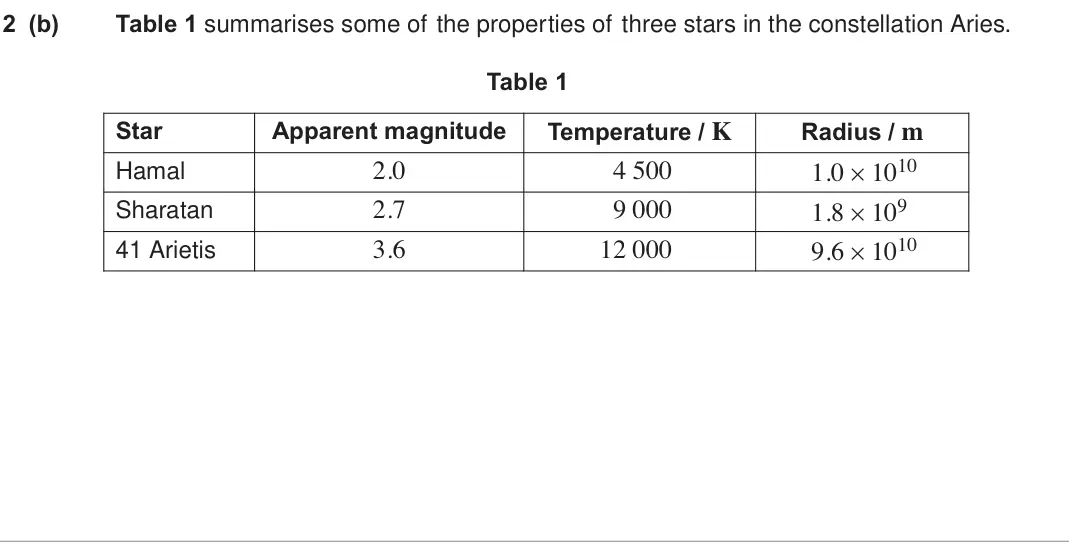
All 33 questions on Absolute magnitude, M, as a list
- June 2025, Paper 3 Astrophysics, Q01.2 (1 mark): The diameter of HIP 56948 is the same as the diameter of the Sun. Suggest a value for the absolute magnitude of HIP 56948. [1 mark] absolute magnitude =
- June 2025, Paper 3 Astrophysics, Q04.1 (3 marks): Show that the data in Table 2 are consistent with the two stars being in a binary system. [3 marks]
- June 2024, Paper 3 Astrophysics, Q02.1 (2 marks): The distance from the Sun to S is 79 ly. The Earth takes 6 months to move from point P to point Q. Calculate, in degrees, angle A. [2 marks] A = °
- June 2024, Paper 3 Astrophysics, Q02.2 (4 marks): Parallax is used to determine the distance to a different star. Observations of the star produce the following data: distance determined using parallax = 0.40 p
- June 2023, Paper 3 Astrophysics, Q01.1 (1 mark): Draw a labelled diagram to define the parsec (pc). [1 mark] Table 1 shows data for two stars: Rigel and the Sun. Table 1 Star Surface temperature / K Absolute m
- June 2023, Paper 3 Astrophysics, Q01.3 (2 marks): The apparent magnitude of Rigel is 0.11 Calculate, in pc, the distance from Rigel to the Earth. [2 marks] distance = pc
- June 2023, Paper 3 Astrophysics, Q04 (6 marks): M40 A and M40 B are two stars that appear very close to each other when viewed from Earth. There are two possible reasons for this: • they are an orbiting binar
- June 2022, Paper 3 Astrophysics, Q03.2 (2 marks): Show that the absolute magnitude X of quasar 3C 273 is about −27 [2 marks]
- June 2022, Paper 3 Astrophysics, Q03.3 (3 marks): Assume that the quasar and the galaxy are both viewed from the same distance. Explain which would be the brighter object. Go on to calculate the ratio brightnes
- November 2021, Paper 3 Astrophysics, Q02.2 (3 marks): The Andromeda galaxy is approximately 7.7 × 10⁵ pc from Earth. Deduce whether a type 1a supernova which occurred in Andromeda can be observed from Earth with th
- November 2020, Paper 3 Astrophysics, Q02.3 (1 mark): State which star in Table 1 is dimmest on the absolute magnitude scale. [1 mark]
- November 2020, Paper 3 Astrophysics, Q02.4 (3 marks): Calculate the absolute magnitude of Schedar. [3 marks] absolute magnitude =
- June 2019, Paper 3 Astrophysics, Q02.3 (3 marks): Deduce which star, Gamma A or HD 66141, has the larger diameter. [3 marks]
- June 2019, Paper 3 Astrophysics, Q02.5 (3 marks): Calculate the distance from the Earth to Procyon. Give an appropriate unit for your answer. [3 marks] distance = unit
- June 2017, Paper 3 Astrophysics, Q03.1 (2 marks): Define the parsec. You may use a diagram as part of your answer. [2 marks
- June 2017, Paper 3 Astrophysics, Q03.5 (1 mark): Which star has the brightest absolute magnitude? Tick () the correct box. [1 mark Kornephoros Rasalgethi Rutilicus Sarin
- June 2017, Paper 3 Astrophysics, Q03.6 (3 marks): Determine the absolute magnitude of Sarin. [3 marks absolute magnitude =
- Specimen, Paper 3 Astrophysics, Q02.3 (3 marks): The Summer Triangle consists of three stars, Altair, Deneb and Vega. Some of the properties of the three stars are summarised in Table 2. Table 2 Altair Deneb V
- Specimen, Paper 3 Astrophysics, Q02.4 (3 marks): The Summer Triangle consists of three stars, Altair, Deneb and Vega. Some of the properties of the three stars are summarised in Table 2. Table 2 Altair Deneb V
- June 2016, PHYA5 Astrophysics (old spec), Q2(b)(ii) (3 marks): Hamal is 66 light years from the Earth. Calculate the absolute magnitude of Hamal. [3 marks] absolute magnitude = _____________________________
- June 2016, PHYA5 Astrophysics (old spec), Q2(b)(iii) (3 marks): Identify which star is the greatest distance from Earth. Explain your answer. [3 marks] ________________________________________________________________________
- June 2015, PHYA5 Astrophysics (old spec), Q1(a)(i) (2 marks): Calculate the largest possible distance, in m, between the Earth and Vesta. [2 marks] distance = m
- June 2015, PHYA5 Astrophysics (old spec), Q2(c) (3 marks): The distance from the Earth to Menkalinan is 7.7 × 10¹⁷ m. Calculate the value of the absolute magnitude of Menkalinan when it appears dimmest. [3 marks] absolu
- June 2014, PHYA5 Astrophysics (old spec), Q2(b)(ii) (3 marks): Explain how measurements of a type 1a supernova can be used to determine how far away it is from the Earth. [3 marks]
- June 2014, PHYA5 Astrophysics (old spec), Q3(a) (1 mark): Define the term absolute magnitude. [1 mark]
- June 2014, PHYA5 Astrophysics (old spec), Q4(a) (2 marks): Explain what is meant by a parsec. Draw a labelled diagram in support of your answer. [2 marks]
- June 2014, PHYA5 Astrophysics (old spec), Q4(b) (3 marks): The Hipparcos satellite used the parallax method to measure the distance to more than 100 000 stars with a precision of 0.002 arc seconds. Calculate, in metres,
- June 2014, PHYA5 Astrophysics (old spec), Q4(c)(i) (1 mark): Explain how data in the table indicate that the two stars are not part of a binary system. [1 mark]
- June 2014, PHYA5 Astrophysics (old spec), Q4(c)(ii) (1 mark): Explain why the angular separation of the two stars changes when observed from the Earth during a 12 month period. [1 mark]
- June 2012, PHYA5 Astrophysics (old spec), Q3(a)(i) (1 mark): Explain what is meant by absolute magnitude. (1 mark)
- June 2012, PHYA5 Astrophysics (old spec), Q3(a)(ii) (1 mark): Which of the two stars is closer to the Earth? Explain your answer. (1 mark)
- June 2011, PHYA5 Astrophysics (old spec), Q3(b)(ii) (2 marks): The peak value for the apparent magnitude of this supernova was 12.9. Using this measurement and information from Figure 1, calculate the distance to the Antenn
- June 2010, PHYA5 Astrophysics (old spec), Q2(a) (3 marks): Calculate the distance to Sirius, giving an appropriate unit. distance = (3 marks)
Questions, mark schemes and examiner’s reports are © AQA, from their published past papers. Plumi isn’t affiliated with any exam board. Want whole papers? AQA A-Level Physics past papers.
The Plumi iPad app also offers exam-style questions with AI feedback on your handwritten working.