 plumi
Rutherford scattering: AQA A‑Level Physics questions
AQA A-Level Physics past-paper questions on 3.8.1.1 Rutherford scattering, 2008–2025, with mark schemes and examiner’s reports where available.
Paper
All papers
Exam
All years
Calculations
Q05.1
The whole paper ↗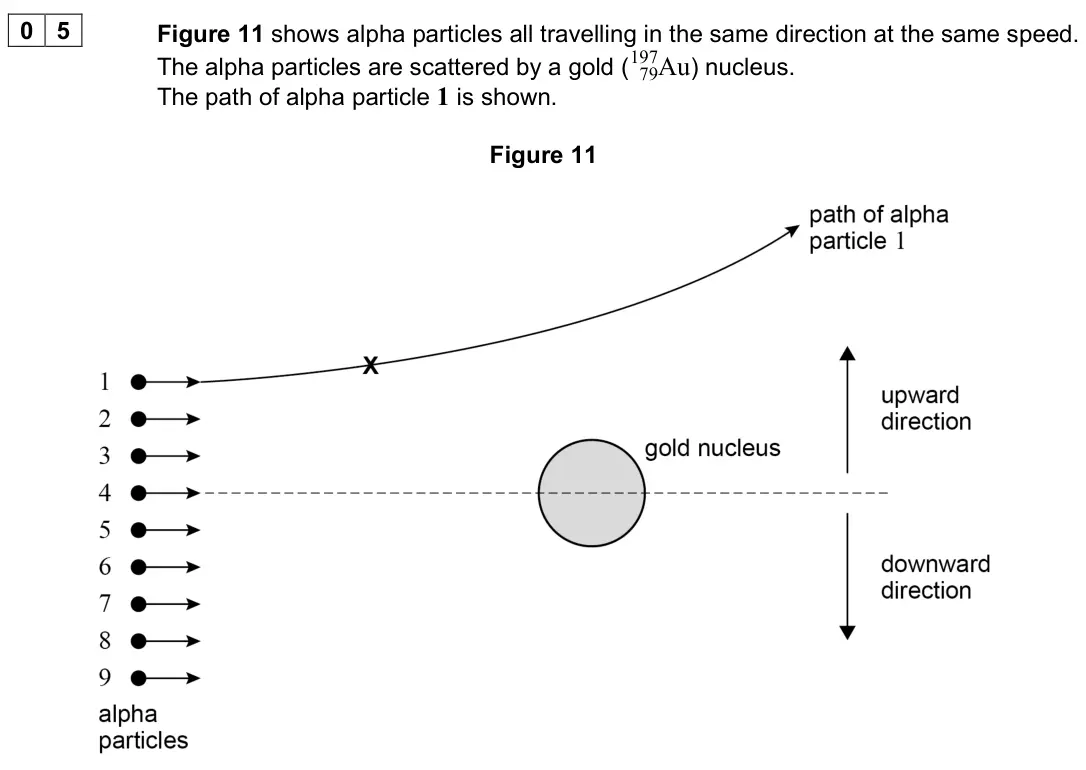
Q05.2
The whole paper ↗Q05.3
The whole paper ↗- Your answer
Q01.7
The whole paper ↗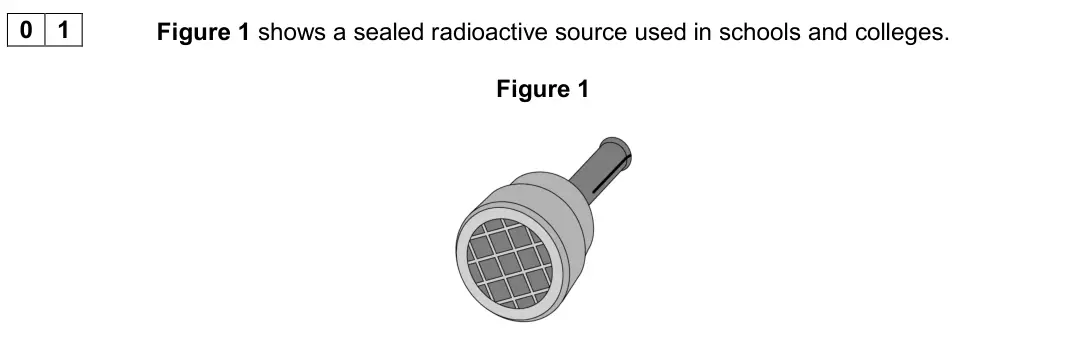
- Your answer
Q01.4
The whole paper ↗
Q01.5
The whole paper ↗Q1(b)(i)
The whole paper ↗
Q1(b)(ii)
The whole paper ↗Q1(a)
The whole paper ↗Q1(c)
The whole paper ↗Q2(a)(i)
The whole paper ↗
Q2(a)(ii)
The whole paper ↗Q3(b)(i)
The whole paper ↗
All 27 questions on Rutherford scattering, as a list
- June 2023, Paper 2, Q26 (1 mark): Alpha particle scattering can be demonstrated using a thin gold foil. Which statement about this demonstration is not true? [1 mark] A The foil is thin enough t
- June 2022, Paper 2, Q25 (1 mark): What was deduced or observed in the Rutherford scattering experiment? [1 mark] A All gold atoms are not alike. B Alpha particles are helium nuclei. C Some parti
- June 2022, Paper 2, Q26 (1 mark): Which row is correct for α, β and γ radiation? [1 mark] α β γ A Is it deflected by a magnetic field? yes yes no B Is it deflected by an electric field? yes yes
- November 2021, Paper 2, Q26 (1 mark): The diagram shows the path of a proton being deflected by the nucleus of an atom. Point P is the position of the proton when it is closest to the nucleus. What
- November 2021, Paper 2, Q27 (1 mark): The diagram shows an area of 0.10 m2 normal to a line connecting it to a point source of gamma radiation. The source emits photons uniformly in all directions.
- November 2020, Paper 2, Q05.1 (1 mark): State the fundamental force involved when alpha particle 1 is scattered by the nucleus in Figure 11. [1 mark]
- November 2020, Paper 2, Q05.2 (1 mark): Draw an arrow at position X on Figure 11 to show the direction of the rate of change in momentum of alpha particle 1 [1 mark]
- November 2020, Paper 2, Q05.3 (2 marks): Suggest one of the alpha particles in Figure 11 which may be deflected downwards with a scattering angle of 90° Justify your answer. [2 marks] alpha particle nu
- November 2020, Paper 2, Q28 (1 mark): A point source emits gamma radiation. The intensity I of the radiation is measured at different distances d from the source. Which graph will show a straight li
- June 2019, Paper 3A, Q01.7 (2 marks): Determine e using Figure 6. [2 marks] e = mm
- June 2017, Paper 2, Q26 (1 mark): The Rutherford scattering experiment led to [1 mark] A the discovery of the electron. B the quark model of hadrons. C the discovery of the nucleus. D evidence f
- Specimen, Paper 1, Q01.4 (1 mark): A common type of smoke detector contains a very small amount of americium-241, Am 95 241 0 1 The alpha radiation produced by americium-241 causes the ionisation
- Specimen, Paper 1, Q01.5 (2 marks): A common type of smoke detector contains a very small amount of americium-241, Am 95 241 0 1 A friend who has not studied physics suggests that a smoke detector
- June 2016, PHYA5 Section A (old spec), Q1(b)(i) (2 marks): Sketch a labelled diagram showing the experimental arrangement of the apparatus used by Rutherford. [2 marks]
- June 2016, PHYA5 Section A (old spec), Q1(b)(ii) (6 marks): State and explain the results of the scattering experiment. Your answer should include the following: the main observations the significance of each observati
- June 2015, PHYA5 Section A (old spec), Q1(a) (1 mark): Which ionizing radiation produces the greatest number of ion pairs per mm in air? Tick () the correct answer. [1 mark] α particles β particles γ rays X-rays
- June 2015, PHYA5 Section A (old spec), Q1(c) (2 marks): Following an accident, a room is contaminated with dust containing americium which is an α-emitter. Explain the most hazardous aspect of the presence of this du
- June 2015, PHYA5 Section A (old spec), Q2(a)(i) (1 mark): State the main interaction when an alpha particle is scattered by a gold nucleus. [1 mark]
- June 2015, PHYA5 Section A (old spec), Q2(a)(ii) (1 mark): The gold foil is replaced with another foil of the same size made from a mixture of isotopes of gold. Nothing else in the experiment is changed. Explain whether
- June 2012, PHYA5 Section A (old spec), Q3(b)(i) (2 marks): Assume the source emits γ rays uniformly in all directions. Show that the ratio number of γ photons incident on detector number of γ photons produced by source
- June 2012, PHYA5 Section A (old spec), Q3(b)(ii) (3 marks): The γ ray detector detects 1 in 400 of the γ photons incident on the facing surface of the detector. Calculate the activity of the source. State an appropriate
- June 2012, PHYA5 Section A (old spec), Q5(c) (6 marks): Nuclear radii have been investigated using α particles in Rutherford scattering experiments and by using electrons in diffraction experiments. Make comparisons
- June 2010, PHYA1 (old spec), Q2(b)(i) (1 mark): State the nature of an alpha particle. (1 mark)
- June 2008, PA01 (2008 spec), Q2(a) (2 marks): 2 (a) (i) Explain why the incident α particles should be in a narrow beam. 2 (a) (ii) The metal foil should be very thin to prevent too many α particles from be
- June 2008, PA01 (2008 spec), Q2(b) (2 marks): 2 (b) Describe the angular distribution of the scattered α particles coming from the foil. State the scattering angles at which the number of α particles will b
- June 2008, PA01 (2008 spec), Q2(c) (4 marks): 2 (c) State and explain two deductions made from the scattering distribution about the structure of the atoms in the foil. (4 marks)
- June 2008, PA01 (2008 spec), Q2(d) (3 marks): 2 (d) On Figure 1 complete the paths taken by the parallel monoenergetic α particles which all come close enough to the nucleus to be deflected. Figure 1 monoen
Questions, mark schemes and examiner’s reports are © AQA, from their published past papers. Plumi isn’t affiliated with any exam board. Want whole papers? AQA A-Level Physics past papers.
The Plumi iPad app also offers exam-style questions with AI feedback on your handwritten working.