 plumi
Radioactive decay: AQA A‑Level Physics questions
AQA A-Level Physics past-paper questions on 3.8.1.3 Radioactive decay, 2008–2025, with mark schemes and examiner’s reports where available.
Paper
All papers
Exam
All years
Calculations
Q03.2
The whole paper ↗
Q02.1
The whole paper ↗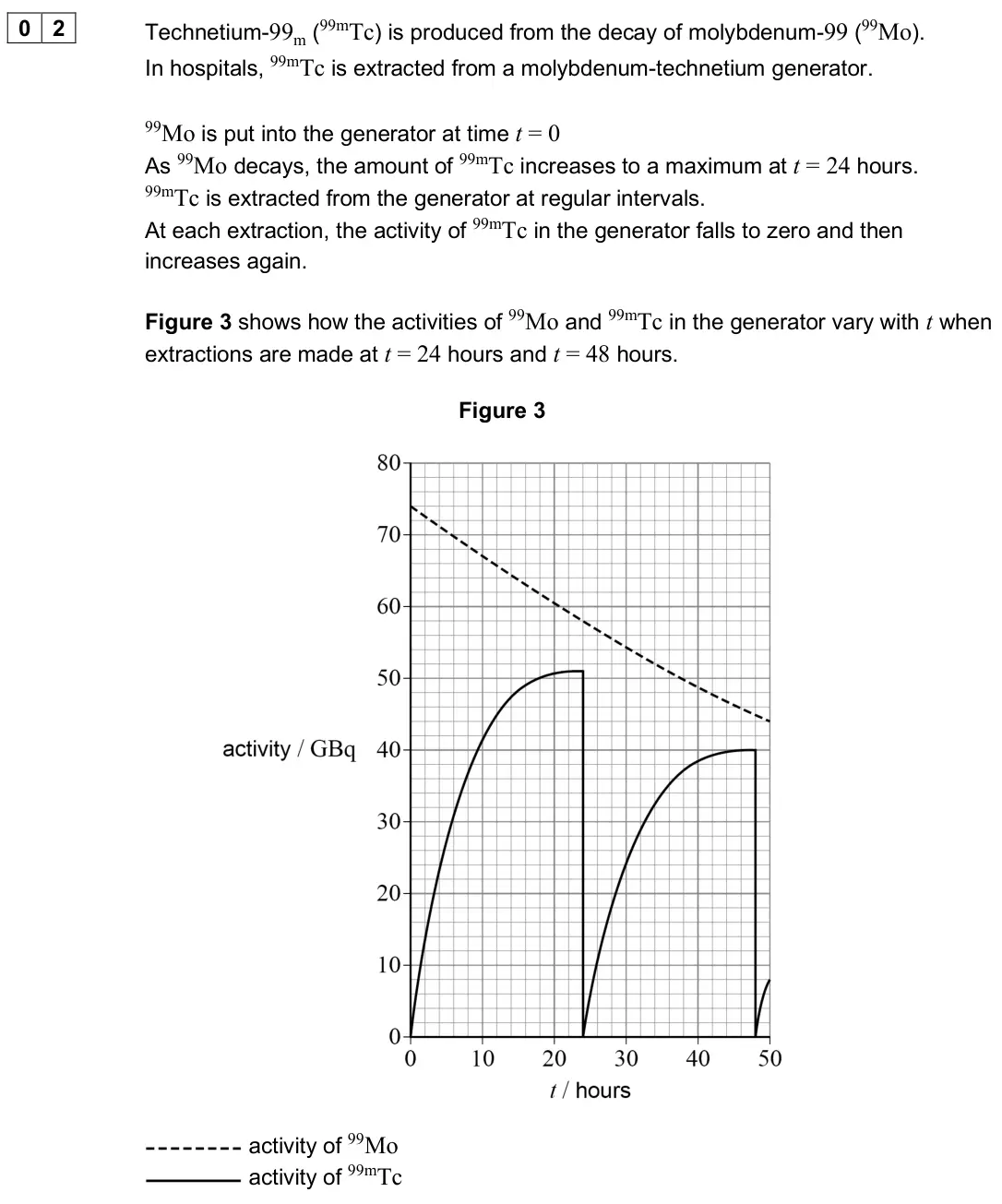
Q07.1
The whole paper ↗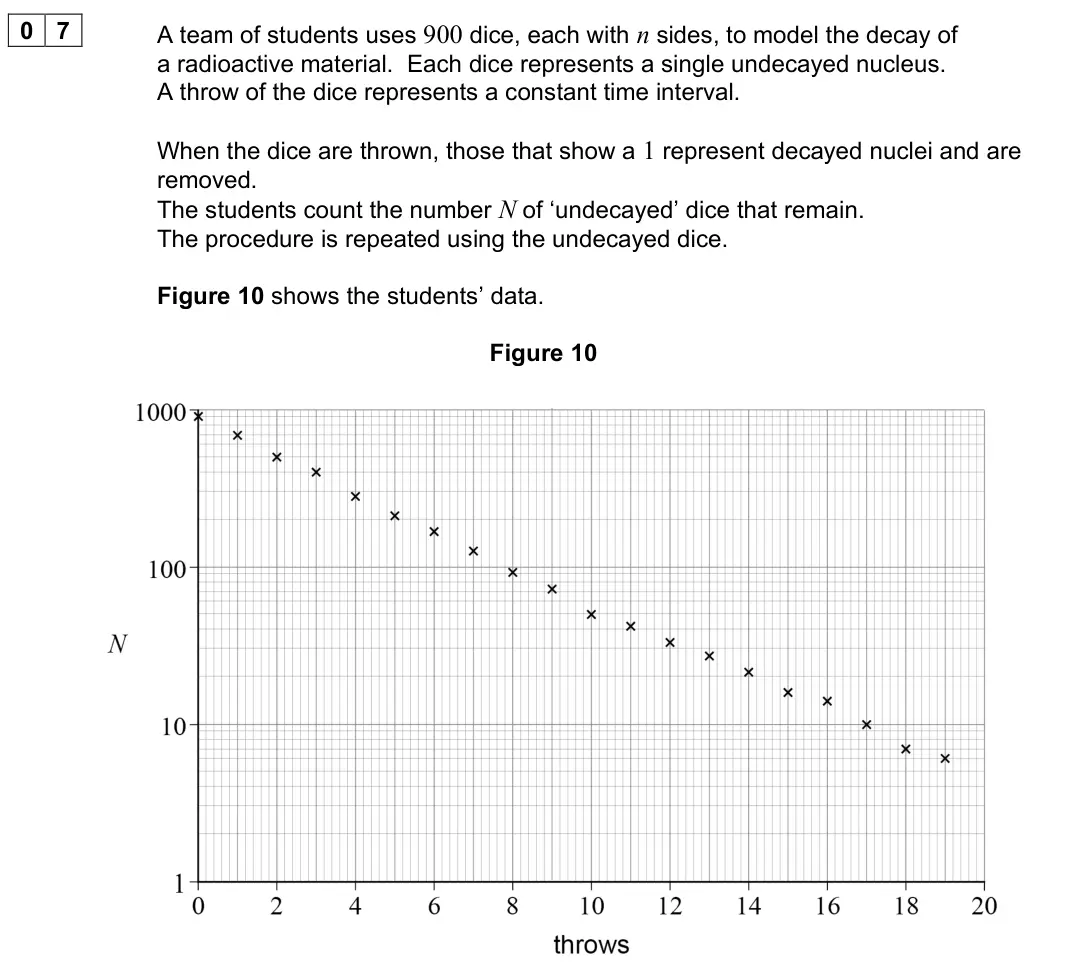
Q07.2
The whole paper ↗Q06.2
The whole paper ↗
Q06.3
The whole paper ↗- Your answer
Q02.5
The whole paper ↗
Q02.6
The whole paper ↗Q05.4
The whole paper ↗Q06.1
The whole paper ↗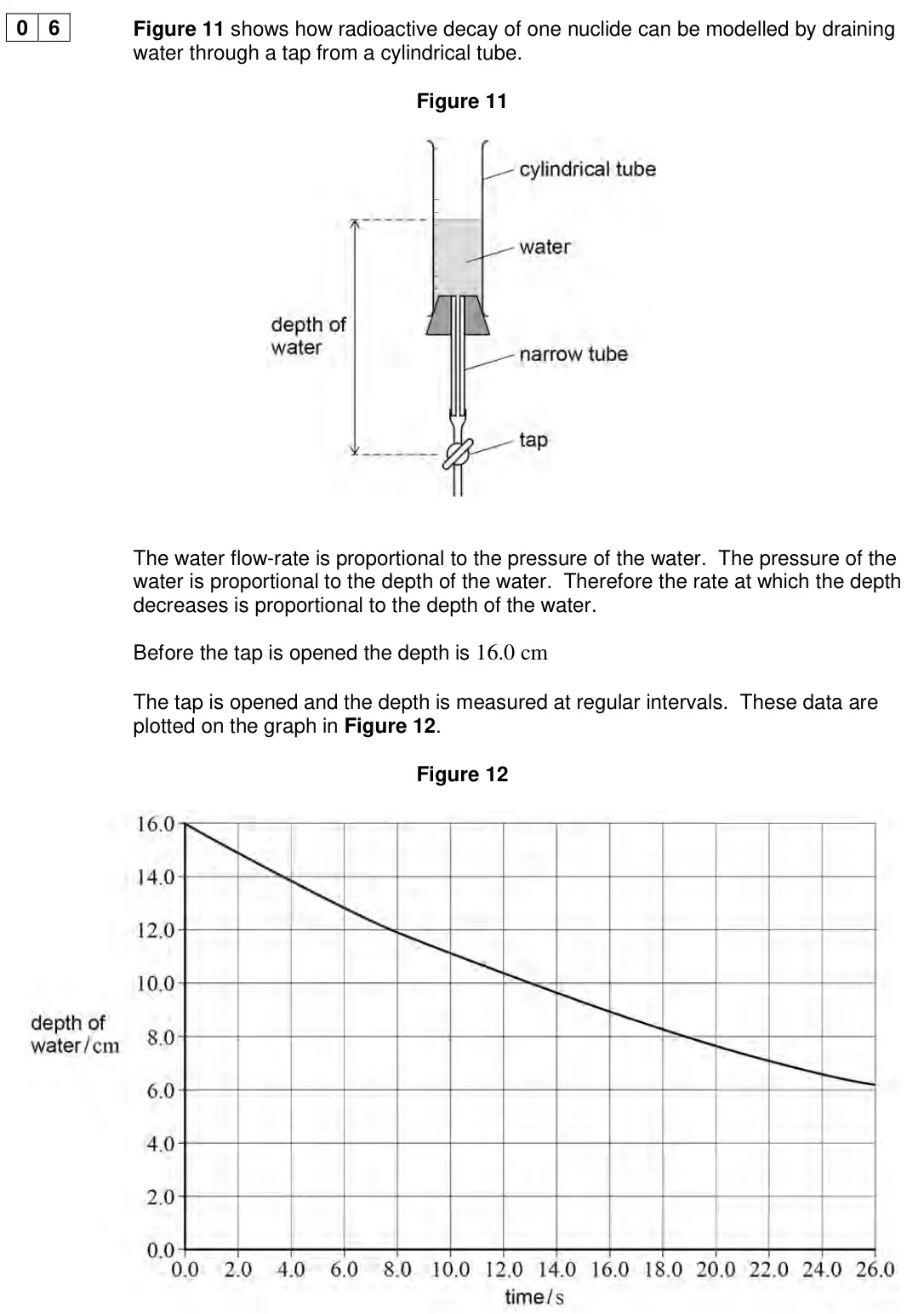
Q06.2
The whole paper ↗
All 43 questions on Radioactive decay, as a list
- June 2025, Paper 2, Q03.2 (5 marks): The plutonium-238 undergoes alpha decay. The energy released by this decay is converted into electrical energy with an efficiency of 4.58%. The power provided b
- June 2025, Paper 2, Q25 (1 mark): A radiation meter is placed at a distance d from a source of gamma radiation. The corrected count rate is 800 counts per second. When the radiation meter is mov
- June 2025, Paper 3 Medical physics, Q02.1 (2 marks): Show that about 6 × 10¹⁵ nuclei of 99Mo decay between t = 0 and t = 24 hours. decay constant for 99Mo = 2.8 × 10⁻⁶ s−1 [2 marks]
- June 2024, Paper 2, Q07.1 (1 mark): Explain why N has been plotted on a logarithmic scale in Figure 10. [1 mark]
- June 2024, Paper 2, Q07.2 (5 marks): In this experiment, a decay constant λ can be defined that models the radioactive decay constant. Determine λ. Go on to use your value for λ to show that n = 4
- June 2024, Paper 2, Q32 (1 mark): A rock sample is found to contain the stable isotope lead-207. When it was formed, the rock contained uranium-235 but did not contain any lead-207. Uranium-235
- June 2023, Paper 2, Q28 (1 mark): The random nature of radioactive decay means that it is never possible to predict [1 mark] A when a particular nucleus will decay. B whether a β− particle or a
- June 2023, Paper 2, Q30 (1 mark): Tritium is a radioactive nuclide used in ‘Exit’ signs. When a sign was manufactured the activity of the tritium in it was 37 MBq. After 10 years the tritium in
- June 2023, Paper 2, Q32 (1 mark): The graph shows the variation of activity with time for a sample of a nuclide X. What was the initial number of nuclei of X in the sample? [1 mark] A 4.67 × 10⁵
- June 2022, Paper 2, Q27 (1 mark): A sample of radioactive material consists of 200 g of nuclide P and 100 g of nuclide Q. Nuclide P has a half-life of 2 days and nuclide Q has a half-life of 4 d
- June 2022, Paper 2, Q28 (1 mark): A nuclide has a half-life of 10 ms. The decay constant for this nuclide lies between [1 mark] A 1 s−1 and 10 s−1. B 10 s−1 and 102 s−1. C 102 s−1 and 103 s−1. D
- November 2021, Paper 2, Q28 (1 mark): X and Y are two radioactive nuclides. X has a half-life of 3.0 minutes and Y has a half-life of 9.0 minutes. Two freshly prepared samples of X and Y start decay
- November 2020, Paper 2, Q06.2 (2 marks): The amounts of U-235 and U-238 in the ore decrease due to radioactive decay at different rates. A sample of uranium ore today contains 993 g of U-238 The mass o
- November 2020, Paper 2, Q06.3 (1 mark): A thermal nuclear reactor requires a minimum of 3.0% of its uranium mass to be U-235 The ratio of U-235 to U-238 in the ore has changed over time. 2.00 × 10⁹ ye
- November 2020, Paper 2, Q29 (1 mark): The number of parent nuclei in a sample of a radioactive element is N at time t. The radioactive element has a half-life 1 2 t The rate of decay is proportional
- June 2019, Paper 3A, Q02.5 (2 marks): Figure 10 shows part of the graph drawn from the student’s data. Figure 10 It can be shown that y decreases exponentially with t. Show that , the decay constant
- June 2019, Paper 3A, Q02.6 (1 mark): T1 2⁄ is the time for y to decrease by 50%, as shown in Figure 11. Figure 11 Determine T1 2 ⁄ . [1 mark] T1 2⁄ = s
- June 2018, Paper 2, Q05.4 (2 marks): State two possible reasons why the results do not follow the expected inverse-square law. [2 marks] Reason 1 Reason 2
- June 2018, Paper 2, Q06.1 (1 mark): Determine the predicted depth of water when the time is 57 s [1 mark] depth = cm
- June 2018, Paper 2, Q06.2 (1 mark): Suggest how the apparatus in Figure 11 may be changed to represent a radioactive sample of the same nuclide with a greater number of nuclei. [1 mark]
- June 2018, Paper 2, Q06.3 (1 mark): Suggest how the apparatus in Figure 11 may be changed to represent a radioactive sample of a nuclide with a smaller decay constant. [1 mark]
- June 2018, Paper 2, Q06.4 (1 mark): The age of the Moon has been estimated from rock samples containing rubidium (Rb) and strontium (Sr), brought back from Moon landings. Rb 37 87 decays to Sr 38
- June 2018, Paper 2, Q06.5 (3 marks): A sample of Moon rock contains 1.23 mg of Rb 37 87 . Calculate the mass, in g, of Rb 37 87 that the rock sample contained when it was formed 4.47 × 10⁹ years ag
- June 2018, Paper 2, Q06.6 (3 marks): Calculate the activity of a sample of Rb 37 87 of mass 1.23 mg Give an appropriate unit for your answer. [3 marks] activity = unit
- June 2017, Paper 2, Q28 (1 mark): Nobelium-259 has a half-life of 3500 s. What is the decay constant of nobelium-259? [1 mark] A 8.7 × 10⁻⁵ s−1 B 2.0 × 10⁻⁴ s−1 C 1.7 × 10⁻² s−1 D 1.2 × 10⁻² s−1
- June 2017, Paper 2, Q29 (1 mark): A pure sample of nuclide X containing N nuclei has an activity A. The half-life of X is 6000 years. A pure sample of nuclide Y containing 3N nuclei has an activ
- June 2017, Paper 2, Q30 (1 mark): Cobalt-60 has a half-life of 5.27 years. What is the total activity of 1.0 g of cobalt-60? [1 mark] A 4.2 × 10¹³ Bq B 2.2 × 10¹⁴ Bq C 2.5 × 10¹⁵ Bq D 1.3 × 10²¹
- Specimen, Paper 2, Q04.1 (1 mark): An ancient sealed flask contains a liquid, assumed to be water. An archaeologist asks a scientist to determine the volume of liquid in the flask without opening
- Specimen, Paper 2, Q04.2 (3 marks): An ancient sealed flask contains a liquid, assumed to be water. An archaeologist asks a scientist to determine the volume of liquid in the flask without opening
- Specimen, Paper 2, Q04.3 (3 marks): An ancient sealed flask contains a liquid, assumed to be water. An archaeologist asks a scientist to determine the volume of liquid in the flask without opening
- Specimen, Paper 2, Q04.4 (2 marks): An ancient sealed flask contains a liquid, assumed to be water. An archaeologist asks a scientist to determine the volume of liquid in the flask without opening
- Specimen, Paper 2, Q28 (1 mark): Which of the following best describes the decay constant for a radioisotope? [1 mark] A The reciprocal of the half-life of the radioisotope. B The rate of decay
- Specimen, Paper 2, Q30 (1 mark): After 64 days the activity of a radioactive nuclide has fallen to one sixteenth of its original value. The half-life of the radioactive nuclide is [1 mark] A 2
- June 2015, PHYA5 Section A (old spec), Q3(b)(i) (2 marks): Show that the decay constant of the sample is about 3.4 × 10⁻⁶ s–1. [2 marks]
- June 2015, PHYA5 Section A (old spec), Q3(b)(ii) (1 mark): Assume that the activity shown in Figure 2 comes only from the decay of neptunium. Estimate the number of neptunium nuclei present in the sample at time t = 5.0
- June 2014, PHYA5 Section A (old spec), Q2(a)(i) (1 mark): The half-life of carbon-14 is 5740 years. Calculate the radioactive decay constant in yr –1 of carbon-14. [1 mark] decay constant yr –1
- June 2014, PHYA5 Section A (old spec), Q2(a)(ii) (3 marks): A piece of wood taken from an axe handle found on an archaeological site has 0.375 times as many carbon-14 atoms as an equal mass of living wood. Calculate the
- June 2014, PHYA5 Section A (old spec), Q2(b) (2 marks): Suggest why the method of carbon dating is likely to be unreliable if a sample is: [2 marks] 2 (b) (i) less than 200 years old, 2 (b) (ii) more than 60 000 year
- June 2012, PHYA5 Section A (old spec), Q2(c)(i) (2 marks): Sketch on Figure 3 graphs to show how the number of 238 92U atoms and the number of 206 82Pb atoms in the rock sample vary over a period of 1.0 × 10¹⁰ years fro
- June 2012, PHYA5 Section A (old spec), Q2(c)(ii) (1 mark): A certain time, t, after its formation the sample contained twice as many 238 92U atoms as 206 82Pb atoms. Show that the number of 238 92U atoms in the rock sam
- June 2012, PHYA5 Section A (old spec), Q2(c)(iii) (3 marks): Calculate t in years. answer = years (3 marks)
- June 2012, PHYA5 Section A (old spec), Q3(b)(ii) (3 marks): The γ ray detector detects 1 in 400 of the γ photons incident on the facing surface of the detector. Calculate the activity of the source. State an appropriate
- June 2008, PHA5CORE (2008 spec), Q1(a) (3 marks): 1 (a) An isotope of technetium 99Tc m, 43 which is in a metastable state, decays emitting only γ rays. When the isotope is placed 20 cm from a γ ray detector th
Questions, mark schemes and examiner’s reports are © AQA, from their published past papers. Plumi isn’t affiliated with any exam board. Want whole papers? AQA A-Level Physics past papers.
The Plumi iPad app also offers exam-style questions with AI feedback on your handwritten working.