 plumi
α, β and γ radiation: AQA A‑Level Physics questions
AQA A-Level Physics past-paper questions on 3.8.1.2 α, β and γ radiation, 2008–2025, with mark schemes and examiner’s reports where available.
Paper
All papers
Exam
All years
Calculations
Q04.4
The whole paper ↗
Q01.1
The whole paper ↗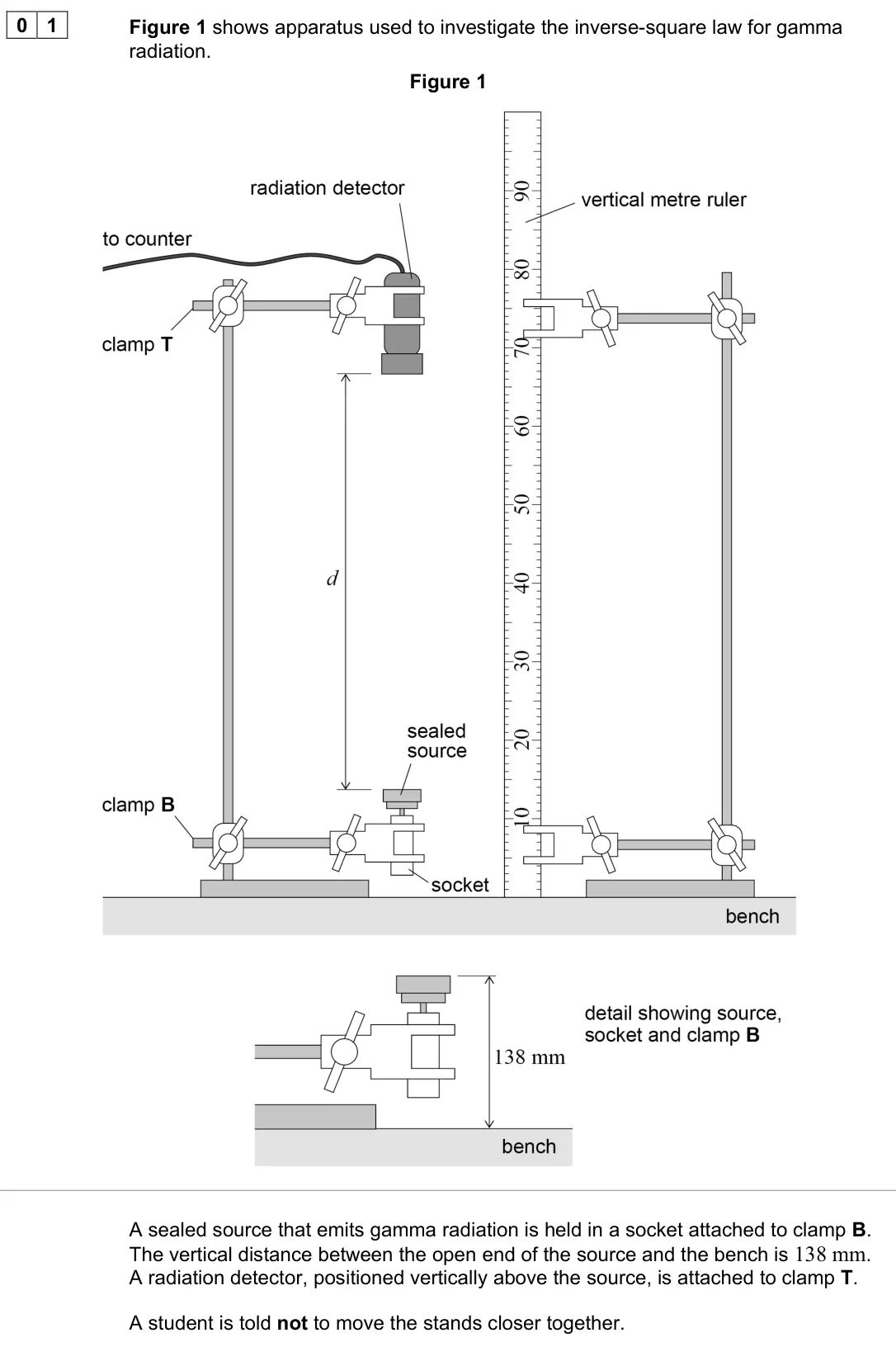
Q01.2
The whole paper ↗Q01.3
The whole paper ↗Q01.4
The whole paper ↗Q01.5
The whole paper ↗Q01.6
The whole paper ↗Q01.7
The whole paper ↗Q01.8
The whole paper ↗- Your answer
Q01.1
The whole paper ↗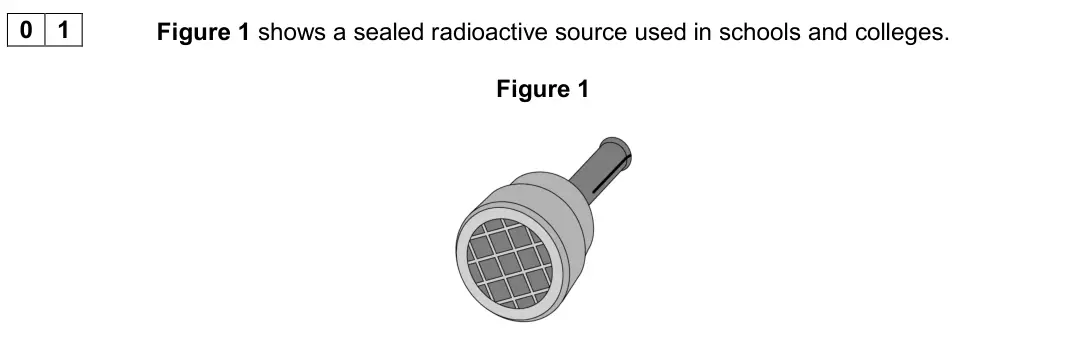
Q01.4
The whole paper ↗Q01.5
The whole paper ↗Q01.6
The whole paper ↗Q05.1
The whole paper ↗Q05.2
The whole paper ↗
All 36 questions on α, β and γ radiation, as a list
- June 2025, Paper 2, Q29 (1 mark): Which is not a use of water in the nuclear industry? [1 mark] A to absorb neutrons released from fission B to cool a nuclear reactor C to shield radiation produ
- June 2023, Paper 2, Q04.4 (3 marks): The alpha source in Figure 4 is moved to different heights h above the mesh. Figure 7 shows how the number of sparks N produced in 10 minutes varies with h. No
- June 2023, Paper 2, Q28 (1 mark): The random nature of radioactive decay means that it is never possible to predict [1 mark] A when a particular nucleus will decay. B whether a β− particle or a
- June 2023, Paper 2, Q29 (1 mark): Radiation is used to measure the thickness of an aluminium sheet accurately. The thickness of the sheet is about 0.5 mm. Which type of radiation is most appropr
- June 2022, Paper 2, Q30 (1 mark): Which is not true for gamma radiation? [1 mark] A It is more penetrating than alpha or beta radiation of the same energy through the same material. B Its intens
- November 2021, Paper 3A, Q01.1 (2 marks): Describe a procedure for the student to find the value of d, the vertical distance between the open end of the source and the radiation detector. In your answer
- November 2021, Paper 3A, Q01.2 (2 marks): Before the source was brought into the room, a background count Cb was recorded. Cb = 630 counts in 15 minutes With the source and detector in the positions sho
- November 2021, Paper 3A, Q01.3 (2 marks): The apparatus is adjusted so that d = 380 mm. Counts are made that show RC = 0.76 s−1. The student predicts that: RC = 2 k d where k is a constant. Explain whet
- November 2021, Paper 3A, Q01.4 (2 marks): Describe a safe procedure to reduce d. Give a reason for your procedure. [2 marks]
- November 2021, Paper 3A, Q01.5 (2 marks): Determine ∆d. [2 marks] ∆d = mm
- November 2021, Paper 3A, Q01.6 (3 marks): Explain how the student could confirm whether Figure 2 supports the prediction: RC = 2 k d No calculation is required. [3 marks]
- November 2021, Paper 3A, Q01.7 (1 mark): The distance between the source and the detector is adjusted so that d is very small and R1 is 100 s−1. On average, two of the gamma photons that enter the dete
- November 2021, Paper 3A, Q01.8 (2 marks): A student says that if 100 gamma photons enter a detector in one second and td is 0.01 s, all the photons should be detected. Explain, with reference to the nat
- June 2019, Paper 2, Q18 (1 mark): When a small radioactive source is placed in a cloud chamber, straight tracks about 4 cm long are observed. The same source is placed 10 cm from a Geiger tube a
- June 2019, Paper 3A, Q01.1 (2 marks): State two safety procedures to reduce risk when using this type of source. [2 marks] Safety procedure 1 Safety procedure 2
- June 2019, Paper 3A, Q01.4 (3 marks): The sealed source emits γ radiation in addition to α and β– particles. A student uses the sealed source to investigate the inverse-square law for γ radiation. T
- June 2019, Paper 3A, Q01.5 (3 marks): Figure 3 shows an aluminium absorber placed between the sealed source and a radiation detector. This is to make sure that only γ radiation from the source reach
- June 2019, Paper 3A, Q01.6 (5 marks): Ionisation takes place inside the detector. The effective distance travelled by γ radiation from the source is (d + e). The distance e, shown in Figure 5, canno
- June 2018, Paper 2, Q05.1 (1 mark): Suggest, with a reason, which type of radiation is likely to be the most appropriate for the sterilisation of metallic surgical instruments. [1 mark]
- June 2018, Paper 2, Q05.2 (1 mark): Explain why the public need not worry that irradiated surgical instruments become radioactive once sterilised. [1 mark]
- June 2018, Paper 2, Q05.3 (2 marks): A student detects the counts from a radioactive source using a G-M radiation detector as shown in Figure 10. Figure 10 The student measures the count rate for t
- June 2018, Paper 2, Q05.4 (2 marks): State two possible reasons why the results do not follow the expected inverse-square law. [2 marks] Reason 1 Reason 2
- June 2017, Paper 2, Q27 (1 mark): A Geiger counter is placed near a radioactive source and different materials are placed between the source and the Geiger counter. The results of the tests are
- June 2016, PHYA5 Section A (old spec), Q2(a) (1 mark): The exposure of the general public to background radiation has changed substantially over the past 100 years. State one source of radiation that has contributed
- June 2016, PHYA5 Section A (old spec), Q2(b)(i) (3 marks): Calculate the average count-rate she would expect to record when the source is placed 0.90 m from the detector. [3 marks] count-rate = ________________________
- June 2016, PHYA5 Section A (old spec), Q2(b)(ii) (1 mark): The average count per minute of 2050 was determined from a measurement over a period of 5 minutes. Explain why the student might choose to record for longer tha
- June 2016, PHYA5 Section A (old spec), Q2(b)(iii) (2 marks): When the detector was moved to 0.90 m the count-rate was lower than that calculated in part (b)(i). It is suggested that the source may also emit β particles. E
- June 2015, PHYA5 Section A (old spec), Q1(b)(i) (2 marks): Complete Table 1 below showing the typical maximum range in air for α and β particles. [2 marks] Table 1 Type of radiation Typical range in air / m α β
- June 2015, PHYA5 Section A (old spec), Q1(b)(ii) (1 mark): γ rays have a range of at least 1 km in air. However, a γ ray detector placed 0.5 m from a γ ray source detects a noticeably smaller count-rate as it is moved a
- June 2015, PHYA5 Section A (old spec), Q3(b)(i) (2 marks): Show that the decay constant of the sample is about 3.4 × 10⁻⁶ s–1. [2 marks]
- June 2015, PHYA5 Section A (old spec), Q3(b)(ii) (1 mark): Assume that the activity shown in Figure 2 comes only from the decay of neptunium. Estimate the number of neptunium nuclei present in the sample at time t = 5.0
- June 2015, PHYA5 Section A (old spec), Q3(c)(iii) (2 marks): Substantial shielding around the core protects nearby workers from the most hazardous radiations. Radiation from the core includes α and β particles, γ rays, X–
- June 2014, PHYA5 Section A (old spec), Q5(a) (2 marks): A nuclear reactor core is contained in a steel vessel surrounded by concrete. State and explain the purpose of the concrete other than its structural function.
- June 2013, PHYA5 Section A (old spec), Q5 (6 marks): A radioactive source used in a school laboratory is thought to emit α particles and γ radiation. Describe an experiment that may be used to verify the types of
- June 2012, PHYA5 Section A (old spec), Q3(a) (1 mark): In a radioactivity experiment, background radiation is taken into account when taking corrected count rate readings in a laboratory. One source of background ra
- June 2012, PHYA5 Section A (old spec), Q3(c) (3 marks): Calculate the corrected count rate when the detector is moved 0.10m further from the source. answer = countss–1 (3 marks)
Questions, mark schemes and examiner’s reports are © AQA, from their published past papers. Plumi isn’t affiliated with any exam board. Want whole papers? AQA A-Level Physics past papers.
The Plumi iPad app also offers exam-style questions with AI feedback on your handwritten working.