 plumi
Moving charges in a magnetic field: AQA A‑Level Physics questions
AQA A-Level Physics past-paper questions on 3.7.5.2 Moving charges in a magnetic field, 2008–2025, with mark schemes and examiner’s reports where available.
Paper
All papers
Exam
All years
Calculations
Q06.2
The whole paper ↗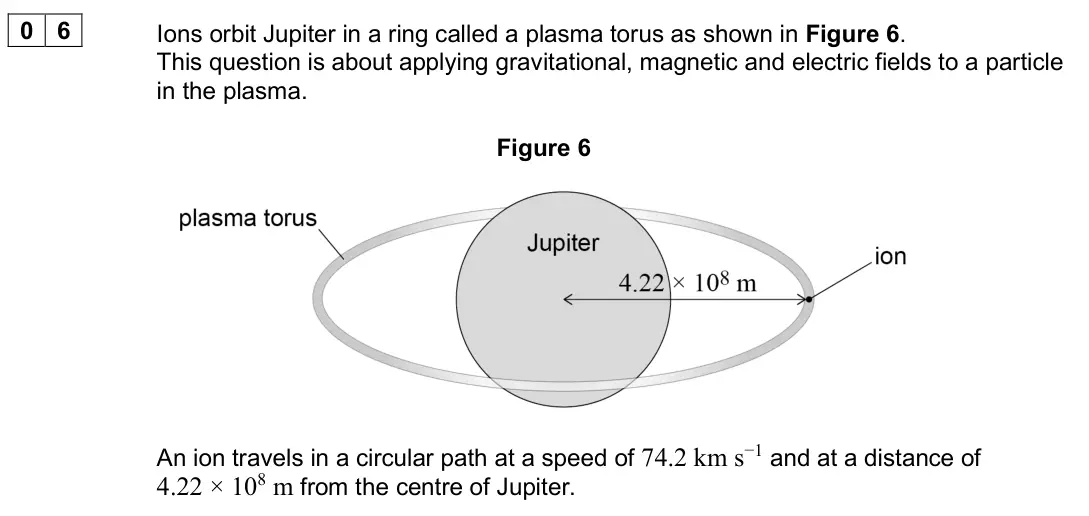
Q06.3
The whole paper ↗Q05.1
The whole paper ↗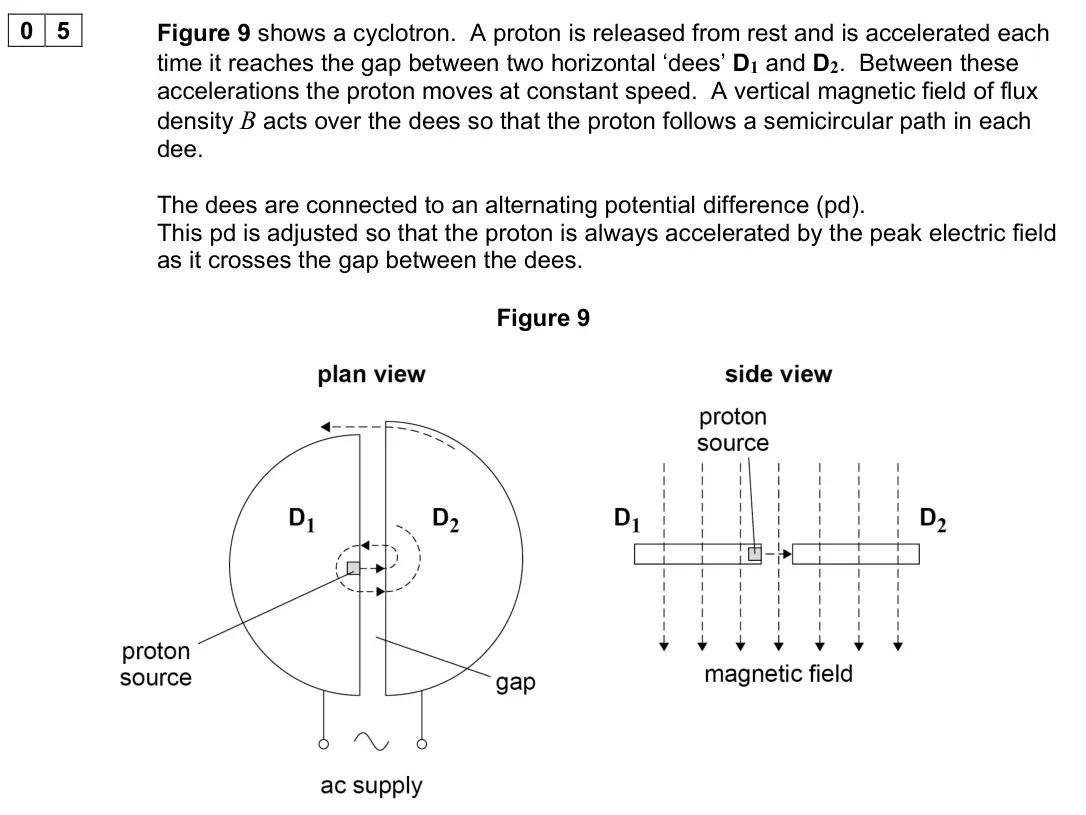
Q05.2
The whole paper ↗Q05.3
The whole paper ↗Q05.4
The whole paper ↗Q03.1
The whole paper ↗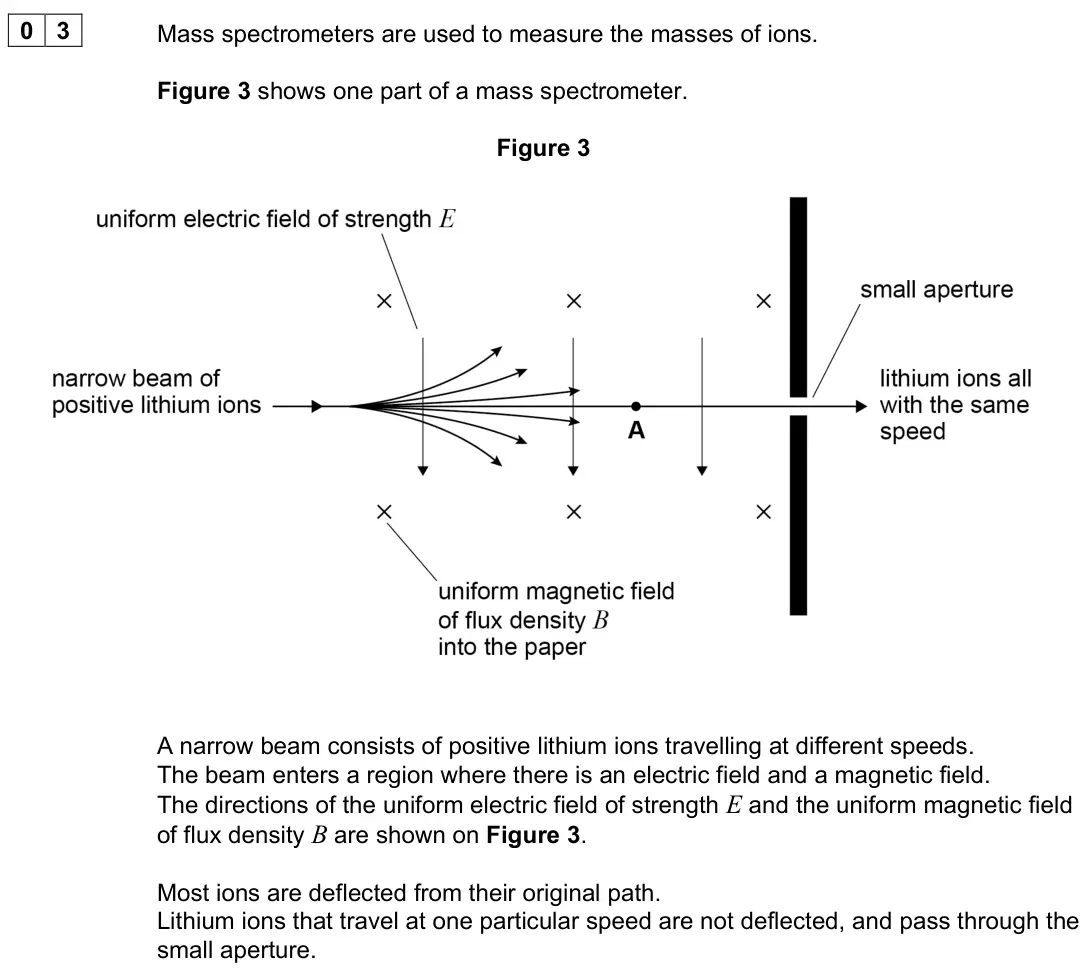
Q03.2
The whole paper ↗Q03.3
The whole paper ↗Q03.4
The whole paper ↗- Your answer
- Your answer
Q03.1
The whole paper ↗
Q03.2
The whole paper ↗Q03.3
The whole paper ↗- Your answer
- Your answer
All 58 questions on Moving charges in a magnetic field, as a list
- June 2025, Paper 2, Q06.2 (1 mark): Draw an arrow on Figure 7 to show the direction of this magnetic field. [1 mark]
- June 2025, Paper 2, Q06.3 (3 marks): The ion moves with a speed of 74.2 km s−1 in a circle of radius 4.22 × 10⁸ m. Calculate the magnitude of the magnetic flux density required for this motion. Sta
- June 2024, Paper 2, Q16 (1 mark): An electron enters a uniform magnetic field at right angles to the field. The flux density of the field is B. The electron moves with a non-relativistic speed v
- June 2023, Paper 2, Q21 (1 mark): A beam consists of ionised atoms of two isotopes of an element. When the beam enters a uniform magnetic field, the ions move in circular paths. The ions have th
- June 2022, Paper 2, Q14 (1 mark): When an electron moves at a speed v perpendicular to a uniform magnetic field of flux density B, the radius of its path is R. A second electron moves at a speed
- November 2021, Paper 2, Q05.1 (2 marks): Explain why the proton travels in a semicircular path in a dee. [2 marks]
- November 2021, Paper 2, Q05.2 (1 mark): The peak pd of the alternating supply is 10.0 kV. The proton leaves the cyclotron with kinetic energy of 14 MeV. Determine the number of times the proton moves
- November 2021, Paper 2, Q05.3 (3 marks): Show that Ek is given by 2 2 2 k p 2 e B R E m = [3 marks]
- November 2021, Paper 2, Q05.4 (4 marks): A hospital decides to purchase a cyclotron in order to manufacture its own radioactive isotopes using high-speed protons. The required minimum kinetic energy of
- November 2020, Paper 2, Q03.1 (1 mark): The positive lithium ion A in Figure 3 moves at a speed v. Draw two labelled arrows on Figure 3 to show the directions of the electric force FE and the magnetic
- November 2020, Paper 2, Q03.2 (2 marks): Lithium ions travelling at 1.5 × 10⁵ m s−1 pass through the small aperture. Calculate E. B = 0.12 T [2 marks] E = V m−1
- November 2020, Paper 2, Q03.3 (1 mark): Ions that pass through the small aperture enter a second uniform magnetic field of flux density B. Ions of different mass are separated because they follow diff
- November 2020, Paper 2, Q03.4 (2 marks): The ions of different mass are deflected and strike the detector surface at different distances from the small aperture as shown in Figure 4. A singly-charged l
- June 2019, Paper 2, Q13 (1 mark): When an electron is moving at a speed v perpendicular to a uniform magnetic field of flux density B, it follows a path of radius R. A second electron moves at a
- June 2018, Paper 2, Q26 (1 mark): Different magnetic fields are present in the two chambers shown. A particle enters the first chamber at a velocity of 80 m s–1 and is deflected into a circular
- June 2017, Paper 2, Q03.1 (1 mark): Explain why it is not possible for the magnetic field to alter the speed of a proton while it is in one of the D-shaped regions. [1 mark]
- June 2017, Paper 2, Q03.2 (3 marks): Derive an expression to show that the time taken by a proton to travel round one semi-circular path is independent of the radius of the path. [3 marks]
- June 2017, Paper 2, Q03.3 (2 marks): The maximum radius of the path followed by the proton is 0.55 m and the magnetic flux density of the uniform field is 0.44 T. Ignore any relativistic effects. C
- Specimen, Paper 2, Q19 (1 mark): Charged particles, each of mass m and charge Q, travel at a constant speed in a circle of radius r in a uniform magnetic field of flux density B. Which expressi
- June 2015, PHYA4 Section A (old spec), Q22 (1 mark): Which one of the following statements is correct? An electron follows a circular path when it is moving at right angles to A a uniform magnetic field. B a unifo
- June 2015, PHYA4 Section A (old spec), Q23 (1 mark): Two electrons, X and Y, travel at right angles to a uniform magnetic field. X experiences a magnetic force, FX, and Y experiences a magnetic force, FY. What is
- June 2015, PHYA5 Turning points (old spec), Q1(a)(i) (2 marks): Explain why the path followed by the electron beam in the magnetic field is a circular arc. [2 marks]
- June 2015, PHYA5 Turning points (old spec), Q1(a)(ii) (1 mark): Show that the speed v of the electrons is given by v = ––– where r is the radius of the path of an electron in the magnetic field and B is the flux density of t
- June 2014, PHYA4 Section A (old spec), Q21 (1 mark): The path followed by an electron of momentum p, carrying charge –e, which enters a magnetic field at right angles, is a circular arc of radius r. What would be
- June 2014, PHYA4 Section B (old spec), Q2(b)(iii) (2 marks): With a current of 0.38A, the average velocity of an electron in the wire is 5.5 × 10⁻⁶ms–1 and the average magnetic force on one electron is 1.4 × 10⁻²⁵N. Calcu
- June 2014, PHYA5 Turning points (old spec), Q3(a)(i) (2 marks): Explain why a magnetic lens deflects the electrons without changing their kinetic energy. [2 marks]
- June 2013, PHYA4 Section B (old spec), Q3(a)(i) (2 marks): State two situations in which a charged particle will experience no magnetic force when placed in a magnetic field. first situation second situation
- June 2013, PHYA4 Section B (old spec), Q3(a)(ii) (2 marks): A charged particle moves in a circular path when travelling perpendicular to a uniform magnetic field. By considering the force acting on the charged particle,
- June 2013, PHYA4 Section B (old spec), Q3(b)(i) (1 mark): State the direction in which the magnetic field should be applied in order for the protons to travel along the semicircular paths inside each of the dees as sho
- June 2013, PHYA4 Section B (old spec), Q3(b)(ii) (2 marks): In a particular cyclotron the flux density of the uniform magnetic field is 0.48T. Calculate the speed of a proton when the radius of its path inside the dee is
- June 2013, PHYA4 Section B (old spec), Q3(b)(iii) (2 marks): Calculate the time taken for this proton to travel at constant speed in a semicircular path of radius 190mm inside the dee. time s (2 marks)
- June 2013, PHYA4 Section B (old spec), Q3(b)(iv) (2 marks): As the protons gain energy, the radius of the path they follow increases steadily, as shown in Figure 2. Show that your answer to part (b)(iii) does not depend
- June 2013, PHYA4 Section B (old spec), Q3(c) (3 marks): The protons leave the cyclotron when the radius of their path is equal to the outer radius of the dees. Calculate the maximum kinetic energy, in MeV, of the pro
- January 2013, PHYA4 Section A (old spec), Q21 (1 mark): Which line, A to D, in the table correctly describes the trajectory of charged particles which enter separately, at right angles, a uniform electric field, and
- June 2012, PHYA4 Section A (old spec), Q21 (1 mark): A beam of positive ions enters a region of uniform magnetic field, causing the beam to change direction as shown in the diagram. What is the direction of the ma
- June 2012, PHYA4 Section B (old spec), Q3(a) (4 marks): In the presence of a suitably directed uniform magnetic field, charged particles move at constant speed in a circular path of constant radius. By reference to t
- June 2012, PHYA4 Section B (old spec), Q3(b)(ii) (3 marks): Calculate the flux density of the uniform magnetic field that would be required to produce this force. State an appropriate unit. answer = unit (3 marks)
- June 2012, PHYA4 Section B (old spec), Q3(c) (2 marks): The speed of the protons gradually increases as their energy is increased by the LHC. State and explain how the magnetic field in the LHC must change as the spe
- January 2012, PHYA4 Section A (old spec), Q21 (1 mark): When a β particle moves at right angles through a uniform magnetic field it experiences a force F. An α particle moves at right angles through a magnetic field
- January 2012, PHYA4 Section A (old spec), Q22 (1 mark): Charged particles, each of mass m and charge Q, travel at a constant speed in a circle of radius r in a uniform magnetic field of flux density B. Which expressi
- June 2011, PHYA4 Section A (old spec), Q21 (1 mark): Two charged particles, P and Q, move in circular orbits in a magnetic field of uniform flux density. The particles have the same charge but the mass of P is les
- June 2011, PHYA4 Section B (old spec), Q4(a)(i) (1 mark): State the condition under which this equation applies. (1 mark)
- June 2011, PHYA4 Section B (old spec), Q4(a)(ii) (1 mark): Identify the physical quantities that are represented by the four symbols in the equation. F B Q v (1 mark)
- June 2011, PHYA4 Section B (old spec), Q4(b)(i) (1 mark): State the direction in which the magnetic field should be applied. (1 mark)
- June 2011, PHYA4 Section B (old spec), Q4(b)(ii) (2 marks): Explain why the ions have no overall deflection when a magnetic field of the required strength has been applied. (2 marks)
- June 2011, PHYA4 Section B (old spec), Q4(b)(iii) (4 marks): A stream of ions passes between the plates at a velocity of 1.7x10⁵ms–1. The separation d of the plates is 65mm and the pd across them is 48V. Calculate the val
- June 2011, PHYA4 Section B (old spec), Q4(c) (2 marks): Explain what would happen to ions with a velocity higher than 1.7x10⁵ms–1 when they pass between the plates at a time when the conditions in part (b)(iii) have
- January 2011, PHYA4 Section A (old spec), Q19 (1 mark): A negatively charged particle moves at right angles to a uniform magnetic field. The magnetic force on the particle acts A in the direction of the field. B in t
- January 2011, PHYA4 Section A (old spec), Q20 (1 mark): An electron moving with a constant speed enters a uniform magnetic field in a direction perpendicular to the magnetic field. What is the shape of the path that
- June 2010, PHYA4 Section A (old spec), Q20 (1 mark): An electron moving with a constant speed enters a uniform magnetic field in a direction at right angles to the field. What is the subsequent path of the electro
- June 2010, PHYA4 Section A (old spec), Q21 (1 mark): A jet of air carrying positively charged particles is directed horizontally between the poles of a strong magnet, as shown in the diagram. In which direction ar
- June 2010, PHYA4 Section B (old spec), Q4(a) (1 mark): When viewed from vertically above, the electron moves clockwise around the horizontal circle. In which one of the six directions shown on Figure 3, +x, –x, +y,
- June 2010, PHYA4 Section B (old spec), Q4(c)(i) (2 marks): By considering the centripetal force acting on the electron, show that its speed is 5.6 × 10⁶ms–1. (2 marks)
- June 2010, PHYA5 Turning points (old spec), Q1(b)(i) (3 marks): Explain why the electrons move in a circular path at a constant speed in the magnetic field.
- January 2010, PHYA4 Section A (old spec), Q21 (1 mark): A current of 8.0A is passed through a conductor of length 0.40m and cross-sectional area 1.0 × 10⁻⁶m2. The conductor contains 8.0 × 1028 free electrons per m3.
- January 2010, PHYA4 Section A (old spec), Q22 (1 mark): An electron moves due North in a horizontal plane with uniform speed. It enters a uniform magnetic field directed due South in the same plane. Which one of the
- January 2010, PHYA4 Section A (old spec), Q23 (1 mark): Particles of mass m, each carrying charge Q and travelling with speed v, enter a magnetic field of flux density B at right angles. Which one of the following ch
- June 2008, PA04A (2008 spec), Q12 (2 marks): 12 An α particle and a β – particle both enter the same uniform magnetic field, which is perpendicular to their direction of motion. If the β – particle has a s
Questions, mark schemes and examiner’s reports are © AQA, from their published past papers. Plumi isn’t affiliated with any exam board. Want whole papers? AQA A-Level Physics past papers.
The Plumi iPad app also offers exam-style questions with AI feedback on your handwritten working.