 plumi
Variable oxidation states: AQA A‑Level Chemistry questions
AQA A-Level Chemistry past-paper questions on 3.2.5.5 Variable oxidation states, 2008–2025, with mark schemes and examiner’s reports where available.
Paper
All papers
Exam
All years
Calculations
Q03.6
The whole paper ↗
Q03.8
The whole paper ↗Q05.5
The whole paper ↗
Q07.4
The whole paper ↗
Q06.1
The whole paper ↗
Q06.4
The whole paper ↗Q03.1
The whole paper ↗
Q03.2
The whole paper ↗Q05.2
The whole paper ↗
Q01.3
The whole paper ↗
Q01.6
The whole paper ↗Q04.3
The whole paper ↗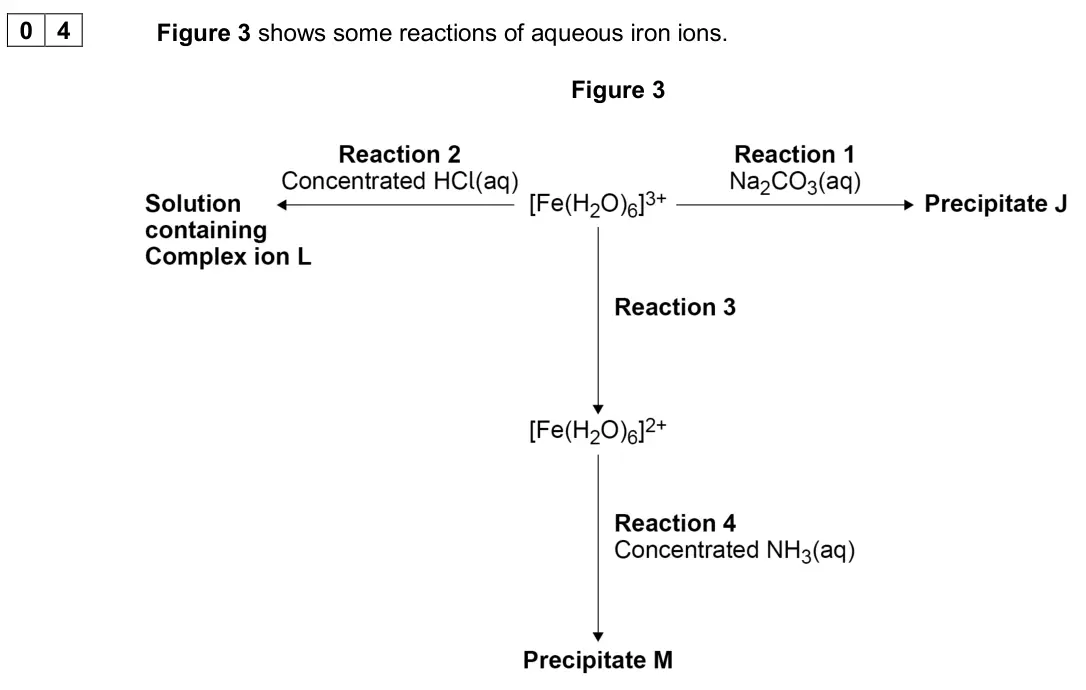
Q06.1
The whole paper ↗
Q05.3
The whole paper ↗
All 52 questions on Variable oxidation states, as a list
- June 2025, Paper 1, Q03.6 (1 mark): Give an equation for the reaction between C2O42– ions and MnO4– ions in acidic solution. [1 mark]
- June 2025, Paper 1, Q03.8 (7 marks): Calculate the Mr of M2[Cu(C2O4)2(H2O)2] Identify M. [7 marks] Mr of M2[Cu(C2O4)2(H2O)2] Identity of M
- June 2025, Paper 1, Q05.5 (1 mark): Iodide ions reduce copper(II) ions in aqueous solution to form a precipitate of copper(I) iodide. Give an equation for this redox reaction. [1 mark]
- June 2025, Paper 1, Q07.4 (2 marks): Table 6 shows some electrode half-equations and their standard electrode potentials. Table 6 Electrode half-equation E o / V VO2+(aq) + 2 H+(aq) + e− → VO2+(aq)
- June 2025, Paper 3, Q21 (1 mark): Which electron configuration represents an element that can have a maximum oxidation state of +5 in its compounds? [1 mark] A 1s2 2s2 2p1 B 1s2 2s2 2p6 3s2 3p5
- June 2024, Paper 1, Q06.1 (2 marks): Use the data in Table 3 to explain why Zn reduces an aqueous solution of VO2+ ions to V2+ ions, but does not reduce it any further. [2 marks]
- June 2024, Paper 1, Q06.4 (4 marks): 0.151 g of impure NH4VO3 is added to dilute sulfuric acid to form a solution containing aqueous VO2+ ions. All the VO3– ions are converted to VO2+ ions. These V
- June 2023, Paper 3, Q24 (1 mark): Which compound can decolourise acidified potassium manganate(VII) solution? [1 mark] A AgNO3 B CuSO4 C FeSO4 D Fe2(SO4)3
- June 2022, Paper 1, Q03.1 (5 marks): Give an ionic equation for the reaction between potassium manganate(VII) and acidified hydrogen peroxide. Calculate the concentration, in mol dm–3, of hydrogen
- June 2022, Paper 1, Q03.2 (1 mark): State why an indicator is not added in this titration. [1 mark]
- June 2022, Paper 3, Q05.2 (6 marks): A student determines the concentration of ethanedioate ions in an acidified solution by titration with potassium manganate(VII) solution. 2 MnO4– + 5 C2O42– + 1
- June 2022, Paper 3, Q21 (1 mark): The reaction between vanadium(IV) ions and manganate(VII) ions in acidic solution can be represented by the equation 5 V4+ + MnO4− + 8 H+ → 5 V5+ + Mn2+ + 4 H2O
- November 2021, Paper 3, Q01.3 (4 marks): Sodium ethanedioate is used to find the concentration of solutions of potassium manganate(VII) by titration. The equation for this reaction is 2 MnO4– + 16 H+ +
- November 2021, Paper 3, Q01.6 (1 mark): State the colour change seen at the end point of each titration. [1 mark]
- November 2020, Paper 3, Q19 (1 mark): Which shows the correct oxidation state and co-ordination number of cobalt in [Co(NH3)5Cl]Cl2? [1 mark] oxidation state co-ordination number A +2 5 B +2 6 C +3
- November 2020, Paper 3, Q21 (1 mark): Which compound decolourises acidified potassium manganate(VII) solution? [1 mark] A Al2(SO4)3 B CuSO4 C FeSO4 D Fe2(SO4)3
- November 2020, Paper 3, Q31 (1 mark): What is the minimum volume, in cm3, of 0.02 mol dm–3 KMnO4 solution needed to oxidise 0.01 mol of VO2+? 5 VO2+ + MnO4– + H2O → 5 VO2+ + Mn2+ + 2 H+ [1 mark] A 1
- June 2019, Paper 1, Q04.3 (1 mark): Suggest a reagent for Reaction 3. [1 mark]
- June 2019, Paper 1, Q06.1 (6 marks): Calculate the percentage of copper by mass in the alloy. Give your answer to the appropriate number of significant figures. [6 marks] % copper
- June 2019, Paper 3, Q05.3 (1 mark): Give the overall ionic equation for the oxidation of Fe2+ by manganate(VII) ions, in acidic conditions. [1 mark]
- June 2019, Paper 3, Q05.4 (1 mark): State the colour change seen at the end point of the titration. [1 mark]
- June 2018, Paper 1, Q09.1 (2 marks): Use data from Table 4 to identify the species that can be used to reduce VO2 + ions to VO2+ in aqueous solution and no further. Explain your answer. Table 4 Ele
- June 2018, Paper 1, Q09.2 (1 mark): Give the oxidation state of vanadium in [VO(H2O)5]2+ [1 mark]
- June 2018, Paper 1, Q09.4 (1 mark): Heating NH4VO3 produces vanadium(V) oxide, water and one other product. Give an equation for the reaction. [1 mark]
- June 2017, Paper 1, Q11.1 (8 marks): A white solid is a mixture of sodium ethanedioate (Na2C2O4), ethanedioic acid dihydrate (H2C2O4.2H2O) and an inert solid. A volumetric flask contained 1.90 g of
- Specimen, Paper 1, Q07.4 (2 marks): 0
- Specimen, Paper 1, Q07.5 (6 marks): Oxidation state =
- Specimen, Paper 3, Q04.3 (4 marks): Original concentration = Equation Calculation mol dm 3
- Specimen, Paper 3, Q23 (1 mark): The following equation represents the oxidation of vanadium(IV) ions by manganate(VII) ions in acid solution. 5V4+ + MnO4 – + 8H+ 5V5+ + Mn2+ + 4H2O What volume
- June 2016, CHEM5 (old spec), Q7(e) (2 marks): For Reaction 5 suggest the reagents and state the colour of [Cr(H2O)6]2+(aq). [2 marks] Reagents Colour Section B Answer all questions in the spaces provided.
- June 2016, CHEM5 (old spec), Q9(b) (1 mark): Select from the list the most suitable substance used to acidify the solution in the conical flask. Put a tick () in the correct box. [1 mark] H2C2O4 H2SO4 HCl
- June 2016, CHEM5 (old spec), Q9(d) (7 marks): Write an equation for the reaction between C2O42– ions and MnO4– ions in acidic solution. Calculate the percentage purity of the original sample of K3[Fe(C2O4)3
- June 2015, CHEM5 (old spec), Q8(b)(i) (2 marks): State the colour change that occurs at the end point of this titration and give a reason for the colour change. [2 marks]
- June 2015, CHEM5 (old spec), Q8(b)(ii) (5 marks): Write an equation for the reaction between iron(II) ions and manganate(VII) ions. Use this equation and the information given to calculate the concentration of
- June 2014, CHEM5 (old spec), Q8(a) (5 marks): Use this information to calculate a value for the mass of FeSO4.7H2O in the sample of X. [5 marks]
- June 2014, CHEM5 (old spec), Q8(b) (2 marks): The student found that the calculated mass of FeSO4.7H2O was greater than the actual mass of the sample that had been weighed out. The student realised that thi
- January 2013, CHEM5 (old spec), Q5(a) (3 marks): An excess of dilute sulfuric acid is added to a solution containing CrO42– ions. Colour of original solution Observation after an excess of reagent has been add
- January 2013, CHEM5 (old spec), Q8(d) (5 marks): In aqueous ammonia, cobalt(II) ions are oxidised to cobalt(III) ions by hydrogen peroxide. The H2O2 is reduced to hydroxide ions. Calculate the minimum volume o
- June 2012, CHEM5 (old spec), Q6(d)(i) (1 mark): Use the half-equations given below to calculate the reacting ratio of moles of manganate(VII) ions to moles of iron(II) ethanedioate. MnO4 – + 8H+ + 5e– → Mn2+
- June 2012, CHEM5 (old spec), Q6(d)(ii) (5 marks): Calculate the percentage by mass of FeC2O4.2H2O in the original sample. (If you have been unable to answer part (d) (i) you may assume that three moles of manga
- June 2012, CHEM5 (old spec), Q7(a) (5 marks): Describe the colour changes that you would observe when an excess of zinc is added to an acidified solution of potassium dichromate(VI) in the absence of air. F
- June 2012, CHEM5 (old spec), Q8(a) (12 marks): Consider the following reaction scheme that starts from [Co(H2O)6]2+ ions. W, X and Y are ions and Z is a compound. Reaction 4 Reaction 1 Reaction 2 Z [Co(H2O)6
- January 2012, CHEM5 (old spec), Q6(a) (2 marks): Write an equation for the reaction between manganate(VII) ions and ethanedioate ions in acidic solution. (2 marks)
- June 2011, CHEM5 (old spec), Q6(d)(i) (1 mark): Give the oxidation state of palladium in this compound. (1 mark)
- June 2011, CHEM5 (old spec), Q8(b)(ii) (5 marks): In a titration, 0.321 g of a moss killer reacted with 23.60 cm3 of acidified 0.0218 mol dm–3 K2Cr2O7 solution. Calculate the percentage by mass of iron in the m
- January 2011, CHEM5 (old spec), Q7(a)(i) (3 marks): Identify a reagent for Reaction 1 and describe the colour change that occurs.
- January 2011, CHEM5 (old spec), Q7(a)(ii) (1 mark): State the colour of the final solution formed in Reaction 2. (1 mark)
- January 2011, CHEM5 (old spec), Q7(b)(ii) (4 marks): Write a half-equation for the reduction of hydrogen peroxide to hydroxide ions. Deduce an overall equation for Reaction 4 and state the colour of the final solu
- January 2011, CHEM5 (old spec), Q7(c) (5 marks): The concentration of a hydrogen peroxide solution can be determined by titration with acidified potassium manganate(VII) solution. In this reaction the hydrogen
- June 2010, CHEM5 (old spec), Q7(d) (6 marks): A solution of iron(II) sulfate was prepared by dissolving 10.00 g of FeSO4.7H2O (Mr = 277.9) in water and making up to 250 cm3 of solution. The solution was lef
- January 2010, CHEM5 (old spec), Q7(d) (2 marks): Give the formula of the cobalt-containing complex in X and state the role of the H2O2 in this reaction. Formula Role of H2O2 (2 marks)
- June 2008, CHM5 (2008 spec), Q6(b) (6 marks): 6 (b) Separate aqueous solutions of potassium manganate(VII) (KMnO4) and sodium manganate(VII) (NaMnO4), each contained 1.000 g of the compound in 250 cm3 of so
Questions, mark schemes and examiner’s reports are © AQA, from their published past papers. Plumi isn’t affiliated with any exam board. Want whole papers? AQA A-Level Chemistry past papers.
The Plumi iPad app also offers exam-style questions with AI feedback on your handwritten working.