 plumi
Substitution reactions: AQA A‑Level Chemistry questions
AQA A-Level Chemistry past-paper questions on 3.2.5.2 Substitution reactions, 2008–2025, with mark schemes and examiner’s reports where available.
Paper
All papers
Exam
All years
Calculations
Q03.4
The whole paper ↗
Q03.5
The whole paper ↗Q03.1
The whole paper ↗
Q03.2
The whole paper ↗Q01.7
The whole paper ↗
Q07.7
The whole paper ↗
Q07.8
The whole paper ↗Q07.5
The whole paper ↗
Q07.6
The whole paper ↗Q07.7
The whole paper ↗Q01.8
The whole paper ↗
Q05.3
The whole paper ↗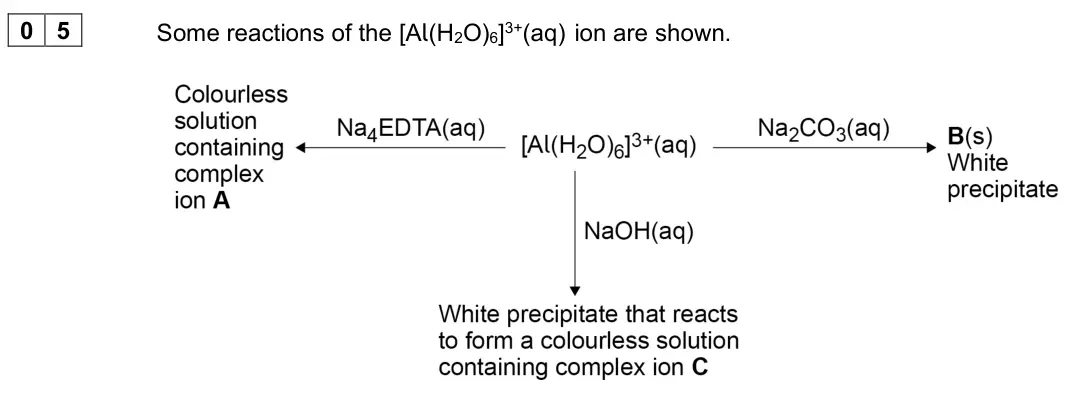
Q04.2
The whole paper ↗
Q04.2
The whole paper ↗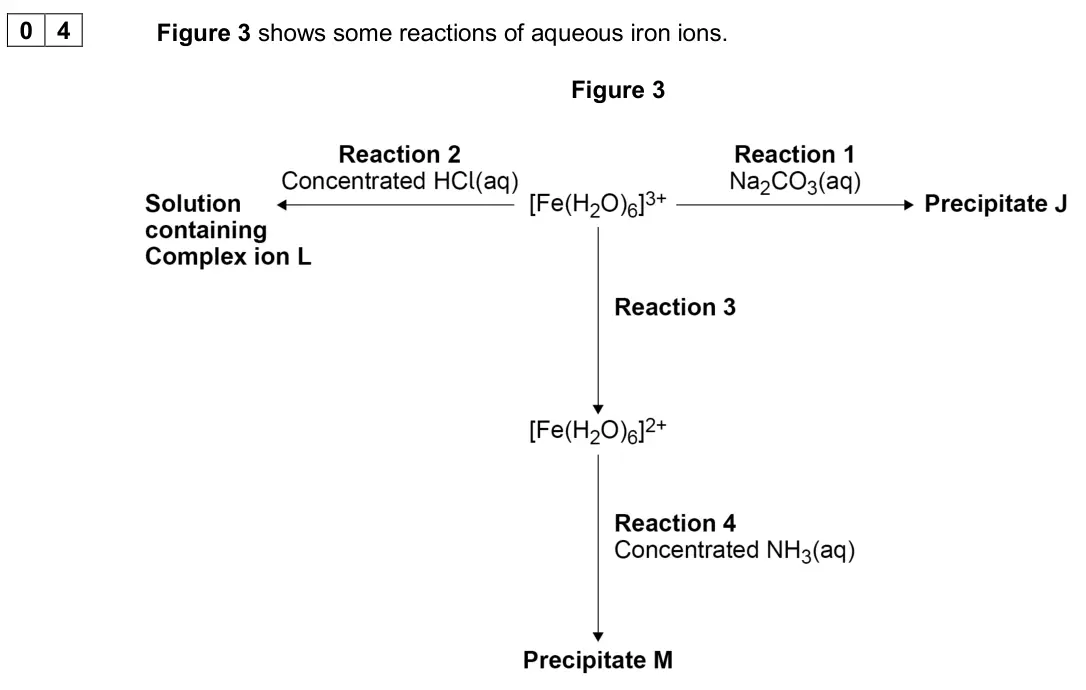
All 70 questions on Substitution reactions, as a list
- June 2025, Paper 1, Q03.4 (6 marks): When a solution containing [Cu(H2O)6]2+ ions reacts with an excess of concentrated hydrochloric acid, a ligand exchange reaction occurs. [Cu(H2O)6]2+(aq) + 4 Cl
- June 2025, Paper 1, Q03.5 (2 marks): An excess of water, followed by an excess of concentrated aqueous ammonia, is added to a solution containing [CuCl4]2– ions. State what is observed. Give an equ
- June 2025, Paper 3, Q23 (1 mark): Which reaction produces an octahedral complex ion? [1 mark] A The addition of excess aqueous ammonia to a solution containing [Co(H2O)6]2+ ions. B The addition
- June 2024, Paper 1, Q03.1 (2 marks): Draw the structure of X. Include the charge. [2 marks]
- June 2024, Paper 1, Q03.2 (2 marks): The formation of X is an example of the chelate effect. Explain the meaning of the chelate effect. [2 marks]
- June 2023, Paper 1, Q01.7 (1 mark): Complete the equation to show the formation of one complex that contains chromium in its +3 oxidation state. [1 mark] CrCl3 + 5 H2O →
- June 2023, Paper 1, Q07.7 (2 marks): Figure 3 shows the structure of the EDTA4 – ion. Figure 3 Atoms of two different elements in EDTA4– can form co-ordinate bonds with an aluminium ion. On Figure
- June 2023, Paper 1, Q07.8 (7 marks): Hydrated aluminium sulfate, Al2(SO4)3.xH2O, is soluble in water. The relative formula mass and value of x can be found from a titration experiment. Aqueous [Al(
- June 2023, Paper 3, Q36 (1 mark): Cisplatin has the formula [Pt(NH3)2Cl2] Cisplatin is an anti-cancer drug that prevents replication of DNA. When cisplatin bonds to DNA, which is the correct lig
- June 2022, Paper 1, Q07.5 (1 mark): Give an ionic equation for the conversion of [CuCl4] 2– to complex ion P. [1 mark]
- June 2022, Paper 1, Q07.6 (2 marks): State the colour of the solution containing the complex ion Q. Give an ionic equation for the conversion of [CuCl4] 2– to Q. [2 marks] Colour Equation
- June 2022, Paper 1, Q07.7 (1 mark): Identify complex ion R. [1 mark]
- June 2022, Paper 3, Q20 (1 mark): Cobalt(II) chloride solution changes colour when an excess of concentrated hydrochloric acid is added. What type of reaction takes place? [1 mark] A hydrolysis
- November 2021, Paper 3, Q01.8 (6 marks): When Na2C2O4(aq) is added to a solution containing [Fe(H2O)6]3+ ions, a reaction occurs in which all six water ligands are replaced by ethanedioate ions. Explai
- November 2020, Paper 1, Q05.3 (1 mark): Deduce the formula of the complex ion A. [1 mark]
- November 2020, Paper 3, Q04.2 (2 marks): Give the equation for this reaction. [2 marks]
- November 2020, Paper 3, Q18 (1 mark): Which will not act as a ligand in the formation of a complex ion? [1 mark] A CH4 B CO C H2O D NH3
- November 2020, Paper 3, Q19 (1 mark): Which shows the correct oxidation state and co-ordination number of cobalt in [Co(NH3)5Cl]Cl2? [1 mark] oxidation state co-ordination number A +2 5 B +2 6 C +3
- June 2019, Paper 1, Q04.2 (2 marks): Give the formula of L and an equation for Reaction 2. [2 marks] Formula of L Equation
- June 2019, Paper 3, Q18 (1 mark): What is observed when concentrated hydrochloric acid is added to an aqueous solution of CuSO4 until no further change occurs? [1 mark] A A colourless gas is evo
- June 2018, Paper 3, Q26 (1 mark): Which statement is correct about this reaction? [Co(NH3)6]2+ + 3H2NCH2CH2NH2 [Co(H2NCH2CH2NH2)3]2+ + 6NH3 [1 mark] A The co-ordination number of cobalt decrea
- June 2017, Paper 1, Q07.3 (2 marks): An excess of ammonia was added to a sample of solution A to form solution B Write an ionic equation for the reaction that occurs when solution A is converted in
- June 2017, Paper 1, Q07.5 (2 marks): Reagent D was added to another sample of solution A to form a yellow-green solution. Identify reagent D and write an ionic equation for the reaction that occurs
- June 2017, Paper 1, Q11.2 (2 marks): Ethanedioate ions react with aqueous iron(III) ions in a ligand substitution reaction. Write an equation for this reaction. Suggest why the value of the enthalp
- June 2017, Paper 1, Q11.4 (1 mark): Ethanedioate ions are poisonous because they react with iron ions in the body. Ethanedioate ions are present in foods such as broccoli and spinach. Suggest one
- Specimen, Paper 1, Q08.2 (4 marks): 3
- Specimen, Paper 1, Q08.3 (1 mark): When the complex ion [Cu(NH3)4(H2O)2] 2+ reacts with 1,2-diaminoethane, the ammonia molecules but not the water molecules are replaced. Write an equation for th
- Specimen, Paper 1, Q08.4 (2 marks): Suggest why the enthalpy change for the reaction in Question 8.3 is approximately zero. [2 marks] 0 8 . 4
- Specimen, Paper 1, Q08.5 (2 marks): Explain why the reaction in Question 8.3 occurs despite having an enthalpy change that is approximately zero. [2 marks] 0 8 . 5
- Specimen, Paper 3, Q21 (1 mark): Which compound gives a colourless solution when an excess of dilute aqueous ammonia is added? [1 mark] A MgCl2 B AgCl C CuCl2 D AlCl3 2 1 0
- June 2016, CHEM5 (old spec), Q8(b) (7 marks): Ethane-1,2-diamine can act as a bidentate ligand. When [Co(H2O)6]2+(aq) ions are treated with an excess of ethane-1,2-diamine, the water ligands are replaced. E
- June 2015, CHEM5 (old spec), Q7(b) (6 marks): Aqueous solutions of copper(II) sulfate and cobalt(II) sulfate undergo ligand substitution reactions when treated separately with an excess of dilute aqueous am
- June 2014, CHEM5 (old spec), Q4(b) (3 marks): Reaction 2 [3 marks] Reagent Copper-containing species Equation
- June 2014, CHEM5 (old spec), Q4(d) (3 marks): Reaction 4 [3 marks] Reagent Copper-containing species Equation
- June 2014, CHEM5 (old spec), Q7(b) (5 marks): Write an equation to show how the [Co(NH3)6]2+(aq) ion reacts with 1,2-diaminoethane. Explain the thermodynamic reasons why this reaction occurs. [5 marks]
- June 2013, CHEM5 (old spec), Q7(b) (4 marks): An excess of concentrated hydrochloric acid is added to separate aqueous solutions containing [Cu(H2O)6]2+ and [Co(H2O)6]2+
- June 2013, CHEM5 (old spec), Q8(b)(i) (3 marks): Write an equation for this reaction. Explain, in terms of the chelate effect, why the complex ion Y is formed in preference to the [Co(H2O)6]2+ complex ion.
- June 2013, CHEM5 (old spec), Q8(c) (5 marks): Compound Z is a complex that contains only cobalt, nitrogen, hydrogen and chlorine. A solid sample of Z was prepared by reaction of 50 cm3 of 0.203 mol dm–3 aqu
- January 2013, CHEM5 (old spec), Q5(c) (3 marks): An excess of ammonia solution is added to a solution containing [Cu(H2O)6]2+ ions. Colour of original solution Observation after an excess of reagent has been a
- January 2013, CHEM5 (old spec), Q8(b) (6 marks): Aqueous cobalt(II) ions react separately with an excess of chloride ions and with an excess of ammonia. For each reaction, draw a diagram to illustrate the stru
- June 2012, CHEM5 (old spec), Q7(c) (3 marks): When an aqueous solution containing [Cr(H2O)6]3+ ions is warmed in the presence of Cl– ions, [Cr(H2O)5Cl]2+ ions are formed and the colour of the solution chang
- June 2012, CHEM5 (old spec), Q8(a) (12 marks): Consider the following reaction scheme that starts from [Co(H2O)6]2+ ions. W, X and Y are ions and Z is a compound. Reaction 4 Reaction 1 Reaction 2 Z [Co(H2O)6
- January 2012, CHEM5 (old spec), Q7(c)(i) (1 mark): Write an equation for the equilibrium that is established when hydrated calcium ions react with EDTA4– ions. (1 mark)
- January 2012, CHEM5 (old spec), Q7(c)(ii) (3 marks): Explain why the equilibrium in part (c) (i) is displaced almost completely to the right to form the EDTA complex.
- January 2012, CHEM5 (old spec), Q8(c) (2 marks): Write an equation for a different reaction between aqueous copper(II) ions ([Cu(H2O)6]2+) and ammonia in which ammonia acts as a Lewis base but not as a Brønste
- January 2012, CHEM5 (old spec), Q8(e)(ii) (5 marks): Write an equation for the reaction that occurs between an aqueous solution of cobalt(II) sulfate and an excess of aqueous diaminoethane. Draw a diagram to show
- June 2011, CHEM5 (old spec), Q6(b) (2 marks): In terms of bonding, explain the meaning of the term complex.
- June 2011, CHEM5 (old spec), Q6(c) (2 marks): Identify one species from the following list that does not act as a ligand. Explain your answer. H2 O2– O2 CO Not a ligand Explanation (2 marks)
- June 2011, CHEM5 (old spec), Q7(a)(iii) (3 marks): Write an equation for the reaction, in aqueous solution, between [Cu(H2O)6]2+ and an excess of chloride ions. State the shape of the complex produced and explai
- June 2011, CHEM5 (old spec), Q7(b) (2 marks): Draw the structure of the ethanedioate ion (C2O4 2–). Explain how this ion is able to act as a ligand.
- June 2011, CHEM5 (old spec), Q7(c)(i) (4 marks): Write an ionic equation for the reaction. Give the co-ordination number of the complex formed and name its shape.
- January 2011, CHEM5 (old spec), Q4(e)(i) (1 mark): Give the meaning of the term multidentate. (1 mark)
- January 2011, CHEM5 (old spec), Q4(e)(ii) (2 marks): A porphyrin ring can be represented by the symbol PR. It reacts with aqueous iron(II) ions as shown in the equation below. The enthalpy change for this reaction
- January 2011, CHEM5 (old spec), Q4(e)(iii) (2 marks): In vitamin B12 the cobalt(II) ion is co-ordinated to a porphyrin ring, a cyanide (CN–) ion and an additional unidentate ligand. The cyanide ion is very toxic. P
- June 2010, CHEM5 (old spec), Q4(b) (2 marks): Explain the meaning of the term complex ion. (2 marks)
- June 2010, CHEM5 (old spec), Q4(d)(i) (2 marks): Draw circles around the atoms of two different elements that link to a transition metal ion by a co-ordinate bond when EDTA4– behaves as a ligand. (2 marks) 4 2
- June 2010, CHEM5 (old spec), Q4(d)(ii) (1 mark): Write an equation for the reaction between EDTA4– and a [Co(H2O)6]2+ ion. Use the abbreviation EDTA4– in your equation. (1 mark)
- June 2010, CHEM5 (old spec), Q4(d)(iii) (2 marks): Explain why the complex ion, formed as a product of the reaction in part (d) (ii), is more stable than the [Co(H2O)6]2+ ion. (2 marks)
- June 2010, CHEM5 (old spec), Q4(e)(i) (2 marks): In this diagram, bonds between nitrogen and iron are shown as N→Fe and as N–Fe. State the meaning of each of these symbols. Meaning of → Meaning of – (2 marks)
- June 2010, CHEM5 (old spec), Q4(e)(ii) (1 mark): State the function of haemoglobin in the blood. (1 mark)
- June 2010, CHEM5 (old spec), Q4(e)(iii) (2 marks): With reference to haemoglobin, explain why carbon monoxide is toxic. (2 marks)
- June 2010, CHEM5 (old spec), Q5(a) (3 marks): Identify ion W. Describe its appearance and write an equation for its formation from [Cu(H2O)6]2+(aq) ions. Ion W Appearance Equation (3 marks)
- June 2010, CHEM5 (old spec), Q5(c) (3 marks): Identify ion Y. Describe its appearance and write an equation for its formation from X. Ion Y Appearance Equation (3 marks)
- January 2010, CHEM5 (old spec), Q6(a) (2 marks): Write an equation for this substitution reaction to form the complex ion Q. (2 marks)
- January 2010, CHEM5 (old spec), Q7(c) (2 marks): Write an equation for the reaction that occurs when the pink solution is converted into W. (2 marks)
- January 2010, CHEM5 (old spec), Q7(e) (3 marks): Give the formula of the cobalt-containing complex in Y and explain why this complex is more stable than the cobalt-containing complex in W. Formula Explanation
- January 2010, CHEM5 (old spec), Q7(f) (2 marks): Identify the cobalt-containing complex in solution Z and explain why its co-ordination number is different from that in the pink solution of CoCl2 Complex Expla
- June 2008, CHM5 (2008 spec), Q1(b) (1 mark): 1 (b) Define the term Lewis base. (1 mark)
- June 2008, CHM5 (2008 spec), Q7(b) (2 marks): 7 (b) Draw a structure, including all the bonds, to show how one ethanedioate ion, C2O2 4 –, bonds as a bidentate ligand to a Co2+ ion. On your structure repres
- June 2008, CHM6W (2008 spec), Q21 (1 mark): 21 A substitution reaction occurs when ammonia reacts with 1 [Cu(H2O)6]2+ 2 BF3 3 CH3Br 4 HBr
Questions, mark schemes and examiner’s reports are © AQA, from their published past papers. Plumi isn’t affiliated with any exam board. Want whole papers? AQA A-Level Chemistry past papers.
The Plumi iPad app also offers exam-style questions with AI feedback on your handwritten working.