 plumi
Electrode potentials and cells: AQA A‑Level Chemistry questions
AQA A-Level Chemistry past-paper questions on 3.1.11.1 Electrode potentials and cells, 2008–2025, with mark schemes and examiner’s reports where available.
Paper
All papers
Exam
All years
Calculations
Q07.4
The whole paper ↗
Q03.1
The whole paper ↗
Q03.2
The whole paper ↗Q03.3
The whole paper ↗Q03.4
The whole paper ↗Q06.1
The whole paper ↗
Q06.2
The whole paper ↗Q06.3
The whole paper ↗Q02.1
The whole paper ↗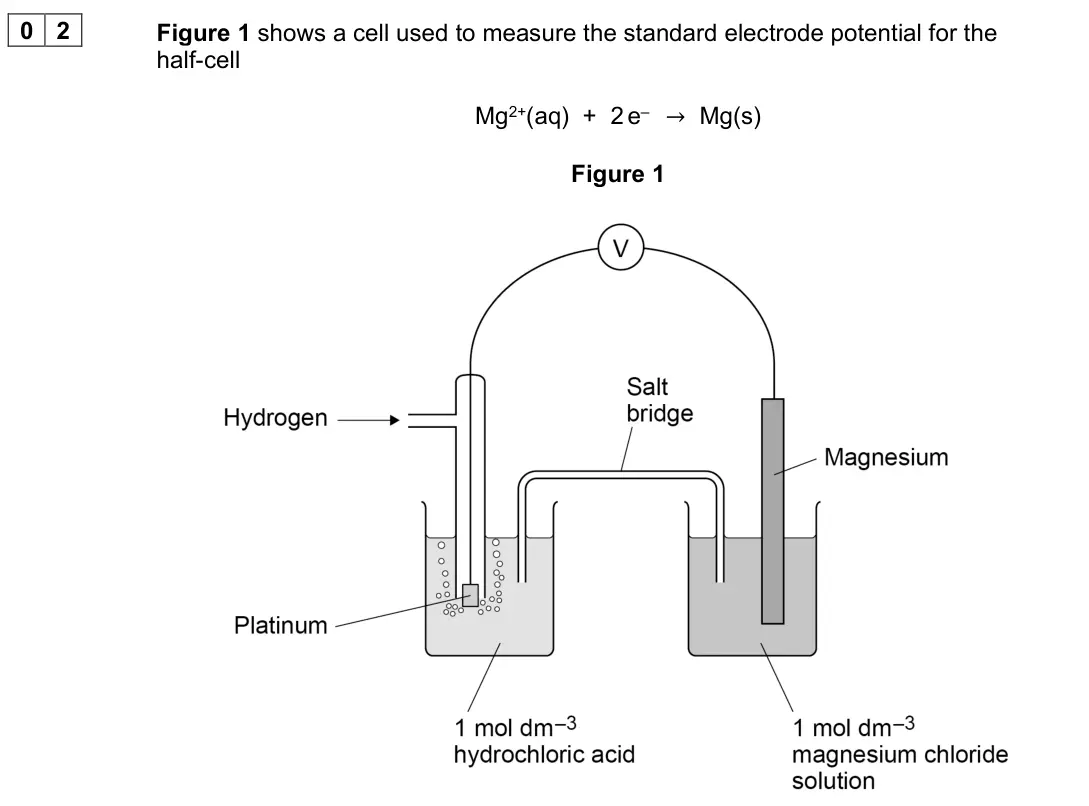
Q02.2
The whole paper ↗Q02.3
The whole paper ↗Q02.4
The whole paper ↗Q08.1
The whole paper ↗
Q08.1
The whole paper ↗
Q08.2
The whole paper ↗Q08.3
The whole paper ↗Q08.4
The whole paper ↗
All 107 questions on Electrode potentials and cells, as a list
- June 2025, Paper 1, Q07.4 (2 marks): Table 6 shows some electrode half-equations and their standard electrode potentials. Table 6 Electrode half-equation E o / V VO2+(aq) + 2 H+(aq) + e− → VO2+(aq)
- June 2025, Paper 3, Q03.1 (3 marks): Figure 1 shows three mistakes made by the student. Identify each mistake and the change needed to correct it. [3 marks] Mistake 1 Change 1 Mistake 2 Change 2 Mi
- June 2025, Paper 3, Q03.2 (1 mark): What feature of the voltmeter ensures that the voltmeter measures the cell EMF? [1 mark] Tick () one box. Low resistance Variable resistance High resistance
- June 2025, Paper 3, Q03.3 (1 mark): The Fe3+/Fe2+ electrode is the positive electrode when the cell is set up correctly at 298 K Give the redox equation for the overall reaction that occurs in the
- June 2025, Paper 3, Q03.4 (6 marks): Table 4 shows some standard electrode potentials. Table 4 Half-equation E o / V Fe2+(aq) + 2 e– → Fe(s) –0.44 Cu2+(aq) + e– → Cu+(aq) +0.15 Cu2+(aq) + 2 e– → Cu
- June 2024, Paper 1, Q06.1 (2 marks): Use the data in Table 3 to explain why Zn reduces an aqueous solution of VO2+ ions to V2+ ions, but does not reduce it any further. [2 marks]
- June 2024, Paper 1, Q06.2 (1 mark): Identify the species in Table 3 that can reduce an aqueous solution of VO2+ to V [1 mark]
- June 2024, Paper 1, Q06.3 (3 marks): Two half-cells Fe2+(aq) / Fe(s) and VO2+(aq) / V3+(aq) are connected. Calculate the EMF of this cell. Give the conventional representation for this cell. Give a
- June 2024, Paper 3, Q17 (1 mark): A cell with EMF = +2.15 V is made from two electrodes. The half-equations for the two electrodes are shown. positive electrode: PbO2(s) + 3 H+(aq) + HSO4–(aq) +
- June 2023, Paper 1, Q02.1 (2 marks): State the purpose of the salt bridge. Identify an ionic compound that could be used in the salt bridge. [2 marks] Purpose Identity
- June 2023, Paper 1, Q02.2 (1 mark): State how, if at all, the EMF of this cell will change if the surface area of the platinum electrode is increased. [1 mark]
- June 2023, Paper 1, Q02.3 (1 mark): Water is added to the beaker containing the magnesium chloride solution. What is the effect on the magnitude of the EMF of the cell? [1 mark] Tick () one box.
- June 2023, Paper 1, Q02.4 (1 mark): The voltmeter V shown in Figure 1 is replaced by a bulb. Give an equation for the overall reaction that occurs when the cell is operating. [1 mark]
- June 2022, Paper 1, Q08.1 (1 mark): The half-equations for two electrodes that combine to make a non-rechargeable cell are Zn2+(aq) + 2e− → Zn(s) E o = −0.76 V 2 MnO2(s) + 2 NH4+(aq) + 2e– → Mn2O3
- June 2022, Paper 3, Q11 (1 mark): Which change to a hydrogen electrode has no effect on the electrode potential? [1 mark] A the concentration of the hydrogen ions B the pressure of the hydrogen
- June 2022, Paper 3, Q12 (1 mark): Some electrode potential data are shown. Zn2+(aq) + 2 e− → Zn(s) E ɵ = − 0.76 V Pb2+(aq) + 2 e− → Pb(s) E ɵ = − 0.13 V Which is a correct statement about this c
- November 2021, Paper 1, Q08.1 (1 mark): State the meaning of the term electrochemical series. [1 mark]
- November 2021, Paper 1, Q08.2 (1 mark): State two conditions needed for the following half-cell to have E o = 0.00 V H+(aq) + e– → 1 2 H2(g) [1 mark]
- November 2021, Paper 1, Q08.3 (1 mark): Identify the weakest reducing agent in Table 8. [1 mark]
- November 2021, Paper 1, Q08.4 (2 marks): Use half-equations from Table 8 to deduce an equation for the reduction of VO2+ to form VO2+ in aqueous solution by iron. [2 marks]
- November 2021, Paper 1, Q08.5 (2 marks): Use data from Table 8 to explain why [Co(H2O)6]3+(aq) will undergo a redox reaction with [Fe(H2O)6]2+(aq) Give an equation for this reaction. [2 marks] Explanat
- November 2021, Paper 1, Q08.6 (1 mark): Suggest why the two cobalt(III) complex ions in Table 8 have different electrode potentials. [1 mark]
- November 2021, Paper 1, Q09.1 (2 marks): Use data in Table 9 to explain why an aqueous electrolyte is not used for a lithium cell. [2 marks]
- November 2021, Paper 1, Q09.2 (1 mark): In the 1970s lithium-iodine cells became a common power source for heart pacemakers. Lithium iodide is the final product of the cell reaction. Use the data in T
- November 2021, Paper 1, Q09.3 (1 mark): An EMF value for a commercial lithium-iodine cell is 2.80 V Suggest why this value is different from the value calculated in Question 09.2. [1 mark]
- November 2020, Paper 1, Q11.4 (2 marks): The negative electrode is made of carbon and the positive electrode is made of platinum. Give the conventional representation for the glucose–oxygen fuel cell.
- November 2020, Paper 3, Q06.1 (3 marks): State the substances and conditions needed in a standard hydrogen electrode. [3 marks]
- November 2020, Paper 3, Q06.2 (6 marks): Describe an experiment the student does to show that the standard electrode potential for the TiO2+(aq) / Ti(s) electrode is −0.88 V The student is provided wit
- November 2020, Paper 3, Q06.3 (1 mark): Give the half-equation for the electrode reaction in the TiO2+(aq) / Ti(s) electrode in acidic conditions. [1 mark]
- November 2020, Paper 3, Q06.4 (3 marks): Table 2 shows some electrode potential data. Table 2 Electrode reaction Eo / V 2 H+(aq) + 2 e− → H2(g) 0.00 Cu2+(aq) + 2 e− → Cu(s) +0.34 NO3−(aq) + 4 H+(aq) +
- June 2019, Paper 3, Q03.1 (1 mark): Name the piece of apparatus labelled A. [1 mark]
- June 2019, Paper 3, Q03.2 (1 mark): State the purpose of A. [1 mark]
- June 2019, Paper 3, Q03.3 (1 mark): Name the substance used as electrode B in Figure 1. [1 mark]
- June 2019, Paper 3, Q03.4 (4 marks): Complete Table 1 to identify C, D and E from Figure 1. Include the essential conditions for each. [4 marks] Table 1 Identity Conditions C D E
- June 2019, Paper 3, Q03.5 (2 marks): The standard electrode potential, Eo, for the Fe3+/Fe2+ electrode is +0.77 V Give the ionic equation for the overall reaction in the cell in Figure 1. State the
- June 2019, Paper 3, Q03.6 (3 marks): A student sets up a cell as shown in the cell representation. Zn(s)|Zn2+(aq)||Cu2+(aq)|Cu(s) The student measures the cell EMF, Ecell, with several different co
- June 2019, Paper 3, Q03.7 (3 marks): This equation shows how Ecell varies with concentration for this reaction. This equation is in the form of the equation for a straight line, y = mx + c Calculat
- June 2019, Paper 3, Q03.8 (2 marks): In experiment 2 in Table 2 the electrode potential of the Cu2+/Cu electrode is +0.33 V Use data from Table 2 in question 03.6 to calculate the electrode potenti
- June 2019, Paper 3, Q13 (1 mark): The Eo values for two electrodes are shown. Fe2+(aq) + 2 e– → Fe(s) Eo= –0.44 V Cu2+(aq) + 2 e– → Cu(s) Eo= +0.34 V What is the EMF of the cell Fe(s)|Fe2+(aq)||
- June 2018, Paper 1, Q06.1 (1 mark): Explain how the salt bridge provides an electrical connection between the two solutions. [1 mark]
- June 2018, Paper 1, Q06.2 (1 mark): The standard electrode potential for the Cu2+/Cu electrode is Cu2+(aq) + 2e– → Cu(s) Eo = + 0.34 V Calculate the electrode potential of the left-hand electrode
- June 2018, Paper 1, Q06.3 (1 mark): Both electrodes contain a strip of copper metal in a solution of aqueous Cu2+ ions. State why the left-hand electrode does not have an electrode potential of +0
- June 2018, Paper 1, Q06.4 (1 mark): Give the conventional representation for the cell in Figure 2. Include all state symbols. [1 mark]
- June 2018, Paper 1, Q06.5 (2 marks): When the voltmeter is replaced by a bulb, the EMF of the cell in Figure 2 decreases over time to 0 V Suggest how the concentration of copper(II) ions in the lef
- June 2018, Paper 1, Q09.1 (2 marks): Use data from Table 4 to identify the species that can be used to reduce VO2 + ions to VO2+ in aqueous solution and no further. Explain your answer. Table 4 Ele
- June 2017, Paper 1, Q10.2 (1 mark): State the weakest reducing agent in Table 4. [1 mark]
- June 2017, Paper 1, Q10.3 (2 marks): Write the conventional representation of the cell that has an EMF of +0.43 V [2 marks]
- June 2017, Paper 1, Q10.4 (4 marks): Use data from Table 4 to identify an acid that will oxidise copper. Explain your choice of acid. Use these data to suggest a possible equation for the reaction.
- Specimen, Paper 1, Q03.1 (2 marks): 3 Fuel cells are an increasingly important energy source for vehicles. Standard electrode potentials are used in understanding some familiar chemical reactions
- Specimen, Paper 1, Q03.2 (1 mark): Use data from Table 1 to deduce the halide ion that is the weakest reducing agent. [1 mark] 0 3 . 2
- Specimen, Paper 1, Q03.3 (1 mark): Use data from Table 1 to justify why sulfate ions should not be capable of oxidising bromide ions. [1 mark] 0 3 . 3
- Specimen, Paper 1, Q03.4 (1 mark): EMF = V
- Specimen, Paper 3, Q18 (1 mark): The following cell has an EMF of +0.46 V. Cu Cu2+ Ag+ Ag Which statement is correct about the operation of the cell? [1 mark] A Metallic copper is oxidised by A
- June 2016, CHEM5 (old spec), Q4(a)(i) (1 mark): Identify the weakest oxidising agent in Table 2. [1 mark]
- June 2016, CHEM5 (old spec), Q4(a)(ii) (2 marks): Give the conditions under which the electrode potential of the Zn2+/Zn electrode is –0.76 V. [2 marks]
- June 2016, CHEM5 (old spec), Q4(b) (3 marks): Two half-cells, involving species in Table 2, are connected together to give a cell with an e.m.f. = +0.48 V. Use data from Table 2 to deduce the conventional r
- June 2016, CHEM5 (old spec), Q4(c) (3 marks): Use data from Table 2 to identify a cobalt species that can react with water. Write an equation for the redox reaction that occurs and identify the oxidation pr
- June 2016, CHEM5 (old spec), Q4(d) (2 marks): Use data from Table 2 to explain why gold jewellery is unreactive in moist air. [2 marks]
- June 2016, CHEM5 (old spec), Q5(a)(ii) (2 marks): State and explain the effect, if any, of increasing the pressure of oxygen on the e.m.f of this cell. [2 marks] Effect on e.m.f. Explanation
- June 2015, CHEM5 (old spec), Q6(b) (2 marks): Identify the weakest oxidising agent in Table 6. Explain your choice. [2 marks] Weakest oxidising agent Explanation
- June 2015, CHEM5 (old spec), Q6(c) (4 marks): Write the conventional representation of the cell used to measure the standard electrode potential for the Ag+/Ag electrode. State the conditions necessary when
- June 2015, CHEM5 (old spec), Q6(d) (4 marks): Use data from Table 6 to explain, in terms of redox, what happens when a soluble gold(I) compound containing Au+ ions is added to water. State what you would ob
- June 2015, CHEM5 (old spec), Q6(e)(i) (1 mark): Calculate the e.m.f. of this cell. [1 mark] Answer =
- June 2015, CHEM5 (old spec), Q6(e)(ii) (1 mark): Suggest why potassium chloride would not be suitable for use in the salt bridge of this cell. [1 mark]
- June 2015, CHEM5 (old spec), Q6(f) (2 marks): Use data from Table 6 to explain what happens when a solution of iron(II) chloride is exposed to the air. [2 marks]
- June 2014, CHEM5 (old spec), Q5(a) (2 marks): Give the conventional representation of the cell that is used to measure the standard electrode potential of iron as shown in Table 3. [2 marks]
- June 2014, CHEM5 (old spec), Q5(c) (2 marks): Identify the weakest reducing agent from the species in Table 3. Explain how you deduced your answer. [2 marks] Species Explanation
- June 2014, CHEM5 (old spec), Q5(e) (2 marks): Using the information given in Table 3, deduce an equation for the redox reaction that would occur when hydroxide ions are added to HOCl [2 marks] Question 5 co
- June 2014, CHEM5 (old spec), Q5(f)(i) (1 mark): Use data from Table 3 to calculate the e.m.f. of this cell. [1 mark] Answer =
- June 2014, CHEM5 (old spec), Q5(f)(ii) (1 mark): Use half-equations from Table 3 to construct an overall equation for the cell reaction. [1 mark]
- June 2014, CHEM5 (old spec), Q5(f)(iii) (2 marks): Identify which of A or B, in Figure 1, is the positive electrode. Give a reason for your answer. [2 marks] Positive electrode Reason
- June 2013, CHEM5 (old spec), Q5(a) (1 mark): Explain how the salt bridge D provides an electrical connection between the two electrodes. (1 mark)
- June 2013, CHEM5 (old spec), Q5(b) (1 mark): Suggest why potassium chloride would not be a suitable salt for the salt bridge in this cell. (1 mark)
- June 2013, CHEM5 (old spec), Q5(c) (2 marks): In the external circuit of this cell, the electrons flow through the ammeter from right to left. Suggest why the electrons move in this direction.
- June 2013, CHEM5 (old spec), Q5(d) (1 mark): Explain why the current in the external circuit of this cell falls to zero after the cell has operated for some time. (1 mark)
- June 2013, CHEM5 (old spec), Q5(e)(i) (1 mark): The e.m.f. of this cell is 2.90 V. Use this information to calculate a value for the electrode potential of electrode B. (1 mark)
- January 2013, CHEM5 (old spec), Q7(a) (5 marks): Draw a labelled diagram of the apparatus that could be connected to a standard hydrogen electrode in order to measure the standard electrode potential of the Fe
- January 2013, CHEM5 (old spec), Q7(b) (4 marks): Use data from the table to deduce the equation for the overall cell reaction of a cell that has an e.m.f. of 0.78 V. Give the conventional cell representation f
- January 2013, CHEM5 (old spec), Q7(c) (3 marks): Use data from the table to explain why Au+ ions are not normally found in aqueous solution. Write an equation to show how Au+ ions would react with water.
- January 2013, CHEM5 (old spec), Q7(d) (3 marks): Use data from the table to predict and explain the redox reactions that occur when iron powder is added to an excess of aqueous silver nitrate.
- June 2012, CHEM5 (old spec), Q5(b) (2 marks): Deduce the identity of the weakest oxidising agent in the table. Explain how E values can be used to make this deduction. Weakest oxidising agent Explanation (2
- June 2012, CHEM5 (old spec), Q5(c)(i) (1 mark): Calculate the e.m.f. of this cell. (1 mark)
- June 2012, CHEM5 (old spec), Q5(e)(iii) (1 mark): The e.m.f. of an ethanol–oxygen fuel cell is 1.00 V. Use data from the table on page 10 to calculate a value for the electrode potential of the ethanol electrod
- June 2012, CHEM5 (old spec), Q7(d) (7 marks): The chromium(II) ion [Cr(H2O)6]2+ has different properties from the [Cr(H2O)6]3+ ion. Use data from the table on page 16 to explain why, in an open container, [
- January 2012, CHEM5 (old spec), Q4(a) (3 marks): Identify solution A and give its concentration. State the other essential conditions for the operation of the standard electrode that forms the left-hand side o
- January 2012, CHEM5 (old spec), Q4(b) (3 marks): Identify the material from which electrodes B are made. Give two reasons why this material is suitable for its purpose. Material Reason 1 Reason 2
- January 2012, CHEM5 (old spec), Q4(c) (3 marks): Identify a solution that could be used in C to complete the circuit. Give two reasons why this solution is suitable for its purpose. Solution Reason 1 Reason 2
- January 2012, CHEM5 (old spec), Q4(d) (1 mark): Write the conventional representation for this cell. (1 mark)
- January 2012, CHEM5 (old spec), Q4(e)(i) (1 mark): Write an equation for the overall cell reaction that would occur. (1 mark)
- January 2012, CHEM5 (old spec), Q4(e)(ii) (1 mark): Explain why the ammeter reading would fall to zero after a time. (1 mark)
- January 2012, CHEM5 (old spec), Q5(a) (1 mark): Identify the most powerful reducing agent from all the species in the table. (1 mark)
- January 2012, CHEM5 (old spec), Q5(b) (2 marks): Use data from the table to explain why chlorine should undergo a redox reaction with water. Write an equation for this reaction. Explanation Equation
- January 2012, CHEM5 (old spec), Q5(c) (1 mark): Suggest one reason why the redox reaction between chlorine and water does not normally occur in the absence of light. (1 mark)
- January 2012, CHEM5 (old spec), Q5(e) (2 marks): Use data from the table to explain why one molecule of hydrogen peroxide can oxidise another molecule of hydrogen peroxide. Write an equation for the redox reac
- June 2011, CHEM5 (old spec), Q5(b) (2 marks): Use the table above to identify the strongest reducing agent from the species in the table. Explain how you deduced your answer. Strongest reducing agent Explan
- June 2011, CHEM5 (old spec), Q5(c) (3 marks): Use data from the table to explain why fluorine reacts with water. Write an equation for the reaction that occurs. Explanation Equation
- June 2011, CHEM5 (old spec), Q5(d)(i) (2 marks): Give the conventional representation for this cell. (2 marks)
- June 2011, CHEM5 (old spec), Q5(d)(ii) (1 mark): Calculate the e.m.f. of the cell. (1 mark)
- January 2011, CHEM5 (old spec), Q5(b)(i) (2 marks): Write the conventional representation for the cell using platinum contacts. (2 marks)
- January 2011, CHEM5 (old spec), Q5(b)(ii) (3 marks): Write an overall equation for the cell reaction and identify the oxidising and reducing agents. Overall equation Oxidising agent
- June 2010, CHEM5 (old spec), Q7(a) (4 marks): Describe a standard hydrogen electrode.
- June 2010, CHEM5 (old spec), Q7(b) (2 marks): A conventional representation of a lithium cell is given below. This cell has an e.m.f. of +2.91 V Li(s) | Li+(aq) || Li+(aq) | MnO2(s) , LiMnO2(s) | Pt(s) Writ
- June 2010, CHEM5 (old spec), Q7(c) (2 marks): Suggest what reactions occur, if any, when hydrogen gas is bubbled into a solution containing a mixture of iron(II) and iron(III) ions. Explain your answer.
- January 2010, CHEM5 (old spec), Q3(a) (1 mark): State why the electrode potential for the standard hydrogen electrode is equal to 0.00V. (1 mark)
- January 2010, CHEM5 (old spec), Q3(c) (2 marks): Write the conventional representation for an alkaline hydrogen–oxygen fuel cell. (2 marks)
- June 2008, CHM5 (2008 spec), Q4(a) (6 marks): 4 (a) The cell shown below can be used to measure the electrode potential of magnesium. V X W Hydrogen Z Y 4 (a) (i) Identify possible chemical substances for W
- June 2008, CHM6W (2008 spec), Q20 (1 mark): 20 Consider the half-equations given below. E /V VO+ 2(aq) + 2H+(aq) + e– →VO2+(aq) + H2O(l) +1.00 Cr2O2 7 –(aq) + 14H+(aq) + 6e– →2Cr3+(aq) + 7H2O(l) +1.33 Co3
Questions, mark schemes and examiner’s reports are © AQA, from their published past papers. Plumi isn’t affiliated with any exam board. Want whole papers? AQA A-Level Chemistry past papers.
The Plumi iPad app also offers exam-style questions with AI feedback on your handwritten working.