 plumi
Balanced equations and associated calculations: AQA A‑Level Chemistry questions
AQA A-Level Chemistry past-paper questions on 3.1.2.5 Balanced equations and associated calculations, 2008–2025, with mark schemes and examiner’s reports where available.
Paper
All papers
Exam
All years
Calculations
Q03.7
The whole paper ↗
Q03.8
The whole paper ↗Q05.2
The whole paper ↗
Q08.4
The whole paper ↗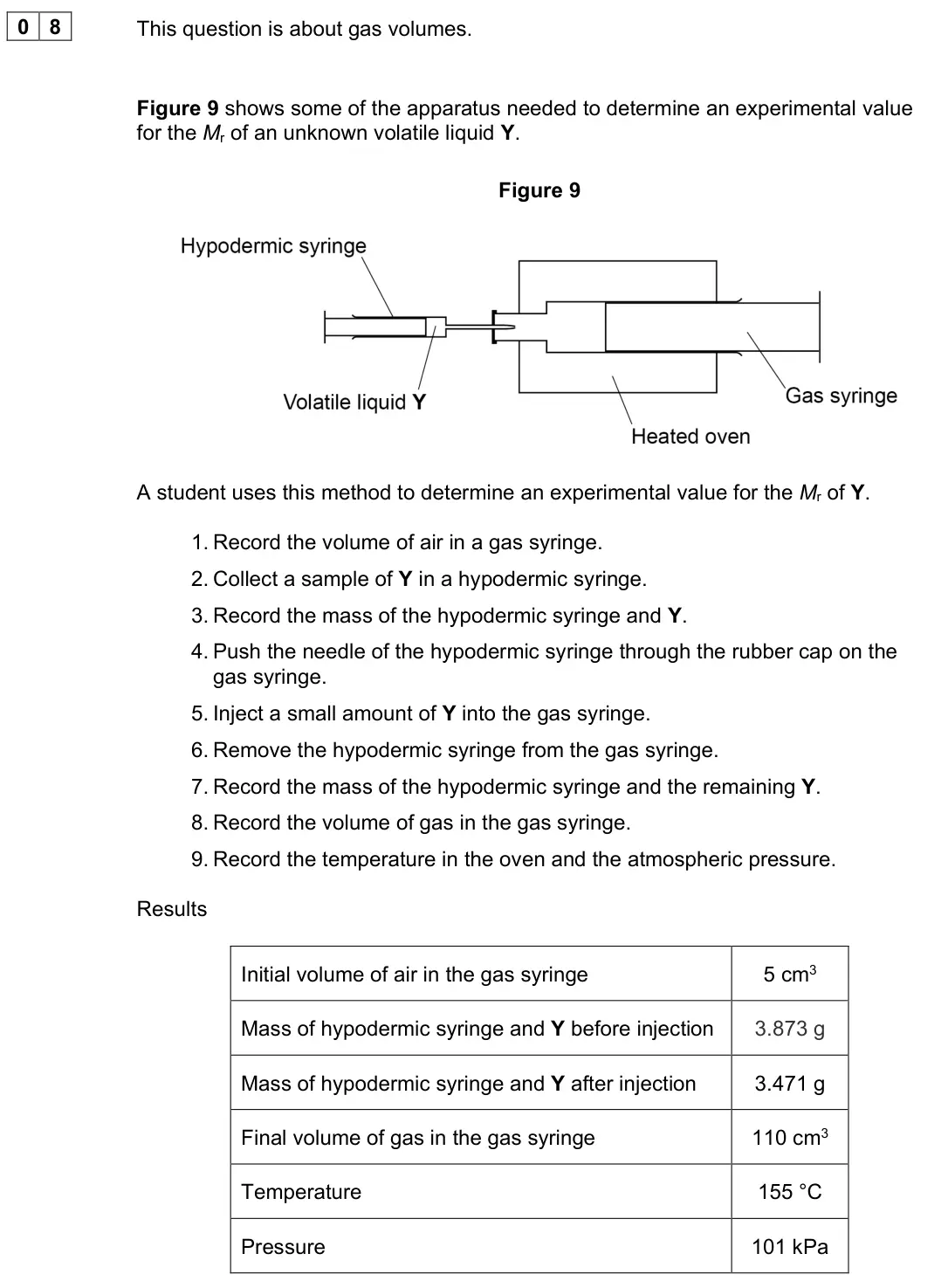
Q01.1
The whole paper ↗
Q01.2
The whole paper ↗Q05.1
The whole paper ↗
Q05.2
The whole paper ↗Q05.3
The whole paper ↗Q02.4
The whole paper ↗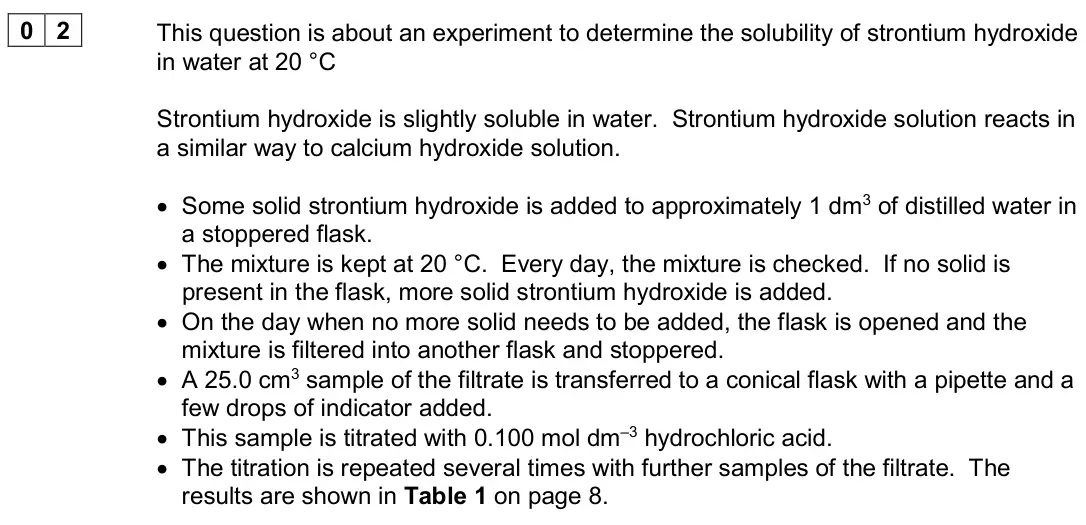
Q02.5
The whole paper ↗Q06.4
The whole paper ↗
Q03.4
The whole paper ↗
Q07.1
The whole paper ↗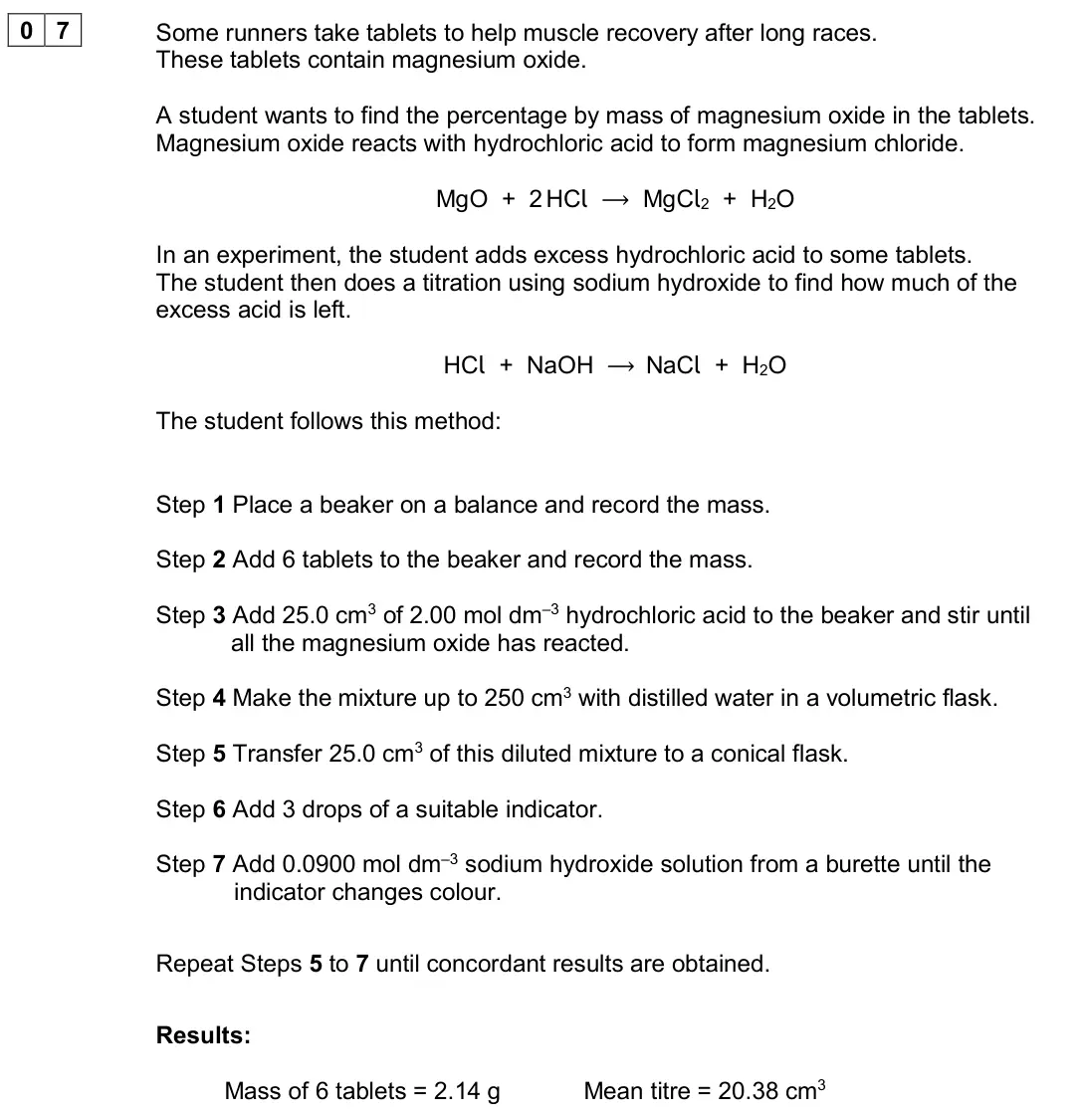
Q07.2
The whole paper ↗Q07.3
The whole paper ↗
All 292 questions on Balanced equations and associated calculations, as a list
- June 2025, Paper 1, Q03.7 (1 mark): Calculate the mean titre from the student’s results. [1 mark] cm3
- June 2025, Paper 1, Q03.8 (7 marks): Calculate the Mr of M2[Cu(C2O4)2(H2O)2] Identify M. [7 marks] Mr of M2[Cu(C2O4)2(H2O)2] Identity of M
- June 2025, Paper 2, Q05.2 (4 marks): The yield of TNT in this reaction is 42.5%. Calculate the mass, in g, of TNT (Mr = 227.0) obtained from 1050 cm3 of methylbenzene. Methylbenzene has density = 0
- June 2025, Paper 2, Q08.4 (4 marks): A mixture of methane and propane has a volume of 40 cm3 This mixture needs exactly 170 cm3 of oxygen for complete combustion. The equations for these reactions
- June 2025, AS Paper 1, Q01.1 (2 marks): Calculate the percentage atom economy to form TiCl4 in this first stage of the extraction. [2 marks] Percentage atom economy
- June 2025, AS Paper 1, Q01.2 (1 mark): Suggest one economic advantage of using a process with a high percentage atom economy. [1 mark]
- June 2025, AS Paper 1, Q05.1 (5 marks): Calculate the relative molecular mass of H2A [5 marks] Relative molecular mass of H2A
- June 2025, AS Paper 1, Q05.2 (1 mark): The uncertainty in the use of the burette in each titration is ±0.15 cm3 Calculate the percentage uncertainty in the use of the burette in titration 1. [1 mark]
- June 2025, AS Paper 1, Q05.3 (8 marks): Suggest one way to reduce the percentage uncertainty in each titration without changing the apparatus. Justify your answer. [2 marks] Suggestion Justification 0
- June 2025, AS Paper 1, Q13 (1 mark): What is the maximum mass of sodium chloride that can be made from 10.0 g of sodium and 10.0 g of chlorine? [1 mark] A 8.24 g B 16.5 g C 20.0 g D 25.4 g
- June 2025, AS Paper 1, Q21 (1 mark): A student is asked to prepare a solution of hydrochloric acid with a concentration of 0.0400 mol dm–3 What volume of distilled water should the student add to 2
- June 2024, Paper 1, Q02.4 (1 mark): The diagrams in Figure 2 show the part of a pipette with the graduation line. Which diagram identifies the pipette that is correctly filled? [1 mark] Tick () o
- June 2024, Paper 1, Q02.5 (6 marks): Solubility can be quoted as ‘g of solute per 100 cm3 of solution’. Table 1 shows the results of the titrations between strontium hydroxide and hydrochloric acid
- June 2024, Paper 1, Q06.4 (4 marks): 0.151 g of impure NH4VO3 is added to dilute sulfuric acid to form a solution containing aqueous VO2+ ions. All the VO3– ions are converted to VO2+ ions. These V
- June 2024, Paper 2, Q03.4 (4 marks): A sample of butane has a volume of 20 cm3 at room temperature and pressure. The sample is burned completely in 1350 cm3 of air. The final mixture is cooled to r
- June 2024, Paper 3, Q08 (1 mark): Compound P is converted into compound R by a two-stage synthesis via compound Q. The yields for the individual steps are: P → Q 50% Q → R 30% What is the overal
- June 2024, AS Paper 1, Q07.1 (1 mark): Each reading from the balance has an uncertainty of ±0.005 g Calculate the percentage uncertainty in using the balance in this experiment. [1 mark] Percentage u
- June 2024, AS Paper 1, Q07.2 (1 mark): Calculate the amount, in moles, of hydrochloric acid that was added to the tablets in Step 3. Give your answer to an appropriate precision. [1 mark] Amount of h
- June 2024, AS Paper 1, Q07.3 (6 marks): Use your answer to Question 07.2 and the information given to calculate the percentage by mass of magnesium oxide in the tablets. [6 marks] Percentage by mass o
- June 2024, AS Paper 1, Q10 (1 mark): What is the percentage atom economy for the formation of sodium nitrate in the reaction between sodium carbonate and nitric acid? Na2CO3 + 2 HNO3 → 2 NaNO3 + H2
- June 2024, AS Paper 1, Q12 (1 mark): The table shows some results from a titration. Titration Rough Titre 1 Titre 2 Titre 3 Initial reading / cm3 0.00 11.30 0.00 8.55 Final reading / cm3 26.85 37.2
- June 2024, AS Paper 1, Q17 (1 mark): Ammonia is oxidised as shown. w NH3 + x O2 → y H2O + z NO Which whole number values for w, x, y and z balance the equation? [1 mark] w x y z A 2 3 3 2 B 4 7 4 4
- June 2024, AS Paper 1, Q23 (1 mark): Which of these practical steps will improve the accuracy of a titration? [1 mark] A Using a 10.0 cm3 pipette instead of a 25.0 cm3 pipette. B Rinsing the sides
- June 2024, AS Paper 2, Q05.1 (7 marks): Magnesium reacts with hydrochloric acid. Mg(s) + 2 HCl(aq) → MgCl2(aq) + H2(g) 0.400 g of magnesium is added to 20.0 cm3 of 1.50 mol dm–3 hydrochloric acid. Ide
- June 2024, AS Paper 2, Q05.2 (2 marks): Propane (C3H8) undergoes complete combustion in a plentiful supply of oxygen. Give an equation for the complete combustion of propane. Use this equation to calc
- June 2024, AS Paper 2, Q08 (1 mark): The equation shows how P reacts with Q to make R and S. P + 2 Q → R + S When a mixture of 0.25 mol of P and 0.40 mol of Q react, 0.15 mol of R is obtained. What
- June 2024, AS Paper 2, Q21 (1 mark): This is the equation for the conversion of 1,2-dibromoethane to butanedinitrile. CH2BrCH2Br + 2 KCN → NCCH2CH2CN + 2 KBr What is the percentage atom economy for
- June 2023, Paper 1, Q06.1 (1 mark): Calculate the mass, in g, of solid barium hydroxide (Mr = 171.3) needed to prepare 250 cm3 of 0.100 mol dm–3 barium hydroxide solution. [1 mark] Mass g
- June 2023, Paper 1, Q06.2 (3 marks): The mass of barium hydroxide from Question 06.1 is dissolved in a beaker containing 150 cm3 of distilled water. Describe how this solution is used to make 250 c
- June 2023, Paper 1, Q06.3 (1 mark): Before the first titration, the 25 cm3 pipette is rinsed with a small volume of the 0.100 mol dm–3 barium hydroxide solution. State why it is good practice to r
- June 2023, Paper 1, Q06.4 (1 mark): Hydrochloric acid is added to the burette using a funnel. State why it is good practice to remove the funnel from the burette before the titration. [1 mark]
- June 2023, Paper 1, Q06.5 (3 marks): In a different experiment, 0.952 g of solid barium hydroxide is used to make 250 cm3 of standard barium hydroxide solution. 25.0 cm3 of this barium hydroxide so
- June 2023, Paper 1, Q06.6 (1 mark): The uncertainty in the 25.0 cm3 of solution from the pipette is ±0.05 cm3 The total uncertainty in the 24.50 cm3 of solution from the burette is ±0.15 cm3 Calcu
- June 2023, Paper 1, Q07.8 (7 marks): Hydrated aluminium sulfate, Al2(SO4)3.xH2O, is soluble in water. The relative formula mass and value of x can be found from a titration experiment. Aqueous [Al(
- June 2023, Paper 2, Q07.4 (2 marks): A 600 cm3 sample of propanone is mixed with 2800 cm3 of oxygen in a container at 60 °C and 100 kPa. The mixture is ignited. When the reaction is complete, the r
- June 2023, Paper 3, Q01.7 (5 marks): A student uses the method to prepare some ethyl ethanoate. The student adds 10.0 cm3 of ethanol (Mr = 46.0) to 5.25 g of ethanoic acid (Mr = 60.0) and obtains 5
- June 2023, Paper 3, Q06.1 (2 marks): Show, by calculation, that the calcium hydroxide is in excess. [2 marks]
- June 2023, AS Paper 1, Q02.6 (6 marks): Mg(OH)2 is used as an antacid to treat indigestion. A student does an experiment to determine the percentage by mass of Mg(OH)2 in an indigestion tablet. 40.0 c
- June 2023, AS Paper 1, Q03.1 (3 marks): Suggest three improvements to this method. [3 marks] 1 2 3
- June 2023, AS Paper 1, Q03.2 (1 mark): A different student uses the correct method to prepare 250 cm3 of sodium carbonate solution in a volumetric flask. The uncertainty for the volumetric flask is ±
- June 2023, AS Paper 1, Q10 (1 mark): Which suggestion improves the accuracy of the titres? [1 mark] A Rinsing the conical flask with vinegar between each titration. B Rinsing the conical flask with
- June 2023, AS Paper 1, Q11 (1 mark): Which suggestion decreases the percentage uncertainty in the mean titre? [1 mark] A Use a more dilute solution of sodium hydroxide in the burette. B Use a more
- June 2023, AS Paper 1, Q12 (1 mark): Which reaction has the highest percentage atom economy for the production of hydrogen? [1 mark] A LiH + H2O → LiOH + H2 B CO + H2O → CO2 + H2 C 2 Al + 3 H2O → A
- June 2023, AS Paper 2, Q07.3 (5 marks): In a similar experiment, 12.0 cm3 of 2,3,3-trimethylbutan-1-ol (Mr = 116.0) produces 6.12 g of 2,3,3-trimethylbut-1-ene. Calculate the percentage yield. density
- June 2023, AS Paper 2, Q17 (1 mark): What is the minimum volume, in dm3, of air needed for the complete combustion of 1 dm3 of methane? Assume that air contains 20% of oxygen by volume. Assume that
- June 2023, AS Paper 2, Q23 (1 mark): What is the atom economy for the formation of ethylamine in this reaction? CH3CH2Br + 2 NH3 → CH3CH2NH2 + NH4Br [1 mark] A 31.5% B 35.7% C 36.1% D 41.3%
- June 2022, Paper 1, Q03.1 (5 marks): Give an ionic equation for the reaction between potassium manganate(VII) and acidified hydrogen peroxide. Calculate the concentration, in mol dm–3, of hydrogen
- June 2022, Paper 1, Q03.4 (5 marks): Hydrogen peroxide decomposes to form water and oxygen. Give an equation for this reaction. Calculate the amount, in moles, of hydrogen peroxide that would be ne
- June 2022, Paper 2, Q05.6 (4 marks): Calculate the mass, in g, of hexan-2-ol formed from 11.0 cm3 of hex-1-ene if the yield is 31.0% Give your answer to 1 decimal place. Density of hex-1-ene = 0.67
- June 2022, Paper 2, Q09.1 (2 marks): A suitable target titre for the titration is 30.0 cm3 of 0.025 mol dm−3 Br2(aq). Justify why a much smaller target titre would not be appropriate. Calculate the
- June 2022, Paper 2, Q09.2 (5 marks): Calculate a suitable mass of olive oil to transfer to the volumetric flask using your answer to Question 09.1 and the structure of Y. Assume that the olive oil
- June 2022, Paper 2, Q09.3 (2 marks): Suggest an extra step to ensure that the mass of olive oil in the solution is recorded accurately. Justify your suggestion. [2 marks] Extra step Justification
- June 2022, Paper 2, Q09.4 (1 mark): State the reason for inverting the flask several times. [1 mark]
- June 2022, Paper 3, Q07 (1 mark): Complete combustion of 0.0100 mol of an organic acid produced 0.0200 mol of carbon dioxide. The same amount of the acid required 20 cm3 of 1.00 mol dm–3 NaOH (a
- June 2022, AS Paper 1, Q02.1 (2 marks): A student makes a solution of citric acid by dissolving some solid citric acid in water. Describe a method to add an accurately known mass of solid to a beaker
- June 2022, AS Paper 1, Q02.2 (3 marks): The student dissolves 0.834 g of citric acid in water and makes the solution up to 500 cm3 Calculate the concentration, in mol dm–3, of citric acid in this solu
- June 2022, AS Paper 1, Q02.3 (6 marks): The student uses this method to complete a titration. • Rinse a burette with distilled water. • Fill the burette with sodium hydroxide solution. • Use a measuri
- June 2022, AS Paper 1, Q02.4 (2 marks): Table 1 shows the student’s burette readings after the mistakes in the practical procedure have been corrected. Table 1 Rough Run 1 Run 2 Run 3 Final reading /
- June 2022, AS Paper 1, Q02.5 (1 mark): The total uncertainty in the use of the burette is ±0.15 cm3 Calculate the percentage uncertainty in the use of the burette in Run 1. [1 mark] Percentage uncert
- June 2022, AS Paper 2, Q04.1 (5 marks): TNT (C7H5N3O6) is an explosive because it can decompose very quickly and exothermically to form a large volume of gas. An equation for this decomposition is 2 C
- June 2022, AS Paper 2, Q04.2 (1 mark): Alkenes have the general formula CnH2n When alkenes undergo complete combustion, 1.0 mol of CnH2n reacts with 3n 2 mol of oxygen. Calculate the volume of oxygen
- June 2022, AS Paper 2, Q04.3 (1 mark): Alkanes have the general formula CnH2n+2 Alkanes undergo complete combustion in a plentiful supply of oxygen. CnH2n+2 + x O2 → n CO2 + (n+1) H2O Determine x in
- June 2022, AS Paper 2, Q05.3 (2 marks): In an experiment, 10.3 g of 1-iodopropane (Mr = 169.9) are reacted with an excess of ammonia. 2.3 g of propylamine (Mr = 59.0) are produced. Calculate the perce
- June 2022, AS Paper 2, Q06.1 (2 marks): The equation for a process used to manufacture CCl3F is SbF3Br2 + CCl4 → CCl3F + SbF2Br2Cl Calculate the percentage atom economy for the production of CCl3F in
- November 2021, Paper 1, Q04.4 (6 marks): Iron reacts with dilute hydrochloric acid to form iron(II) chloride and hydrogen. Fe(s) + 2 HCl(aq) → FeCl2(aq) + H2(g) A 0.998 g sample of pure iron is added t
- November 2021, Paper 2, Q01.3 (6 marks): A 1.450 g sample of coconut oil is heated with 0.421 g of KOH in aqueous ethanol until all of the triester is hydrolysed. The mixture is cooled. The remaining K
- November 2021, Paper 2, Q08.4 (2 marks): Suggest why chemists usually aim to design production methods • with fewer steps • with a high percentage atom economy. [2 marks] Fewer steps High percentage at
- November 2021, Paper 3, Q01.3 (4 marks): Sodium ethanedioate is used to find the concentration of solutions of potassium manganate(VII) by titration. The equation for this reaction is 2 MnO4– + 16 H+ +
- November 2021, Paper 3, Q01.4 (1 mark): Figure 1 shows the 25.0 cm3 pipette used to measure the sodium ethanedioate solution. Figure 1 On Figure 1, draw the meniscus of the solution when the pipette i
- November 2021, Paper 3, Q01.5 (2 marks): Potassium manganate(VII) is oxidising and harmful. Sodium ethanedioate is toxic. Suggest safety precautions, other than eye protection, that should be taken whe
- November 2021, Paper 3, Q01.7 (2 marks): Figure 2 shows the burette containing potassium manganate(VII) solution. Figure 2 Give two practical steps needed before recording the initial burette reading.
- November 2021, Paper 3, Q06.5 (4 marks): After correcting the mistakes, the student heats a reaction mixture containing 6.50 g of propan-1-ol with an excess of the oxidising agent. The propanoic acid s
- November 2021, Paper 3, Q25 (1 mark): Which compound needs the greatest amount of oxygen for the complete combustion of 1 mol of the compound? [1 mark] A ethanal B ethanol C ethane-1,2-diol D methan
- November 2021, Paper 3, Q29 (1 mark): Nitration of 1.70 g of methyl benzoate (Mr = 136.0) produces methyl 3-nitrobenzoate (Mr = 181.0). The percentage yield is 65.0% What mass, in g, of methyl 3-nit
- November 2021, AS Paper 1, Q06 (5 marks): Calcium sulfide reacts with calcium sulfate as shown. CaS + 3 CaSO4 → 4 CaO + 4 SO2 2.50 g of calcium sulfide are heated with 9.85 g of calcium sulfate until th
- November 2021, AS Paper 1, Q08.1 (6 marks): Use the results in Table 3 to calculate the mean titre value. Use the mean titre to calculate the percentage by mass of sodium ethanoate in the original sample.
- November 2021, AS Paper 1, Q08.2 (2 marks): The student rinses the burette with deionised water before filling with sodium hydroxide solution. State and explain the effect, if any, that this rinsing will
- November 2021, AS Paper 2, Q03.2 (4 marks): The student reacts 2.0 cm3 of propan-2-ol (CH3CH(OH)CH3) with an excess of acidified potassium dichromate(VI). The student obtains 0.954 g of propanone (CH3COCH
- November 2021, AS Paper 2, Q06.2 (2 marks): In the second experiment, another flask is used for a combustion reaction. Method • Remove all the air from the flask. • Add 0.0010 mol of 2,2,4-trimethylpentan
- November 2021, AS Paper 2, Q23 (1 mark): What is the percentage atom economy for the production of ethanol from glucose? C6H12O6 → 2 C2H5OH + 2 CO2 [1 mark] A 25.6% B 27.1% C 51.1% D 54.2%
- November 2020, Paper 1, Q08.1 (7 marks): Use all the information given to calculate the percentage by mass of NaClO in the original bleach solution. Give your answer to 3 significant figures. [7 marks]
- November 2020, Paper 1, Q08.2 (1 mark): The total uncertainty from two readings and an end point error in using a burette is ± 0.15 cm3 What is the total percentage uncertainty in using the burette in
- November 2020, Paper 2, Q04.5 (5 marks): A 6.01 g sample of salicylic acid (Mr = 138.0) is reacted with 10.5 cm3 of ethanoic anhydride (Mr = 102.0). In the reaction the yield of aspirin is 84.1% The de
- November 2020, Paper 3, Q03.4 (2 marks): The concentration of iron(III) in the solution is 4.66 x 10⁻³ mol dm–3 Calculate the mass, in mg, of iron in the tablet used to make the 250 cm3 of solution. [2
- November 2020, Paper 3, Q36 (1 mark): A student rinsed the apparatus before starting an acid-base titration. The results of the titration showed that the volume of acid added from the burette was la
- November 2020, AS Paper 1, Q02.1 (5 marks): Calculate the mass of sodium hydroxide used to make the original solution. [5 marks] Mass of sodium hydroxide g
- November 2020, AS Paper 1, Q02.2 (1 mark): The student uses a funnel to fill the burette with sulfuric acid before starting the titration. After filling, the student forgets to remove the funnel from the
- November 2020, AS Paper 1, Q02.3 (1 mark): State one advantage of using a conical flask rather than a beaker for the titration. [1 mark]
- November 2020, AS Paper 1, Q07.5 (1 mark): Calculate, using your answer to Question 07.4, the mass, in grams, of sodium iodide in the mixture. Mr (NaI) = 149.9 [1 mark] Mass of sodium iodide g
- November 2020, AS Paper 1, Q07.6 (2 marks): Calculate, using your answer to Question 07.5, the percentage by mass of sodium chloride in the mixture. [2 marks] Percentage of sodium chloride
- November 2020, AS Paper 2, Q03 (6 marks): A student investigates two experimental methods of making methylpropanal. The equations for these two methods are shown. In each method, the student uses 1.00 g
- November 2020, AS Paper 2, Q07.3 (5 marks): Ethanedioic acid reacts with an excess of sodium hydroxide to form sodium ethanedioate. H2C2O4 (aq) + 2 NaOH (aq) → Na2C2O4 (aq) + 2 H2O (I) A student mixes 10.
- November 2020, AS Paper 2, Q19 (1 mark): What is the minimum volume of 0.0500 mol dm–3 aqueous bromine needed to react completely with 0.0200 g of buta-1,3-diene? (Mr of buta-1,3-diene = 54.0) [1 mark]
- June 2019, Paper 1, Q06.1 (6 marks): Calculate the percentage of copper by mass in the alloy. Give your answer to the appropriate number of significant figures. [6 marks] % copper
- June 2019, Paper 1, Q06.2 (2 marks): Suggest two ways that the student could reduce the percentage uncertainty in the measurement of the volume of sodium thiosulfate solution, using the same appara
- June 2019, Paper 1, Q07.1 (2 marks): A sample of sulfur trioxide was heated and allowed to reach equilibrium at a given temperature. The equilibrium mixture contained 6.08 g of sulfur dioxide. Calc
- June 2019, Paper 2, Q02.4 (5 marks): In this preparation, the student added an excess of concentrated phosphoric acid to 14.4 g of cyclohexanol (Mr = 100.0). The student obtained 4.15 cm3 of cycloh
- June 2019, Paper 2, Q08.7 (3 marks): Calculate the mass, in kg, of hydroquinone (Mr = 110.0) needed to produce 250 kg of paracetamol. [3 marks] Mass kg
- June 2019, Paper 2, Q10.2 (4 marks): A student dissolved some of the dicarboxylic acid from Question 10.1 in water and made up the solution to 250 cm3 in a volumetric flask. In a titration, a 25.0
- June 2019, Paper 3, Q01.1 (1 mark): Give the simplest ionic equation for this reaction. [1 mark]
- June 2019, Paper 3, Q05.2 (1 mark): The titration results are shown in Table 3. Table 3 1 2 3 Final volume / cm3 22.90 45.60 22.60 Initial volume / cm3 0.00 22.90 0.00 Titre / cm3 22.90 22.70 22.6
- June 2019, Paper 3, Q05.5 (1 mark): Name the piece of apparatus used for these stages of the method. [1 mark] Taking the 25.0 cm3 portions Adding the potassium manganate(VII) solution
- June 2019, Paper 3, Q05.6 (1 mark): The balance used to weigh the 680 mg of iron wire has an uncertainty of ±0.005 g A container was weighed and its mass was subtracted from the total mass of the
- June 2019, Paper 3, Q06 (1 mark): Which amount of sodium hydroxide would react exactly with 7.5 g of a diprotic acid, H2A (Mr = 150)? [1 mark] A 50 cm3 of 0.05 mol dm–3 NaOH(aq) B 100 cm3 of 0.5
- June 2019, Paper 3, Q07 (1 mark): Lead(II) nitrate and potassium iodide react according to the equation Pb(NO3)2(aq) + 2 KI(aq) → PbI2(s) + 2 KNO3(aq) In an experiment, 25.0 cm3 of a 0.100 mol d
- June 2019, AS Paper 1, Q06.1 (5 marks): Use the results to calculate the Mr of H2A [5 marks] Mr of H2A
- June 2019, AS Paper 1, Q06.2 (1 mark): The uncertainty in using the pipette in this experiment is ±0.06 cm3 Calculate the percentage uncertainty in using the pipette. [1 mark] % uncertainty
- June 2019, AS Paper 1, Q06.3 (1 mark): Before adding the solution from the burette in the rough titration, there was an air bubble below the tap. At the end of this titration the air bubble was not t
- June 2019, AS Paper 1, Q06.4 (1 mark): During the titration the student washed the inside of the conical flask with some distilled water. Suggest why this washing does not give an incorrect result. [
- June 2019, AS Paper 1, Q07.2 (4 marks): A mixture of magnesium oxide and magnesium hydroxide has a mass of 3200 mg This mixture is reacted with carbon dioxide to form magnesium carbonate and water. Th
- June 2019, AS Paper 1, Q21 (1 mark): The equation below represents the complete combustion of butane. C4H10(g) + 6 1 2 O2(g) 4 CO2(g) + 5 H2O(g) 20 cm3 of butane are completely burned in 0.20 dm3
- June 2019, AS Paper 1, Q23 (1 mark): What is the percentage yield when 20 g of aluminium are produced from 50 g of aluminium oxide? 2Al2O3 → 4Al + 3O2 [1 mark] A 76% B 40% C 33% D 19%
- June 2019, AS Paper 2, Q02.3 (2 marks): Calculate the percentage atom economy for the formation of D in this reaction. Give your answer to the appropriate number of significant figures. [2 marks] % at
- June 2019, AS Paper 2, Q04.3 (2 marks): Sulfur dioxide is produced in the combustion of fossil fuels. The total emissions of sulfur dioxide in the UK have fallen dramatically since 1970. Sulfur dioxid
- June 2019, AS Paper 2, Q07.2 (6 marks): Describe how to prepare 250 cm3 of an aqueous standard solution of propanedioic acid containing an accurately measured mass of the acid. Include essential pract
- June 2019, AS Paper 2, Q07.3 (2 marks): Calculate the mass, in mg, of propanedioic acid (Mr = 104.0) needed to prepare 250 cm3 of a 0.00500 mol dm–3 solution. [2 marks] Mass of propanedioic acid mg
- June 2019, AS Paper 2, Q08.1 (3 marks): Calculate the minimum volume, in cm3, of 0.40 mol dm–3 potassium dichromate(VI) solution needed to oxidise 6.0 cm3 of propan-1-ol to propanal. Mr of propan-1-ol
- June 2018, Paper 1, Q04.5 (3 marks): A student added 6 cm3 of 0.25 mol dm–3 barium chloride solution to 8 cm3 of 0.15 mol dm–3 sodium sulfate solution. The student filtered off the precipitate and
- June 2018, Paper 1, Q08.2 (6 marks): When 250 mg of sodium were added to 500 cm3 of water at 25 °C a gas was produced. Give an equation for the reaction that occurs. Calculate the volume, in cm3, o
- June 2018, Paper 1, Q10.1 (7 marks): A student added 627 mg of hydrated sodium carbonate (Na2CO3.xH2O) to 200 cm3 of 0.250 mol dm–3 hydrochloric acid in a beaker and stirred the mixture. After the
- June 2018, Paper 3, Q03.1 (3 marks): The student collected 5.97 g of cyclohexene in the experiment. Calculate the percentage yield of cyclohexene. [3 marks] Percentage yield %
- June 2018, AS Paper 1, Q07.4 (4 marks): The concentration of ClO– ions in bleach solution can be found by reaction with iodide ions. The overall equation for this reaction is shown. ClO– + 2I– + 2H+ →
- June 2018, AS Paper 1, Q13 (1 mark): A 30 cm3 sample of nitrogen was reacted with a 60 cm3 sample of fluorine according to the equation N2(g) + F2(g) → NF3(g) What is the volume of the gas mixture
- June 2018, AS Paper 1, Q20 (1 mark): Which suggestion would improve the chances of obtaining concordant titres? [1 mark] A Invert the volumetric flask several times after adding the distilled water
- June 2018, AS Paper 1, Q21 (1 mark): Which suggestion about rinsing the conical flask between each titration would improve the accuracy of the titrations? [1 mark] A Rinsing with acid. B Rinsing wi
- June 2018, AS Paper 1, Q22 (1 mark): Which suggestion would reduce the overall measurement uncertainty in the titration? [1 mark] A Use less concentrated alkali in the burette. B Use phenolphthalei
- June 2018, AS Paper 1, Q23 (1 mark): Which of these is important in ensuring that the student’s experiment is safe? [1 mark] A Do the titration in a fume cupboard. B Wear gloves when measuring out
- June 2018, AS Paper 1, Q24 (1 mark): Which colour change is observed at the end point in each titration? [1 mark] A Yellow to red B Red to orange C Yellow to orange D Red to yellow
- June 2018, AS Paper 2, Q02.1 (1 mark): The student rinsed the burette before filling it with the sodium hydroxide solution. State why the student should use sodium hydroxide solution rather than wate
- June 2018, AS Paper 2, Q02.2 (1 mark): The student carried out several titrations. The results are shown in Table 2. Complete Table 2 to show the titre in each titration. [1 mark] Table 2 Titration R
- June 2018, AS Paper 2, Q02.3 (2 marks): Calculate the mean titre using the concordant results. Give your answer to the appropriate number of significant figures. [2 marks] Mean titre cm3
- June 2018, AS Paper 2, Q02.4 (1 mark): The total uncertainty when using the burette is ±0.15 cm3. This is the combination of uncertainties in the start reading, final reading and the determination of
- June 2018, AS Paper 2, Q02.5 (3 marks): Use your answer to Question 02.3 to find the mass, in mg, of citric acid dissolved in 250 cm3 of the solution. The relative molecular mass (Mr) of citric acid i
- June 2018, AS Paper 2, Q02.6 (1 mark): Calculate the percentage purity of this sample of citric acid. [1 mark] Percentage purity %
- June 2018, AS Paper 2, Q17 (1 mark): Ethanol can be made from glucose by fermentation. C6H12O6 → 2C2H5OH + 2CO2 In an experiment, 268 g of ethanol (Mr = 46.0) were made from 1.44 kg of glucose (Mr
- June 2017, Paper 1, Q11.1 (8 marks): A white solid is a mixture of sodium ethanedioate (Na2C2O4), ethanedioic acid dihydrate (H2C2O4.2H2O) and an inert solid. A volumetric flask contained 1.90 g of
- June 2017, Paper 2, Q01.3 (3 marks): Calculate the mass, in grams, of CH3CH2CH2NH2 produced from 25.2 g of CH3CH2CH2Br in Reaction 2 assuming a 75.0% yield. Give your answer to the appropriate numb
- June 2017, Paper 2, Q10.2 (5 marks): A sample of P was mixed with an excess of oxygen and the mixture ignited. After cooling to the original temperature, the total volume of gas remaining was 335 c
- June 2017, Paper 3, Q03.2 (2 marks): Show, by calculation, that an excess of sodium hydroxide is used in this reaction. [2 marks] 10
- June 2017, Paper 3, Q03.9 (3 marks): In a similar experiment, another student used 0.040 mol of ethyl benzoate and obtained 5.12 g of benzoic acid. Calculate the percentage yield of benzoic acid. S
- June 2017, Paper 3, Q04.3 (2 marks): Calculate the concentration of HX in the original solution. [2 marks] Concentration mol dm−3
- June 2017, Paper 3, Q11 (1 mark): What is the mass, in mg, of carbon formed when 3.0 × 10⁻³ mol of propene undergoes incomplete combustion? 2C3H6 + 3O2 → 6C + 6H2O [1 mark] A 9.0 × 10⁻³ B 3.6 ×
- June 2017, Paper 3, Q19 (1 mark): The equation for the reaction between zinc and hydrochloric acid is Zn + 2HCl → ZnCl2 + H2 What is the minimum mass, in mg, of zinc (Ar = 65.4) needed to react
- June 2017, Paper 3, Q33 (1 mark): Phenylethanone can be prepared by the reaction between ethanoyl chloride and benzene. In a preparation, with an excess of benzene, the mass of ethanoyl chloride
- June 2017, AS Paper 1, Q06.1 (2 marks): Balance the equations for the two stages in this process. [2 mark ..…CuFeS2 + ..…O2 + ..…SiO2 → ..…Cu2S + ..…Cu2O + ..…SO2 + ..…FeSiO3 ……Cu2S + ……Cu2O → ……Cu +
- June 2017, AS Paper 1, Q06.3 (4 marks): A passenger jet contains 4050 kg of copper wiring. A rock sample contains 1.25% CuFeS2 by mass. Calculate the mass, in tonnes, of rock needed to produce enough
- June 2017, AS Paper 1, Q06.4 (2 marks): Copper can also be produced by the reaction of carbon with copper(II) oxide according to the equation 2CuO + C → 2Cu + CO2 Calculate the percentage atom economy
- June 2017, AS Paper 1, Q08.6 (4 marks): In aqueous solution, nitrite ions react with acidified chlorate(V) ions according to the equation 2ClO3 − + 5NO2 − + 2H+ → Cl2 + 5NO3 − + H2O A 25.0 cm3 sample
- June 2017, AS Paper 1, Q16 (1 mark): 1 6 25.0 cm3 samples of NaOH solution were taken by pipette from a beaker. These were then titrated with an aqueous solution of ethanoic acid. The concentration
- June 2017, AS Paper 1, Q17 (1 mark): 1 7 A 20.0 cm3 sample of a 0.400 mol dm−3 aqueous solution of a metal bromide (MBrn) reacts exactly with 160 cm3 of 0.100 mol dm−3 aqueous silver nitrate. What
- June 2017, AS Paper 2, Q05.1 (4 marks): The student found that 25.0 cm3 of the ethanedioic acid solution reacted completely with 25.30 cm3 of 0.500 mol dm−3 sodium hydroxide solution. Calculate the ma
- June 2017, AS Paper 2, Q05.2 (1 mark): The student used a wash bottle containing deionised water when approaching the end-point to rinse the inside of the conical flask. Explain why this improved the
- June 2017, AS Paper 2, Q05.3 (1 mark): Give the meaning of the term concordant titres. [1 mark]
- June 2017, AS Paper 2, Q06.2 (3 marks): When 2.0 cm3 of 1-bromo-2-methylpropane (Mr = 136.9) were reacted with an excess of sodium hydroxide, 895 mg of 2-methylpropan-1-ol (Mr = 74.0) were obtained. T
- June 2017, AS Paper 2, Q10 (1 mark): What is the burette reading for this transparent liquid? [1 mark] A 24.10 cm3 B 24.30 cm3 C 25.70 cm3 D 25.90 cm3
- June 2017, AS Paper 2, Q11 (1 mark): A volumetric flask was used to prepare 250 cm3 of a solution. The solute was added from a plastic weighing container. Mass / g Weighing container with solute 10
- June 2016, AS Paper 1, Q03.1 (3 marks): Calculate the mean titre and use this to determine the amount, in moles, of HCl that reacted with 25.0 cm3 of the MHCO3 solution. [3 marks
- June 2016, AS Paper 1, Q03.2 (3 marks): Calculate the amount, in moles, of MHCO3 in 250 cm3 of the solution. Then calculate the experimental value for the Mr of MHCO3. Give your answer to the appropri
- June 2016, AS Paper 1, Q03.3 (2 marks): The student identified use of the burette as the largest source of uncertainty in the experiment. Using the same apparatus, suggest how the procedure could be i
- June 2016, AS Paper 1, Q03.4 (6 marks): Another student is required to make up 250 cm3 of an aqueous solution that contains a known mass of MHCO3. The student is provided with a sample bottle containi
- June 2016, AS Paper 1, Q09.1 (4 marks): A student was given a powder made from a mixture of anhydrous barium chloride and anhydrous magnesium chloride. The student dissolved 1.056 g of the powder in w
- June 2016, AS Paper 1, Q22 (1 mark): 2 2 30 cm3 of xenon are mixed with 20 cm3 of fluorine. The gases react according to the following equation. Assume that the temperature and pressure remain cons
- June 2016, AS Paper 1, Q23 (1 mark): 2 3 Which of the following solutions would react exactly with a solution containing 0.0500 mol sulfuric acid? [1 mark] A 50.0 cm3 of 1.00 mol dm−3 KOH B 100.0 c
- June 2016, AS Paper 1, Q24 (1 mark): In a car airbag, sodium azide (NaN3) decomposes to form sodium metal and nitrogen gas. 2NaN3(s) → 2Na(s) + 3N2(g) The sodium metal then reacts with potassium ni
- June 2016, AS Paper 2, Q08.1 (3 marks): The equation for the reaction between ethanoic acid and magnesium is shown. 2CH3COOH(aq) + Mg(s) → (CH3COO)2Mg(aq) + H2(g) With the aid of calculations, show th
- June 2016, AS Paper 2, Q11 (1 mark): Propene can be made by the dehydration of propan-2-ol. What is the percentage yield when 30 g of propene (Mr = 42.0) are formed from 50 g of propan-2-ol (Mr = 6
- Specimen, Paper 2, Q09.4 (3 marks): In an experiment starting with 5.05 g of phenylamine, 4.82 g of purified product were obtained in step 1. Calculate the percentage yield in this reaction. Give
- Specimen, Paper 3, Q02.2 (1 mark): Complete Table 2. [1 mark 0 2 . 2
- Specimen, Paper 3, Q02.3 (2 marks): Mean titre = c Calculation Justification
- Specimen, Paper 3, Q02.5 (1 mark): Percentage uncertainty = %
- Specimen, Paper 3, Q02.6 (2 marks): 8
- Specimen, Paper 3, Q04.3 (4 marks): Original concentration = Equation Calculation mol dm 3
- Specimen, Paper 3, Q08 (1 mark): An ester is hydrolysed as shown by the following equation. RCOOR/ + H2O RCOOH + R/OH What is the percentage yield of RCOOH when 0.50 g of RCOOH (Mr = 100) is ob
- Specimen, Paper 3, Q15 (1 mark): 8
- June 2016, CHEM5 (old spec), Q9(d) (7 marks): Write an equation for the reaction between C2O42– ions and MnO4– ions in acidic solution. Calculate the percentage purity of the original sample of K3[Fe(C2O4)3
- June 2016, CHEM1 (old spec), Q2(d)(ii) (2 marks): SCl2 reacts with NaF to form SF4 and S2Cl2 and one other product. Write an equation for the reaction. [2 marks] 2 2
- June 2016, CHEM1 (old spec), Q3(a)(i) (2 marks): Write an equation for the reaction. [2 marks]
- June 2016, CHEM1 (old spec), Q3(a)(ii) (1 mark): Suggest one observation that could be made during the reaction. [1 mark]
- June 2016, CHEM1 (old spec), Q6(a) (4 marks): In the first step of the first method, phosphorus is burned in air at 500 ºC to produce gaseous phosphorus(V) oxide. P4(s) + 5O2(g) P4O10(g) 220 g of phosphorus
- June 2016, CHEM1 (old spec), Q6(b) (3 marks): In the second step of the first method, phosphorus(V) oxide reacts with water to form phosphoric(V) acid. P4O10(s) + 6H2O(l) 4H3PO4(aq) Calculate the mass of ph
- June 2016, CHEM1 (old spec), Q6(c) (4 marks): In the second method to produce phosphoric(V) acid, 3.50 kg of Ca3(PO4)2 are added to an excess of aqueous sulfuric acid. Ca3(PO4)2(s) + 3H2SO4(aq) 2H3PO4(aq) +
- June 2016, CHEM1 (old spec), Q6(d) (1 mark): Explain whether the first method or the second method of production of phosphoric acid has the higher atom economy. You are not required to do a calculation. [1
- June 2016, CHEM2 (old spec), Q7(a)(i) (1 mark): Write an equation for the reaction that takes place when ZnS is roasted in air. [1 mark]
- June 2015, CHEM5 (old spec), Q8(b)(ii) (5 marks): Write an equation for the reaction between iron(II) ions and manganate(VII) ions. Use this equation and the information given to calculate the concentration of
- June 2015, CHEM1 (old spec), Q1(d)(iii) (1 mark): Write an equation to show the formation of one mole of ClF3 from its elements. [1 mark]
- June 2015, CHEM1 (old spec), Q3(c) (1 mark): Silicon dioxide reacts with hydrofluoric acid (HF) to produce hexafluorosilicic acid (H2SiF6) and one other substance. Write an equation for this reaction. [1 m
- June 2015, CHEM1 (old spec), Q7(a) (5 marks): Sodium azide is made by reacting dinitrogen monoxide gas with sodium amide (NaNH2) as shown by the equation. 2NaNH2 + N2O NaN3 + NaOH + NH3 Calculate the mass o
- June 2015, CHEM1 (old spec), Q7(c)(i) (3 marks): A 500 cm3 volume of the nitrous acid solution was used to destroy completely 150 g of the sodium azide. Calculate the concentration, in mol dm–3, of the nitrous
- June 2015, CHEM1 (old spec), Q7(c)(ii) (1 mark): Nitrous acid decomposes on heating. Balance the following equation for this reaction. [1 mark] HNO2 HNO3 + NO + H2O
- June 2015, CHEM2 (old spec), Q7(a)(i) (1 mark): Balance the following equation for this reaction of glucose to form propanone, carbon dioxide and water. [1 mark] C6H12O6 CH3COCH3 + CO2 + H2O
- June 2015, CHEM2 (old spec), Q9(c) (4 marks): Pure vanadium, for nuclear reactors, is formed by the reaction of hydrogen with purified VCl2 Write an equation for this reaction in which the only other produc
- June 2014, CHEM4 (old spec), Q5(e)(i) (1 mark): Acrylonitrile can be formed from propene. Write an equation for the reaction of propene with ammonia and oxygen to form acrylonitrile and one other product. [1
- June 2014, CHEM5 (old spec), Q8(a) (5 marks): Use this information to calculate a value for the mass of FeSO4.7H2O in the sample of X. [5 marks]
- June 2014, CHEM1 (old spec), Q2(a)(ii) (1 mark): Calculate the amount, in moles, of oxygen gas produced in this reaction. [1 mark]
- June 2014, CHEM1 (old spec), Q2(b) (1 mark): Suggest a name for this type of reaction that iron(III) nitrate undergoes. [1 mark]
- June 2014, CHEM1 (old spec), Q2(c) (1 mark): Suggest why the iron(III) oxide obtained is pure. Assume a complete reaction. [1 mark]
- June 2014, CHEM1 (old spec), Q3(b)(ii) (2 marks): Balance the following equation to show how anhydrous nickel(II) chloride can be obtained from the hydrated salt using SOCl2 Identify one substance that could re
- June 2014, CHEM1 (old spec), Q6(a)(i) (5 marks): A 7.26 g sample of calcium phosphate reacted completely when added to an excess of aqueous nitric acid to form 38.0 cm3 of solution. Calculate the concentration
- June 2014, CHEM1 (old spec), Q6(a)(ii) (2 marks): Calculate the percentage atom economy for the formation of calcium nitrate in this reaction. Give your answer to 1 decimal place. [2 marks]
- June 2014, CHEM1 (old spec), Q6(b) (1 mark): Write an equation to show the reaction between calcium hydroxide and phosphoric acid to produce calcium phosphate and water. [1 mark]
- June 2014, CHEM1 (old spec), Q7(c) (1 mark): Write an equation to show the formation of thallium(I) bromide from its elements. [1 mark]
- June 2014, CHEM2 (old spec), Q3(a)(i) (1 mark): Write an equation for the reaction of iron with antimony sulfide to form antimony and iron(II) sulfide. [1 mark]
- June 2014, CHEM2 (old spec), Q3(b)(i) (1 mark): Write an equation for this reaction. [1 mark]
- June 2013, CHEM4 (old spec), Q5(a)(ii) (1 mark): Write an equation for the formation of lactic acid from sucrose and water. (1 mark)
- June 2013, CHEM5 (old spec), Q8(c) (5 marks): Compound Z is a complex that contains only cobalt, nitrogen, hydrogen and chlorine. A solid sample of Z was prepared by reaction of 50 cm3 of 0.203 mol dm–3 aqu
- June 2013, CHEM1 (old spec), Q5(a) (1 mark): Write an equation for the formation of aluminium chloride from its elements. (1 mark)
- June 2013, CHEM1 (old spec), Q7(b) (4 marks): Zinc chloride can be prepared in the laboratory by the reaction between zinc oxide and hydrochloric acid. The equation for the reaction is ZnO + 2HCl ZnCl2 + H2
- June 2013, CHEM1 (old spec), Q7(c) (4 marks): Zinc chloride can also be prepared in the laboratory by the reaction between zinc and hydrogen chloride gas. Zn + 2HCl ZnCl2 + H2 An impure sample of zinc powde
- June 2013, CHEM2 (old spec), Q4(a)(i) (1 mark): Balance the equation for this reaction. 3CuS(s) + ……HNO3(aq) ……CuSO4(aq) + ……NO(g) + ……H2O(I) (1 mark)
- January 2013, CHEM4 (old spec), Q3(a)(ii) (2 marks): Write an equation for the complete combustion of C17H35COOCH3 (2 marks)
- January 2013, CHEM5 (old spec), Q8(d) (5 marks): In aqueous ammonia, cobalt(II) ions are oxidised to cobalt(III) ions by hydrogen peroxide. The H2O2 is reduced to hydroxide ions. Calculate the minimum volume o
- January 2013, CHEM1 (old spec), Q3(d)(ii) (1 mark): Write an equation to show how OF2 reacts with steam to form oxygen and hydrogen fluoride. (1 mark)
- January 2013, CHEM1 (old spec), Q4(e) (1 mark): Balance the following equation that shows how butane is used to make the compound called maleic anhydride. CH3CH2CH2CH3 + O2 C2H2(CO)2O + H2O (1 mark) →
- January 2013, CHEM1 (old spec), Q5(b)(ii) (3 marks): Calculate the mass of NO2 formed from 3.00 kg of ammonia in Reaction 2 assuming an 80.0% yield. Give your answer in kilograms. (If you have been unable to calcu
- January 2013, CHEM1 (old spec), Q5(c) (2 marks): Consider Reaction 3 in this process. 3NO2(g) + H2O(I) → 2HNO3(aq) + NO(g) Calculate the concentration of nitric acid produced when 0.543 mol of NO2 is reacted w
- January 2013, CHEM2 (old spec), Q3(b)(i) (2 marks): Write an equation for the first stage of this extraction in which titanium(IV) oxide is converted into titanium(IV) chloride. (2 marks)
- January 2013, CHEM2 (old spec), Q3(c)(i) (1 mark): In the first stage of this extraction, the FeCr2O4 is converted into Na2CrO4 Balance the equation for this reaction. FeCr2O4 + Na2CO3 + O2 Na2CrO4 + 2Fe2O3 + 8C
- January 2013, CHEM2 (old spec), Q6(a) (1 mark): Write an equation for the decomposition of hydrazine into ammonia and nitrogen only. (1 mark)
- June 2012, CHEM5 (old spec), Q6(d)(ii) (5 marks): Calculate the percentage by mass of FeC2O4.2H2O in the original sample. (If you have been unable to answer part (d) (i) you may assume that three moles of manga
- June 2012, CHEM1 (old spec), Q5(c)(i) (4 marks): Boron trichloride is easily hydrolysed to form two different acids as shown in the following equation. BCl3(g) + 3H2O(I) H3BO3(aq) + 3HCl(aq) Calculate the conc
- June 2012, CHEM1 (old spec), Q5(c)(ii) (1 mark): Boric acid (H3BO3) can react with sodium hydroxide to form sodium borate and water. Write an equation for this reaction. (1 mark)
- June 2012, CHEM1 (old spec), Q5(d) (3 marks): Boron trichloride can be reduced by using hydrogen to form pure boron. BCl3(g) + 1–H2(g) B(s) + 3HCl(g) Calculate the percentage atom economy for the formation
- June 2012, CHEM2 (old spec), Q1(e)(i) (1 mark): Write an equation for the overall reaction. (1 mark)
- June 2012, CHEM2 (old spec), Q2(d)(ii) (1 mark): Write an equation for the complete combustion of methanol. (1 mark)
- June 2012, CHEM2 (old spec), Q2(d)(iii) (1 mark): The equation for the synthesis of methanol is shown below. CO2(g) + 3H2(g) CH3OH(g) + H2O(g) Use this equation and your answer to part (d) (ii) to deduce an equ
- June 2012, CHEM2 (old spec), Q3(a) (1 mark): Complete the following equation for the manufacture of phosphorus. Ca5F(PO4)3 + 9SiO2 + C 9CaSiO3 + CaF2 + CO + P (1 mark)
- June 2012, CHEM2 (old spec), Q4(b)(i) (1 mark): Write an equation for the reaction of FeTiO3 with chlorine and carbon to produce iron(III) chloride (FeCl3), titanium(IV) chloride and carbon monoxide. (1 mark)
- January 2012, CHEM4 (old spec), Q9(d) (1 mark): Using the molecular formula (C7H5N3O6), write an equation for the decomposition reaction that occurs on the detonation of TNT. In this reaction equal numbers of
- January 2012, CHEM5 (old spec), Q7(c)(iii) (3 marks): In a titration, 6.25 cm3 of a 0.0532 mol dm–3 solution of EDTA reacted completely with the calcium ions in a 150 cm3 sample of a saturated solution of calcium h
- January 2012, CHEM1 (old spec), Q3(d)(ii) (1 mark): Calculate the percentage atom economy for the formation of C6H13Cl (Mr = 120.5) in this reaction. (1 mark)
- January 2012, CHEM1 (old spec), Q5(e) (1 mark): Write an equation for the reaction between silicon and nitrogen to form silicon nitride, Si3N4 (1 mark) Section B Answer all questions in the spaces provided.
- January 2012, CHEM1 (old spec), Q6(a) (3 marks): In an experiment, an 8.14 g sample of lead reacted completely with a 2.00 mol dm–3 solution of nitric acid. Calculate the volume, in dm3, of nitric acid require
- January 2012, CHEM1 (old spec), Q6(c)(i) (1 mark): Balance the following equation that shows this thermal decomposition. Pb(NO3)2(s) → PbO(s) + NO2(g) + O2(g) (1 mark)
- January 2012, CHEM1 (old spec), Q6(c)(ii) (1 mark): Suggest one reason why the yield of nitrogen dioxide formed during this reaction is often less than expected. (1 mark)
- January 2012, CHEM1 (old spec), Q6(c)(iii) (1 mark): Suggest one reason why it is difficult to obtain a pure sample of nitrogen dioxide from this reaction. (1 mark)
- January 2012, CHEM2 (old spec), Q1(a)(i) (1 mark): Write an equation for the formation of SiCl4 from SiO2 using chlorine and carbon. (1 mark)
- January 2012, CHEM2 (old spec), Q1(b)(i) (1 mark): Write an equation for this reaction. (1 mark)
- January 2012, CHEM2 (old spec), Q1(c) (1 mark): The magnesium used to make magnesium ferrosilicon alloys is extracted from magnesium oxide using silicon. Write an equation for this reaction to produce magnesi
- June 2011, CHEM5 (old spec), Q8(b)(ii) (5 marks): In a titration, 0.321 g of a moss killer reacted with 23.60 cm3 of acidified 0.0218 mol dm–3 K2Cr2O7 solution. Calculate the percentage by mass of iron in the m
- June 2011, CHEM1 (old spec), Q2(a)(ii) (1 mark): Calculate the amount, in moles, of CaCO3 that reacted with the nitric acid. Give your answer to 3 significant figures. (1 mark)
- June 2011, CHEM1 (old spec), Q2(a)(iii) (2 marks): Calculate the minimum mass of powdered CaCO3 that should be added to react with all of the nitric acid. Give your answer to 3 significant figures. (2 marks)
- June 2011, CHEM1 (old spec), Q2(b)(ii) (1 mark): Hence calculate the amount, in moles, of oxygen produced. (1 mark)
- June 2011, CHEM1 (old spec), Q7(e) (3 marks): Pentane can react with chlorine as shown in the following equation. C5H12 + Cl2 C5H11Cl + HCl Calculate the percentage atom economy for the formation of C5H11Cl
- June 2011, CHEM2 (old spec), Q4(a)(i) (1 mark): Write an equation for the first stage in this extraction. (1 mark)
- June 2011, CHEM2 (old spec), Q5(a)(i) (1 mark): Balance the equation for the reaction of copper with concentrated nitric acid. Cu + HNO3 Cu(NO3)2 + NO2 + H2O (1 mark)
- January 2011, CHEM5 (old spec), Q7(c) (5 marks): The concentration of a hydrogen peroxide solution can be determined by titration with acidified potassium manganate(VII) solution. In this reaction the hydrogen
- January 2011, CHEM1 (old spec), Q3(a)(i) (1 mark): Calculate the amount, in moles, of HCl in 33.2 cm3 of 0.150 mol dm–3 hydrochloric acid. Give your answer to 3 significant figures. (1 mark)
- January 2011, CHEM1 (old spec), Q3(a)(ii) (1 mark): Calculate the amount, in moles, of M2CO3 that reacted with this amount of HCl. Give your answer to 3 significant figures. (1 mark)
- January 2011, CHEM1 (old spec), Q3(a)(iii) (1 mark): Calculate the amount, in moles, of M2CO3 in the 3.44 g sample. Give your answer to 3 significant figures. (1 mark)
- January 2011, CHEM1 (old spec), Q3(c) (1 mark): Suggest one possible danger when a metal carbonate is reacted with an acid in a sealed flask. (1 mark)
- January 2011, CHEM1 (old spec), Q3(d)(ii) (3 marks): Calculate the mass of MgSO4 produced in this reaction assuming a 95% yield.
- January 2011, CHEM2 (old spec), Q6(b)(ii) (1 mark): Balance the following equation for the reaction of serpentine with carbon dioxide. Mg3Si2O5(OH)4 + CO2 → MgCO3 + SiO2 + H2O (1 mark)
- June 2010, CHEM5 (old spec), Q7(d) (6 marks): A solution of iron(II) sulfate was prepared by dissolving 10.00 g of FeSO4.7H2O (Mr = 277.9) in water and making up to 250 cm3 of solution. The solution was lef
- June 2010, CHEM1 (old spec), Q1(a)(ii) (1 mark): Write an equation to show the formation of one molecule of CIF3 from chlorine and fluorine molecules. (1 mark)
- June 2010, CHEM1 (old spec), Q1(e) (2 marks): An ultrasound imaging agent has the formula C4F10 It can be made by the reaction of butane and fluorine as shown in the following equation. C4H10 + 10F2 →C4F10
- June 2010, CHEM1 (old spec), Q3(a)(ii) (1 mark): Calculate the total amount, in moles, of gas produced from this sample of magnesium nitrate. (1 mark)
- June 2010, CHEM1 (old spec), Q3(c)(i) (1 mark): Calculate the amount, in moles, of HCl needed to react completely with the 0.0152mol sample of magnesium oxide. (1 mark) 3
- June 2010, CHEM1 (old spec), Q3(c)(ii) (1 mark): This 0.0152mol sample of magnesium oxide required 32.4cm3 of hydrochloric acid for complete reaction. Use this information and your answer to part (c) (i) to ca
- June 2010, CHEM2 (old spec), Q3(a)(i) (1 mark): Balance the following equation for this reaction. FeS2 + O2 Fe2O3 + SO2 (1 mark)
- January 2010, CHEM4 (old spec), Q2(b)(ii) (2 marks): Calculate the concentration, in mol dm–3, of the sodium hydroxide solution used.
- January 2010, CHEM5 (old spec), Q8(c) (5 marks): A chemical company has a waste tank of volume 25000dm3. The tank is full of phosphoric acid (H3PO4) solution formed by adding some unwanted phosphorus(V) oxide
- January 2010, CHEM1 (old spec), Q2(a)(ii) (1 mark): Hence calculate the amount, in moles, of sodium hydroxide which reacted. (1 mark) 3
- January 2010, CHEM1 (old spec), Q2(a)(iii) (1 mark): Calculate the concentration, in moldm–3, of the sodium hydroxide solution used. (1 mark)
- January 2010, CHEM1 (old spec), Q2(b) (2 marks): Calculate the percentage atom economy for the production of ammonia in the reaction between ammonium sulfate and sodium hydroxide. (2 marks)
- January 2010, CHEM1 (old spec), Q2(c) (1 mark): Ammonia is manufactured by the Haber Process. N2 + 3H2 2NH3 Calculate the percentage atom economy for the production of ammonia in this process. (1 mark) 2 3
- January 2010, CHEM2 (old spec), Q8(a)(i) (1 mark): Balance the following equation for this first stage in which copper(I) sulfide is formed. ……CuFeS2 + ……SiO2 + ……O2 Cu2S + ……FeSiO3 + ……SO2 (1 mark)
- January 2010, CHEM2 (old spec), Q8(b) (1 mark): In the second stage of this extraction, the copper(I) sulfide is converted into copper(II) oxide. This occurs by roasting the sulfide with oxygen at high temper
- June 2009, CHEM1 (old spec), Q2(a)(ii) (1 mark): 2 (a) (ii) Hence calculate the amount, in moles, of nitric acid needed to react completely with this sample of magnesium. (1 mark)
- June 2009, CHEM1 (old spec), Q2(a)(iii) (1 mark): 2 (a) (iii) Calculate the amount, in moles, of nitric acid originally added to this sample of magnesium. (1 mark)
- June 2009, CHEM1 (old spec), Q2(a)(iv) (1 mark): 2 (a) (iv) Hence calculate the amount, in moles, of nitric acid that remains unreacted. (1 mark)
- June 2009, CHEM1 (old spec), Q4(c) (2 marks): 4 (c) A reaction of hexane with chlorine is shown by the equation below. C6H14 + 2Cl2 →C6H12Cl2 + 2HCl Calculate the percentage atom economy for the formation o
- June 2009, CHEM2 (old spec), Q4(d)(ii) (1 mark): 4 (d) (ii) Show how combining the equations from these two methods can lead to the 1:2 mol ratio of carbon monoxide to hydrogen required for this synthesis of m
- June 2009, CHEM2 (old spec), Q10(b) (5 marks): 10 (b) Write an equation for Extraction Process 2 and an equation for Extraction Process 3. Calculate the percentage atom economy for the extraction of bromine
- January 2009, CHEM1 (old spec), Q2(g) (1 mark): 2 (g) Balance the following equation which shows how AsH3 can be made. …… AsCl3 + …… NaBH4 →…… AsH3 + …… NaCl + …… BCl3 (1 mark)
- January 2009, CHEM1 (old spec), Q3(a)(i) (2 marks): 3 (a) (i) Calculate the percentage atom economy for the formation of TiO2 (2 marks)
- January 2009, CHEM1 (old spec), Q3(a)(ii) (1 mark): 3 (a) (ii) In view of the low atom economy of this reaction, suggest how a company can maximise its profits without changing the reaction conditions or the prod
- January 2009, CHEM1 (old spec), Q3(b)(ii) (1 mark): 3 (b) (ii) Calculate the maximum amount, in moles, of TiO2 which can be formed in this experiment. (1 mark)
- January 2009, CHEM1 (old spec), Q3(b)(iii) (1 mark): 3 (b) (iii) Calculate the maximum mass of TiO2 formed in this experiment. (1 mark)
- January 2009, CHEM1 (old spec), Q3(b)(iv) (1 mark): 3 (b) (iv) In this experiment only 63.0 g of TiO2 were produced. Calculate the percentage yield of TiO2 (1 mark)
- January 2009, CHEM1 (old spec), Q5(a)(i) (1 mark): 5 (a) (i) Calculate the amount, in moles, of HCl which reacted with 0.548 g MCO3 (1 mark)
- January 2009, CHM1 (2008 spec), Q2(c) (4 marks): 2 (c) Use your answer to part (b) to calculate the mass of calcium carbide (Mr = 64.1) which reacted with the water. Hence, calculate the percentage purity of t
- June 2008, CHM1 (2008 spec), Q1(c) (3 marks): 1 (c) Lead is used in lead-acid car batteries. 1 (c) (i) Balance the equation, given below, for the overall reaction which occurs when a lead-acid battery produ
- June 2008, CHM1 (2008 spec), Q2(a) (3 marks): 2 (a) Oxygen may be prepared by the decomposition of hydrogen peroxide, H2O2, as shown in the equation below. 2H2O2(aq) →2H2O(l) + O2(g) A 150 cm3 sample of 2.7
- June 2008, CHM1 (2008 spec), Q2(b) (4 marks): 2 (b) Phosphine, PH3, and oxygen can react to form phosphoric acid, H3PO4, as shown in the equation below. PH3 + 2O2 →H3PO4 An excess of oxygen was mixed with 1
- June 2008, CHM4 (2008 spec), Q5(c) (4 marks): 5 (c) Compound G is a primary amine with molecular formula C4H11N In Reaction 2, the percentage conversion of F into G is 53.4%. 5 (c) (i) Calculate the mass of
- June 2008, CHM5 (2008 spec), Q6(b) (6 marks): 6 (b) Separate aqueous solutions of potassium manganate(VII) (KMnO4) and sodium manganate(VII) (NaMnO4), each contained 1.000 g of the compound in 250 cm3 of so
- June 2008, CHM6W (2008 spec), Q7 (1 mark): 7 The largest mass of silver chloride is precipitated when an excess of silver nitrate solution is added to A 25.0 cm3 of a 0.800 mol dm–3 solution of hydrochlo
- June 2008, CHM6W (2008 spec), Q9 (1 mark): 9 Four possible thermal decomposition reactions of N2O5(s) are shown below. Which one of the following reactions has the largest mole fraction of oxygen gas in
- June 2008, CHM6W (2008 spec), Q16 (1 mark): 16 C6H5COCl + C6H5OH →C6H5COOC6H5 + HCl (Mr = 140.5) (Mr = 198) In the reaction above, 1.20 g of the acyl chloride produced 0.800 g of the ester. The percentage
- January 2008, CHM1 (2008 spec), Q2(a) (3 marks): (a) Sodium carbonate is used to neutralise a 100 cm3 sample of 1.75 mol dm–3 hydrochloric acid. (i) Calculate the number of moles of HCl in the 100 cm3 sample o
- January 2008, CHM1 (2008 spec), Q2(b) (4 marks): (b) Hydrated sodium carbonate has the formula Na2CO3.10H2O (i) Calculate the percentage, by mass, of Na2CO3 in hydrated sodium carbonate. (ii) Calculate the mas
- January 2008, CHM2 (2008 spec), Q3(b) (1 mark): (b) Write an equation for the complete combustion of ethanol, C2H5OH (1 mark)
Questions, mark schemes and examiner’s reports are © AQA, from their published past papers. Plumi isn’t affiliated with any exam board. Want whole papers? AQA A-Level Chemistry past papers.
The Plumi iPad app also offers exam-style questions with AI feedback on your handwritten working.