 plumi
Shapes of complex ions: AQA A‑Level Chemistry questions
AQA A-Level Chemistry past-paper questions on 3.2.5.3 Shapes of complex ions, 2008–2025, with mark schemes and examiner’s reports where available.
Paper
All papers
Exam
All years
Calculations
Q03.4
The whole paper ↗
Q03.9
The whole paper ↗Q01.6
The whole paper ↗
Q07.4
The whole paper ↗
Q04.5
The whole paper ↗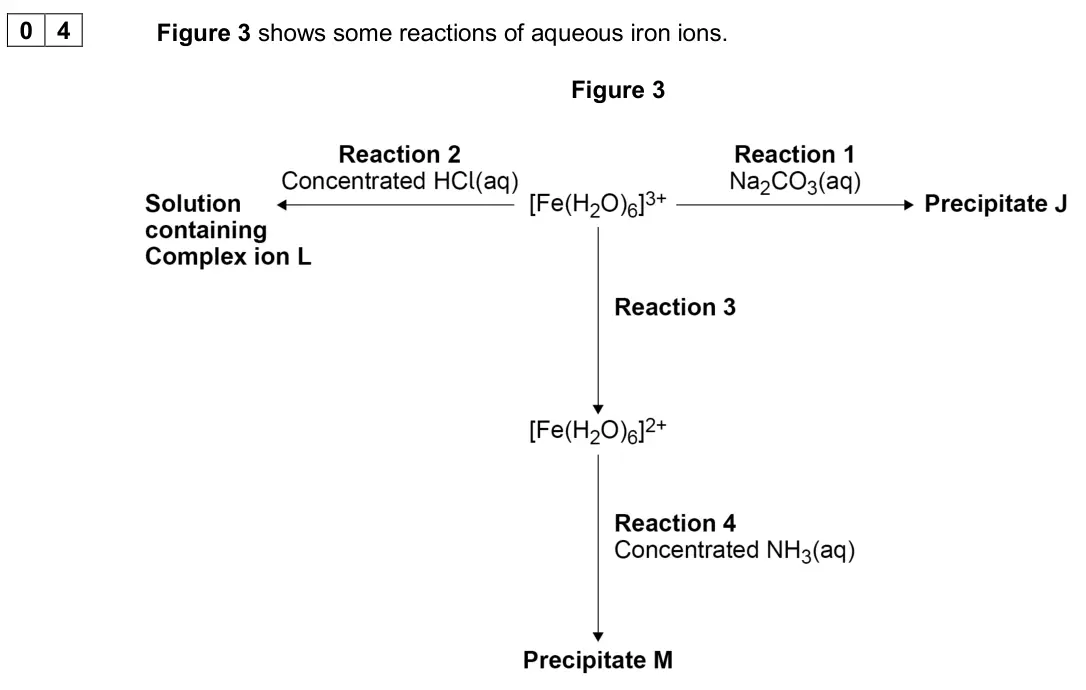
Q09.3
The whole paper ↗
Q11.3
The whole paper ↗
Q01.3
The whole paper ↗Q01.4
The whole paper ↗Q7(c)(i)
The whole paper ↗
All 35 questions on Shapes of complex ions, as a list
- June 2025, Paper 1, Q03.4 (6 marks): When a solution containing [Cu(H2O)6]2+ ions reacts with an excess of concentrated hydrochloric acid, a ligand exchange reaction occurs. [Cu(H2O)6]2+(aq) + 4 Cl
- June 2025, Paper 1, Q03.9 (2 marks): Draw the structure of two stereoisomers of the complex ion in M2[Cu(C2O4)2(H2O)2] and include the charge on each structure. [2 marks] Structure 1 Structure 2
- June 2025, Paper 3, Q17 (1 mark): Which type(s) of stereoisomerism is/are shown by the complex ion [Cr(H2NCH2CH2NH2)3]3+? [1 mark] A none B cis-trans only C optical only D cis-trans and optical
- June 2025, Paper 3, Q22 (1 mark): Which statement is correct? [1 mark] A Tollens’ reagent contains linear [Ag(NH3)2]+ ions. B Tollens’ reagent contains octahedral [Ag(NH3)6]+ ions. C Fehling’s s
- June 2025, Paper 3, Q23 (1 mark): Which reaction produces an octahedral complex ion? [1 mark] A The addition of excess aqueous ammonia to a solution containing [Co(H2O)6]2+ ions. B The addition
- June 2025, Paper 3, Q32 (1 mark): Which structure is correct for transplatin? [1 mark] A B C D
- June 2023, Paper 1, Q01.6 (3 marks): The compound [Cr(NH3)4Cl2]Cl contains a complex ion that shows isomerism. Draw the two isomers of the complex ion. State the type of isomerism shown. [3 marks]
- June 2023, Paper 3, Q23 (1 mark): Which statement about the shapes of ions is not correct? [1 mark] A [CoCl4]2– is square planar. B NH4+ is tetrahedral. C [Co(H2NCH2CH2NH2)3]2+ is octahedral. D
- June 2022, Paper 1, Q07.4 (1 mark): Name the shape of the [CuCl4] 2– ion. [1 mark]
- June 2022, Paper 3, Q19 (1 mark): Which pair of reagents reacts to form a tetrahedral complex? [1 mark] A CoCl2(aq) and concentrated NH3(aq) B CuSO4(aq) and concentrated NH3(aq) C CuSO4(aq) and
- November 2021, Paper 3, Q08 (1 mark): Which statement about chloride ions is not correct? [1 mark] A They form a white precipitate with silver nitrate solution that is soluble in dilute aqueous ammo
- November 2020, Paper 3, Q20 (1 mark): Which statement is not correct? [1 mark] A CuCl42– is square planar. B NH4+ is tetrahedral. C [Co(H2NCH2CH2NH2)3]2+ is octahedral. D [Fe(H2O)6]2+ is octahedral.
- June 2019, Paper 1, Q04.5 (6 marks): Transition metal complexes have different shapes and many show isomerism. Describe the different shapes of complexes and show how they lead to different types o
- June 2018, Paper 1, Q09.3 (2 marks): The [V(H2O)4Cl2]+ ion exists as two isomers. One isomer is shown. Draw the structure of the other isomer and state the type of isomerism. [2 marks] Type of isom
- June 2018, Paper 3, Q27 (1 mark): Which complex exists as optical isomers? [1 mark] A [Ag(NH3)2]+ B [Co(C2O4)3]4– C [Cu(EDTA)]2– D [Cu(NH3)4(H2O)2]2+
- June 2017, Paper 1, Q11.3 (3 marks): Draw the displayed formula of the iron complex produced in the reaction in Question 11.2 Indicate the value of the O—Fe—O bond angle. State the type of isomeris
- June 2017, Paper 3, Q15 (1 mark): Cisplatin is an anti-cancer drug. Which structure represents a stereoisomer of cisplatin? [1 mark] A B C D
- Specimen, Paper 1, Q01.3 (1 mark): Suggest one reason why electron pair repulsion theory cannot be used to predict the shape of the [CoCl4] 2– ion. [1 mark] 0 1 . 3
- Specimen, Paper 1, Q01.4 (2 marks): Shape Bond angle
- June 2014, CHEM5 (old spec), Q7(c)(i) (3 marks): Draw the displayed structure of cisplatin. On your structure, show the value of one of the bond angles at platinum. State the charge, if any, on the complex. [3
- June 2013, CHEM5 (old spec), Q8(b)(ii) (3 marks): Draw a diagram that shows the shape of the complex ion Y and shows the type of bond between the ethane-1,2-diamine molecules and the cobalt. (3 marks)
- January 2013, CHEM5 (old spec), Q8(b) (6 marks): Aqueous cobalt(II) ions react separately with an excess of chloride ions and with an excess of ammonia. For each reaction, draw a diagram to illustrate the stru
- June 2012, CHEM5 (old spec), Q6(c) (1 mark): Predict the value of the bond angle between the two bonds to iron that are formed by these two water molecules. (1 mark)
- January 2012, CHEM5 (old spec), Q7(b) (6 marks): Other than octahedral, there are several different shapes shown by transition metal complexes. Name three of these shapes and for each one give the formula of a
- January 2012, CHEM5 (old spec), Q8(e)(ii) (5 marks): Write an equation for the reaction that occurs between an aqueous solution of cobalt(II) sulfate and an excess of aqueous diaminoethane. Draw a diagram to show
- June 2011, CHEM5 (old spec), Q6(d)(ii) (2 marks): Give the names of two possible shapes for the complex palladium ion in this compound. Shape 1 Shape 2 (2 marks) Section B Answer all questions in the spaces pro
- June 2011, CHEM5 (old spec), Q7(a)(iii) (3 marks): Write an equation for the reaction, in aqueous solution, between [Cu(H2O)6]2+ and an excess of chloride ions. State the shape of the complex produced and explai
- June 2011, CHEM5 (old spec), Q7(c)(ii) (2 marks): In the complex formed, the two water molecules are opposite each other. Draw a diagram to show how the ethanedioate ions are bonded to a copper ion and give a v
- January 2011, CHEM5 (old spec), Q4(c)(i) (1 mark): a linear complex (1 mark)
- January 2011, CHEM5 (old spec), Q4(c)(ii) (1 mark): a square planar complex (1 mark)
- January 2011, CHEM5 (old spec), Q4(c)(iii) (1 mark): a tetrahedral complex (1 mark)
- January 2010, CHEM5 (old spec), Q7(a) (2 marks): Give the formula of the complex responsible for the pink colour in aqueous CoCl2 and name its shape. Formula Name of shape (2 marks)
- January 2010, CHEM5 (old spec), Q7(f) (2 marks): Identify the cobalt-containing complex in solution Z and explain why its co-ordination number is different from that in the pink solution of CoCl2 Complex Expla
- June 2008, CHM5 (2008 spec), Q7(a) (8 marks): 7 (a) Draw the shape of each of the following and, in each case, name the shape. 7 (a) (i) HCHO ( ) ( ) 7 (a) (ii) [CoCl4]2– ( ) ( ) [ 4] 7 (a) (iii) [IF4]– 7 (
- June 2008, CHM6W (2008 spec), Q27 (1 mark): 27 Species with at least one bond angle of 90° include 1 XeF4 2 PF5 3 [Co(NH3)6]3+ 4 Si(CH3)4
Questions, mark schemes and examiner’s reports are © AQA, from their published past papers. Plumi isn’t affiliated with any exam board. Want whole papers? AQA A-Level Chemistry past papers.
The Plumi iPad app also offers exam-style questions with AI feedback on your handwritten working.