 plumi
Catalysts: AQA A‑Level Chemistry questions
AQA A-Level Chemistry past-paper questions on 3.2.5.6 Catalysts, 2008–2025, with mark schemes and examiner’s reports where available.
Paper
All papers
Exam
All years
Calculations
Q04.4
The whole paper ↗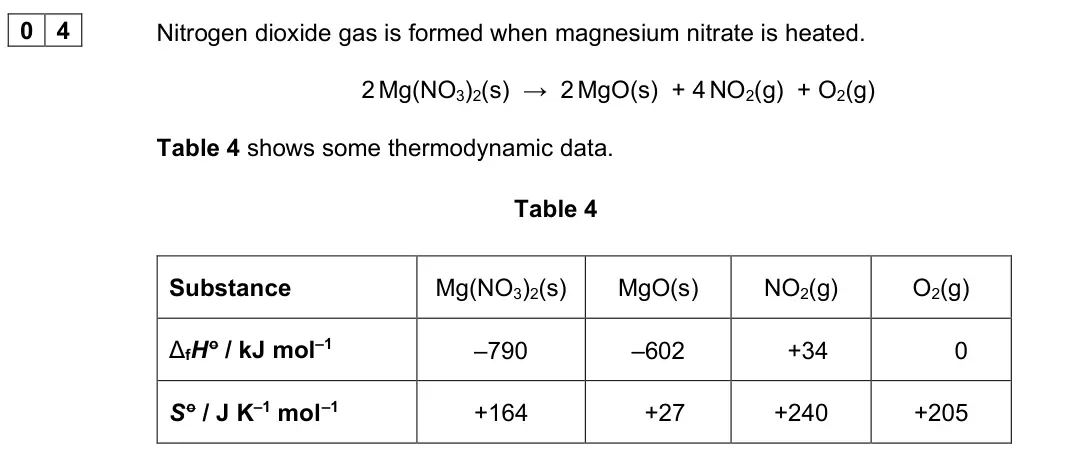
Q07.3
The whole paper ↗
Q03.3
The whole paper ↗
Q05.2
The whole paper ↗
Q05.3
The whole paper ↗Q04.1
The whole paper ↗
Q04.2
The whole paper ↗Q04.3
The whole paper ↗Q01.4
The whole paper ↗
Q02.3
The whole paper ↗
Q03.4
The whole paper ↗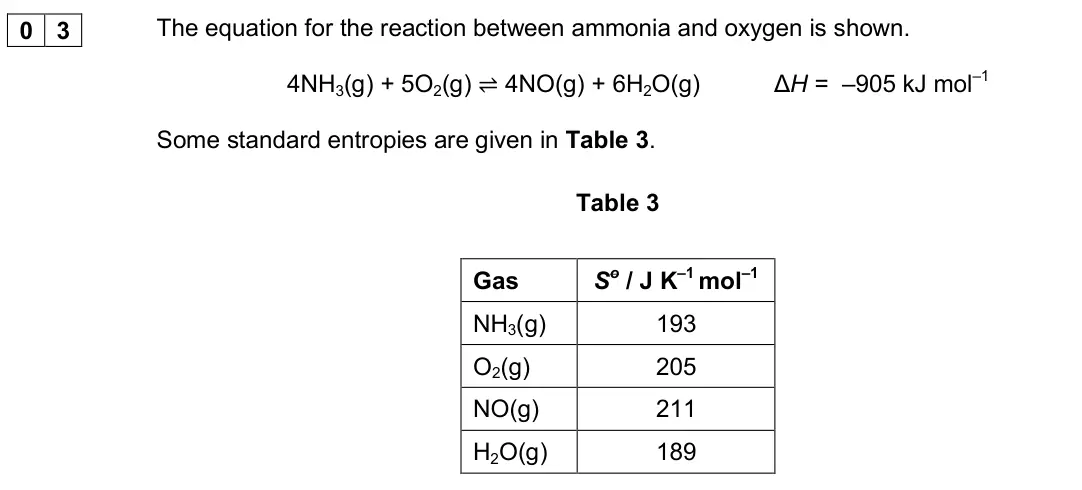
Q09.5
The whole paper ↗
Q04.5
The whole paper ↗Q6(f)(i)
The whole paper ↗
Q6(f)(ii)
The whole paper ↗Q6(f)(iii)
The whole paper ↗Q6(f)(iv)
The whole paper ↗
All 56 questions on Catalysts, as a list
- June 2025, Paper 1, Q04.4 (1 mark): An alloy of platinum and rhodium is used as a catalyst in the reaction. What type of catalyst is this? [1 mark] Tick ( ) one box. Autocatalyst Heterogeneous cat
- June 2025, Paper 1, Q07.3 (2 marks): Vanadium(V) oxide is a catalyst in the Contact process. 2 SO2(g) + O2(g) ⇌ 2 SO3(g) Give two equations to show how vanadium(V) oxide acts as a catalyst in this
- June 2024, Paper 1, Q03.3 (6 marks): Outline how Fe2+ ions catalyse the reaction between S2O82– ions and I– ions in aqueous solution. In your answer you should include • a sketch graph to show how
- June 2023, Paper 3, Q27 (1 mark): Which process does not involve a heterogeneous catalyst? [1 mark] A catalytic cracking of alkanes B Contact process C decomposition of ozone D Haber process
- June 2022, Paper 3, Q05.2 (6 marks): A student determines the concentration of ethanedioate ions in an acidified solution by titration with potassium manganate(VII) solution. 2 MnO4– + 5 C2O42– + 1
- June 2022, Paper 3, Q05.3 (3 marks): The reaction between peroxodisulfate ions and iodide ions in aqueous solution can be catalysed by Co2+ ions. S2O82– + 2 I– → 2 SO42– + I2 Table 6 gives relevant
- November 2021, Paper 1, Q04.1 (6 marks): Discuss the role of iron as a heterogeneous catalyst in the Haber process. 3 H2 + N2 ⇌ 2 NH3 Your answer should include: • the meaning of the term heterogeneous
- November 2021, Paper 1, Q04.2 (4 marks): Fe2+ ions catalyse the reaction between peroxodisulfate(VI) ions and iodide ions in aqueous solution. S2O82–(aq) + 2 I–(aq) → 2 SO42–(aq) + I2(aq) Explain why t
- November 2021, Paper 1, Q04.3 (1 mark): Give a reason why Zn2+ ions do not catalyse the reaction in Question 04.2. [1 mark]
- November 2020, Paper 3, Q01.4 (2 marks): Petrol vehicles have a catalytic converter which decreases emissions of oxides of nitrogen. Platinum in the catalytic converter acts as a heterogeneous catalyst
- November 2020, Paper 3, Q02.3 (2 marks): In the Contact process, sulfur(IV) oxide is converted into sulfur(VI) oxide using vanadium(V) oxide as a catalyst. Give two equations to show how the vanadium(V
- June 2018, Paper 1, Q03.4 (3 marks): Platinum acts as a heterogeneous catalyst in the reaction between ammonia and oxygen. It provides an alternative reaction route with a lower activation energy.
- June 2018, Paper 1, Q09.5 (1 mark): Vanadium(V) oxide is the catalyst used in the manufacture of sulfur trioxide. Give two equations to show how the catalyst is used and regenerated. [1 mark]
- June 2018, Paper 3, Q29 (1 mark): Which ion cannot catalyse the reaction between iodide (I–) and peroxodisulfate (S2O8 2–)? Use the data below to help you answer this question. [1 mark] Half-equ
- June 2017, Paper 3, Q17 (1 mark): V2O5 can be used as a catalyst in the Contact Process. Which is a step in the Contact Process in which the vanadium is oxidised? [1 mark] A SO2 + V2O5 → SO3 + 2
- Specimen, Paper 1, Q04.5 (1 mark): 0
- June 2016, CHEM5 (old spec), Q6(f)(i) (1 mark): State what is meant by the term heterogeneous. [1 mark]
- June 2016, CHEM5 (old spec), Q6(f)(ii) (2 marks): Write two equations that show how this catalyst is involved in the Contact Process. [2 marks]
- June 2016, CHEM5 (old spec), Q6(f)(iii) (1 mark): Suggest why the vanadium(V) oxide is used in small pellet form rather than as large lumps. [1 mark]
- June 2016, CHEM5 (old spec), Q6(f)(iv) (1 mark): State why the reactants should be purified before they come into contact with the vanadium(V) oxide. [1 mark]
- June 2016, CHEM5 (old spec), Q9(a) (2 marks): The reaction between C2O42– ions and MnO4– ions is autocatalysed. Explain what is meant by the term autocatalysed and identify the catalyst in the reaction. [2
- June 2016, CHEM5 (old spec), Q9(c) (3 marks): The reaction between C2O42– ions and MnO4– ions is very slow at first. Explain why the reaction is initially slow. [3 marks]
- June 2015, CHEM5 (old spec), Q9(a) (6 marks): Write an equation for this redox reaction. Identify the species that acts as the catalyst. Explain how the properties of the species enable it to act as a catal
- June 2015, CHEM5 (old spec), Q9(b) (4 marks): Sketch a graph to show how the concentration of MnO4– ions varies with time in this reaction. Explain the shape of the graph. [4 marks]
- June 2014, CHEM5 (old spec), Q7(d) (4 marks): Explain, with the aid of equations, how and why vanadium(V) oxide is used in the Contact Process. [4 marks]
- June 2013, CHEM5 (old spec), Q8(a) (4 marks): Ethanal is oxidised to ethanoic acid by oxygen. The equation for this reaction is 2CH3CHO + O2 → 2CH3COOH This redox reaction is slow at room temperature but sp
- January 2013, CHEM5 (old spec), Q6(a) (1 mark): State the general property of transition metals that allows the vanadium in vanadium(V) oxide to act as a catalyst in the Contact Process. (1 mark)
- January 2013, CHEM5 (old spec), Q6(b) (2 marks): Write two equations to show how vanadium(V) oxide acts as a catalyst in the Contact Process. Equation 1 Equation 2 (2 marks)
- January 2013, CHEM5 (old spec), Q6(c)(i) (1 mark): Give the meaning of the term heterogeneous. (1 mark)
- January 2013, CHEM5 (old spec), Q6(c)(ii) (1 mark): Give one reason why impurities in the reactants can cause problems in processes that use heterogeneous catalysts. (1 mark) 2
- January 2013, CHEM5 (old spec), Q6(d)(i) (1 mark): Give the meaning of the term autocatalysed. (1 mark)
- January 2013, CHEM5 (old spec), Q6(d)(ii) (1 mark): Identify the autocatalyst in this reaction. (1 mark)
- January 2013, CHEM5 (old spec), Q6(d)(iii) (2 marks): Write two equations to show how the autocatalyst is involved in this oxidation of C2O42– ions. Equation 1 Equation 2 (2 marks) Section B Answer all questions in
- June 2012, CHEM5 (old spec), Q8(b) (4 marks): A flue-gas desulfurisation process involves the oxidation, by oxygen, of aqueous sulfate(IV) ions (SO32–) into aqueous sulfate(VI) ions (SO42–). This reaction i
- January 2012, CHEM5 (old spec), Q6(c) (3 marks): This reaction is autocatalysed. Give the meaning of the term autocatalyst. Explain how the above curve indicates clearly that the reaction is autocatalysed. Mea
- January 2012, CHEM5 (old spec), Q6(d) (1 mark): Identify the autocatalyst in this reaction. (1 mark)
- January 2012, CHEM5 (old spec), Q6(e) (2 marks): Write two equations to show how the autocatalyst is involved in this reaction. Equation 1 Equation 2 (2 marks) Section B Answer all questions in the spaces prov
- June 2011, CHEM5 (old spec), Q8(a) (5 marks): Explain how and why iron ions catalyse the reaction between iodide ions and S2O8 2– ions. Write equations for the reactions that occur.
- January 2011, CHEM5 (old spec), Q4(d)(i) (1 mark): Write an equation for the overall reaction in the Contact Process. (1 mark)
- January 2011, CHEM5 (old spec), Q4(d)(ii) (1 mark): Explain the meaning of the term heterogeneous as applied to a catalyst. (1 mark)
- January 2011, CHEM5 (old spec), Q4(d)(iii) (2 marks): Write two equations to illustrate how vanadium(V) oxide acts as a catalyst in the Contact Process. Equation 1 Equation 2 (2 marks)
- January 2011, CHEM5 (old spec), Q4(d)(iv) (2 marks): Suggest what is done to a heterogeneous catalyst such as vanadium(V) oxide to maximise its efficiency and how this is achieved. (2 marks)
- June 2010, CHEM5 (old spec), Q3(a) (1 mark): State the meaning of the term homogeneous. (1 mark)
- June 2010, CHEM5 (old spec), Q3(b) (1 mark): Suggest why ions from s block elements do not usually act as catalysts. (1 mark)
- June 2010, CHEM5 (old spec), Q3(c) (1 mark): Write an equation for the overall reaction that occurs, in aqueous solution, between S2O8 2– ions and I– ions. (1 mark)
- June 2010, CHEM5 (old spec), Q3(d) (1 mark): Give one reason why, in the absence of a catalyst, the activation energy for the reaction between S2O82– ions and I– ions is high. (1 mark) 2
- June 2010, CHEM5 (old spec), Q3(e) (3 marks): Write two equations to show how Fe2+ ions can catalyse the reaction between S2O8 2– ions and I– ions. Suggest one reason why the activation energy for each of t
- June 2010, CHEM5 (old spec), Q3(f) (1 mark): Explain why Fe3+ ions are as effective as Fe2+ ions in catalysing this reaction. (1 mark)
- January 2010, CHEM5 (old spec), Q1(b) (1 mark): State the characteristic property of transition metals that enables them to act as catalysts in redox reactions. (1 mark)
- January 2010, CHEM5 (old spec), Q1(c)(i) (2 marks): Write two equations to show how the catalyst is involved in this reaction. Equation 1 Equation 2 (2 marks)
- January 2010, CHEM5 (old spec), Q1(c)(ii) (1 mark): Suggest one reason why poisoning reduces the effectiveness of a heterogeneous catalyst. (1 mark)
- January 2010, CHEM5 (old spec), Q1(c)(iii) (1 mark): Suggest how poisoning of a catalyst, used in an industrial process, can be minimised. (1 mark)
- January 2010, CHEM5 (old spec), Q9(c)(ii) (5 marks): Sketch a curve to show how you would expect the concentration of manganate(VII) ions to change with time until the colour has faded because the concentration ha
- June 2008, CHM5 (2008 spec), Q5(c) (2 marks): 5 (c) On the axes above, sketch a curve to show how the results will change if the experiment leading to curve A is repeated in the presence of a catalyst conta
- June 2008, CHM5 (2008 spec), Q5(d) (4 marks): 5 (d) In the oxidation of iodide ions by peroxodisulphate ions, the Fe2+ ions act as a catalyst in a two-step process. 5 (d) (i) Write an equation for each of t
- June 2008, CHM5 (2008 spec), Q5(e) (4 marks): 5 (e) Silver is used as a heterogeneous catalyst for the exothermic process illustrated by the following equation. O H2C=CH2 + O2 →H2C–CH2 1 2 5 (e) (i) Explain
Questions, mark schemes and examiner’s reports are © AQA, from their published past papers. Plumi isn’t affiliated with any exam board. Want whole papers? AQA A-Level Chemistry past papers.
The Plumi iPad app also offers exam-style questions with AI feedback on your handwritten working.