 plumi
Action of anticancer drugs: AQA A‑Level Chemistry questions
AQA A-Level Chemistry past-paper questions on 3.3.13.5 Action of anticancer drugs, 2008–2025, with mark schemes and examiner’s reports where available.
Paper
All papers
Exam
All years
Calculations
Q04.1
The whole paper ↗
Q04.2
The whole paper ↗Q04.3
The whole paper ↗Q08.3
The whole paper ↗Q08.4
The whole paper ↗Q7(c)(i)
The whole paper ↗
Q7(c)(ii)
The whole paper ↗Q7(c)(iii)
The whole paper ↗Q6(a)
The whole paper ↗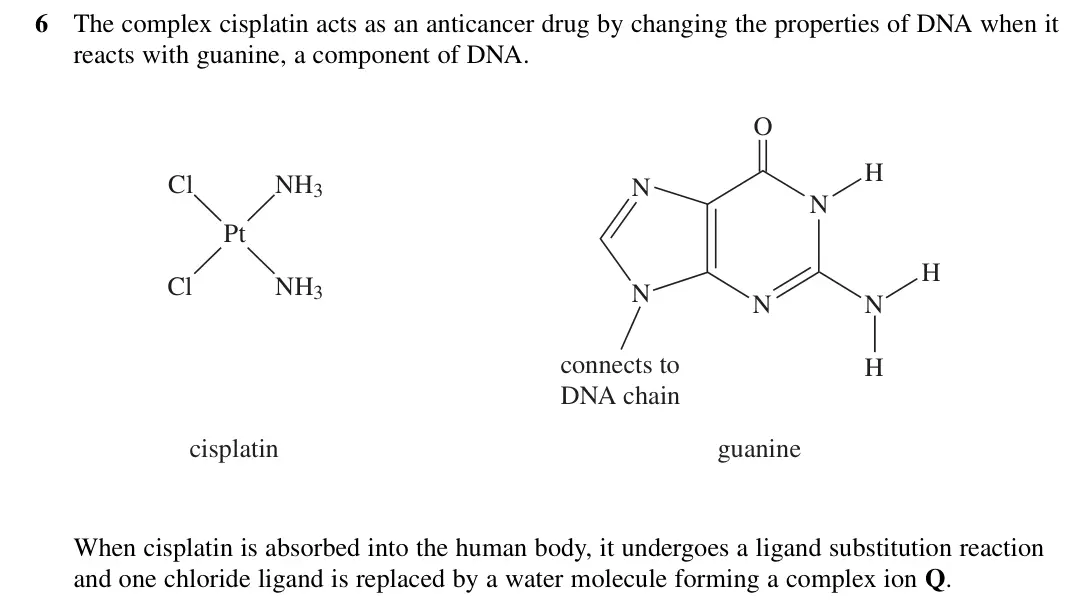
Q6(b)(i)
The whole paper ↗Q6(b)(ii)
The whole paper ↗Q6(c)
The whole paper ↗
All 15 questions on Action of anticancer drugs, as a list
- June 2025, Paper 3, Q32 (1 mark): Which structure is correct for transplatin? [1 mark] A B C D
- June 2023, Paper 3, Q36 (1 mark): Cisplatin has the formula [Pt(NH3)2Cl2] Cisplatin is an anti-cancer drug that prevents replication of DNA. When cisplatin bonds to DNA, which is the correct lig
- November 2020, Paper 3, Q04.1 (1 mark): Cisplatin works by causing the death of rapidly dividing cells. Name the process that is prevented by cisplatin during cell division. [1 mark]
- November 2020, Paper 3, Q04.2 (2 marks): Give the equation for this reaction. [2 marks]
- November 2020, Paper 3, Q04.3 (2 marks): When the complex ion B reacts with DNA, the water molecule is replaced as a bond forms between platinum and a nitrogen atom in a guanine nucleotide. The remaini
- June 2017, Paper 3, Q15 (1 mark): Cisplatin is an anti-cancer drug. Which structure represents a stereoisomer of cisplatin? [1 mark] A B C D
- Specimen, Paper 2, Q08.3 (1 mark): Cisplatin works because one of the atoms on guanine can form a co-ordinate bond with platinum, replacing one of the ammonia or chloride ligands. Another atom on
- Specimen, Paper 2, Q08.4 (1 mark): An adverse effect of cisplatin is that it also prevents normal healthy cells from replicating. Suggest one way in which cisplatin can be administered so that th
- June 2014, CHEM5 (old spec), Q7(c)(i) (3 marks): Draw the displayed structure of cisplatin. On your structure, show the value of one of the bond angles at platinum. State the charge, if any, on the complex. [3
- June 2014, CHEM5 (old spec), Q7(c)(ii) (1 mark): When cisplatin is ingested, an initial reaction involves one of the chloride ligands being replaced by water. Write an equation for this reaction. [1 mark]
- June 2014, CHEM5 (old spec), Q7(c)(iii) (1 mark): Suggest how the risk associated with the use of this drug can be minimised. [1 mark]
- January 2010, CHEM5 (old spec), Q6(a) (2 marks): Write an equation for this substitution reaction to form the complex ion Q. (2 marks)
- January 2010, CHEM5 (old spec), Q6(b)(i) (2 marks): The first way involves a hydrogen atom, from one of the ammonia ligands on Q, bonding to an atom in a guanine molecule. State the type of bond formed to guanine
- January 2010, CHEM5 (old spec), Q6(b)(ii) (2 marks): The second way involves a ligand substitution reaction in which an atom in a guanine molecule bonds to platinum by displacing the water molecule from Q. State t
- January 2010, CHEM5 (old spec), Q6(c) (2 marks): State and explain one risk associated with the use of cisplatin as an anticancer drug. Risk Explanation (2 marks)
Questions, mark schemes and examiner’s reports are © AQA, from their published past papers. Plumi isn’t affiliated with any exam board. Want whole papers? AQA A-Level Chemistry past papers.
The Plumi iPad app also offers exam-style questions with AI feedback on your handwritten working.