 plumi
Trends in properties: AQA A‑Level Chemistry questions
AQA A-Level Chemistry past-paper questions on 3.2.3.1 Trends in properties, 2008–2025, with mark schemes and examiner’s reports where available.
Paper
All papers
Exam
All years
Calculations
Q01.5
The whole paper ↗
Q05.4
The whole paper ↗
Q02.1
The whole paper ↗
Q02.7
The whole paper ↗Q02.8
The whole paper ↗Q06.2
The whole paper ↗Q05.4
The whole paper ↗
Q01.1
The whole paper ↗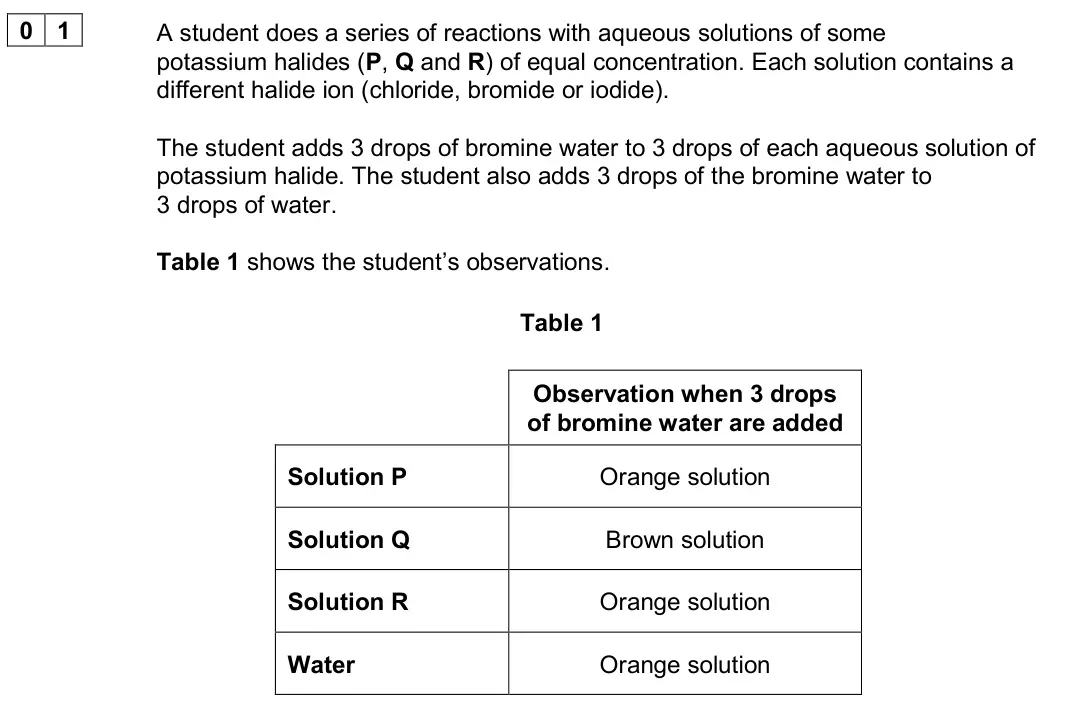
Q01.2
The whole paper ↗Q01.3
The whole paper ↗Q06.1
The whole paper ↗
Q06.2
The whole paper ↗Q06.3
The whole paper ↗
All 148 questions on Trends in properties, as a list
- June 2025, Paper 1, Q01.5 (3 marks): Identify the anion in solution X. Give an ionic equation, including state symbols, for the reaction that occurs in Test 2. Explain why AgNO3(aq) is acidified. [
- June 2025, Paper 1, Q05.4 (4 marks): Solid sodium bromide reacts with concentrated sulfuric acid. Two reactions occur • an acid-base reaction • a redox reaction. Give an equation and an observation
- June 2025, AS Paper 1, Q02.1 (2 marks): Table 1 shows the boiling points of some halogens. Table 1 Halogen Boiling point / °C Fluorine –188 Chlorine –35 Bromine 59 Explain the trend in the boiling poi
- June 2025, AS Paper 1, Q02.7 (2 marks): A halide ion X– reduces concentrated sulfuric acid to hydrogen sulfide. Identify the halide ion. Give an equation for the reaction. [2 marks] Halide ion Equatio
- June 2025, AS Paper 1, Q02.8 (3 marks): Some solid sodium halides react with concentrated sulfuric acid without any redox reaction taking place. Identify a sodium halide that behaves in this way. Give
- June 2025, AS Paper 1, Q06.2 (1 mark): Describe a test to confirm that a solution contains hydroxide ions. [1 mark]
- June 2025, AS Paper 1, Q17 (1 mark): Which silver halide(s) react(s) with concentrated ammonia solution to form a colourless solution? [1 mark] A silver chloride only B silver chloride and silver b
- June 2024, Paper 1, Q05.4 (2 marks): Give the equation for the reaction of solid sodium chloride with concentrated sulfuric acid. State the role of the chloride ions in this reaction. [2 marks] Equ
- June 2024, Paper 3, Q20 (1 mark): Which statement correctly describes a trend down Group 7 from Cl to I? X represents Cl, Br or I [1 mark] A The boiling point of HX increases. B The bond dissoci
- June 2024, Paper 3, Q21 (1 mark): Which statement about chloride ions is correct? [1 mark] A They are oxidised by concentrated sulfuric acid. B They form a cream precipitate with silver nitrate
- June 2024, AS Paper 1, Q01.1 (2 marks): Identify the halide ion present in Q. Give the ionic equation for the reaction that occurs when bromine water is added to Q. [2 marks] Halide ion in Q Ionic equ
- June 2024, AS Paper 1, Q01.2 (2 marks): Explain, in terms of oxidising ability, why the observations from these reactions do not allow the student to identify the halide ion present in P and the halid
- June 2024, AS Paper 1, Q01.3 (3 marks): The student does a second experiment to determine the halide ion in each of P and R. The student adds a few drops of aqueous silver nitrate solution to 2 cm3 of
- June 2024, AS Paper 1, Q04 (6 marks): A student is provided with separate unlabelled samples of four different solutions for analysis. The four solutions are known to be ammonium nitrate, potassium
- June 2024, AS Paper 1, Q19 (1 mark): Which of these solid sodium halides does not reduce concentrated sulfuric acid? [1 mark] A NaAt B NaBr C NaCl D NaI
- June 2023, Paper 3, Q22 (1 mark): Which species is the strongest reducing agent? [1 mark] A F2 B I2 C F– D I–
- June 2023, AS Paper 1, Q06.1 (2 marks): Explain why the electronegativity of the halogens decreases down the group. [2 marks]
- June 2023, AS Paper 1, Q06.2 (2 marks): State one similarity in, and one difference between, these reactions. [2 marks] Similarity Difference
- June 2023, AS Paper 1, Q06.3 (3 marks): Solid sodium iodide reacts with concentrated sulfuric acid to form hydrogen sulfide. Give a half-equation to show the oxidation of iodide ions. Give a half-equa
- June 2023, AS Paper 1, Q19 (1 mark): Which solution contains carbonate ions? [1 mark] A Solution P B Solution Q C Solution R D Solution S
- June 2023, AS Paper 1, Q20 (1 mark): What could be the identity of the compound in solution P? [1 mark] A MgBr2 B BaBr2 C MgCl2 D BaCl2
- June 2023, AS Paper 1, Q21 (1 mark): What observation is expected in Test 2 for solution S? [1 mark] A No visible change B Effervescence C White precipitate D Pale yellow precipitate
- June 2023, AS Paper 1, Q22 (1 mark): In Test 2, the mixture formed by solution S is filtered. Which substance is present in the filtrate? [1 mark] A AgBr B Agl C Ba(NO3)2 D Mg(NO3)2
- June 2023, AS Paper 1, Q23 (1 mark): What could be the identity of the compound in solution T? [1 mark] A MgCl2 B BaCl2 C MgBr2 D BaBr2
- June 2022, Paper 1, Q06.3 (2 marks): A student bubbles chlorine gas through a solution of sodium iodide. State the observation the student would make. Give an ionic equation for the reaction. [2 ma
- June 2022, Paper 1, Q06.4 (3 marks): The student adds a few drops of concentrated sulfuric acid to a small amount of solid sodium iodide. Two gaseous sulfur-containing products are formed. Give an
- June 2022, Paper 1, Q06.5 (3 marks): The student adds a few drops of acidified silver nitrate solution to a solution of an unknown impure sodium halide. The student observes bubbles of gas and a co
- June 2022, Paper 3, Q18 (1 mark): A test for chloride ions in aqueous solution involves adding dilute nitric acid followed by aqueous silver nitrate. What is the reason for adding the nitric aci
- June 2022, AS Paper 1, Q06.3 (2 marks): When iodide ions are oxidised using concentrated sulfuric acid, sulfur dioxide, a yellow solid and a foul-smelling gas are all formed. Give an equation to show
- June 2022, AS Paper 1, Q08.1 (2 marks): Identify the gas formed in Test 1. Describe a further test to confirm the identity of this gas. [2 marks] Identity of gas Test
- June 2022, AS Paper 1, Q08.2 (2 marks): Explain how the observations from Test 1 and Test 2 can be used to show that solution B contains hydrochloric acid. [2 marks]
- June 2022, AS Paper 1, Q08.3 (4 marks): Describe a series of tests that the student can use to show that solution C contains ammonium sulfate. [4 marks]
- June 2022, AS Paper 1, Q08.4 (2 marks): The student does an additional experiment to show that solution D contains a mixture of halide ions. One of the halide ions is chloride. Method: Step 1 Add an e
- June 2022, AS Paper 1, Q16 (1 mark): Which is a correct trend down Group 7 from fluorine to iodine? [1 mark] A The boiling point of the element decreases. B The oxidising ability of the element dec
- June 2022, AS Paper 1, Q18 (1 mark): Which statement is correct? [1 mark] A Chloride ions reduce concentrated sulfuric acid to form sulfur dioxide. B Bromide ions reduce concentrated sulfuric acid
- November 2021, Paper 3, Q04.1 (2 marks): Give an equation for the reaction of solid sodium bromide with concentrated sulfuric acid to form bromine. State one observation made during this reaction. [2 m
- November 2021, Paper 3, Q04.2 (5 marks): A solution that is thought to contain chloride ions and iodide ions is tested. 1. Dilute nitric acid is added to the solution. 2. Aqueous silver nitrate is adde
- November 2021, Paper 3, Q08 (1 mark): Which statement about chloride ions is not correct? [1 mark] A They form a white precipitate with silver nitrate solution that is soluble in dilute aqueous ammo
- November 2021, AS Paper 1, Q04.2 (2 marks): Different gases are formed when solution B reacts in Test 1 and in Test 2. Suggest the identity of each gas. Give the simplest ionic equation for the formation
- November 2021, AS Paper 1, Q04.3 (3 marks): The student thinks that solution C contains either chloride ions or bromide ions. Describe a further test, or tests, to show whether solution C contains chlorid
- November 2021, AS Paper 1, Q19 (1 mark): Which pair of solutions, when mixed, reacts to form a dark brown solution? [1 mark] A NaF(aq) + Cl2(aq) B NaCl(aq) + Br2(aq) C NaBr(aq) + Cl2(aq) D NaI(aq) + Br
- November 2021, AS Paper 1, Q20 (1 mark): Some solid sodium halides are reacted with concentrated sulfuric acid. Which solid sodium halide does not produce a sulfur-containing gas as one of the products
- November 2020, Paper 1, Q09.1 (1 mark): State what is observed when silver nitrate solution is added to sodium fluoride solution. [1 mark]
- November 2020, Paper 1, Q09.2 (3 marks): State one observation when solid sodium chloride reacts with concentrated sulfuric acid. Give an equation for the reaction. State the role of the chloride ions
- November 2020, Paper 1, Q09.3 (3 marks): Give an equation for the redox reaction between solid sodium bromide and concentrated sulfuric acid. Explain, using oxidation states, why this is a redox reacti
- November 2020, Paper 1, Q09.4 (2 marks): State what is observed when aqueous chlorine is added to sodium bromide solution. Give an ionic equation for the reaction. [2 marks] Observation Ionic equation
- November 2020, Paper 3, Q15 (1 mark): In the test for a halide ion in aqueous solution, dilute nitric acid is added before the addition of silver nitrate solution. Why is nitric acid added? [1 mark]
- November 2020, AS Paper 1, Q07.2 (4 marks): Solid sodium iodide reacts with concentrated sulfuric acid to form iodine and sulfur in a redox reaction. Give a half-equation to show the conversion of iodide
- November 2020, AS Paper 1, Q07.3 (1 mark): Silver nitrate is added to the solution. Suggest why an excess is used. [1 mark]
- November 2020, AS Paper 1, Q17 (1 mark): Which property increases down Group 7? [1 mark] A ability to oxidise a given reducing agent B boiling point C electronegativity D first ionisation energy
- November 2020, AS Paper 1, Q22 (1 mark): Which equation shows a redox reaction that does not occur? [1 mark] A Br2(aq) + 2 KI(aq) → I2(aq) + 2 KBr(aq) B Cl2(g) + 2 KI(aq) → I2(aq) + 2 KCl(aq) C Cl2(g)
- June 2019, Paper 1, Q05.1 (2 marks): Solid sodium chloride reacts with concentrated sulfuric acid. Give an equation for this reaction. State the role of the sulfuric acid in this reaction. [2 marks
- June 2019, Paper 1, Q05.2 (3 marks): Fumes of sulfur dioxide are formed when sodium bromide reacts with concentrated sulfuric acid. For this reaction • give an equation • give one other observation
- June 2019, Paper 1, Q05.5 (6 marks): Solution Y contains two different negative ions. To a sample of solution Y in a test tube a student adds • silver nitrate solution • then an excess of dilute ni
- June 2019, Paper 3, Q16 (1 mark): An aqueous solution of a salt gives a white precipitate when mixed with aqueous silver nitrate and when mixed with dilute sulfuric acid. Which could be the form
- June 2019, Paper 3, Q17 (1 mark): Which statement is not correct about the trends in properties of the hydrogen halides from HCl to HI ? [1 mark] A The boiling points decrease. B The bond dissoc
- June 2019, AS Paper 1, Q08.2 (3 marks): NaCl(aq) and Na2CO3(aq) [3 marks] Reagent Observation with NaCl Observation with Na2CO3 Section B Answer all questions in this section. Only one answer per ques
- June 2019, AS Paper 1, Q19 (1 mark): What is the best oxidising agent? [1 mark] A F2 B F– C I2 D I–
- June 2019, AS Paper 1, Q22 (1 mark): Which statement is correct about reactions involving halide ions? [1 mark] A Sodium chloride forms chlorine when added to concentrated sulfuric acid. B Sodium c
- June 2018, AS Paper 1, Q04.1 (6 marks): Separate unlabelled solid samples of three anhydrous sodium compounds are provided for a student to identify. These compounds are known to be sodium carbonate,
- June 2018, AS Paper 1, Q16 (1 mark): Which statement is correct about the reaction between concentrated sulfuric acid and solid sodium bromide? [1 mark] A Bromide ions are reduced. B Hydrogen bromi
- June 2017, Paper 1, Q01.4 (2 marks): Identify a reagent that could be used to indicate the presence of iodide ions in an aqueous solution and describe the observation made. [2 marks] Reagent Observ
- June 2017, Paper 3, Q02.7 (2 marks): Concentrated sulfuric acid reacts with solid sodium chloride. Give the observation you would make in this reaction. State the role of the sulfuric acid. [2 mark
- June 2017, Paper 3, Q02.8 (3 marks): Concentrated sulfuric acid reacts with solid sodium iodide, to produce several products. Observations made during this reaction include the formation of a black
- June 2017, AS Paper 1, Q10 (1 mark): 1 0 Which is the best technique to remove the silver chloride that forms when aqueous solutions of silver nitrate and sodium chloride react? [1 mark] A Refluxin
- June 2017, AS Paper 1, Q11 (1 mark): Which statement about astatine is correct? [1 mark A Astatine has a greater electronegativity than bromine B Astatine is a better oxidising agent than bromine C
- June 2017, AS Paper 1, Q23 (1 mark): 2 3 Which species is not produced by a redox reaction between solid sodium iodide and concentrated sulfuric acid? [1 mark] A Na2SO4 B H2S C S D SO2 END OF QUEST
- June 2016, AS Paper 1, Q08.4 (3 marks): A solution of sodium chlorate(l) was added to a colourless solution of potassium iodide. Suggest what is observed. Explain the reaction that leads to this obser
- June 2016, CHEM2 (old spec), Q6(a) (2 marks): The electronegativities of the halogens are shown in Table 4. Table 4 Explain the trend in electronegativities shown by the halogens. [2 marks] Halogen Fluorine
- June 2016, CHEM2 (old spec), Q6(c)(i) (1 mark): A sample of solid sodium iodide is reacted with concentrated sulfuric acid. A black solid forms and hydrogen sulfide gas is produced. Write a half-equation for
- June 2016, CHEM2 (old spec), Q6(c)(ii) (1 mark): Write a half-equation for the formation of the black solid. [1 mark]
- June 2016, CHEM2 (old spec), Q6(c)(iii) (1 mark): Use your answers to parts (c) (i) and (c) (ii) to write an overall equation for the reaction of sodium iodide with concentrated sulfuric acid. [1 mark]
- June 2016, CHEM2 (old spec), Q6(c)(iv) (1 mark): Give the role of sulfuric acid in its reaction with sodium iodide. Tick () one box. [1 mark] Acid Oxidising agent Reducing agent Electrophile
- June 2016, CHEM2 (old spec), Q6(c)(v) (1 mark): Write an equation for the reaction of concentrated sulfuric acid with solid sodium fluoride. [1 mark]
- June 2016, CHEM2 (old spec), Q6(c)(vi) (1 mark): Suggest one reason why the reaction of sodium fluoride with concentrated sulfuric acid is different from the reaction with sodium iodide. [1 mark]
- June 2015, CHEM2 (old spec), Q1(b)(i) (1 mark): Write the simplest ionic equation for the reaction of chlorine with bromide ions. [1 mark]
- June 2015, CHEM2 (old spec), Q1(b)(ii) (1 mark): Give one observation that would be made during this reaction. [1 mark]
- June 2015, CHEM2 (old spec), Q1(d) (2 marks): Explain why chlorine has a lower boiling point than bromine. [2 marks]
- June 2015, CHEM2 (old spec), Q2(c) (3 marks): Aqueous silver nitrate and aqueous sodium nitrate [3 marks] Reagent Observation with aqueous silver nitrate Observation with aqueous sodium nitrate
- June 2015, CHEM2 (old spec), Q8(e) (4 marks): Hydrogen bromide (HBr) could be used in the overall conversion of P into R, instead of using HCl Hydrogen bromide is made by the reaction of NaBr with concentra
- June 2014, CHEM2 (old spec), Q6(b)(i) (1 mark): Balance the equation for the reaction that forms sulfur. [1 mark]
- June 2014, CHEM2 (old spec), Q6(b)(ii) (1 mark): Deduce the half-equation for the formation of iodine from iodide ions. [1 mark]
- June 2014, CHEM2 (old spec), Q6(b)(iii) (1 mark): Deduce the half-equation for the formation of hydrogen sulfide from concentrated sulfuric acid. [1 mark]
- June 2014, CHEM2 (old spec), Q6(c)(i) (1 mark): Write the simplest ionic equation for the formation of the yellow precipitate. [1 mark]
- June 2014, CHEM2 (old spec), Q6(c)(ii) (1 mark): State what is observed when concentrated ammonia solution is added to this yellow precipitate. [1 mark]
- June 2014, CHEM2 (old spec), Q6(c)(iii) (1 mark): State why the silver nitrate solution is acidified when testing for iodide ions. [1 mark]
- June 2014, CHEM2 (old spec), Q6(c)(iv) (1 mark): Explain why dilute hydrochloric acid is not used to acidify the silver nitrate solution in this test for iodide ions. [1 mark]
- June 2013, CHEM2 (old spec), Q1(b) (1 mark): Write an equation for the reaction of concentrated sulfuric acid with potassium bromide to form potassium hydrogensulfate and hydrogen bromide. (1 mark)
- June 2013, CHEM2 (old spec), Q1(c) (3 marks): Bromine is one of the products formed when concentrated sulfuric acid reacts with hydrogen bromide. Write an equation for this reaction. State the role of sulfu
- June 2013, CHEM2 (old spec), Q2(a) (3 marks): AgBr(s) and AgI(s) Reagent Observation with AgBr(s) Observation with AgI(s)
- June 2013, CHEM2 (old spec), Q2(b) (3 marks): HCl(aq) and HNO3(aq) Reagent Observation with HCl(aq) Observation with HNO3(aq)
- June 2013, CHEM2 (old spec), Q6(a)(i) (1 mark): Write the simplest ionic equation for this reaction. (1 mark)
- June 2013, CHEM2 (old spec), Q6(a)(ii) (1 mark): Give one observation that you would make when this reaction occurs. (1 mark)
- June 2013, CHEM2 (old spec), Q6(c) (2 marks): Explain why chlorine has a lower boiling point than bromine.
- January 2013, CHEM2 (old spec), Q9 (5 marks): Concentrated sulfuric acid reacts with solid potassium iodide as shown in the equation. 8KI + 9H2SO4 4l2 + 8KHSO4 + H2S + 4H2O Give two observations that you wo
- January 2013, CHEM2 (old spec), Q10(a) (2 marks): Write the simplest ionic equation for the reaction between chlorine and aqueous potassium bromide. State what is observed when this reaction occurs.
- January 2013, CHEM2 (old spec), Q10(d) (3 marks): State how you could test a sample of water to show that it contains chloride ions. In your answer, give a reagent, one observation and the simplest ionic equati
- June 2012, CHEM2 (old spec), Q9(a)(i) (3 marks): Identify the species responsible for the brown colour in Test 1. Write the simplest ionic equation for the reaction that has taken place in Test 1. State the ty
- June 2012, CHEM2 (old spec), Q9(a)(ii) (3 marks): Name the species responsible for the white precipitate in Test 2. Write the simplest ionic equation for the reaction that has taken place in Test 2. State what
- June 2012, CHEM2 (old spec), Q9(b)(i) (2 marks): Write the simplest ionic equation for the reaction that has taken place in Test 3. Identify the species responsible for the misty white fumes produced in Test 3
- June 2012, CHEM2 (old spec), Q9(b)(ii) (4 marks): The student had read in a textbook that the equation for one of the reactions in Test 4 is as follows. 8H+ + 8I– + H2SO4 4I2 + H2S + 4H2O Write the two half-equ
- January 2012, CHEM2 (old spec), Q5(c)(i) (1 mark): Identify the black solid. (1 mark)
- January 2012, CHEM2 (old spec), Q5(c)(ii) (1 mark): Deduce the half-equation for the formation of sulfur from concentrated sulfuric acid. (1 mark)
- January 2012, CHEM2 (old spec), Q5(d) (1 mark): When iodide ions react with concentrated sulfuric acid in a different redox reaction, the oxidation state of sulfur changes from +6 to –2. The reduction product
- January 2012, CHEM2 (old spec), Q5(e)(i) (1 mark): Write the simplest ionic equation for the formation of the yellow precipitate. (1 mark)
- January 2012, CHEM2 (old spec), Q5(e)(ii) (1 mark): State what is observed when concentrated ammonia solution is added to this precipitate. (1 mark)
- January 2012, CHEM2 (old spec), Q5(e)(iii) (1 mark): State why the silver nitrate is acidified when testing for iodide ions. (1 mark)
- January 2012, CHEM2 (old spec), Q5(f)(iii) (2 marks): Suggest why iodide ions are stronger reducing agents than chloride ions.
- June 2011, CHEM2 (old spec), Q3(b) (1 mark): Identify a sodium halide that does not undergo a redox reaction when added as a solid to concentrated sulfuric acid. (1 mark)
- June 2011, CHEM2 (old spec), Q3(d) (1 mark): Give the formula of the substance responsible for the orange colour when chlorine gas is bubbled through an aqueous solution of sodium bromide. (1 mark)
- June 2011, CHEM2 (old spec), Q3(e) (2 marks): Solid sodium iodide undergoes a redox reaction with concentrated sulfuric acid. Give the formula for each of the following in this reaction. Formula of the soli
- June 2011, CHEM2 (old spec), Q8(a)(i) (3 marks): Identify the yellow precipitate that did not dissolve in concentrated ammonia solution. Write the simplest ionic equation for the formation of this precipitate
- June 2011, CHEM2 (old spec), Q8(a)(ii) (1 mark): Give one reason why the silver nitrate solution was acidified before it was used in this test. (1 mark)
- June 2011, CHEM2 (old spec), Q8(a)(iii) (2 marks): The method that the scientists used could not detect one type of halide ion. Identify this halide ion. Give one reason for your answer.
- January 2011, CHEM2 (old spec), Q3(a) (3 marks): NaF(aq) and NaCl(aq) Reagent Observation with NaF(aq) Observation with NaCl(aq) (3 marks)
- January 2011, CHEM2 (old spec), Q3(c) (3 marks): AgCl(s) and AgI(s) Reagent Observation with AgCl(s) Observation with AgI(s) (3 marks)
- January 2011, CHEM2 (old spec), Q10(c)(ii) (1 mark): Write an equation for the reaction of solid potassium chloride with concentrated sulfuric acid. (1 mark)
- January 2011, CHEM2 (old spec), Q10(c)(iii) (2 marks): Explain why chloride ions are weaker reducing agents than bromide ions.
- June 2010, CHEM2 (old spec), Q2(a)(ii) (2 marks): State the colour of the precipitate formed when iodide ions react with silver nitrate and write the simplest ionic equation for this reaction. Colour of precipi
- June 2010, CHEM2 (old spec), Q2(a)(iii) (2 marks): Use your knowledge of the reactions of halide ions with silver nitrate to suggest why the student did not include 1-fluorobutane in this experiment. (2 marks)
- June 2010, CHEM2 (old spec), Q5(b)(ii) (1 mark): Give the formula of the oxidation product that is formed from sodium bromide in Reaction 2. (1 mark)
- June 2010, CHEM2 (old spec), Q7(c)(i) (1 mark): Write the simplest ionic equation for the reaction of chlorine with bromide ions. (1 mark)
- June 2010, CHEM2 (old spec), Q7(c)(ii) (2 marks): Explain why bromine has a higher boiling point than chlorine. (2 marks) Section B Answer all questions in the spaces provided.
- January 2010, CHEM2 (old spec), Q3(a) (1 mark): This sodium halide is a white solid that reacts with concentrated sulfuric acid to give a brown gas. Formula of sodium halide (1 mark)
- January 2010, CHEM2 (old spec), Q3(b) (1 mark): When a solution of this sodium halide is mixed with silver nitrate solution, no precipitate is formed. Formula of sodium halide (1 mark)
- January 2010, CHEM2 (old spec), Q3(c) (1 mark): When this solid sodium halide reacts with concentrated sulfuric acid, the reaction mixture remains white and steamy fumes are given off. Formula of sodium halid
- January 2010, CHEM2 (old spec), Q3(d) (1 mark): A colourless aqueous solution of this sodium halide reacts with orange bromine water to give a dark brown solution. Formula of sodium halide (1 mark)
- January 2010, CHEM2 (old spec), Q10(c) (3 marks): When chlorine reacts with water in bright sunlight, only two products are formed. One of these products is a colourless, odourless gas and the other is an acidi
- June 2009, CHEM2 (old spec), Q6(a) (1 mark): 6 (a) Explain why hydrochloric acid should not be used to acidify the silver nitrate. (1 mark)
- June 2009, CHEM2 (old spec), Q6(b) (2 marks): 6 (b) State and explain what would be observed when acidified silver nitrate solution is added to a solution of sodium fluoride. Observation Explanation (2 mark
- June 2009, CHEM2 (old spec), Q6(c) (2 marks): 6 (c) State what would be observed when acidified silver nitrate solution is added to a solution containing iodide ions. Write the simplest ionic equation for t
- June 2009, CHEM2 (old spec), Q10(b) (5 marks): 10 (b) Write an equation for Extraction Process 2 and an equation for Extraction Process 3. Calculate the percentage atom economy for the extraction of bromine
- January 2009, CHM1 (2008 spec), Q5(a)(ii) (2 marks): 5 (a) (ii) Explain the trend in the melting points of the halogens shown in the table above. (2 marks)
- June 2008, CHM2 (2008 spec), Q3(b)(i) (1 mark): 3 (b) (i) Write a half-equation to show how SO2 is formed from sulphuric acid. (1 mark)
- June 2008, CHM2 (2008 spec), Q3(b)(ii) (1 mark): 3 (b) (ii) Write a half-equation to show how Br2 is formed from Br– ions. (1 mark)
- June 2008, CHM2 (2008 spec), Q3(b)(iii) (1 mark): 3 (b) (iii) Hence write an overall equation for the reaction of Br– ions with sulphuric acid. (1 mark)
- June 2008, CHM2 (2008 spec), Q3(b)(iv) (1 mark): 3 (b) (iv) Deduce the role of Br– ions in this reaction. (1 mark)
- June 2008, CHM2 (2008 spec), Q3(c)(i) (1 mark): 3 (c) (i) Identify a halide ion that does not produce SO2 when the solid sodium halide reacts with concentrated sulphuric acid. (1 mark)
- June 2008, CHM2 (2008 spec), Q3(c)(ii) (1 mark): 3 (c) (ii) Write an equation for the reaction of concentrated sulphuric acid with the halide ion that you identified in part (c)(i). (1 mark)
- June 2008, CHM2 (2008 spec), Q3(c)(iii) (1 mark): 3 (c) (iii) State the role of sulphuric acid in this reaction. (1 mark)
- June 2008, CHM2 (2008 spec), Q3(d) (1 mark): 3 (d) When chlorine gas is bubbled into a solution of sodium bromide the following reaction occurs. Cl2(g) + 2NaBr(aq) →2NaCl(aq) + Br2(aq) Deduce the role of C
- June 2008, CHM2 (2008 spec), Q3(e)(i) (1 mark): 3 (e) (i) Identify a halide ion that reacts with silver nitrate solution to produce a precipitate which dissolves completely in dilute aqueous ammonia. (1 mark)
- June 2008, CHM2 (2008 spec), Q3(e)(ii) (1 mark): 3 (e) (ii) Write an ionic equation for the reaction between silver nitrate and the halide ion you identified in part (e)(i). (1 mark)
- June 2008, CHM2 (2008 spec), Q3(e)(iii) (1 mark): 3 (e) (iii) Identify the halide ion which cannot be detected using silver nitrate. (1 mark)
- June 2008, CHM5 (2008 spec), Q4(c) (5 marks): 4 (c) A redox reaction occurs when concentrated sulphuric acid reacts with solid potassium bromide. 4 (c) (i) Write half-equations and an overall equation for t
- June 2008, CHM6W (2008 spec), Q18 (1 mark): 18 Which one of the following statements is correct? A HI has a higher boiling point than HCl because HI has stronger hydrogen bonding. B PCl5 is hydrolysed by
- January 2008, CHM2 (2008 spec), Q1(a) (3 marks): (a) (i) State what is observed when aqueous silver nitrate is added to an aqueous solution containing bromide ions. Write an ionic equation for the reaction whi
- January 2008, CHM2 (2008 spec), Q1(b) (4 marks): (b) (i) State what is observed when chlorine is added to an aqueous solution containing bromide ions. Write an ionic equation for the reaction which occurs. Obs
Questions, mark schemes and examiner’s reports are © AQA, from their published past papers. Plumi isn’t affiliated with any exam board. Want whole papers? AQA A-Level Chemistry past papers.
The Plumi iPad app also offers exam-style questions with AI feedback on your handwritten working.