 plumi
Using radiation to investigate stars: WJEC A‑Level Physics questions
Every WJEC A-Level Physics exam question on 1.6 Using radiation to investigate stars, 2016–2025, with its mark scheme and examiner’s report.
Find questions1,173
Calculations
Q7(e)
The whole paper ↗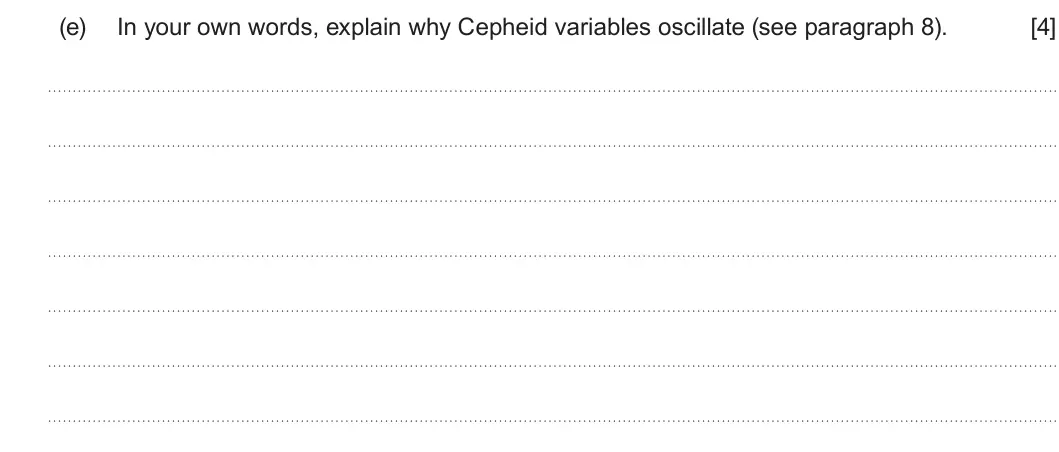
Q7(f)
The whole paper ↗
Q7(g)
The whole paper ↗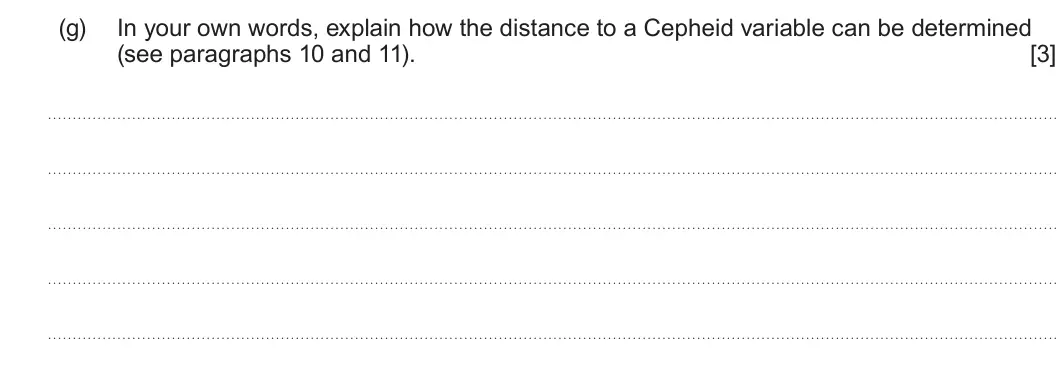
Q7(a)
The whole paper ↗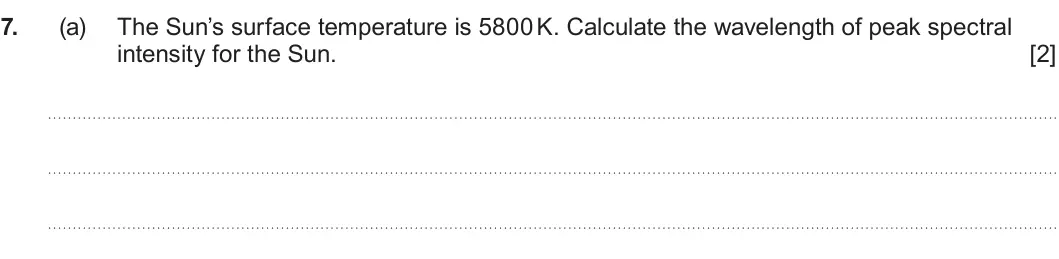
Q7(b)(i)
The whole paper ↗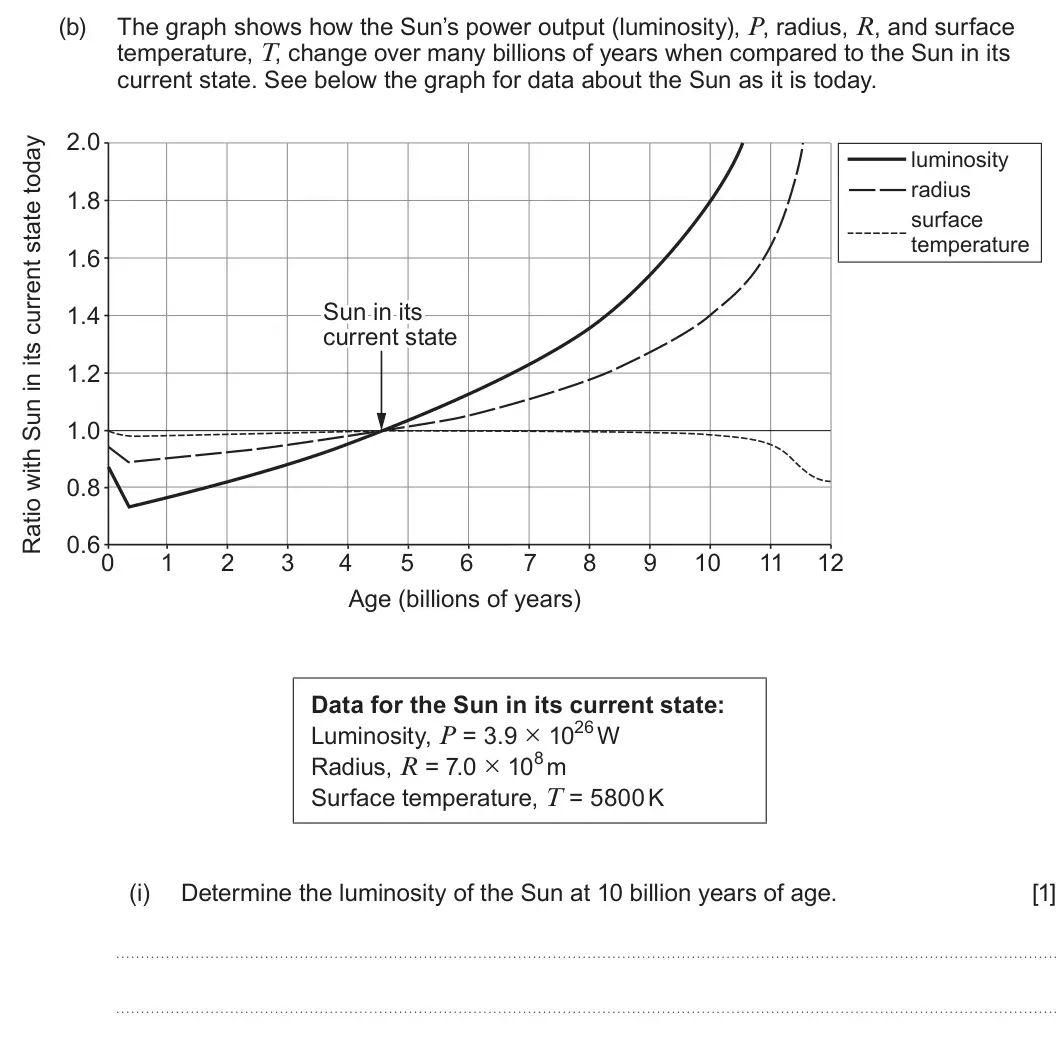
Q7(b)(ii)
The whole paper ↗
Q7(b)(iii)
The whole paper ↗
Q7(c)
The whole paper ↗
Q7(a)
The whole paper ↗
Q7(c)(i)
The whole paper ↗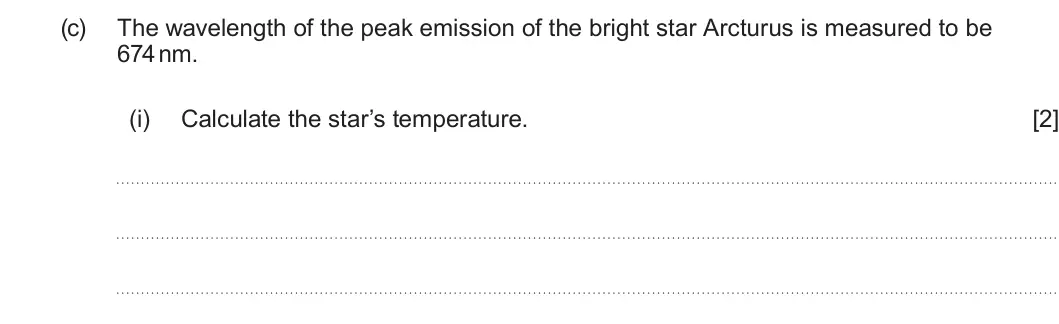
Q7(c)(ii)
The whole paper ↗
Q7(d)
The whole paper ↗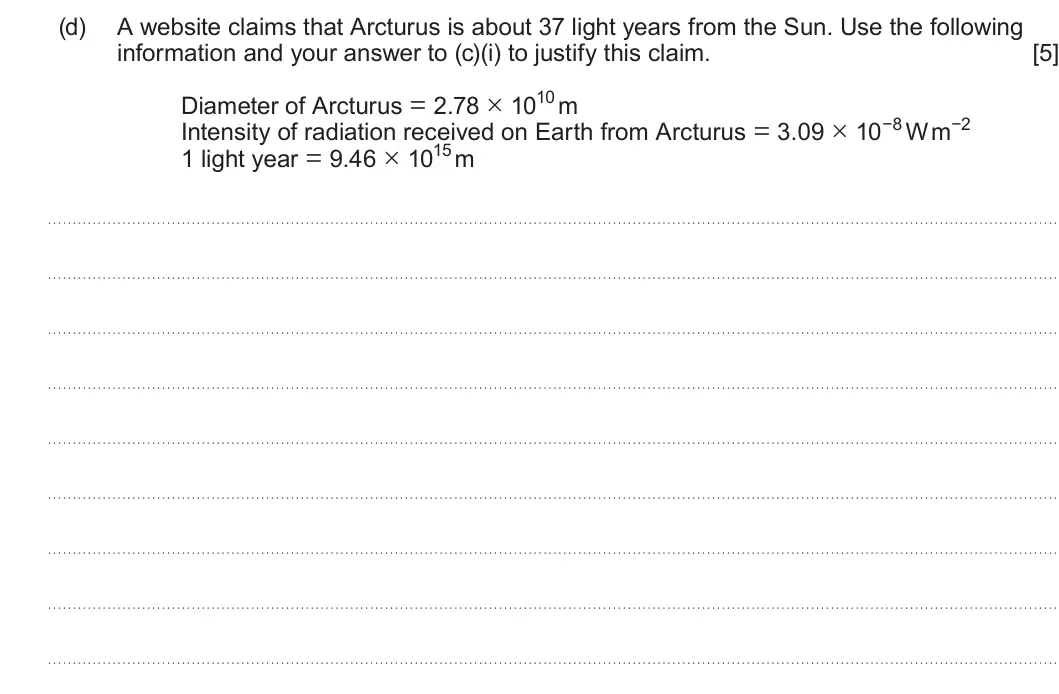
Q7(a)
The whole paper ↗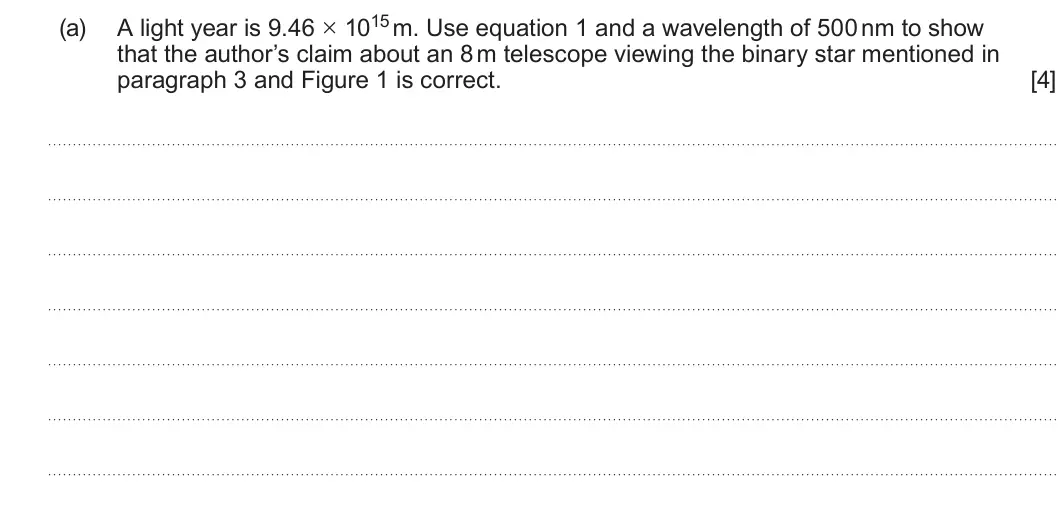
Q7(b)(iii)
The whole paper ↗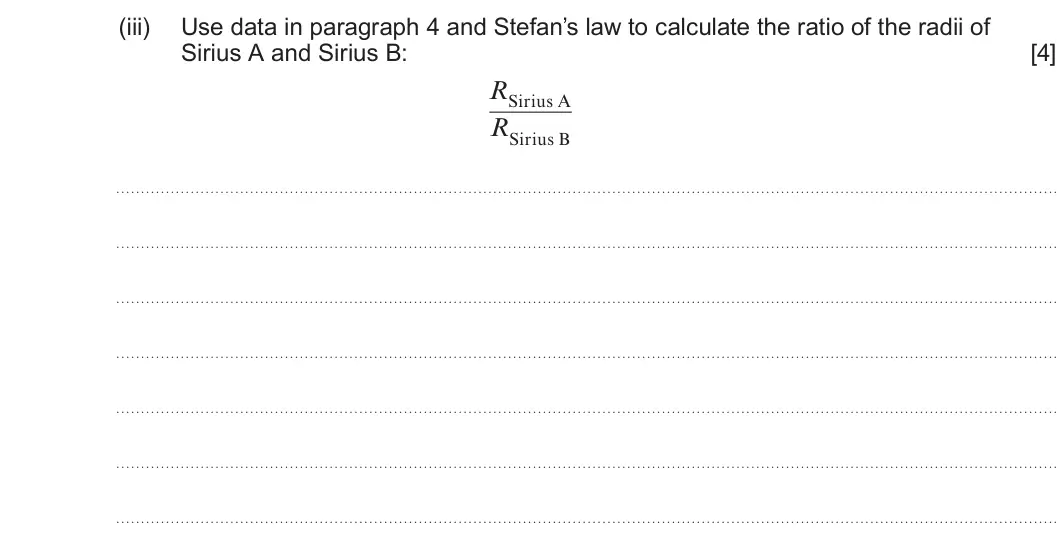
Q7(c)(i)
The whole paper ↗
Q7(c)(ii)
The whole paper ↗
Q7(e)
The whole paper ↗
Q8(a)
The whole paper ↗
Q8(b)
The whole paper ↗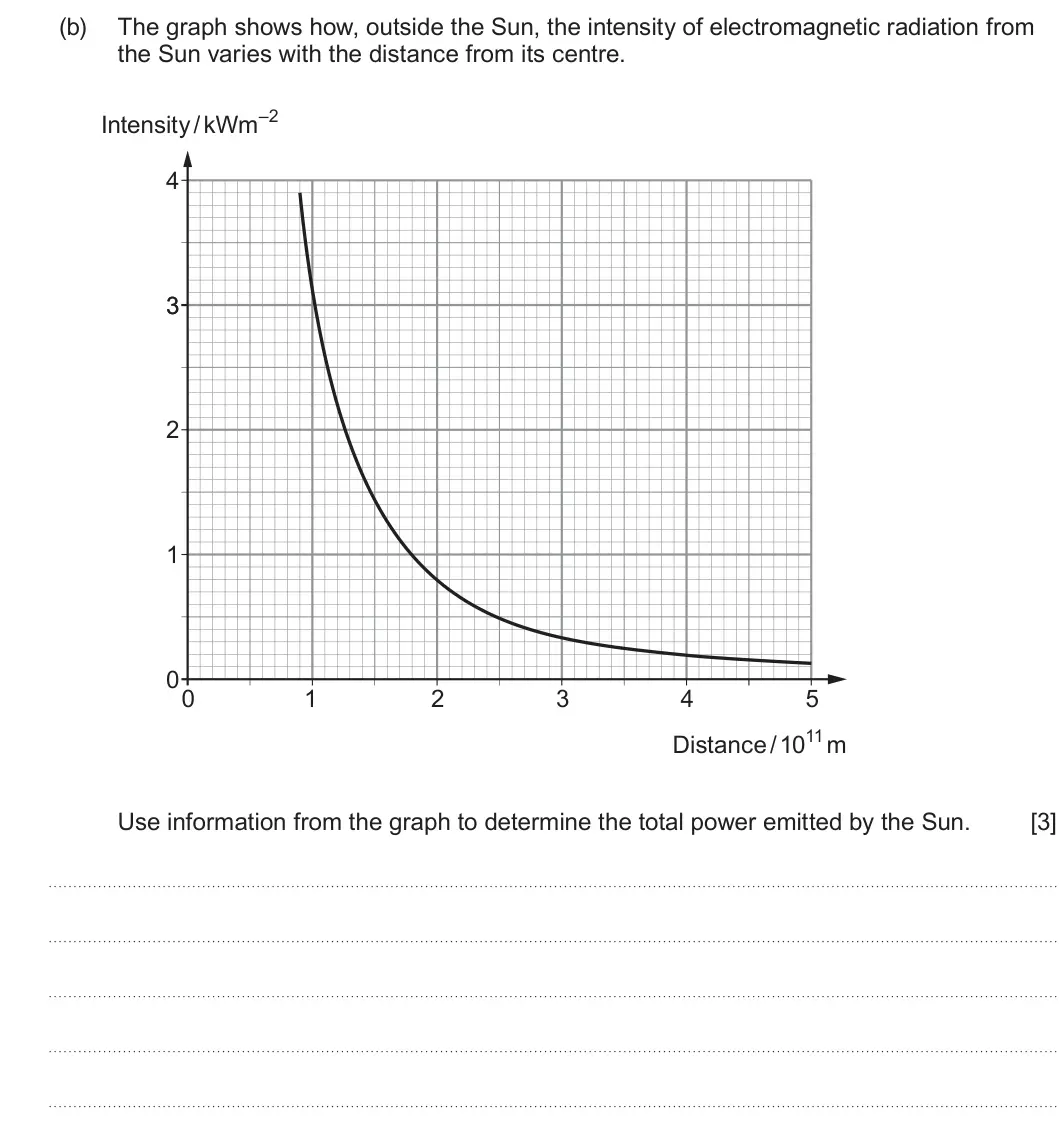
Q8(c)
The whole paper ↗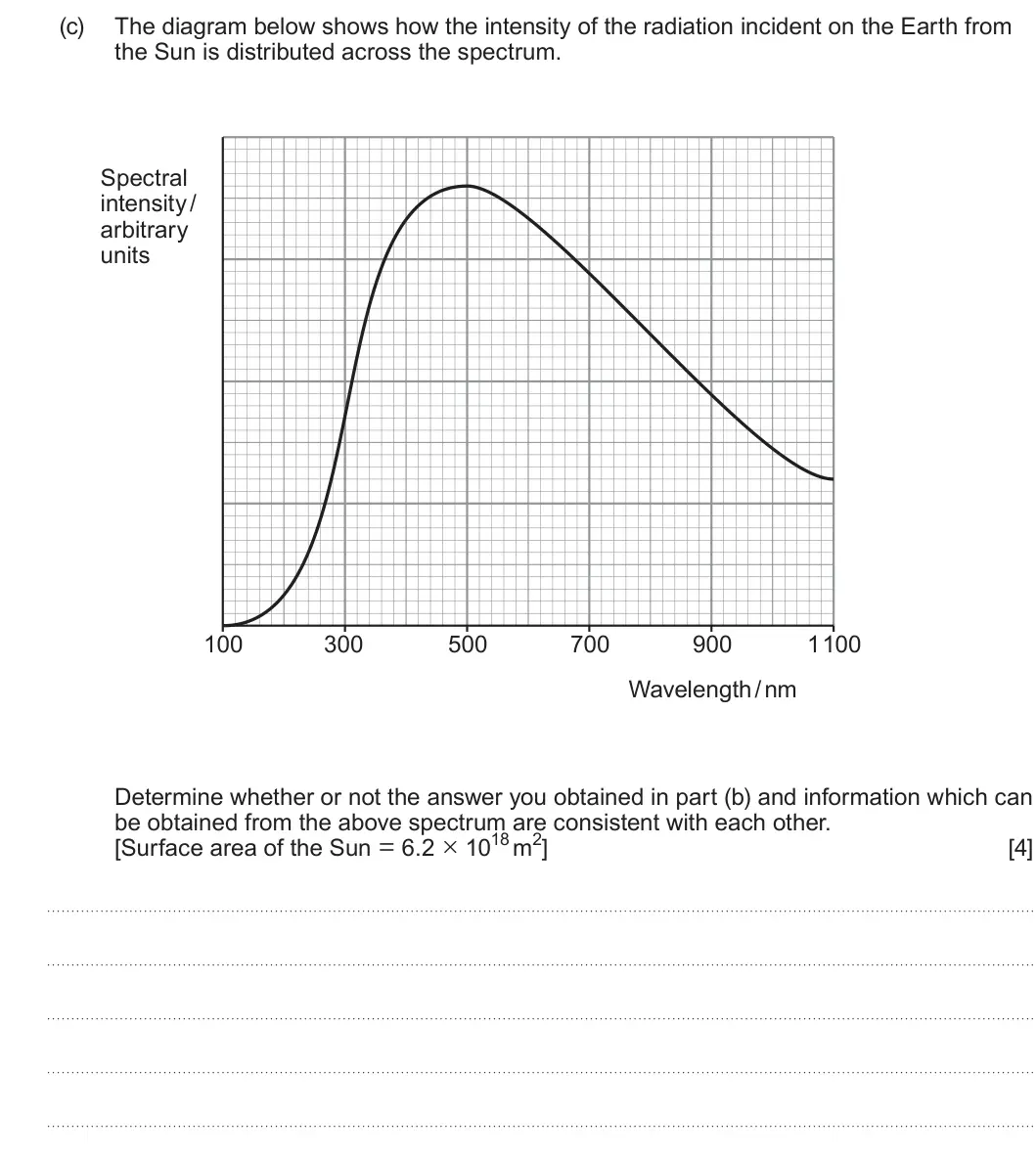
All 42 questions on Using radiation to investigate stars, as a list
- Summer 2025, Unit 3, Q7(e) (4 marks): Read through the following article carefully. Paragraph Are Cepheid variables giant stars or giant musical instruments? Stars called Cepheid variables vary in b
- Summer 2025, Unit 3, Q7(f) (1 mark): Read through the following article carefully. Paragraph Are Cepheid variables giant stars or giant musical instruments? Stars called Cepheid variables vary in b
- Summer 2025, Unit 3, Q7(g) (3 marks): Read through the following article carefully. Paragraph Are Cepheid variables giant stars or giant musical instruments? Stars called Cepheid variables vary in b
- Summer 2025, AS Unit 1, Q7(a) (2 marks): The Sun’s surface temperature is 5800 K. Calculate the wavelength of peak spectral intensity for the Sun. [2]
- Summer 2025, AS Unit 1, Q7(b)(i) (1 mark): Determine the luminosity of the Sun at 10 billion years of age. [1]
- Summer 2025, AS Unit 1, Q7(b)(ii) (2 marks): Calculate the surface area of the Sun at 10 billion years of age. [2]
- Summer 2025, AS Unit 1, Q7(b)(iii) (3 marks): The graph indicates that the surface temperature at 10 billion years of age will only be slightly less than its current value. Using a suitable calculation, sho
- Summer 2025, AS Unit 1, Q7(c) (3 marks): The answer to (b)(iii) indicates that there will be little change to the colour of the Sun until it is about 10 billion years old. An astronomer makes the follo
- Summer 2024, AS Unit 1, Q7(a) (2 marks): Explain what is meant by the term ‘multiwavelength astronomy’. [2]
- Summer 2024, AS Unit 1, Q7(c)(i) (2 marks): Calculate the star’s temperature. [2]
- Summer 2024, AS Unit 1, Q7(c)(ii) (1 mark): The visible spectrum extends from approximately 400 nm to 700 nm. State the colour of Arcturus. [1]
- Summer 2024, AS Unit 1, Q7(d) (5 marks): A website claims that Arcturus is about 37 light years from the Sun. Use the following information and your answer to (c)(i) to justify this claim. [5] Diameter
- Summer 2023, Unit 3, Q7(a) (4 marks): Read through the following article carefully. Paragraph A summary of binary stars First of all, we call two stars orbiting their common centre of mass a “binary
- Summer 2023, Unit 3, Q7(b)(iii) (4 marks): Read through the following article carefully. Paragraph A summary of binary stars First of all, we call two stars orbiting their common centre of mass a “binary
- Summer 2023, Unit 3, Q7(c)(i) (3 marks): Read through the following article carefully. Paragraph A summary of binary stars First of all, we call two stars orbiting their common centre of mass a “binary
- Summer 2023, Unit 3, Q7(c)(ii) (2 marks): Read through the following article carefully. Paragraph A summary of binary stars First of all, we call two stars orbiting their common centre of mass a “binary
- Summer 2023, Unit 3, Q7(e) (2 marks): Read through the following article carefully. Paragraph A summary of binary stars First of all, we call two stars orbiting their common centre of mass a “binary
- Summer 2023, AS Unit 1, Q8(a) (2 marks): The solar spectrum includes an absorption spectrum. Describe the appearance of this spectrum and state where in the Sun the absorption occurs. [2]
- Summer 2023, AS Unit 1, Q8(b) (3 marks): The graph shows how, outside the Sun, the intensity of electromagnetic radiation from the Sun varies with the distance from its centre. Intensity / kWm–2 4 3 2
- Summer 2023, AS Unit 1, Q8(c) (4 marks): The diagram below shows how the intensity of the radiation incident on the Earth from the Sun is distributed across the spectrum. Spectral intensity / arbitrary
- Summer 2022, AS Unit 1, Q7(a) (1 mark): Stars are very good approximations of black bodies. Explain what is meant by the term black body. [1]
- Summer 2022, AS Unit 1, Q7(b)(i) (2 marks): Confirm that the graph shows an inverse square relationship between I and d. [2]
- Summer 2022, AS Unit 1, Q7(b)(ii) (2 marks): Show that the Sun’s luminosity is approximately 4 × 1026 W. [2]
- Summer 2022, AS Unit 1, Q7(c) (4 marks): The graph shows how the intensity of the radiation incident on the Earth from the Sun is distributed across the spectrum. Spectral intensity 100 300 500 700 900
- Summer 2019, AS Unit 1, Q7(a) (2 marks): Describe the main features of the spectrum of a star and state where in the star they arise. [2]
- Summer 2019, AS Unit 1, Q7(b)(i) (3 marks): Determine the ratio: Intensity of radiation reaching Earth from Sirius [3] Intensity of radiation reaching Earth from Vega
- Summer 2019, AS Unit 1, Q7(b)(ii) (2 marks): The two stars have similar surface temperatures. Below is a black body radiation curve for Sirius. Using your answer to (b)(i), sketch the expected black body c
- Summer 2019, AS Unit 1, Q7(b)(iii) (4 marks): [4]
- Summer 2019, AS Unit 1, Q7(c) (3 marks): The image below is of the whirlpool galaxy, M51 (or NGC 5194). This is one of the first galaxies to be photographed by astronomers. Optical 450-750 nm 6,000 K S
- Summer 2018, AS Unit 1, Q6(a) (6 marks): A blackbody graph of spectral intensity against wavelength for a star is shown. A magnified section, showing the finer detail of the spectrum is also given. An
- Summer 2018, AS Unit 1, Q6(b)(i) (3 marks): intensity of its electromagnetic radiation reaching the Earth is 1.32 × 10⁻⁸ W m–2. Show that its luminosity is approximately 4 × 1027 W. [3]
- Summer 2018, AS Unit 1, Q6(b)(ii) (3 marks): Calculate Altair’s diameter given that its surface temperature is 7 700 K. [3] FOR THE LAST QUESTION
- Summer 2017, AS Unit 1, Q4(a) (1 mark): Stars are very good approximations to black bodies. State what is meant by a black body. [1]
- Summer 2017, AS Unit 1, Q4(b)(i) (3 marks): Use the graph to state three differences between Polaris and Chi Pegasi. [3]
- Summer 2017, AS Unit 1, Q4(b)(ii) (2 marks): The surface temperature of Polaris is 7 250 K. How does the graph confirm this? [2]
- Summer 2017, AS Unit 1, Q4(b)(iii) (2 marks): Polaris is 431 light years from Earth and the intensity of radiation received on Earth from it is 4.05 × 10⁻⁹ W m–2. Show that the luminosity of Polaris is appr
- Summer 2017, AS Unit 1, Q4(b)(iv) (3 marks): Calculate the radius of Polaris. [3]
- Summer 2016, AS Unit 1, Q3(a)(i) (3 marks): Confirm that Wien’s displacement law is valid for the stars. [3]
- Summer 2016, AS Unit 1, Q3(a)(ii) (2 marks): Astronomers state that one of the stars appears ‘bluer’ than the other. Explain how the spectra support this statement and state which star would appear bluer.
- Summer 2016, AS Unit 1, Q3(b)(i) (4 marks): Show that the luminosity of Canopus is approximately 500 times the luminosity of Sirius A. [4]
- Summer 2016, AS Unit 1, Q3(b)(ii) (2 marks): Calculate the intensity of the radiation reaching the surface of the Earth from Sirius A. (Distance between Sirius A and Earth = 8.15 × 10¹⁶ m.) [2]
- Summer 2016, AS Unit 1, Q3(b)(iii) (2 marks): The intensity of the radiation reaching the Earth’s surface from Canopus is less than that from Sirius A, even though Canopus has a greater luminosity than Siri
Questions, mark schemes and examiner’s reports are © WJEC CBAC Ltd, from their published past papers. Plumi isn’t affiliated with any exam board. Want whole papers? Every WJEC A-Level Physics paper.
Rather write your answers by hand on iPad? Plumi marks them against the same mark schemes.