 plumi
Dynamics: WJEC A‑Level Physics questions
Every WJEC A-Level Physics exam question on 1.3 Dynamics, 2016–2025, with its mark scheme and examiner’s report.
Find questions1,173
Calculations
Q1(a)
The whole paper ↗
Q1(b)(i)
The whole paper ↗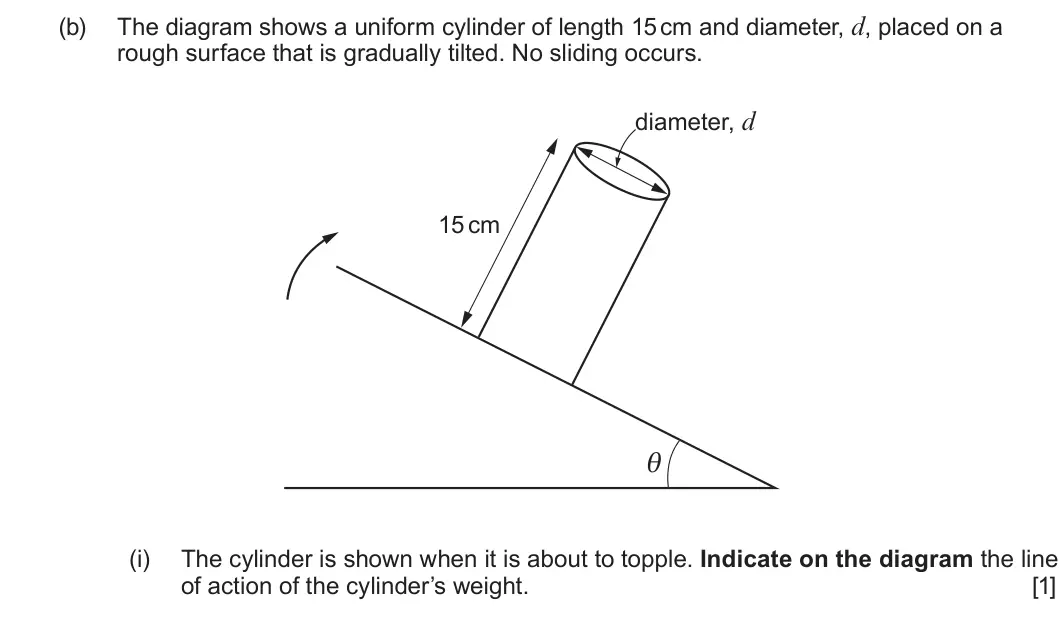
Q1(b)(ii)
The whole paper ↗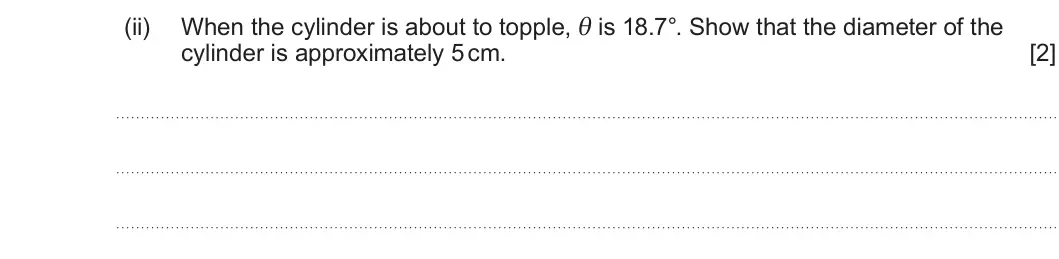
Q1(c)
The whole paper ↗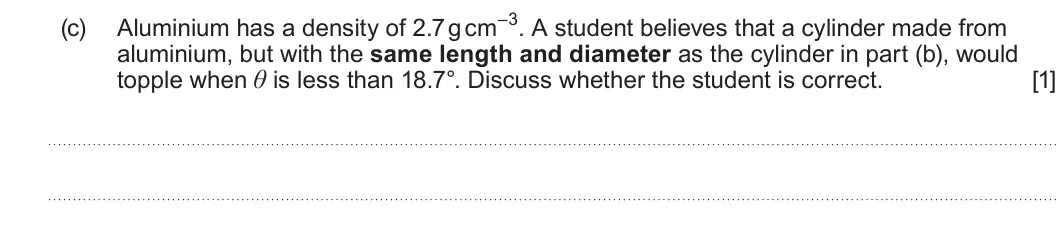
Q2(b)
The whole paper ↗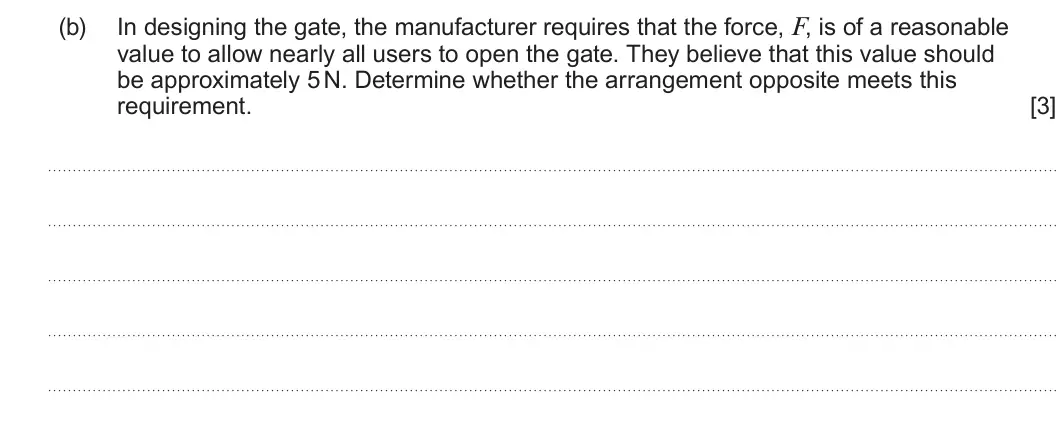
Q5(a)
The whole paper ↗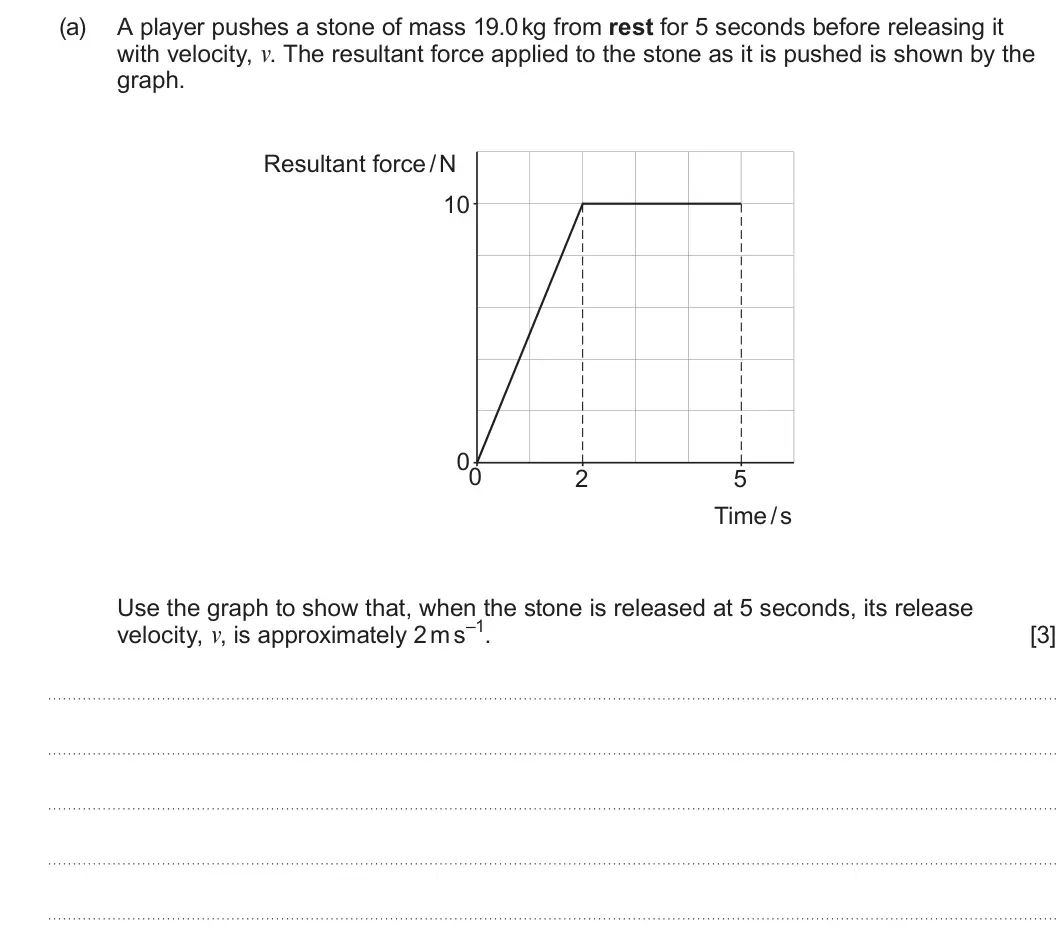
Q5(c)(i)
The whole paper ↗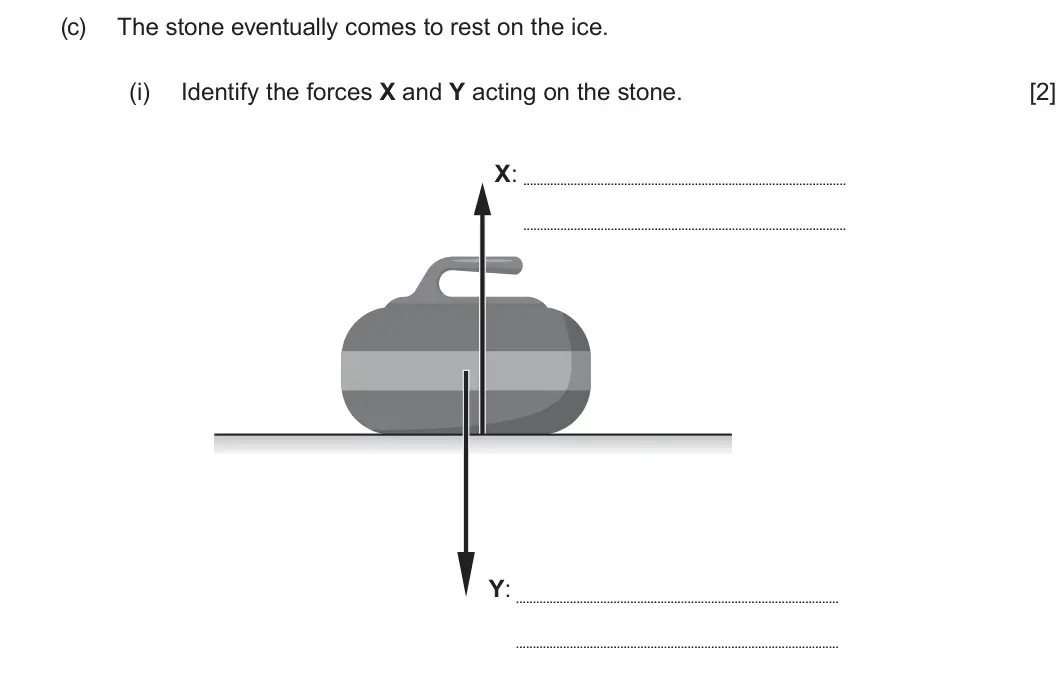
Q5(c)(ii)
The whole paper ↗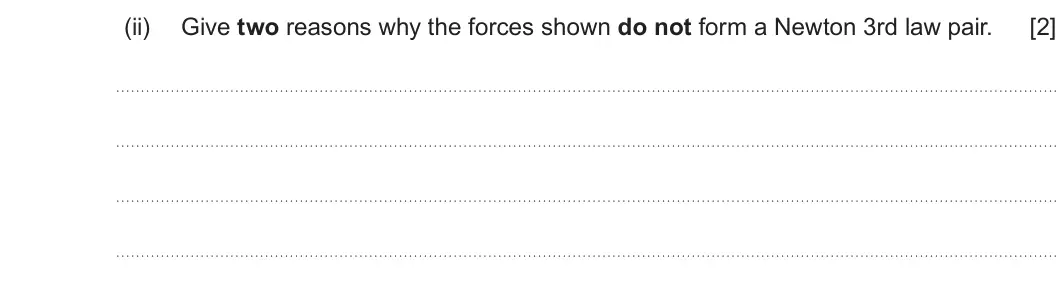
Q1(a)
The whole paper ↗
Q1(b)(i)
The whole paper ↗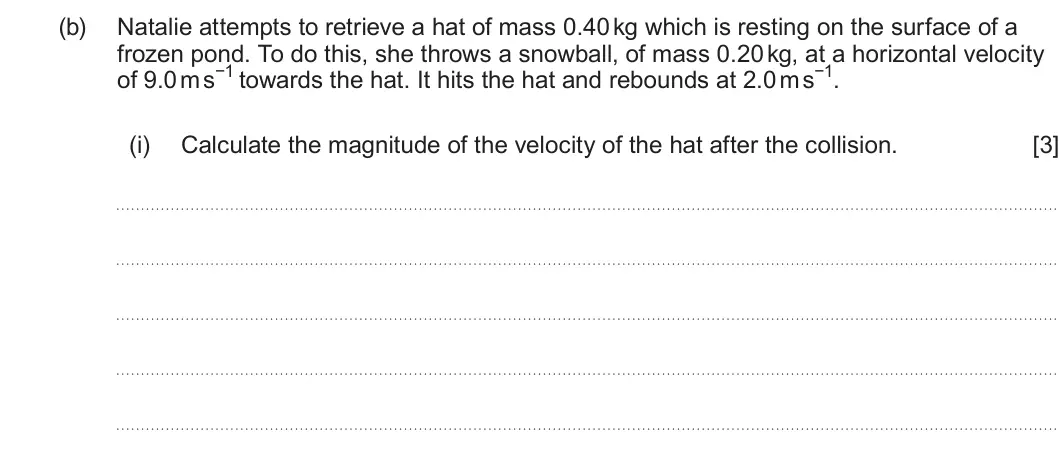
Q1(b)(ii)
The whole paper ↗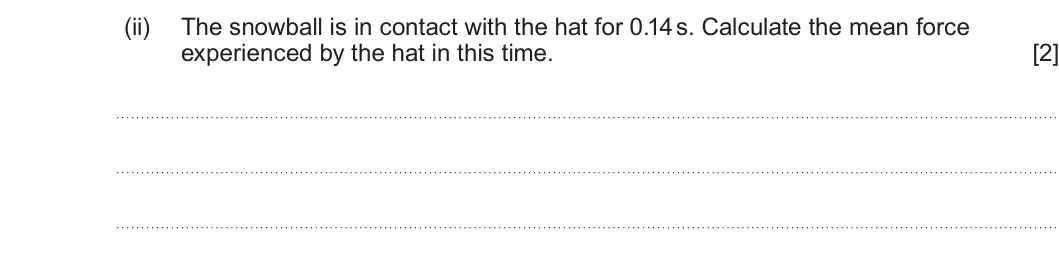
Q1(c)
The whole paper ↗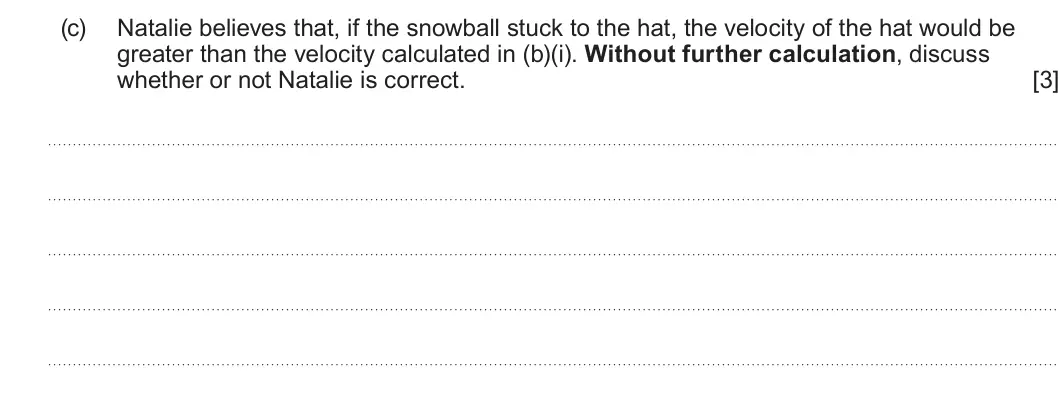
Q2(a)
The whole paper ↗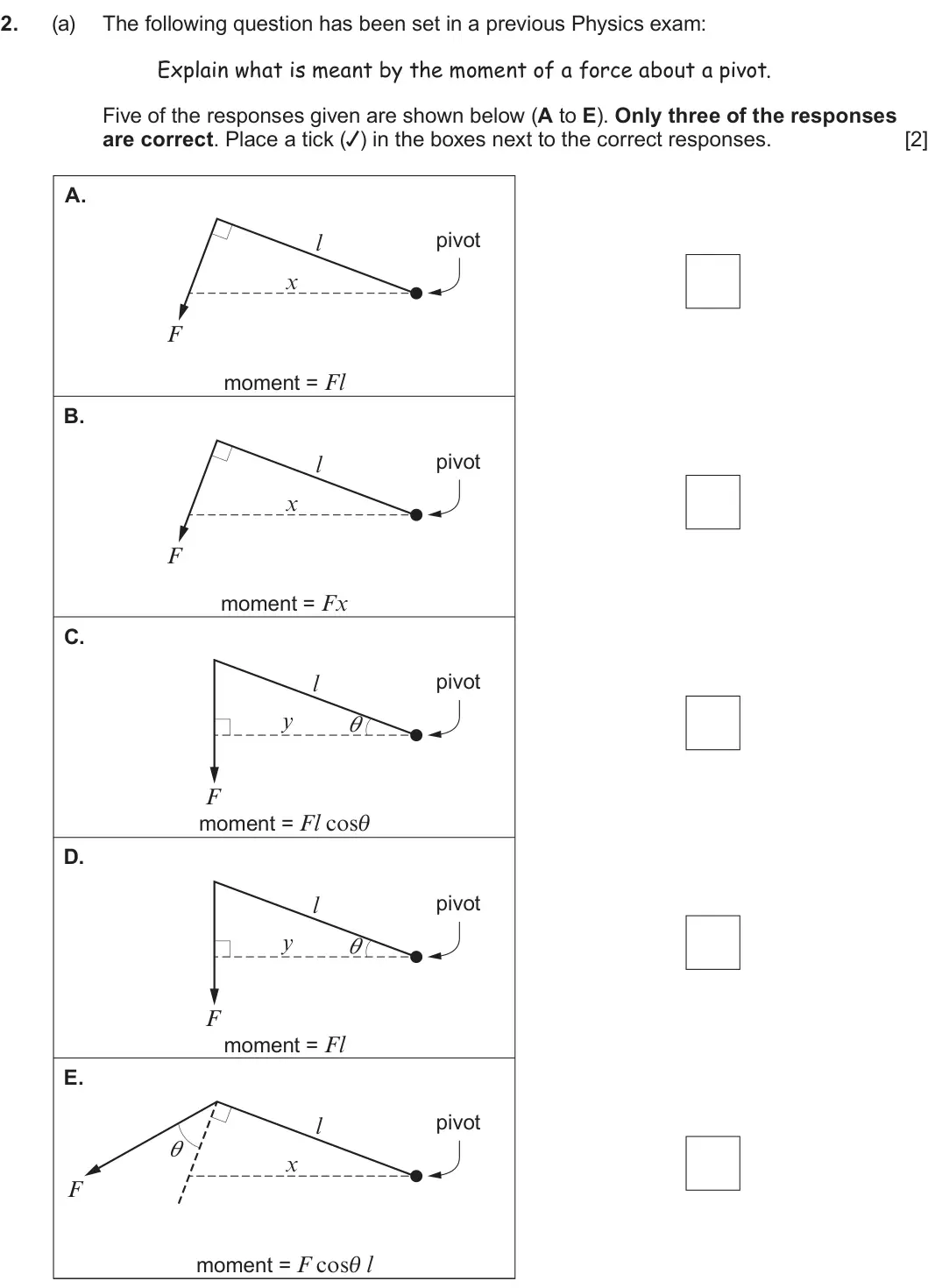
Q2(b)(i)
The whole paper ↗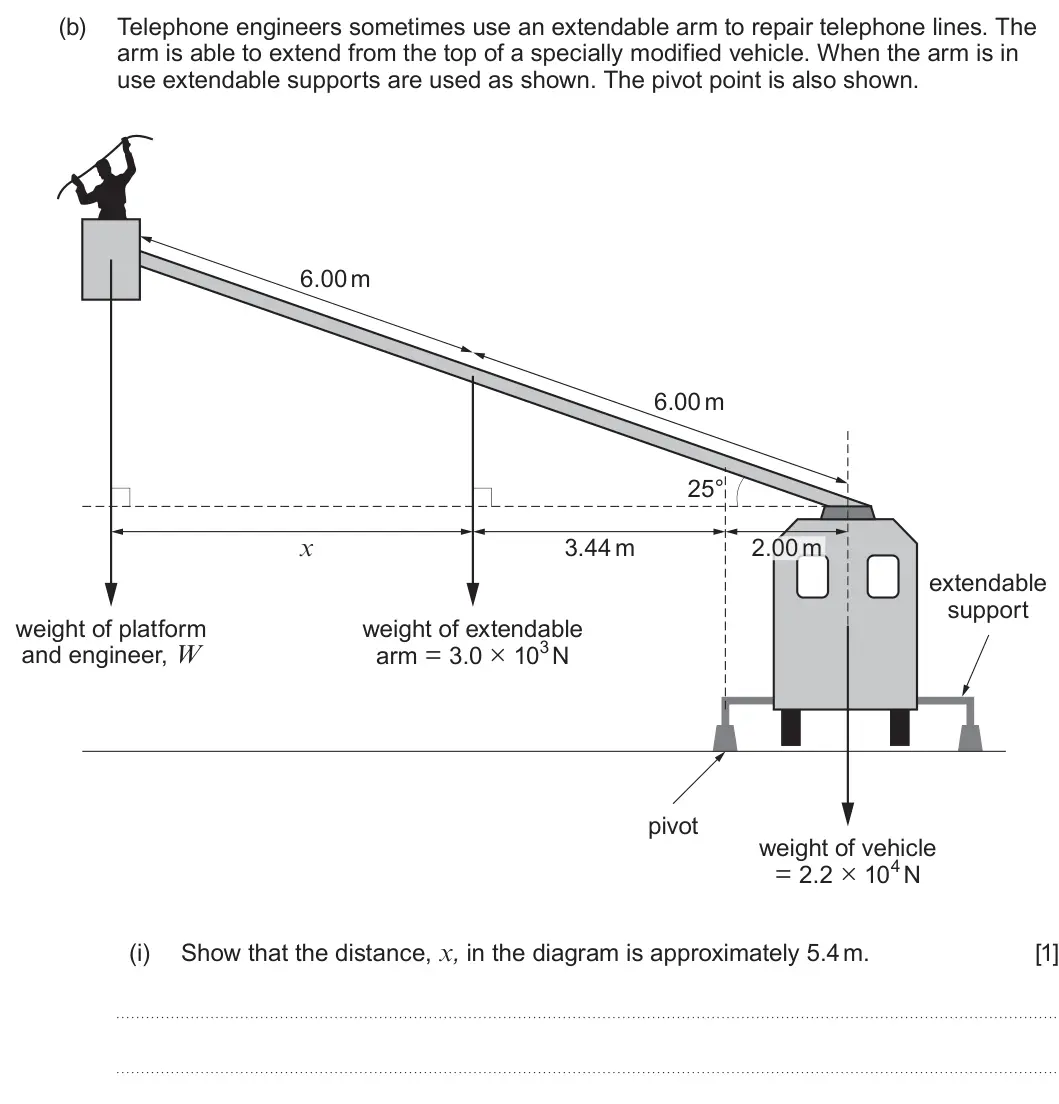
Q2(b)(ii)
The whole paper ↗
Q2(b)(iii)
The whole paper ↗
Q3(b)(ii)
The whole paper ↗
Q1(b)
The whole paper ↗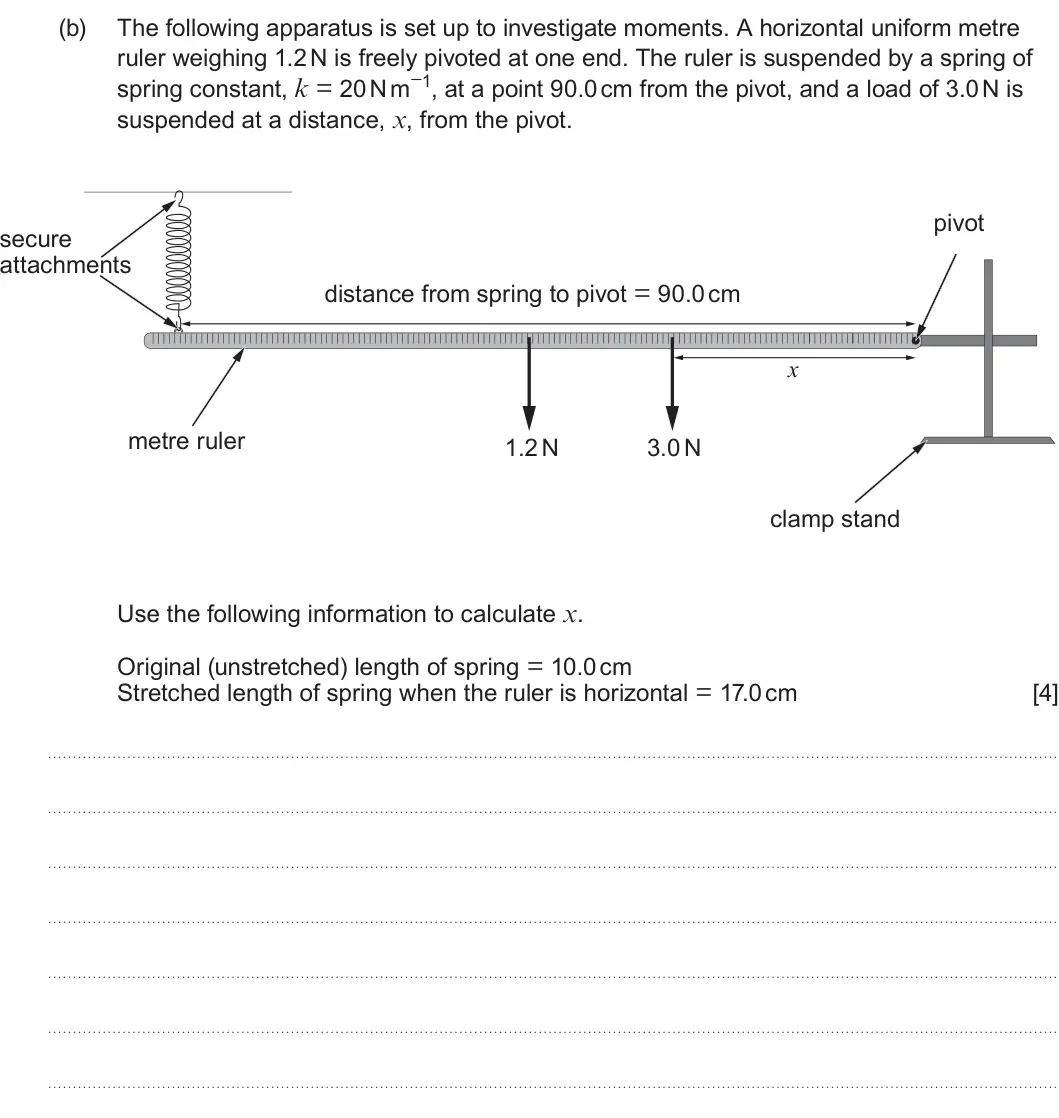
Q5(a)
The whole paper ↗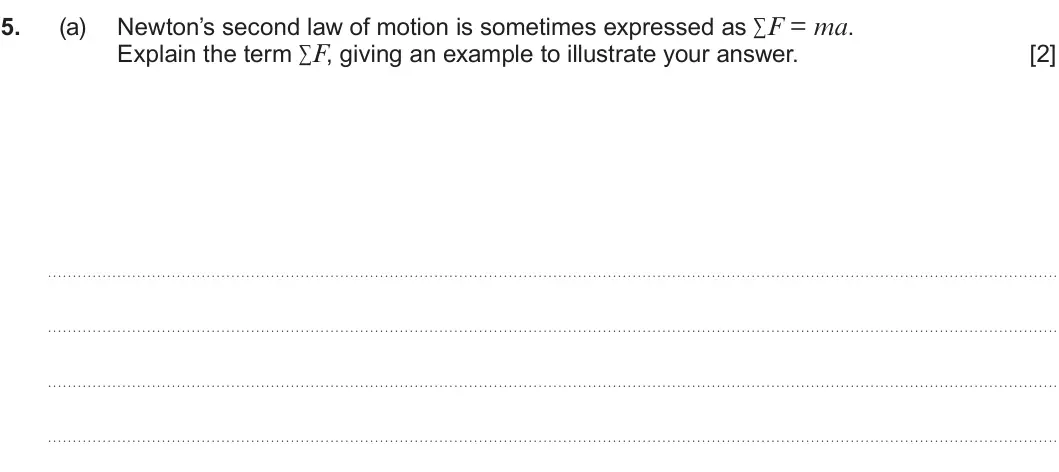
Q5(b)(i)
The whole paper ↗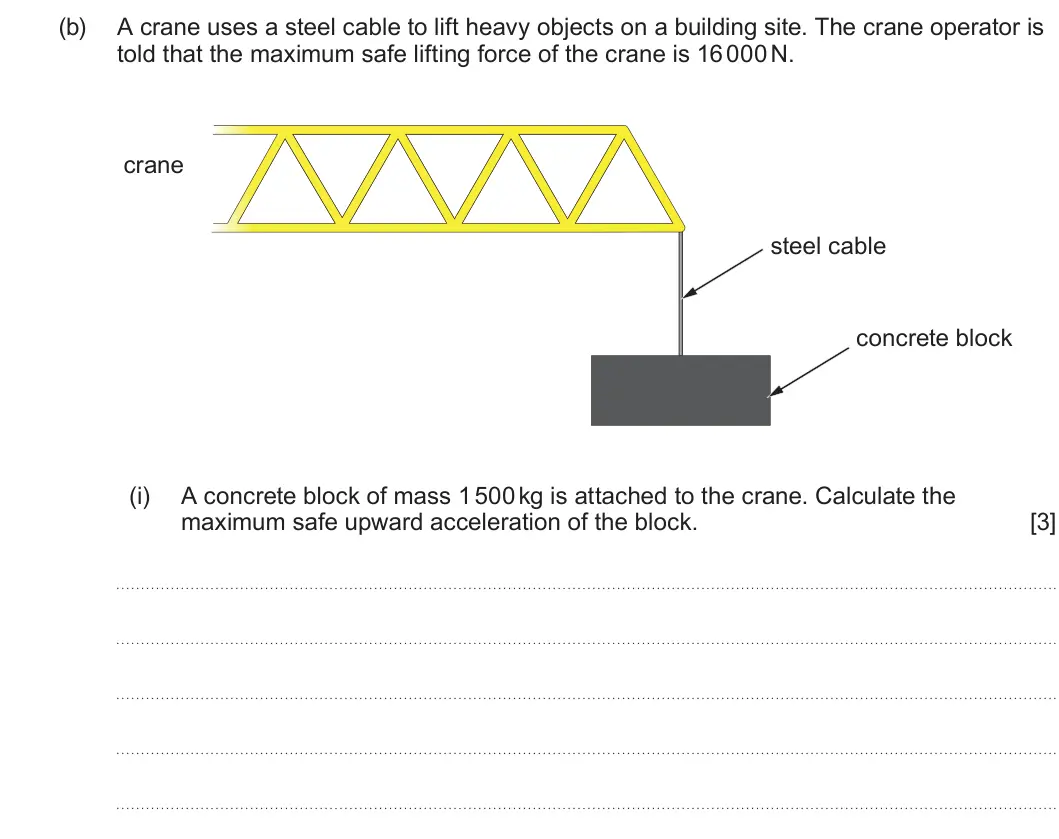
All 75 questions on Dynamics, as a list
- Summer 2025, AS Unit 1, Q1(a) (1 mark): Explain what is meant by the centre of gravity of a body. [1]
- Summer 2025, AS Unit 1, Q1(b)(i) (1 mark): The cylinder is shown when it is about to topple. Indicate on the diagram the line of action of the cylinder’s weight. [1]
- Summer 2025, AS Unit 1, Q1(b)(ii) (2 marks): cylinder is approximately 5 cm. [2]
- Summer 2025, AS Unit 1, Q1(c) (1 mark): aluminium, but with the same length and diameter as the cylinder in part (b), would topple when θ is less than 18.7°. Discuss whether the student is correct. [1
- Summer 2025, AS Unit 1, Q2(b) (3 marks): In designing the gate, the manufacturer requires that the force, F, is of a reasonable value to allow nearly all users to open the gate. They believe that this
- Summer 2025, AS Unit 1, Q5(a) (3 marks): A player pushes a stone of mass 19.0 kg from rest for 5 seconds before releasing it with velocity, v. The resultant force applied to the stone as it is pushed i
- Summer 2025, AS Unit 1, Q5(c)(i) (2 marks): Identify the forces X and Y acting on the stone. [2] X: Y:
- Summer 2025, AS Unit 1, Q5(c)(ii) (2 marks): Give two reasons why the forces shown do not form a Newton 3rd law pair. [2]
- Summer 2024, AS Unit 1, Q1(a) (2 marks): State the principle of conservation of momentum. [2]
- Summer 2024, AS Unit 1, Q1(b)(i) (3 marks): Calculate the magnitude of the velocity of the hat after the collision. [3]
- Summer 2024, AS Unit 1, Q1(b)(ii) (2 marks): The snowball is in contact with the hat for 0.14 s. Calculate the mean force experienced by the hat in this time. [2]
- Summer 2024, AS Unit 1, Q1(c) (3 marks): Natalie believes that, if the snowball stuck to the hat, the velocity of the hat would be greater than the velocity calculated in (b)(i). Without further calcul
- Summer 2024, AS Unit 1, Q2(a) (2 marks): The following question has been set in a previous Physics exam: Explain what is meant by the moment of a force about a pivot. Five of the responses given are sh
- Summer 2024, AS Unit 1, Q2(b)(i) (1 mark): Show that the distance, x, in the diagram is approximately 5.4 m. [1]
- Summer 2024, AS Unit 1, Q2(b)(ii) (3 marks): Determine the maximum possible weight of the platform and engineer, W, in the situation shown in the diagram, so that the system does not topple. [3]
- Summer 2024, AS Unit 1, Q2(b)(iii) (4 marks): A sign placed on the platform gives the following warning: Maximum 2 persons or 200 kg Consider whether or not this is a reasonable warning to give. Assume the
- Summer 2024, AS Unit 1, Q3(b)(ii) (5 marks): Hence determine the unknown mass, M, of the glider along with the absolute uncertainty in its value. Give both values to an appropriate number of significant fi
- Summer 2023, AS Unit 1, Q1(b) (4 marks): The following apparatus is set up to investigate moments. A horizontal uniform metre ruler weighing 1.2 N is freely pivoted at one end. The ruler is suspended b
- Summer 2023, AS Unit 1, Q5(a) (2 marks): Newton’s second law of motion is sometimes expressed as ∑F = ma. Explain the term ∑F, giving an example to illustrate your answer. [2]
- Summer 2023, AS Unit 1, Q5(b)(i) (3 marks): A concrete block of mass 1 500 kg is attached to the crane. Calculate the maximum safe upward acceleration of the block. [3]
- Summer 2023, AS Unit 1, Q5(b)(ii) (2 marks): The crane operator assumes that the crane is safe to lift any load up to 16 000 N. Discuss whether or not he is correct. [2]
- Summer 2023, AS Unit 1, Q6(a) (3 marks): Estimate, from the graph, the resultant accelerating force acting on carriage A at a time of 1.0 s. [3]
- Summer 2023, AS Unit 1, Q6(b) (3 marks): Impact between carriage A and carriage B occurs between 2.8 s and 3.0 s. Just before impact the applied force is removed. State how the graph confirms that the
- Summer 2023, AS Unit 1, Q6(c)(i) (3 marks): Draw, on the graph opposite, a line showing the momentum of carriage B between 0 s and 4 s. [3]
- Summer 2023, AS Unit 1, Q6(c)(ii) (2 marks): Hence calculate the speed of carriage B after impact given that its mass is 0.16 kg. [2]
- Summer 2022, Unit 3, Q6(g) (2 marks): Read through the following article carefully. How do you produce really low temperatures and can you then do some cool stuff with it? Paragraph Pressure / 105 P
- Summer 2022, AS Unit 1, Q1(a) (2 marks): State the conditions needed for a body to remain in equilibrium. [2]
- Summer 2022, AS Unit 1, Q1(b) (2 marks): The diagram shows a simple clothes carrier. It consists of a uniform horizontal beam (AB) of length 1.80 m resting on two vertical rods. 1.80 m B A 11.8 N When
- Summer 2022, AS Unit 1, Q1(c) (5 marks): The coat is now moved to a new position and a jacket weighing 7.2 N is hung from the beam, all of which is shown below. FB FA 1.80 m B A 0.15 m W 0.40 m 7.2 N 1
- Summer 2022, AS Unit 1, Q3(a)(i) (1 mark): State Newton’s third law of motion. [1]
- Summer 2022, AS Unit 1, Q3(a)(ii) (2 marks): The drone in the picture has four rotors and is shown hovering stationary in the air. The table describes two vertical forces acting on the drone. According to
- Summer 2022, AS Unit 1, Q3(b)(i) (1 mark): State the relationship between force and momentum. [1]
- Summer 2022, AS Unit 1, Q3(b)(ii) (2 marks): The rate of change of momentum of the air from the 4 rotors can be expressed as: 4πr2ρv2 where r is the radius of each of the rotor blades, v is the speed of th
- Summer 2022, AS Unit 1, Q3(b)(iii) (4 marks): Drones such as the one shown in the picture have an increasing number of uses in society. This question considers some of the Physics associated with drones. Ca
- Summer 2022, AS Unit 1, Q3(c)(i) (1 mark): Define velocity. [1]
- Summer 2022, AS Unit 1, Q3(c)(ii) (4 marks): Bill flies the drone from A to B in a time of 32 s along the path shown below. The drone is kept at the same height above the ground for the entire flight. A –
- Summer 2022, AS Unit 1, Q3(d) (2 marks): Drones have many applications in today’s society. Give one benefit and one risk of drone technology. [2]
- Summer 2019, Unit 3, Q7(f) (3 marks): positron annihilates an electron at room temperature, two photons of wavelength 2.43 × 10⁻¹² m are produced. Explain, using conservation of momentum, why these
- Summer 2019, AS Unit 1, Q3(a) (2 marks): State the principle of conservation of momentum. [2]
- Summer 2019, AS Unit 1, Q3(b)(i) (2 marks): Calculate the velocity of the spaceship immediately after the explosion. [2]
- Summer 2019, AS Unit 1, Q3(b)(ii) (3 marks): Show that the kinetic energy possessed by the probe and spaceship after separation is greater than the kinetic energy they possessed before separation. [3]
- Summer 2019, AS Unit 1, Q3(b)(iii) (1 mark): Account for this increase in kinetic energy. [1]
- Summer 2019, AS Unit 1, Q3(c) (2 marks): During the explosion, a mean force, F, acts on the probe for 2.0 ms. Calculate the value of F. [2]
- Summer 2019, AS Unit 1, Q4(a) (2 marks): The diagram shows a roller-skater being pulled along a horizontal road at constant velocity. The total resistive force to the skater’s motion is 40 N. 40 N T 36
- Summer 2019, AS Unit 1, Q4(b)(i) (1 mark): Assuming that the tension, T, is the same as in part (a), explain why the roller-skater initially accelerates. [1]
- Summer 2019, AS Unit 1, Q4(b)(ii) (3 marks): Calculate this initial acceleration, given that the mass of the roller-skater is 35 kg. [3]
- Summer 2019, AS Unit 1, Q5(a) (2 marks): State the principle of moments. [2]
- Summer 2019, AS Unit 1, Q5(b) (2 marks): The metal block is in the form of a cuboid as shown in Diagram 1 When setting up the experiment Sam accidentally knocks the metal block so that it tilts to the
- Summer 2019, AS Unit 1, Q5(c)(i) (1 mark): Complete the table. [1]
- Summer 2019, AS Unit 1, Q5(c)(ii) (2 marks): The following relationship is used to find the weight, WB, of the block: F = WB d WR + 2 L By taking moments about the pivot, show how this relationship is obta
- Summer 2019, AS Unit 1, Q5(c)(iii) (4 marks): Use the grid to plot a graph of mean F (vertical axis) against d (in mm, on the horizontal axis) and draw a line of best fit. Error bars should not be included.
- Summer 2019, AS Unit 1, Q5(c)(iv) (4 marks): Use your graph to determine: I. WB, the weight of the metal block; [2] II. WR, the weight of the ruler. [2]
- Summer 2018, AS Unit 1, Q1(a) (1 mark): State in words the equation used to calculate the moment of a force about a point. [1]
- Summer 2018, AS Unit 1, Q1(b)(i) (1 mark): Show that the clockwise moment produced by the weight of the window is approximately 8 N m. [1]
- Summer 2018, AS Unit 1, Q1(b)(ii) (2 marks): Hence calculate the force, F, the metal bar exerts on the window. [2]
- Summer 2018, AS Unit 1, Q1(c) (4 marks): Tom and Bethan discuss how the force in the metal bar changes with changing positions. Tom thinks that the force in the bar is greater when the window is in Pos
- Summer 2018, AS Unit 1, Q2(a)(ii) (1 mark): At a later time, the wind has stopped blowing and the hailstone falls at terminal velocity. In terms of forces, explain why the hailstone is at terminal velocit
- Summer 2018, AS Unit 1, Q5(a) (1 mark): A law of motion can be expressed as: change in momentum resultant force = time State the name of the law. [1]
- Summer 2018, AS Unit 1, Q5(b)(i) (2 marks): By drawing a suitable tangent, show that the resultant force on the spacecraft at t = 1.0 s is approximately 2 kN. [2]
- Summer 2018, AS Unit 1, Q5(b)(ii) (1 mark): Hence show that the mass of the spacecraft is approximately 5 000 kg, given that its acceleration at t = 1.0 s is 0.4 m s–2. [1]
- Summer 2018, AS Unit 1, Q5(b)(iii) (1 mark): Label, with the letter P, a point on the graph where the resultant force on the spacecraft is zero. [1]
- Summer 2018, AS Unit 1, Q5(c)(i) (2 marks): State the principle of conservation of momentum. [2]
- Summer 2018, AS Unit 1, Q5(c)(ii) (3 marks): Calculate the velocity of both spacecraft after colliding. [3]
- Summer 2017, AS Unit 1, Q3(a)(i) (2 marks): Draw a line of best fit on the graph and use it to determine the gradient. [2]
- Summer 2017, AS Unit 1, Q3(a)(iii) (3 marks): Determine the value of M, the unknown mass of the glider. [3]
- Summer 2017, AS Unit 1, Q3(a)(iv) (2 marks): Comment on the quality and sufficiency of the data obtained. [2]
- Summer 2017, AS Unit 1, Q3(b)(i) (2 marks): Fill in the missing values on the above diagram. [2]
- Summer 2017, AS Unit 1, Q3(b)(ii) (2 marks): [2]
- Summer 2017, AS Unit 1, Q6(a) (2 marks): State the conditions necessary for a body to remain in equilibrium. [2]
- Summer 2017, AS Unit 1, Q6(b) (3 marks): A shopkeeper wishes to hang a heavy sign of weight 240 N outside his shop using the following arrangement. He has steel wires of various diameters to choose fro
- Summer 2016, AS Unit 1, Q7(b)(i) (3 marks): Explain with suitable calculations how the graphs show that external forces on the system are negligible. [3]
- Summer 2016, AS Unit 1, Q7(b)(ii) (3 marks): Calculate the final velocity of the two wagons given that the total mass of wagon A and wagon B is 25 000 kg. [3]
- Summer 2016, AS Unit 1, Q7(c)(i) (2 marks): State Newton’s Second Law of motion in terms of momentum. [2]
- Summer 2016, AS Unit 1, Q7(c)(ii) (3 marks): Determine from the graph the resultant force on wagon A during the collision. [3]
- Summer 2016, AS Unit 1, Q7(c)(iii) (2 marks): The force experienced by wagon B during the collision is equal and opposite to the force experienced by wagon A. State which law of motion this is an example of
Questions, mark schemes and examiner’s reports are © WJEC CBAC Ltd, from their published past papers. Plumi isn’t affiliated with any exam board. Want whole papers? Every WJEC A-Level Physics paper.
Rather write your answers by hand on iPad? Plumi marks them against the same mark schemes.