 plumi
Particles and nuclear structure: WJEC A‑Level Physics questions
Every WJEC A-Level Physics exam question on 1.7 Particles and nuclear structure, 2016–2025, with its mark scheme and examiner’s report.
Find questions1,173
Calculations
Q6(a)
The whole paper ↗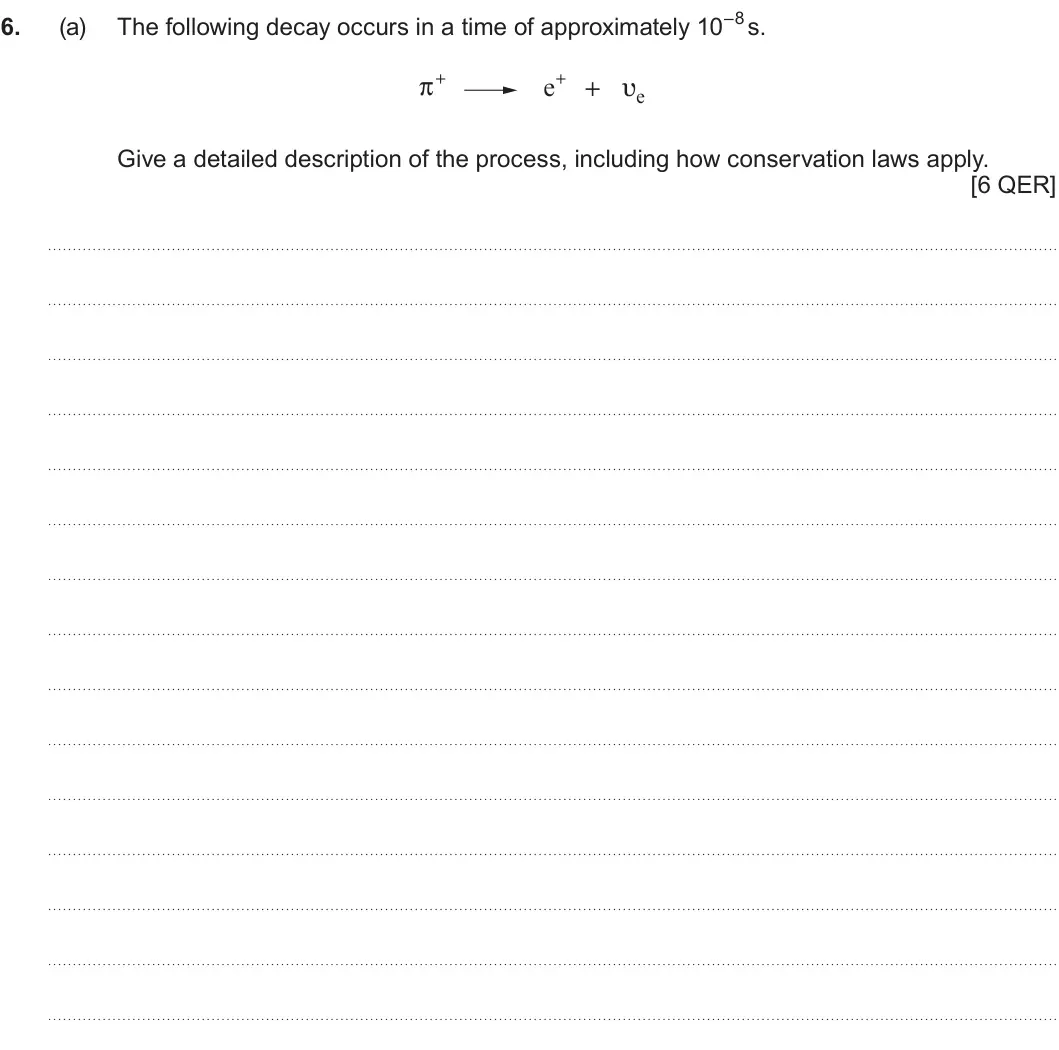
Q6(b)(i)
The whole paper ↗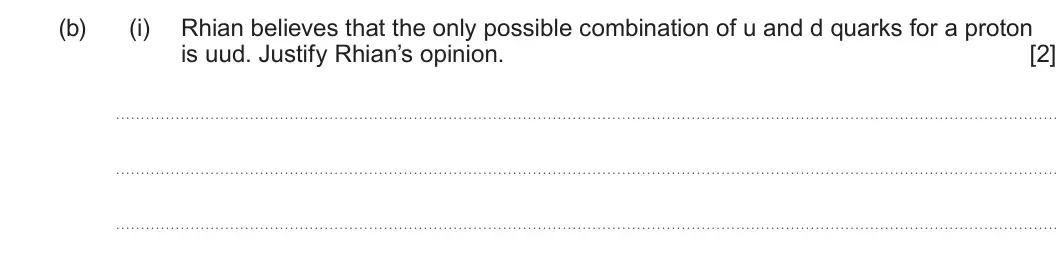
Q6(b)(ii)
The whole paper ↗
Q4(a)
The whole paper ↗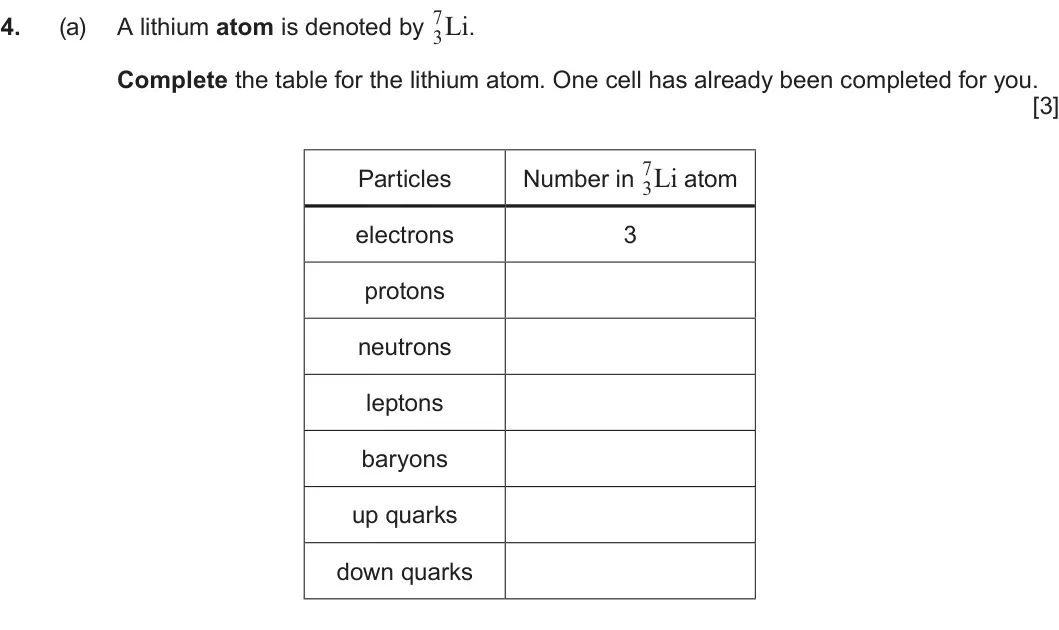
Q4(b)(i)
The whole paper ↗
Q4(b)(ii)
The whole paper ↗
Q4(b)(iii)
The whole paper ↗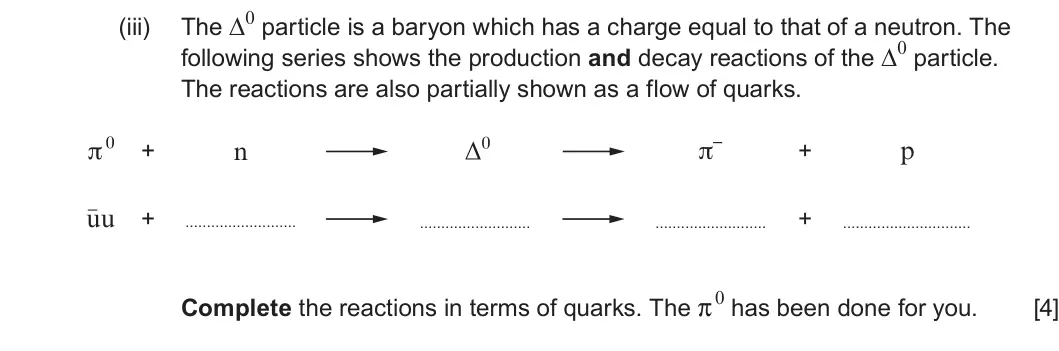
Q4(b)(iv)
The whole paper ↗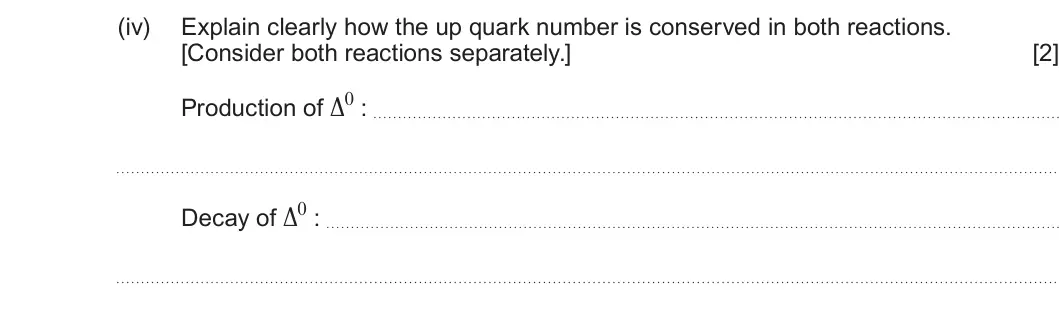
Q4(c)
The whole paper ↗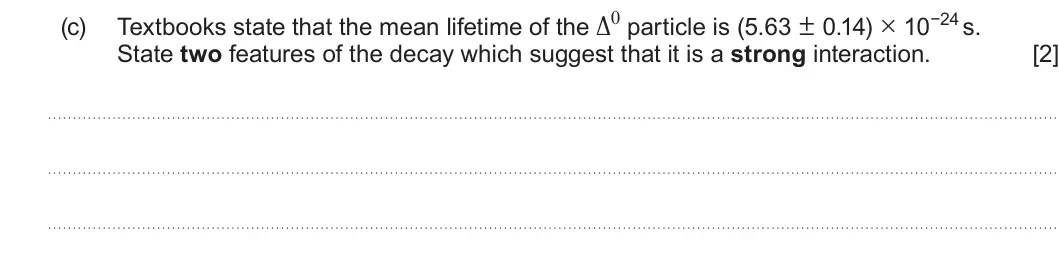
Q7(a)
The whole paper ↗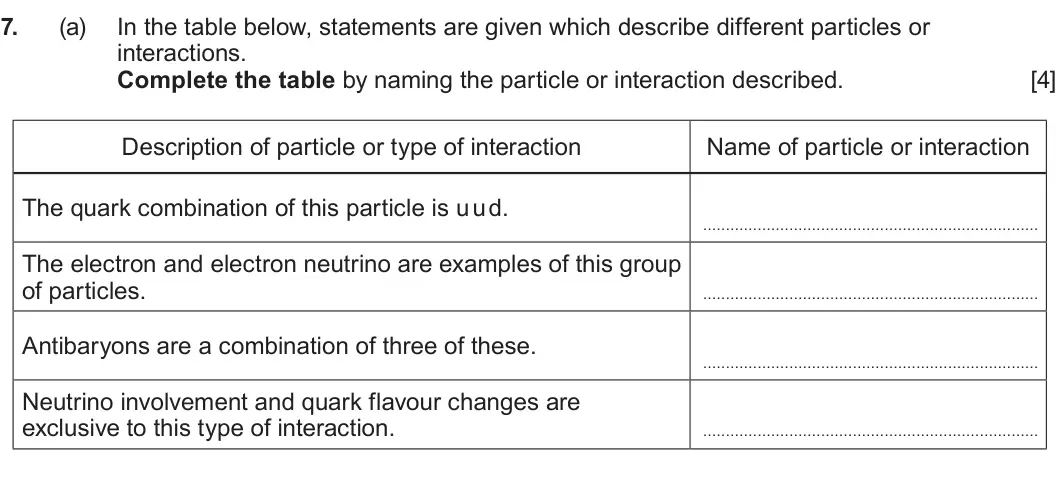
Q7(b)
The whole paper ↗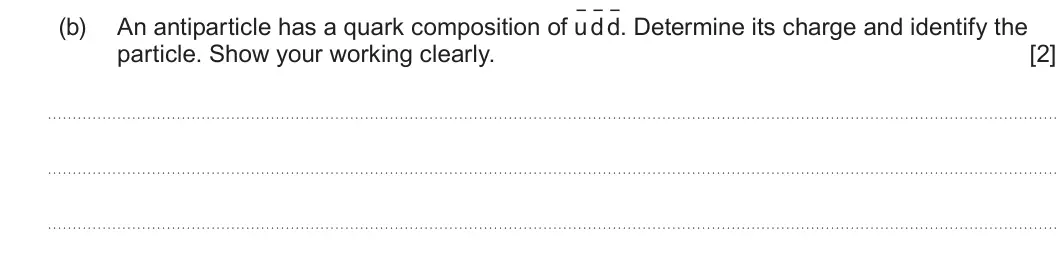
Q7(c)(i)
The whole paper ↗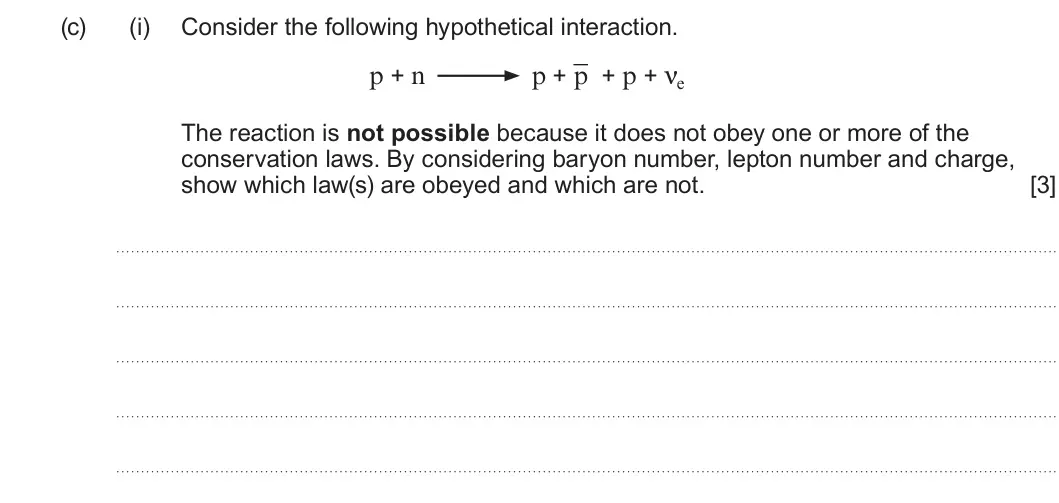
Q7(c)(ii)
The whole paper ↗
Q5(a)
The whole paper ↗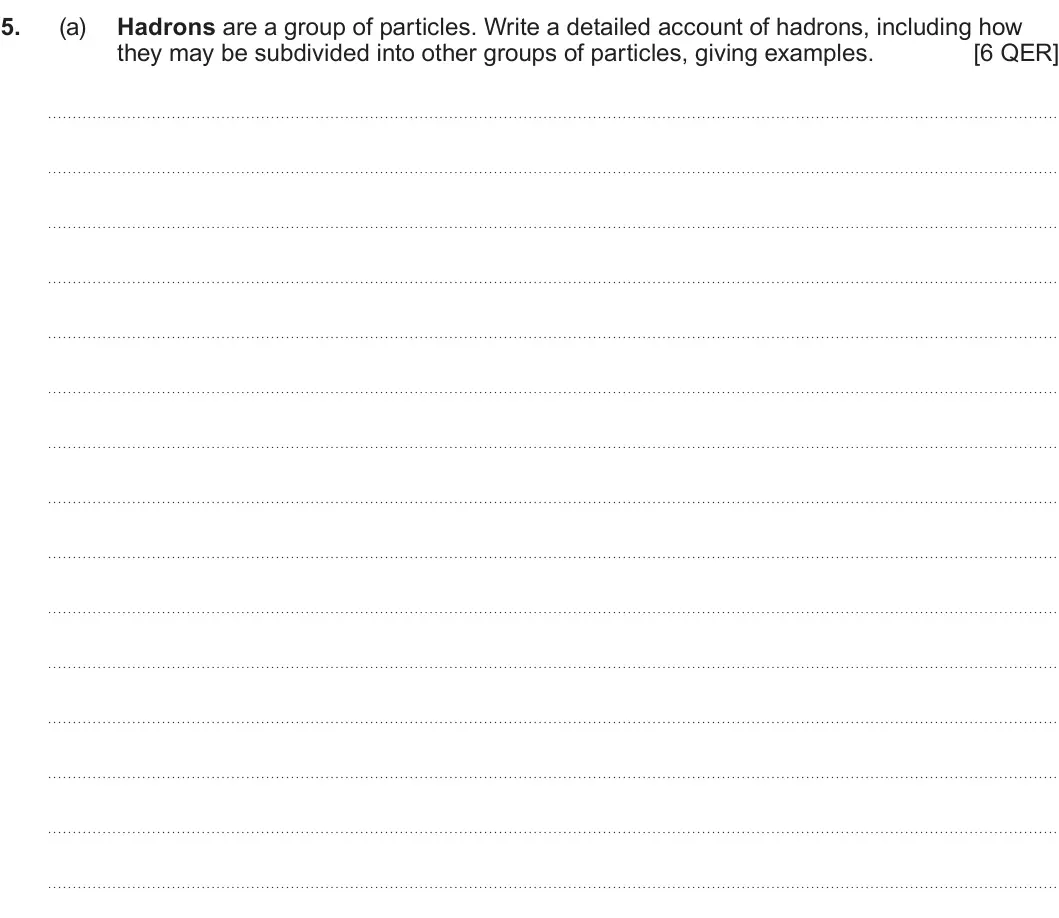
Q5(b)
The whole paper ↗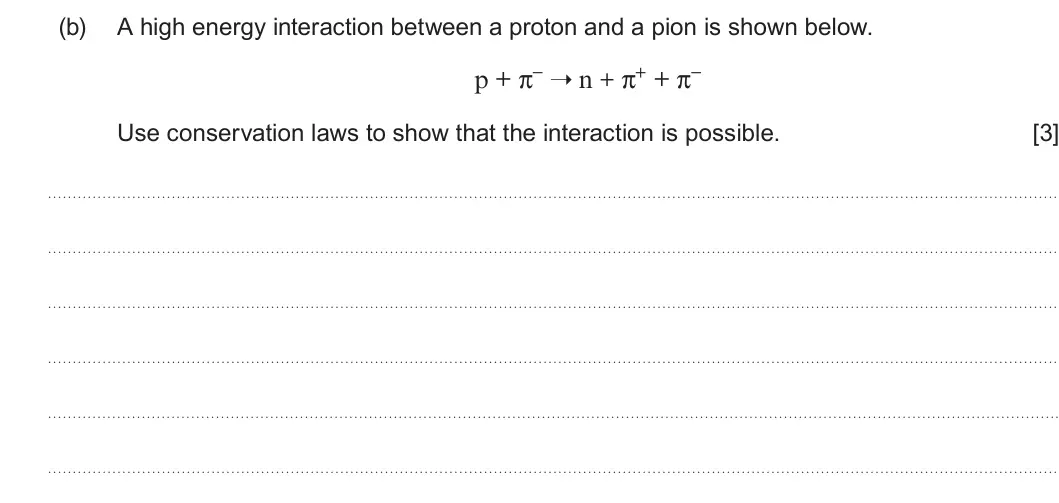
Q7(c)(ii)
The whole paper ↗
Q7(e)
The whole paper ↗
Q7(g)
The whole paper ↗
Q7(h)
The whole paper ↗
Q1(a)(i)
The whole paper ↗
All 37 questions on Particles and nuclear structure, as a list
- Summer 2025, AS Unit 1, Q6(a) (6 marks): + e+ υe π + Give a detailed description of the process, including how conservation laws apply. [6 QER]
- Summer 2025, AS Unit 1, Q6(b)(i) (2 marks): Rhian believes that the only possible combination of u and d quarks for a proton is uud. Justify Rhian’s opinion. [2]
- Summer 2025, AS Unit 1, Q6(b)(ii) (1 mark): Circle the term(s) that can be used to describe a proton. [1] baryon lepton meson hadron anti-particle charged-pion
- Summer 2024, AS Unit 1, Q4(a) (3 marks): 3Li. Complete the table for the lithium atom. One cell has already been completed for you. [3] Number in 7 Particles 3Li atom electrons 3 protons neutrons lepto
- Summer 2024, AS Unit 1, Q4(b)(i) (1 mark): State what a meson is, in terms of quarks. [1]
- Summer 2024, AS Unit 1, Q4(b)(ii) (1 mark): [1]
- Summer 2024, AS Unit 1, Q4(b)(iii) (4 marks): following series shows the production and decay reactions of the ∆0 particle. The reactions are also partially shown as a flow of quarks. p + n + uu + + Complet
- Summer 2024, AS Unit 1, Q4(b)(iv) (2 marks): Explain clearly how the up quark number is conserved in both reactions. [Consider both reactions separately.] [2] Production of ∆0 : Decay of ∆0 :
- Summer 2024, AS Unit 1, Q4(c) (2 marks): State two features of the decay which suggest that it is a strong interaction. [2]
- Summer 2023, AS Unit 1, Q7(a) (4 marks): In the table below, statements are given which describe different particles or interactions. Complete the table by naming the particle or interaction described.
- Summer 2023, AS Unit 1, Q7(b) (2 marks): An antiparticle has a quark composition of u d d. Determine its charge and identify the particle. Show your working clearly. [2]
- Summer 2023, AS Unit 1, Q7(c)(i) (3 marks): Consider the following hypothetical interaction. p + n p + p + p + νe The reaction is not possible because it does not obey one or more of the conservation laws
- Summer 2023, AS Unit 1, Q7(c)(ii) (1 mark): would allow the reaction to occur. Explain whether or not he is correct. [1]
- Summer 2022, AS Unit 1, Q5(a) (6 marks): Hadrons are a group of particles. Write a detailed account of hadrons, including how they may be subdivided into other groups of particles, giving examples. [6
- Summer 2022, AS Unit 1, Q5(b) (3 marks): A high energy interaction between a proton and a pion is shown below. p + π− ➝ n + π+ + π− Use conservation laws to show that the interaction is possible. [3]
- Summer 2019, Unit 3, Q7(c)(ii) (2 marks): State why your answer to (c)(i) and the results of the alpha particle scattering experiment contradict the “plum-pudding” model (see paragraphs 5 & 6). [2]
- Summer 2019, Unit 3, Q7(e) (1 mark): Explain why the strong nuclear force is required to hold nuclei together (see paragraphs 6 & 9). [1]
- Summer 2019, Unit 3, Q7(g) (1 mark): [1]
- Summer 2019, Unit 3, Q7(h) (2 marks): Calculate the mass of a top quark in kg (see paragraph 15). Note that 1 u ≡ 931 MeV if required. [2]
- Summer 2019, AS Unit 1, Q1(a)(i) (1 mark): the weak nuclear force; [1]
- Summer 2019, AS Unit 1, Q1(a)(ii) (1 mark): the strong nuclear force. [1]
- Summer 2019, AS Unit 1, Q1(b)(i) (1 mark): [1]
- Summer 2019, AS Unit 1, Q1(b)(ii) (2 marks): Explain how lepton number and charge are conserved in this interaction. [2]
- Summer 2019, AS Unit 1, Q1(c)(i) (1 mark): Write down the number of neutrons in: 10 4Be II. 10 5B I. [1]
- Summer 2019, AS Unit 1, Q1(c)(ii) (2 marks): On the level of baryons the interaction can be written as: n p + e– + νe Show clearly that there is a change in quark flavour in this interaction. [2]
- Summer 2018, AS Unit 1, Q4(a)(i) (3 marks): Complete the table. [3]
- Summer 2018, AS Unit 1, Q4(a)(ii) (1 mark): Identify the lepton in the table. [1]
- Summer 2018, AS Unit 1, Q4(b) (2 marks): JJ Thomson, when studying the properties of cathode rays in 1897, discovered the electron. In the early 20th century, Ernest Rutherford, carrying out a series o
- Summer 2018, AS Unit 1, Q4(c)(i) (2 marks): Show clearly that both up-quark number and down-quark number are conserved in this decay. [2]
- Summer 2018, AS Unit 1, Q4(c)(ii) (2 marks): Give two reasons for believing that this decay is a strong force interaction. [2]
- Summer 2018, AS Unit 1, Q4(d) (2 marks): question: ‘You have discovered many new particles, none of which have had any discernible impact on society. How do you justify the huge expense of continuing w
- Summer 2017, AS Unit 1, Q7 (6 marks): The following process describes the decay of a neutron. n → p + e- + νe Give a detailed description of the process, including how conservation laws apply. [6 QE
- Summer 2016, AS Unit 1, Q2(a) (2 marks): State the difference between baryons and mesons in terms of quark make-up. [2]
- Summer 2016, AS Unit 1, Q2(b)(i) (1 mark): [1]
- Summer 2016, AS Unit 1, Q2(b)(ii) (3 marks): Identify particle x, explaining how you use the law of conservation of baryon number and one other conservation law. [3]
- Summer 2016, AS Unit 1, Q2(b)(iii) (1 mark): State how lepton number is conserved in the above interaction. [1]
- Summer 2016, AS Unit 1, Q2(c) (3 marks): A π0 decays in a typical time of 8 × 10–17 s into two photons as shown. State which force is involved in this interaction, giving two reasons for your answer. [
Questions, mark schemes and examiner’s reports are © WJEC CBAC Ltd, from their published past papers. Plumi isn’t affiliated with any exam board. Want whole papers? Every WJEC A-Level Physics paper.
Rather write your answers by hand on iPad? Plumi marks them against the same mark schemes.