 plumi
What is the process inside an electric generator?: OCR GCSE Physics B questions
Every OCR GCSE Physics B exam question on P3.7 What is the process inside an electric generator?, 2018–2025, with its mark scheme and examiner’s report.
Paper
All papers
Exam
All years
Calculations
Q4(a)
The whole paper ↗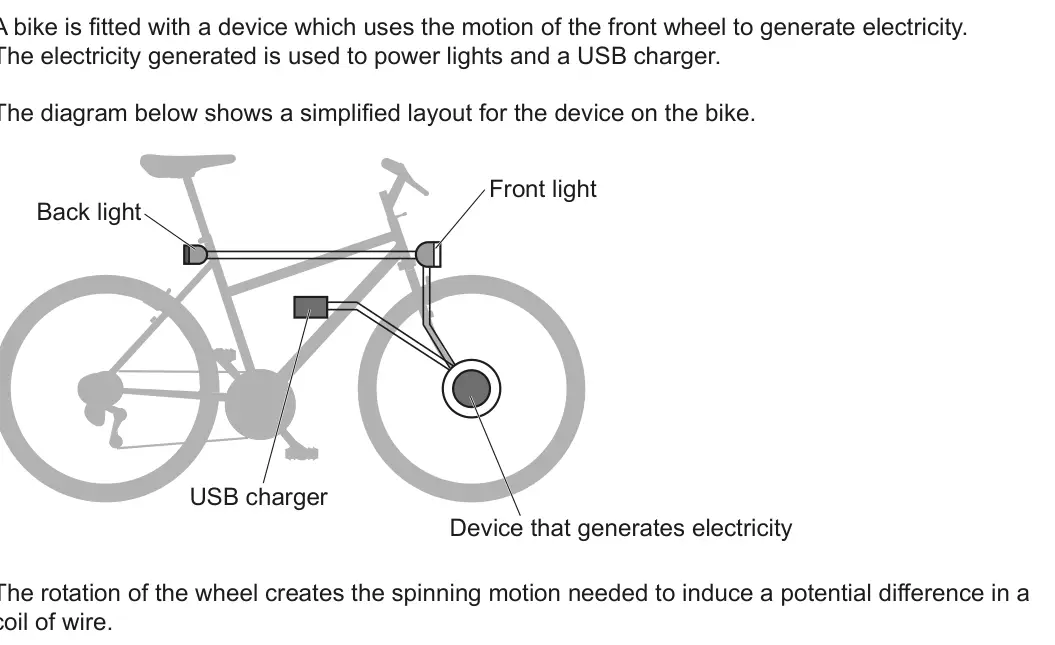
Q4(c)(i)
The whole paper ↗Q4(c)(ii)
The whole paper ↗Q7(a)
The whole paper ↗
Q7(b)
The whole paper ↗Q7(a)(i)
The whole paper ↗
Q7(a)(ii)
The whole paper ↗Q9(a)
The whole paper ↗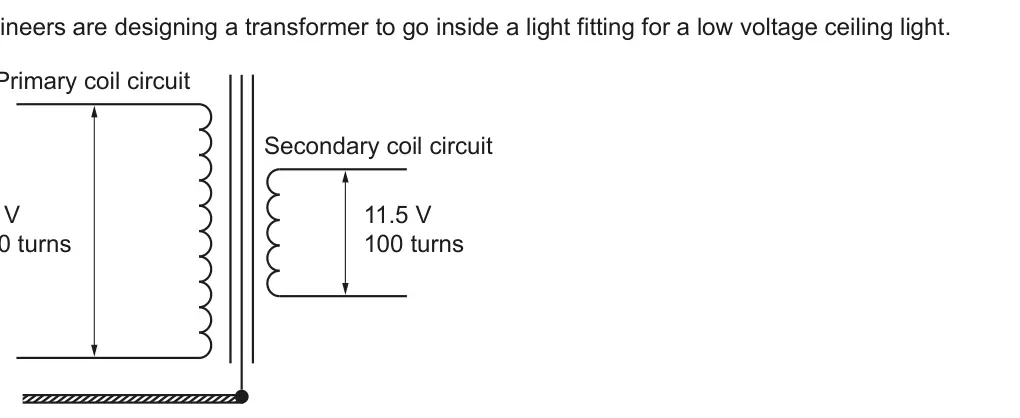
Q9(b)
The whole paper ↗Q9(c)
The whole paper ↗Q7(b)(i)
The whole paper ↗
Q7(b)(ii)
The whole paper ↗Q7(b)(iii)
The whole paper ↗Q6(e)(i)
The whole paper ↗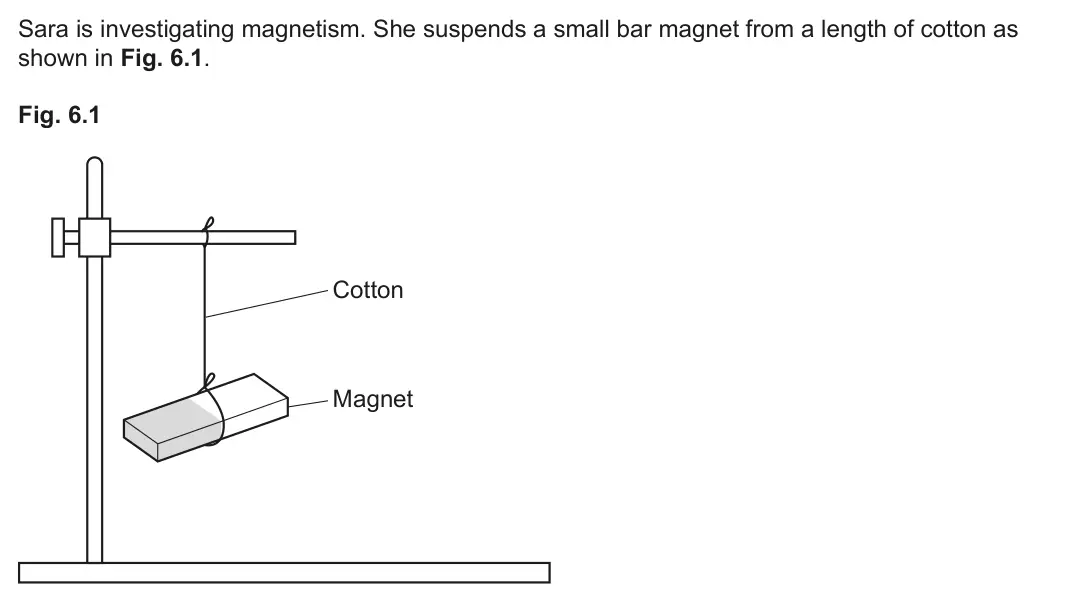
Q6(e)(ii)
The whole paper ↗Q8(a)
The whole paper ↗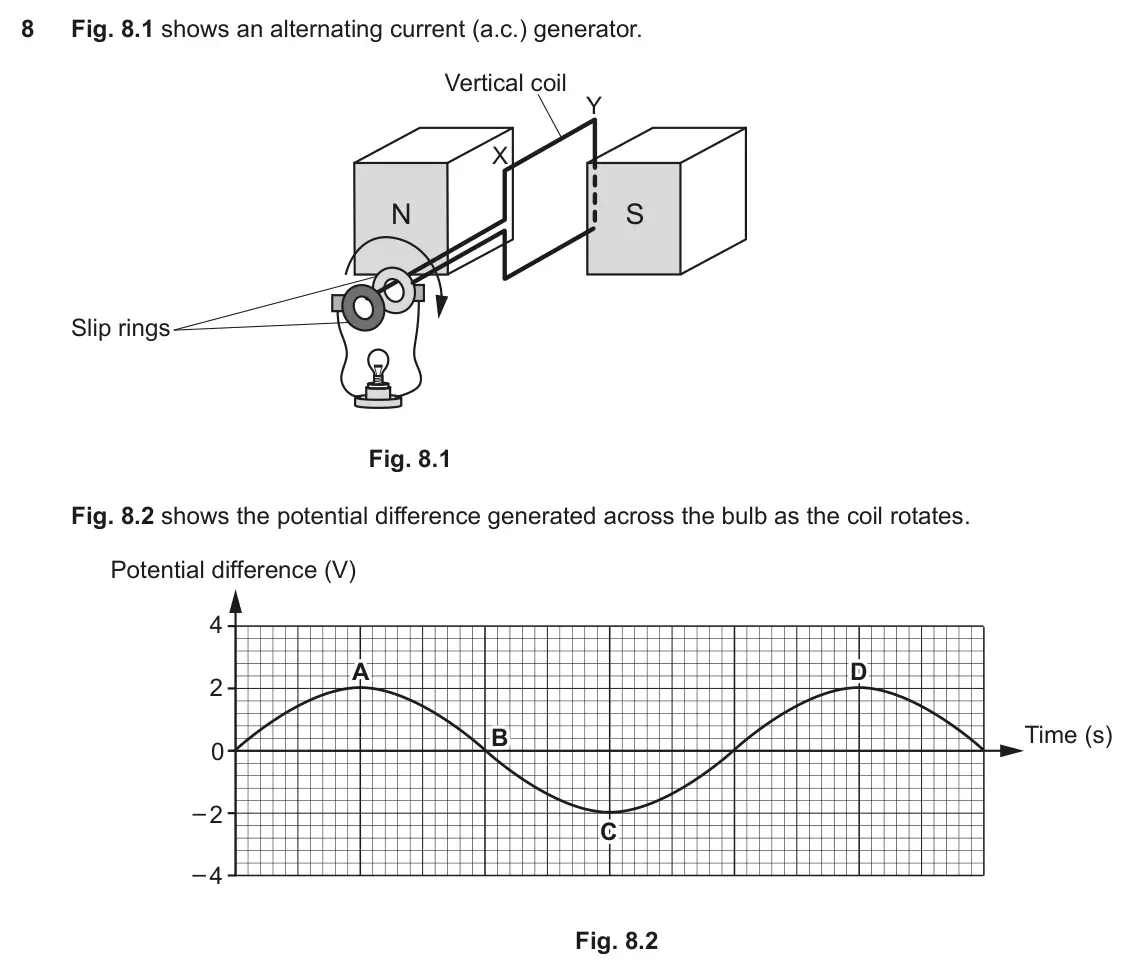
Q8(b)
The whole paper ↗Q8(c)(i)
The whole paper ↗Q8(c)(ii)
The whole paper ↗Q4(a)(i)
The whole paper ↗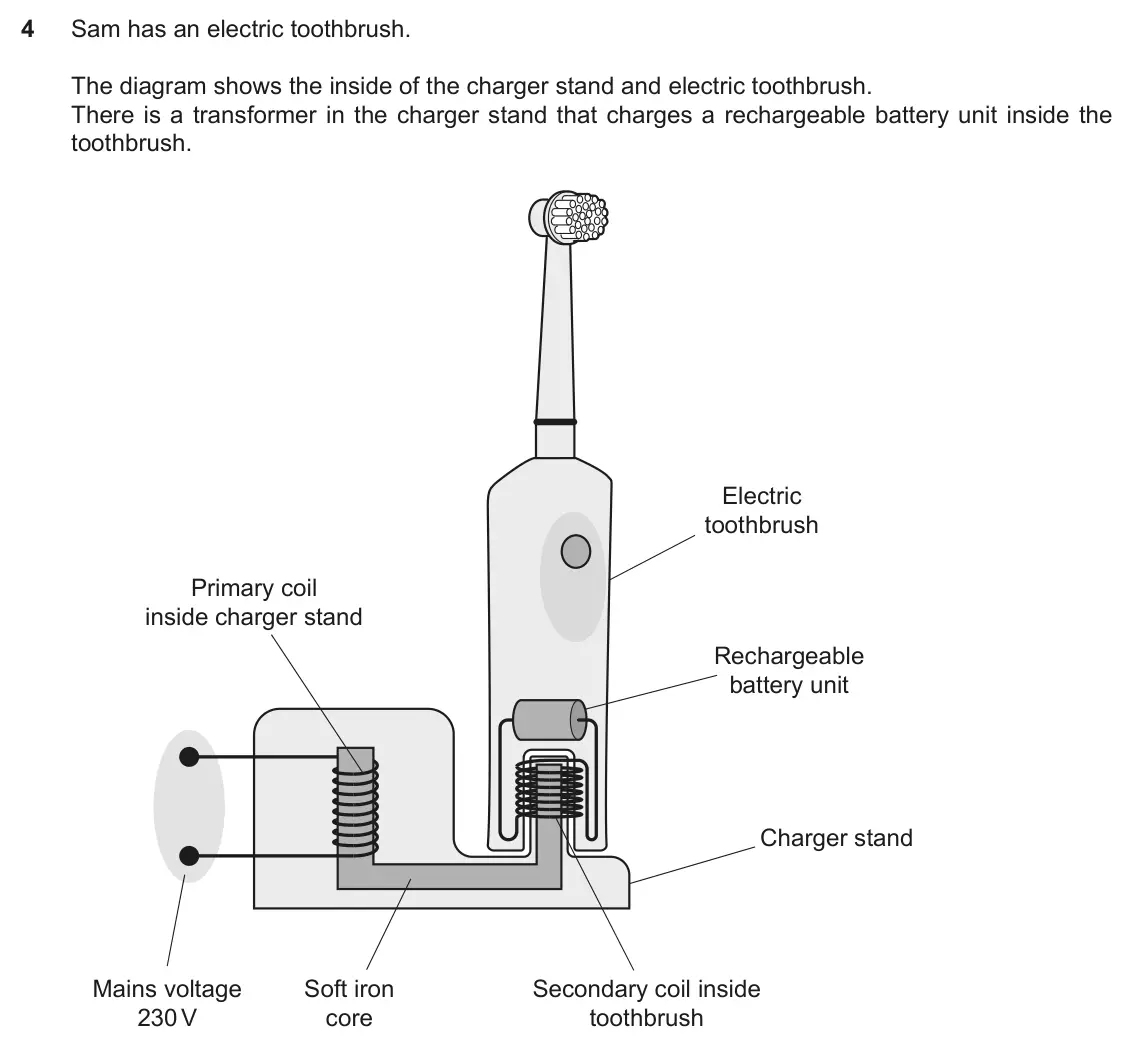
All 36 questions on What is the process inside an electric generator?, as a list
- June 2025, Paper 1 Foundation, Q4(a) (1 mark): What must be spinning near the coil of wire to induce a potential difference? Tick (✓) one box. A battery A current A magnet A transformer [1]
- June 2025, Paper 1 Foundation, Q4(c)(i) (1 mark): Draw a line of best fit on the graph. [1]
- June 2025, Paper 1 Foundation, Q4(c)(ii) (1 mark): Find the pedal speed for a potential difference of 5V. Use your line of best fit. Pedal speed = rpm [1]
- June 2025, Paper 3 Higher, Q7(a) (1 mark): What must the coil of wire be connected to so that a direct current is produced in the circuit? Tick (✓) one box. An ammeter A slip ring A split ring commutator
- June 2025, Paper 3 Higher, Q7(b) (1 mark): The graph shows the potential difference-time graph for the exercise bike. Potential difference (V) Time (s) Which feature of the potential difference-time grap
- June 2024, Paper 1 Foundation, Q7(a)(i) (1 mark): The diagram shows a transformer that converts potential difference from 25 000 V to 400 000 V. Primary coil Secondary coil What type of transformer is this? Tic
- June 2024, Paper 1 Foundation, Q7(a)(ii) (3 marks): The current in the 25 000 V primary coil of the transformer is 18 000 A. The secondary coil has a potential difference of 400 000 V. Calculate the current in th
- June 2024, Paper 3 Higher, Q9(a) (3 marks): Explain why a battery cannot be used in a transformer. [3]
- June 2024, Paper 3 Higher, Q9(b) (2 marks): Show how the potential differences of the primary and secondary coils relate to the number of turns on each coil. Use data from the diagram in your answer. [2]
- June 2024, Paper 3 Higher, Q9(c) (2 marks): This transformer is only 85% efficient. The engineers want to make it more efficient to make the light fitting safer for household use. Explain why transformers
- June 2024, Paper 4 Higher, Q7(b)(i) (3 marks): During an earthquake P-waves cause the magnet to move up and down inside the coil. Explain how the movement of the magnet produces an electrical signal to the d
- June 2024, Paper 4 Higher, Q7(b)(ii) (2 marks): S-waves cause the magnet to swing from side to side. During the earthquake the P-waves and S-waves have a similar amplitude of vibration. Explain why the trace
- June 2024, Paper 4 Higher, Q7(b)(iii) (1 mark): Ryan wants to make the amplitude of the trace larger when P-waves are detected. Suggest one change Ryan can make to his apparatus to increase the signal to the
- June 2023, Paper 4 Higher, Q6(e)(i) (1 mark): Describe how Sara can use the motor as a generator. [1]
- June 2023, Paper 4 Higher, Q6(e)(ii) (1 mark): Sara replaces the split ring commutator with slip rings. Describe how the output of the generator changes. [1]
- June 2022, Paper 4 Higher, Q8(a) (1 mark): Which letter in Fig. 8.2, A, B, C, or D, shows the potential difference when the coil is in the vertical position shown in Fig. 8.1? Tick (3) one box. A B C D [
- June 2022, Paper 4 Higher, Q8(b) (4 marks): Explain the change in potential difference during one complete revolution of the coil, using Fig. 8.2. Include the side of the coil labelled XY in Fig. 8.1 in y
- June 2022, Paper 4 Higher, Q8(c)(i) (2 marks): What change could be made to the generator in Fig. 8.1 to change it into a direct current (d.c) generator? [2]
- June 2022, Paper 4 Higher, Q8(c)(ii) (2 marks): Draw the potential difference output for a direct current generator rotated at the same speed, on Fig. 8.3. Potential difference (V) 4 2 Time (s) 0 – 2 – 4 Fig.
- November 2021, Paper 4 Higher, Q4(a)(i) (3 marks): Explain how the battery inside the toothbrush can charge on the charger stand. [3]
- November 2021, Paper 4 Higher, Q4(a)(ii) (3 marks): When the battery is charging the current in the primary coil is 0.25 A and the potential difference across the battery is 20 V. Calculate the current in the sec
- November 2021, Paper 4 Higher, Q4(b) (3 marks): Calculate the ratio of the number of turns in the primary coil to the number of turns in the secondary coil. Use the Data Sheet. Ratio = [3]
- November 2021, Paper 4 Higher, Q9(a) (2 marks): The bulb flashes on and off. As the coil passes through the vertical position the bulb is off. Explain why. [2]
- November 2021, Paper 4 Higher, Q9(b) (2 marks): The coil is rotated at a faster speed. Suggest two changes this will have on the bulb. 1. 2. . [2]
- November 2021, Paper 4 Higher, Q9(c) (1 mark): The slip rings shown in Fig. 9.1 are replaced by a split-ring commutator. Which graph A, B, C or D shows the potential difference that will now be generated acr
- November 2021, Paper 4 Higher, Q9(d)(ii) (4 marks): When the soundwave has a high frequency the changing current that is produced also has a high frequency. Explain how the microphone produces a current from a so
- November 2020, Paper 2 Foundation, Q13(a) (3 marks): The National Grid uses a step-up transformer to increase the potential difference from 25000 V to 400000 V before the current is sent along the transmission cab
- November 2020, Paper 4 Higher, Q2(a) (3 marks): The National Grid uses a step-up transformer to increase the potential difference from 25000 V to 400000 V before the current is sent along the transmission cab
- November 2020, Paper 4 Higher, Q11(a) (4 marks): Explain why negative current flows in Coil 2 when the switch is closed. [4]
- November 2020, Paper 4 Higher, Q11(b) (2 marks): Explain why no current flows in Coil 2, a few seconds after the switch is closed. [2]
- June 2019, Paper 4 Higher, Q8 (6 marks): 8* Electrical energy is transported across the country using the National Grid. Transformers play a key role in this transportation. Describe and explain the ro
- June 2018, Paper 3 Higher, Q7(a) (2 marks): Explain why a current is produced in the coil. [2]
- June 2018, Paper 3 Higher, Q7(b)(i) (2 marks): Complete the graph by plotting the missing results in Table 7.1 and draw a line of best fit. 12 10 8 current 6 (mA) 4 2 00 200 400 600 800 1000 1200 number of t
- June 2018, Paper 3 Higher, Q7(b)(ii) (1 mark): Use your line of best fit to determine the maximum current that Ali could produce if he used a coil with 700 turns. Maximum current = mA [1]
- June 2018, Paper 3 Higher, Q7(b)(iii) (1 mark): Amaya says that this experiment is not valid because the speed of the magnet may be different each time. Suggest how Ali could control the speed of the magnet.
- June 2018, Paper 3 Higher, Q7(c) (2 marks): As Ali pushes the magnet towards the coil, he feels a small repulsive force. Explain why. [2]
Questions, mark schemes and examiner’s reports are © OCR, from their published past papers. Plumi isn’t affiliated with any exam board. Want whole papers? Every OCR GCSE Physics B paper.
Rather write your answers by hand on iPad? Plumi marks them against the same mark schemes.