 plumi
What determines the rate of energy transfer in a circuit?: OCR GCSE Physics B questions
Every OCR GCSE Physics B exam question on P3.4 What determines the rate of energy transfer in a circuit?, 2018–2025, with its mark scheme and examiner’s report.
Paper
All papers
Exam
All years
Calculations
Q4(b)(iii)
The whole paper ↗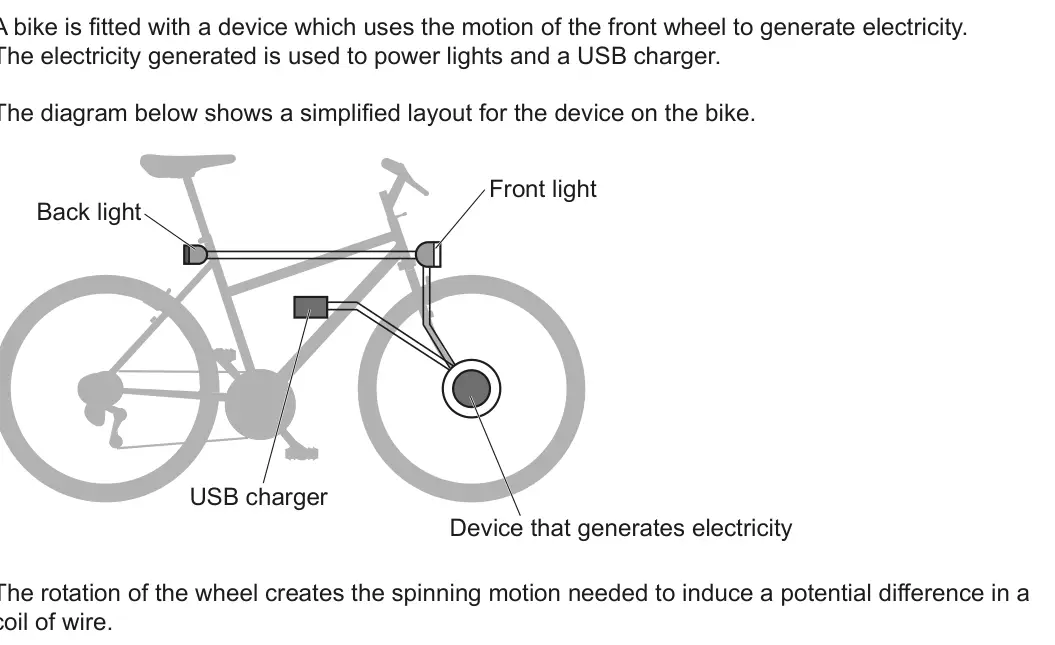
Q4(d)(ii)
The whole paper ↗Q4(d)(iii)
The whole paper ↗Q6(a)(i)
The whole paper ↗
Q6(a)(iii)
The whole paper ↗Q6(a)(iv)
The whole paper ↗Q4(a)(ii)
The whole paper ↗
Q4(b)(i)
The whole paper ↗Q4(c)
The whole paper ↗Q5(c)
The whole paper ↗
Q7(a)(i)
The whole paper ↗Q7(a)(ii)
The whole paper ↗Q9(b)(iii)
The whole paper ↗
Q1(b)(i)
The whole paper ↗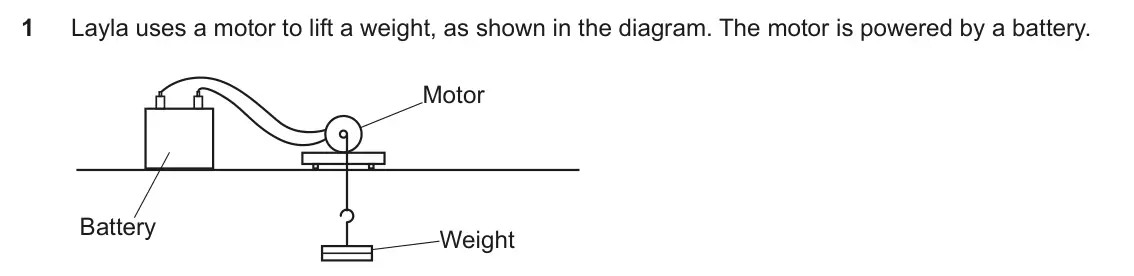
Q6(b)(i)
The whole paper ↗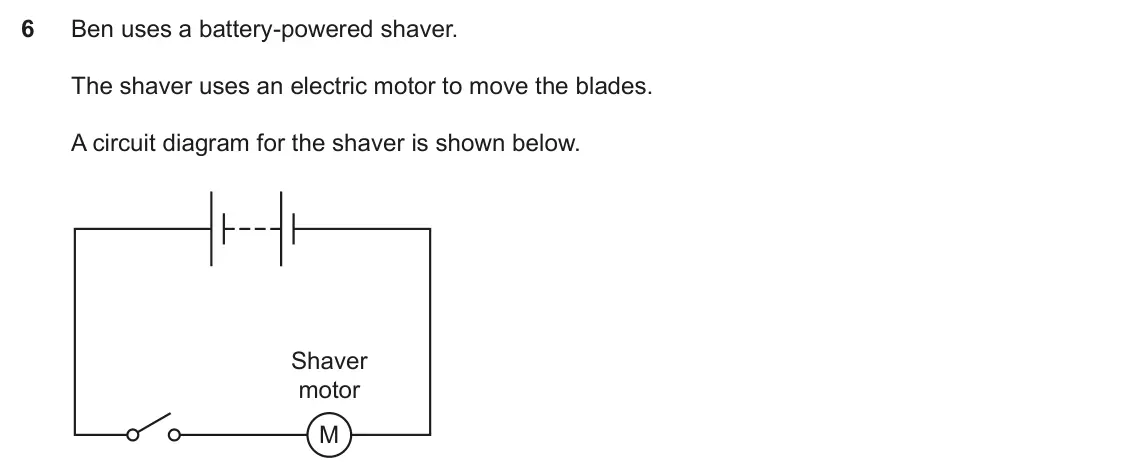
Q6(b)(ii)
The whole paper ↗Q5(a)(i)
The whole paper ↗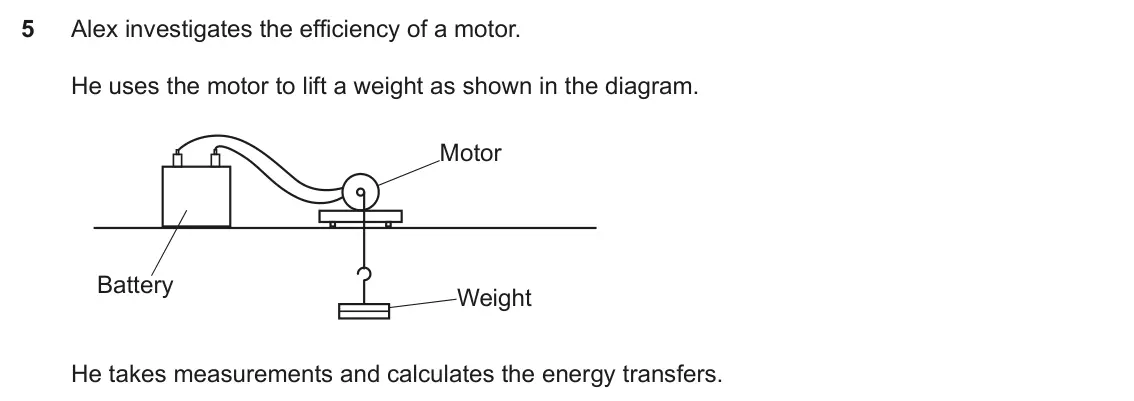
Q13(b)
The whole paper ↗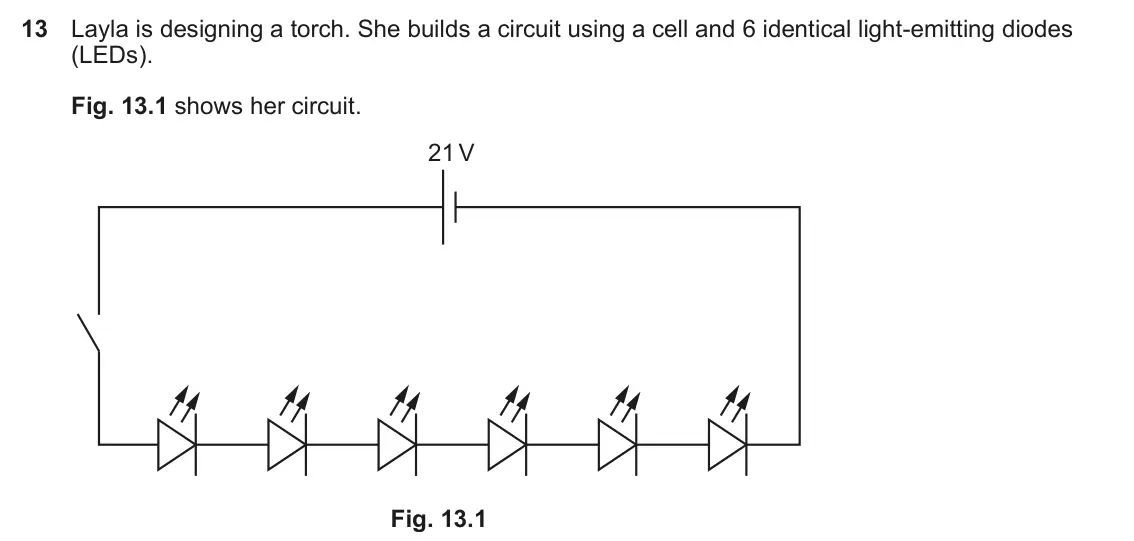
Q5(c)
The whole paper ↗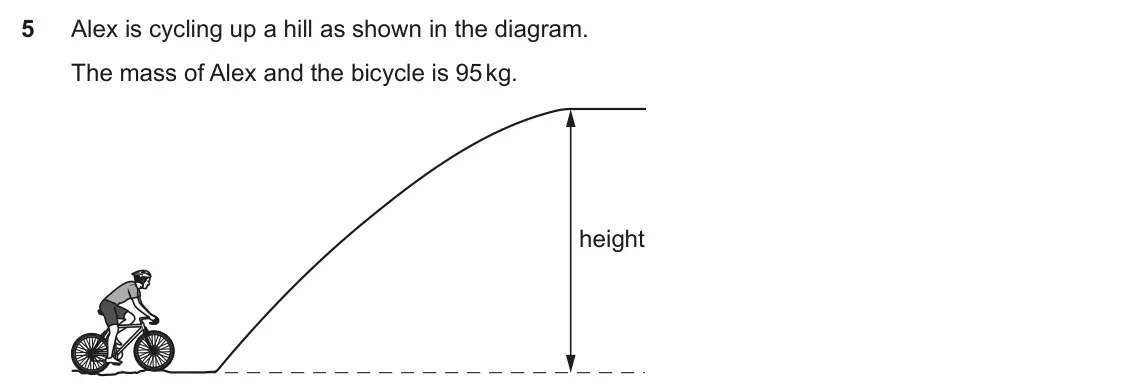
Q9(b)
The whole paper ↗
All 33 questions on What determines the rate of energy transfer in a circuit?, as a list
- June 2025, Paper 1 Foundation, Q4(b)(iii) (2 marks): Complete the sentences to describe the energy transfers in the circuit. Use words from the list. closed current open potential difference power When a flows in
- June 2025, Paper 1 Foundation, Q4(d)(ii) (1 mark): What quantity needs to be multiplied by potential difference to find the power of the USB charger? Tick (✓) one box. Charge Current Resistance Time [1]
- June 2025, Paper 1 Foundation, Q4(d)(iii) (4 marks): Calculate the energy output of the USB charger. • The charge passing through the USB charger is 2000 C. • The potential difference across the USB charger is 5 V
- June 2025, Paper 4 Higher, Q6(a)(i) (2 marks): Describe the change in the energy stores, when there is a current in the circuit. [2]
- June 2025, Paper 4 Higher, Q6(a)(iii) (4 marks): Calculate the work done by the 12 V battery in 20 seconds. Use the Equation Sheet. Work done = J [4]
- June 2025, Paper 4 Higher, Q6(a)(iv) (3 marks): Calculate the power delivered by the 12 V battery. Use the Equation Sheet. State the units. Power = Unit [3]
- June 2024, Paper 4 Higher, Q4(a)(ii) (3 marks): Describe the transfer of energy in the circuit when the switch is closed. Use ideas about energy stores in your answer. [3]
- June 2024, Paper 4 Higher, Q4(b)(i) (3 marks): Calculate the power dissipated by the lamp when the potential difference is 5 V. Use the Equation Sheet. Power = W [3]
- June 2024, Paper 4 Higher, Q4(c) (5 marks): A current of 2.8 A passes through the lamp for 120 s. The energy dissipated in the lamp is 4 kJ. Calculate the potential difference across the lamp. Use the equ
- June 2023, Paper 3 Higher, Q5(c) (3 marks): The hand mixer heats up when it is in use. This is caused by resistance as the current flows through the circuit in the hand mixer. The resistance in the circui
- June 2023, Paper 3 Higher, Q7(a)(i) (3 marks): Calculate the current in the primary coil of the transformer. Use the Equation Sheet. Current = A [3]
- June 2023, Paper 3 Higher, Q7(a)(ii) (3 marks): Explain why electrical power is transmitted at 400 000 V, and not 25 000 V. [3]
- June 2023, Paper 4 Higher, Q9(b)(iii) (4 marks): Li uses a length of the nichrome wire as a heater connected to a different power supply. This heater supplies a power of 20 W when the current is 2.5 A. Calcula
- June 2022, Paper 1 Foundation, Q1(b)(i) (2 marks): Layla measures the power of the motor as 13 W. It takes 3.0 s to lift the weight. Calculate the energy transferred by the motor. Use the equation: energy transf
- June 2022, Paper 1 Foundation, Q6(b)(i) (2 marks): Each time Ben uses the shaver, 180 C of charge flows. Calculate the energy transferred each time he uses the shaver. Use the equation: energy transferred = char
- June 2022, Paper 1 Foundation, Q6(b)(ii) (3 marks): The power of the shaver is 1.1 W. Calculate the current flowing through the shaver. Use the equation: power = potential difference × current Give your answer to
- June 2022, Paper 3 Higher, Q5(a)(i) (3 marks): Calculate the electrical power input to the motor. Use the Data Sheet. Power input = W [3]
- June 2022, Paper 3 Higher, Q13(b) (3 marks): Fig. 13.2 shows the voltage-current characteristic for one LED. 25 20 15 current (mA) 10 5 0 2.4 2.5 2.6 2.7 2.8 2.9 3 3.1 3.2 3.3 3.4 3.5 3.6 potential differe
- June 2022, Paper 4 Higher, Q5(c) (4 marks): Alex buys an electric bike which assists pedalling by supplying 11 A of current from a 24 V battery. It takes Alex 30 seconds to reach the top of the hill. A to
- June 2022, Paper 4 Higher, Q9(b) (2 marks): Kai made a hypothesis before recording his results. When the current is increased in equal amounts, the power input also increases in equal amounts. Therefore,
- November 2021, Paper 1 Foundation, Q2(b) (2 marks): Jane adjusts the potential difference across the heater to 12 V. The current in the heater is now 8.6 A. Calculate the electrical power of the heater. Use the e
- November 2020, Paper 1 Foundation, Q4(c) (3 marks): The table shows some information about the two vacuum cleaners. Vacuum cleaner A B Input power (W) 700 65 Potential difference (V) 230 11 Calculate the current
- November 2020, Paper 4 Higher, Q5(c) (3 marks): In an electrical scent burner the coil of wire in the circuit heats liquid so it turns into a vapour. Dish containing scented liquid Coil of wire To an electric
- June 2019, Paper 1 Foundation, Q9(b) (3 marks): The kettle transfers energy electrically. The resistance of the kettle is 20 Ω. The electric current in the kettle is 11 A. Calculate the power of the kettle. P
- June 2019, Paper 2 Foundation, Q7(a)(iii) (3 marks): The base of the filament lamp has ‘2.4 V, 500 mA’ stamped on it. Calculate the power of the filament lamp at 2.4 V. Power = W [3]
- June 2019, Paper 3 Higher, Q9(a) (3 marks): Describe how to use the circuit in Fig. 9.2 to measure the maximum power provided by each cell. Include details of any calculations that must be completed. [3]
- June 2018, Paper 1 Foundation, Q13(b)(i) (3 marks): Calculate the total energy transferred by the toothbrush in one day if it is used two times a day. Energy transferred = J [3]
- June 2018, Paper 1 Foundation, Q13(b)(ii) (4 marks): Calculate the current in the toothbrush when used for 2 minutes each time. Current = A [4]
- June 2018, Paper 2 Foundation, Q3(b)(i) (3 marks): Using Table 3.1 calculate the output current for transformer B. Use the equation: Input potential difference × Input current = Output potential difference × Out
- June 2018, Paper 2 Foundation, Q3(b)(ii) (3 marks): Use the input data for transformer A to show that the output power of the generator is more than 60 megawatts (MW). 1 MW = 1 000 000 W Output power = MW [3]
- June 2018, Paper 2 Foundation, Q3(c) (2 marks): All power stations use step-up transformers like transformer A between the generator and the National Grid power cables. Explain how using 230 000 V instead of
- June 2018, Paper 3 Higher, Q2(b)(i) (3 marks): Calculate the total energy transferred by the toothbrush in one day if it is used two times a day. Energy transferred = J [3]
- June 2018, Paper 3 Higher, Q2(b)(ii) (4 marks): Calculate the current in the toothbrush when used for 2 minutes each time. Current = A [4]
Questions, mark schemes and examiner’s reports are © OCR, from their published past papers. Plumi isn’t affiliated with any exam board. Want whole papers? Every OCR GCSE Physics B paper.
Rather write your answers by hand on iPad? Plumi marks them against the same mark schemes.