 plumi
What determines the current in an electric circuit?: OCR GCSE Physics B questions
Every OCR GCSE Physics B exam question on P3.2 What determines the current in an electric circuit?, 2018–2025, with its mark scheme and examiner’s report.
Paper
All papers
Exam
All years
Calculations
Q4(b)(i)
The whole paper ↗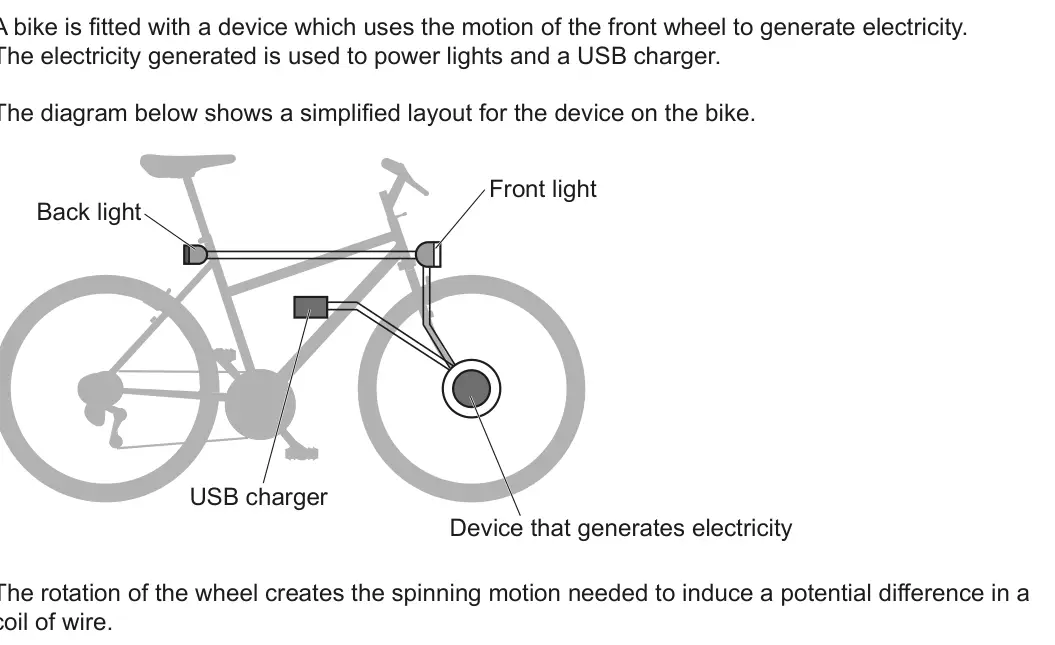
Q4(d)(i)
The whole paper ↗Q6(a)(i)
The whole paper ↗
Q6(a)(ii)
The whole paper ↗Q6(a)(iii)
The whole paper ↗Q6(a)(iv)
The whole paper ↗Q1(c)
The whole paper ↗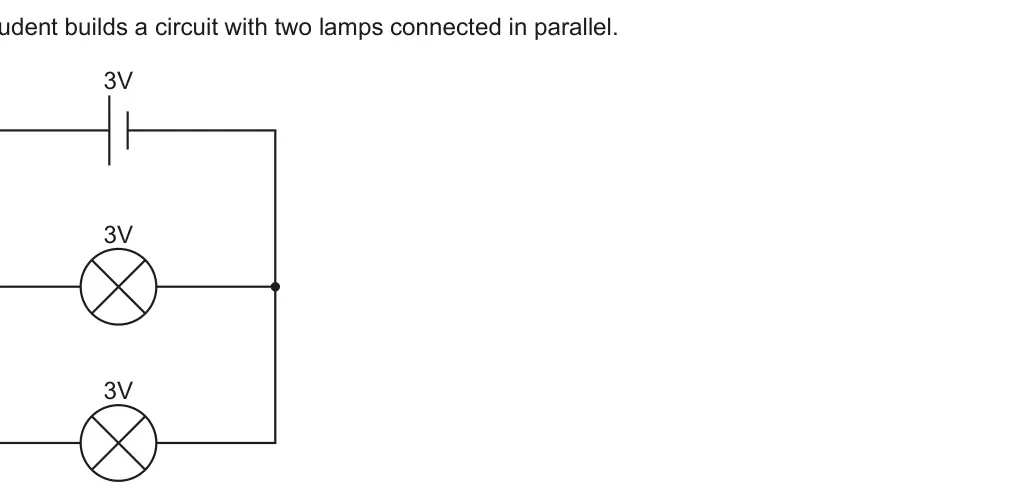
Q9(a)
The whole paper ↗
Q9(b)(i)
The whole paper ↗Q9(b)(ii)
The whole paper ↗Q9(b)(iii)
The whole paper ↗Q9(b)(iv)
The whole paper ↗Q9(c)
The whole paper ↗Q2(a)(i)
The whole paper ↗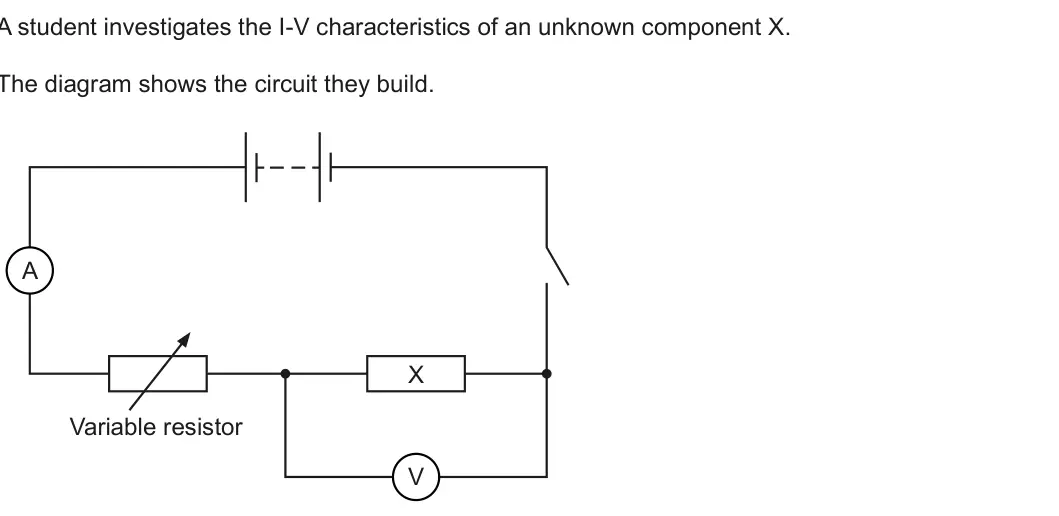
Q2(a)(ii)
The whole paper ↗Q2(a)(iii)
The whole paper ↗Q2(b)(i)
The whole paper ↗Q2(b)(ii)
The whole paper ↗Q2(b)(iii)
The whole paper ↗Q1(a)
The whole paper ↗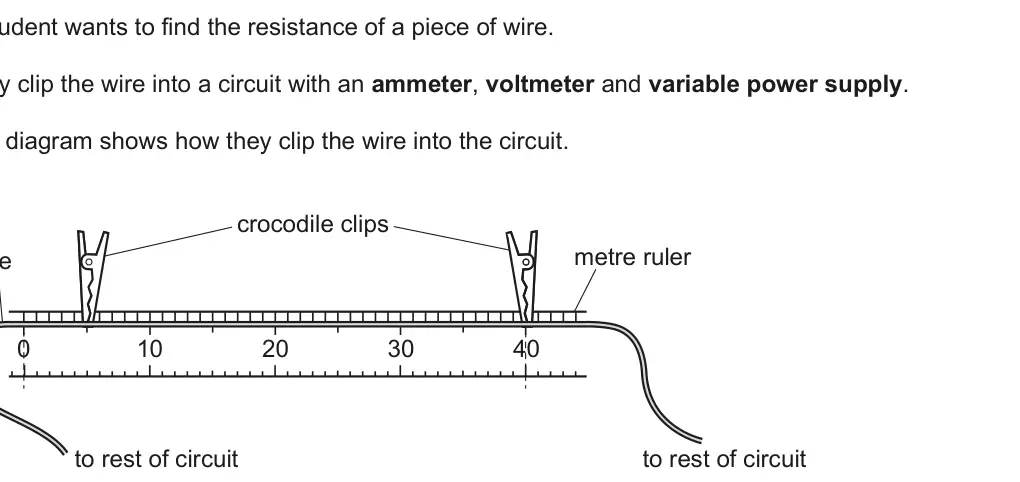
All 110 questions on What determines the current in an electric circuit?, as a list
- June 2025, Paper 1 Foundation, Q4(b)(i) (1 mark): A component can be added to the circuit to measure current. Draw the symbol for the component that measures current. [1]
- June 2025, Paper 1 Foundation, Q4(d)(i) (2 marks): Calculate the charge that flows through the USB charger when: • the current through the USB charger is 0.5 A. • the phone is charged for 1200 s. Use the equatio
- June 2025, Paper 2 Foundation, Q6(a)(i) (1 mark): Complete the graph. You need to plot the first two points. [1]
- June 2025, Paper 2 Foundation, Q6(a)(ii) (1 mark): Draw a line of best fit on the graph. [1]
- June 2025, Paper 2 Foundation, Q6(a)(iii) (2 marks): Describe how the current changes as the number of cells increases. Use the graph. [2]
- June 2025, Paper 2 Foundation, Q6(a)(iv) (1 mark): Suggest why not every point lies on the line of best fit. [1]
- June 2024, Paper 1 Foundation, Q1(c) (2 marks): The student then uses some resistors to control the brightness of the lamps. Draw a line from each circuit symbol to the type of resistor it represents. Circuit
- June 2024, Paper 1 Foundation, Q9(a) (3 marks): Draw a circuit diagram to show the full circuit they use. Use: • this symbol for the wire • this symbol for the variable power supply [3]
- June 2024, Paper 1 Foundation, Q9(b)(i) (1 mark): Plot the two missing points on the graph. 7.0 6.0 5.0 4.0 Potential difference (V) 3.0 2.0 1.0 0 0.2 0.4 0.6 0.8 1.0 1.2 Current (A) [1]
- June 2024, Paper 1 Foundation, Q9(b)(ii) (1 mark): Draw a line of best fit on the graph. [1]
- June 2024, Paper 1 Foundation, Q9(b)(iii) (2 marks): Calculate the gradient of the line. Gradient = [2]
- June 2024, Paper 1 Foundation, Q9(b)(iv) (1 mark): Find the resistance of the wire. Resistance = Ω [1]
- June 2024, Paper 1 Foundation, Q9(c) (2 marks): The student clips a new piece of the same wire in the circuit and repeats their method to find the resistance. The new piece of wire is double the length. Descr
- June 2024, Paper 2 Foundation, Q2(a)(i) (2 marks): The student needs to measure the current and the potential difference in the circuit. Name the two pieces of measuring equipment shown in the circuit. [2] ……………
- June 2024, Paper 2 Foundation, Q2(a)(ii) (1 mark): Why is there a variable resistor in the circuit? Tick (✓) one box. To change the power of the battery. To change the potential difference across X. To measure t
- June 2024, Paper 2 Foundation, Q2(a)(iii) (1 mark): The student states that component X is getting hot whilst they are doing the experiment. Describe one precaution the student can take to prevent the component f
- June 2024, Paper 2 Foundation, Q2(b)(i) (3 marks): Calculate the resistance of X when the potential difference is 4.0 V. Use the equation: potential difference = current × resistance Resistance = Ω [3]
- June 2024, Paper 2 Foundation, Q2(b)(ii) (1 mark): The student concludes that the resistance of component X changes as the potential difference increases. Describe how the graph shows that the student is correct
- June 2024, Paper 2 Foundation, Q2(b)(iii) (1 mark): Suggest what component X is. [1]
- June 2024, Paper 3 Higher, Q1(a) (3 marks): Draw a circuit diagram to show the full circuit they use. Use: • this symbol for the wire • this symbol for the variable power supply [3]
- June 2024, Paper 3 Higher, Q1(b)(i) (1 mark): Plot the two missing points on the graph. 7.0 6.0 5.0 4.0 Potential difference (V) 3.0 2.0 1.0 0 0.2 0.4 0.6 0.8 1.0 1.2 Current (A) [1]
- June 2024, Paper 3 Higher, Q1(b)(ii) (1 mark): Draw a line of best fit on the graph. [1]
- June 2024, Paper 3 Higher, Q1(b)(iii) (2 marks): Calculate the gradient of the line. Gradient = [2]
- June 2024, Paper 3 Higher, Q1(b)(iv) (1 mark): Find the resistance of the wire. Resistance = Ω [1]
- June 2024, Paper 3 Higher, Q1(c) (2 marks): The student clips a new piece of the same wire in the circuit and repeats their method to find the resistance. The new piece of wire is double the length. Descr
- June 2024, Paper 4 Higher, Q4(a)(i) (1 mark): He observes that the battery runs down too quickly for him to get all the required measurements. Suggest how the student can stop this from happening. [1]
- June 2024, Paper 4 Higher, Q4(b)(ii) (4 marks): The student writes this conclusion: ‘As the potential difference increases, the resistance of the lamp increases.’ Determine whether the student is correct. Use
- June 2023, Paper 1 Foundation, Q3(b)(i) (1 mark): Which circuit symbol in Fig. 3.1 represents the fixed resistor? Put a ring around the correct option in Fig. 3.1. [1]
- June 2023, Paper 1 Foundation, Q3(b)(ii) (1 mark): The resistance of the LDR increases in the dark. What happens to the current in this circuit in the dark? Tick (3) one box. The current decreases The current in
- June 2023, Paper 1 Foundation, Q3(e) (3 marks): The energy transferred by the lamp is 3.2 J when the potential difference is 4.0 V. Calculate the charge flowing through the lamp. energy transferred Use the eq
- June 2023, Paper 2 Foundation, Q4(b) (1 mark): Suggest one reason why material B is chosen to make an electrical circuit in a mobile phone. [1]
- June 2023, Paper 2 Foundation, Q8(a)(i) (2 marks): Give two reasons why there is a current. 1. 2. [2]
- June 2023, Paper 2 Foundation, Q8(a)(ii) (2 marks): Taylor records a current of 2 A flowing for a time of 120 s. Calculate the charge that passes through the lamp in this time. Use the equation: charge = current
- June 2023, Paper 3 Higher, Q11(c)(i) (1 mark): Complete the circuit diagram in Fig. 11.4 by drawing the LED (light emitting diode) symbol in the gap. Fig. 11.4 3 V [1]
- June 2023, Paper 3 Higher, Q11(c)(ii) (3 marks): When the lamp is switched on, a current of 0.015 A flows through it. Calculate the charge that flows through the lamp in 50 minutes. Use the equation: charge =
- June 2023, Paper 4 Higher, Q9(b)(i) (3 marks): Describe how Li calculates the resistance of different lengths of the wire. Your answer should include a circuit diagram. [3]
- June 2023, Paper 4 Higher, Q9(b)(ii) (2 marks): Suggest why Li switches off the power supply between each measurement. [2]
- June 2023, Paper 4 Higher, Q9(b)(iii) (4 marks): Li uses a length of the nichrome wire as a heater connected to a different power supply. This heater supplies a power of 20 W when the current is 2.5 A. Calcula
- June 2022, Paper 1 Foundation, Q9(a)(i) (1 mark): Suggest how to keep the temperature of the wire constant. [1]
- June 2022, Paper 1 Foundation, Q9(a)(ii) (2 marks): State two other control variables for this experiment. 1 2 [2]
- June 2022, Paper 1 Foundation, Q9(b) (3 marks): Jane makes the following measurements for one wire. reading on voltmeter = 0.55 V reading on ammeter = 2.5 A Use the Data Sheet. Calculate the resistance of the
- June 2022, Paper 1 Foundation, Q9(c)(i) (2 marks): Complete the graph by plotting the missing result from the table and draw a line of best fit. [2]
- June 2022, Paper 1 Foundation, Q9(c)(ii) (2 marks): Write a conclusion for Jane’s investigation. [2]
- June 2022, Paper 1 Foundation, Q11(a) (1 mark): Complete Fig. 11.1 to include a thermistor correctly connected to the circuit. [1]
- June 2022, Paper 1 Foundation, Q11(b)(i) (1 mark): Suggest how she could make water with a temperature of about 50 °C. [1]
- June 2022, Paper 1 Foundation, Q11(b)(ii) (2 marks): Table 11.2 shows her data including the measurement at 50 °C. Temperature (°C) Resistance (Ω) 0 1300 50 350 80 1800 Table 11.2 How will the new data affect Nina
- June 2022, Paper 1 Foundation, Q11(c) (2 marks): Nina made 7 more measurements at different temperatures. All her data is plotted in Fig. 11.2. 2000 1800 1600 resistance (Ω) 1400 1200 1000 800 600 400 200 0 0
- June 2022, Paper 2 Foundation, Q2(b)(ii) (2 marks): Explain your answer to (b)(i). Use the equation: current = potential difference to help. resistance [2]
- June 2022, Paper 2 Foundation, Q4(a) (2 marks): Name the meters X and Y. X = Y = [2]
- June 2022, Paper 2 Foundation, Q4(b) (1 mark): What is the correct purpose of the variable resistor in this circuit? Tick (3) one box. To change the potential difference keeping the current constant. To meas
- June 2022, Paper 2 Foundation, Q4(c)(i) (2 marks): Plot the results from the table on the graph and draw a line of best fit. Four points have already been plotted. 0.5 0.4 0.3 Current (A) 0.2 0.1 00 2 4 6 8 10 P
- June 2022, Paper 2 Foundation, Q4(c)(ii) (1 mark): Use the graph to find the value of current when the potential difference is 7 V. Current = A [1]
- June 2022, Paper 2 Foundation, Q4(c)(iii) (3 marks): Calculate the resistance of the metal wire. Use the equation: resistance = potential difference ÷ current Use the graph or the table. Resistance = Ω [3]
- June 2022, Paper 2 Foundation, Q4(d) (2 marks): Suggest how Charlie can find out if the resistance of the wire changes with its length. [2]
- June 2022, Paper 3 Higher, Q1(a) (1 mark): Complete Fig. 1.1 to include a thermistor correctly connected to the circuit. [1]
- June 2022, Paper 3 Higher, Q1(b)(i) (1 mark): Suggest how she could make water with a temperature of about 50 °C. [1]
- June 2022, Paper 3 Higher, Q1(b)(ii) (2 marks): Table 1.2 shows her data including the measurement at 50 °C. Temperature (°C) Resistance (Ω) 0 1300 50 350 80 1800 Table 1.2 How will the new data affect Nina’s
- June 2022, Paper 3 Higher, Q1(c) (2 marks): Nina made 7 more measurements at different temperatures. All her data is plotted in Fig. 1.2. 2000 1800 1600 resistance (Ω) 1400 1200 1000 800 600 400 200 0 0 2
- June 2022, Paper 3 Higher, Q6(b)(i) (3 marks): Calculate the initial current that flowed through the wooden rule. Use the Data Sheet. Current = A [3]
- June 2022, Paper 4 Higher, Q4(a) (1 mark): Li’s results are shown in Fig. 4.2. Draw a line of best fit for Li’s results. [1] 60 50 40 Current (mA) 30 20 10 0 0 0.1 0.2 0.3 0.4 0.5 Potential Difference (V
- June 2022, Paper 4 Higher, Q4(b)(i) (3 marks): Name the component, R, in Fig. 4.1 and explain how it is used to produce the graph in Fig. 4.2. Component R is Explanation [3]
- June 2022, Paper 4 Higher, Q4(b)(ii) (4 marks): Calculate the resistance of the diode when the potential difference across it is 0.3 V, using Fig. 4.2. Use the Data Sheet. Resistance = Ω [4]
- June 2022, Paper 4 Higher, Q4(c) (2 marks): Li makes this conclusion: The resistance stays constant. Only the current changes when potential difference is changed. Explain why Li is wrong. [2]
- November 2021, Paper 1 Foundation, Q2(a) (2 marks): The resistance of the heater when it is first switched on is 1.4 Ω. The current in the heater is 9.0 A. Calculate the potential difference across the heater. Us
- November 2021, Paper 1 Foundation, Q2(c) (1 mark): The temperature of the heater increases. Predict what happens to the resistance of the heater. [1]
- November 2021, Paper 1 Foundation, Q11(c) (2 marks): Amaya’s teacher says that there is an electric current flowing between the nuts and the radiation detector. There is an electric current because alpha particles
- November 2021, Paper 2 Foundation, Q4(a)(i) (1 mark): What is the name of the component labelled X in Fig. 4.1? Tick (✓) one box. Thermistor Variable Resistor Fixed Resistor [1]
- November 2021, Paper 2 Foundation, Q4(a)(ii) (3 marks): The potential difference across the lamp is 3.6 V. The current in the circuit is 0.75 A. Calculate the resistance of the lamp. Resistance = Ω [3]
- November 2021, Paper 2 Foundation, Q4(b)(i) (2 marks): Jane wants to make measurements to calculate the resistance of the LDR in the circuit in Fig. 4.2. What two components does Jane need to add to the circuit in F
- November 2021, Paper 2 Foundation, Q4(b)(ii) (2 marks): Jane investigates how the resistance of the LDR varies as the intensity of the light shining on the LDR increases. Jane sketches a graph of her results, as show
- November 2021, Paper 4 Higher, Q3(a)(i) (2 marks): Draw the correct circuit symbols inside the dotted boxes in Fig. 3.1 to complete the circuit. [2]
- November 2021, Paper 4 Higher, Q3(a)(ii) (3 marks): Explain how the current changes when the temperature of the thermistor increases. [3]
- November 2021, Paper 4 Higher, Q3(b) (4 marks): Ling plots a graph of her results, as shown in Fig. 3.2. 1.6 1.4 1.2 1.0 Current (A) 0.8 0.6 0.4 0.2 0 0 0.2 0.4 0.6 0.8 1.0 1.2 1.4 1.6 Potential difference (V
- November 2020, Paper 2 Foundation, Q6(a) (4 marks): Calculate the resistance of the fixed resistor. Use the equation: resistance = potential difference ÷ current Show your working on Fig. 6.1. Give your answer to
- November 2020, Paper 2 Foundation, Q6(b) (3 marks): Amaya repeats the investigation, but replaces the fixed resistor with a filament lamp. Her results are shown in Fig. 6.2. 6 5• 4 Current (A) 3 2 _ 11 12 2 3 7 9
- November 2020, Paper 4 Higher, Q5(a) (1 mark): What is needed for a current to flow in any circuit? Tick (v) two boxes. Ammeter Closed Circuit Filament Lamp Potential Difference Switch Voltmeter [1]
- November 2020, Paper 4 Higher, Q5(b)(i) (4 marks): Calculate the charge flowing through the ammeter when the switch is closed 2 minutes, using Fig. 5.1. Give the correct unit. Charge = Unit • [4]
- November 2020, Paper 4 Higher, Q5(b)(ii) (3 marks): When the switch is closed for 2 minutes, the work done by the battery on the electrons in the circuit is 2160 J. Calculate the potential difference across the b
- November 2020, Paper 4 Higher, Q5(c) (3 marks): In an electrical scent burner the coil of wire in the circuit heats liquid so it turns into a vapour. Dish containing scented liquid Coil of wire To an electric
- June 2019, Paper 1 Foundation, Q1(a) (1 mark): Which two parts of the circuit must be present for a current to flow? Tick (3) two boxes. The ammeters, to measure the current The cell, to provide a potential
- June 2019, Paper 1 Foundation, Q1(b) (2 marks): Amaya measured the current in the lamp as 1.5 A. The potential difference across the lamp is 3.3 V. Calculate the resistance of the lamp. Use the equation: resi
- June 2019, Paper 2 Foundation, Q7(a)(i) (1 mark): Which current against voltage graph (I-V characteristic) for a filament lamp is correct? Put a ring around the correct answer. I I I 0 0 0 0 V 0 V 0 V [1]
- June 2019, Paper 2 Foundation, Q7(a)(ii) (3 marks): Calculate the amount of charge flowing through the filament lamp when it is used for 60 s. Use the equation: charge = current × time Charge = C [3]
- June 2019, Paper 2 Foundation, Q7(c)(i) (1 mark): What is the name of the electrical component that conducts current in only one direction? Tick (3) one box. Diode Lamp Light-Dependent Resistor (LDR) Thermistor
- June 2019, Paper 2 Foundation, Q7(c)(ii) (1 mark): Draw an electrical symbol for your answer to (c)(i). [1]
- June 2019, Paper 2 Foundation, Q10(a) (2 marks): Use Fig. 10.2 to explain how the light intensity affects the resistance of the LDR. [2]
- June 2019, Paper 2 Foundation, Q10(b) (2 marks): The LDR is connected to a cell, an ammeter and a voltmeter. The meter readings from the ammeter and voltmeter are used to determine the resistance of the LDR. C
- June 2019, Paper 2 Foundation, Q10(c)(i) (1 mark): Suggest one thing that must be kept the same to get identical results. [1]
- June 2019, Paper 2 Foundation, Q10(c)(ii) (1 mark): Suggest one improvement that needs to be made to get identical results. [1]
- June 2019, Paper 3 Higher, Q6(a) (4 marks): The resistance of each bulb is 2800 Ω. Calculate the current in Circuit A. Give your answer to 2 significant figures. Current = A [4]
- June 2019, Paper 4 Higher, Q3(a) (2 marks): Use Fig. 3.2 to explain how the light intensity affects the resistance of the LDR. [2]
- June 2019, Paper 4 Higher, Q3(b) (2 marks): The LDR is connected to a cell, an ammeter and a voltmeter. The meter readings from the ammeter and voltmeter are used to determine the resistance of the LDR. C
- June 2019, Paper 4 Higher, Q3(c)(i) (1 mark): Suggest one thing that must be kept the same to get identical results. [1]
- June 2019, Paper 4 Higher, Q3(c)(ii) (1 mark): Suggest one improvement that needs to be made to get identical results. [1]
- June 2018, Paper 1 Foundation, Q9(a)(i) (1 mark): Add a voltmeter to the circuit to measure the potential difference across component Y. [1]
- June 2018, Paper 1 Foundation, Q9(a)(ii) (2 marks): Describe how to use component X to vary the current in the circuit. [2]
- June 2018, Paper 1 Foundation, Q9(b)(i) (4 marks): Calculate the resistance when the potential difference is 6.0 V. Give your answer to 3 significant figures. Resistance = Ω [4]
- June 2018, Paper 1 Foundation, Q9(b)(ii) (1 mark): Describe the relationship between current and resistance. [1]
- June 2018, Paper 1 Foundation, Q9(b)(iii) (2 marks): Suggest what component Y is. Explain your answer. Component Y is Explanation [2]
- June 2018, Paper 1 Foundation, Q13(b)(ii) (4 marks): Calculate the current in the toothbrush when used for 2 minutes each time. Current = A [4]
- June 2018, Paper 2 Foundation, Q8(a)(i) (1 mark): Which of the following statements correctly describes this variation? Tick (3) one box. The resistance is directly proportional to the illuminance. The resistan
- June 2018, Paper 2 Foundation, Q8(a)(ii) (2 marks): Use the graph to estimate the change in resistance of the LDR when the illuminance increases from 10 lux to 70 lux. Change in resistance = kΩ [2]
- June 2018, Paper 3 Higher, Q2(b)(ii) (4 marks): Calculate the current in the toothbrush when used for 2 minutes each time. Current = A [4]
- June 2018, Paper 3 Higher, Q10(a) (1 mark): Draw the symbol for a thermistor in the space labelled R2. [1]
- June 2018, Paper 3 Higher, Q10(b)(i) (3 marks): Describe and explain the relationship shown in the graph. [3]
- June 2018, Paper 3 Higher, Q10(b)(ii) (2 marks): Alex plans to use the sensor to monitor temperature in a greenhouse. To find the temperature, Alex will measure the potential difference across R1. He will then
- June 2018, Paper 3 Higher, Q10(c)(i) (1 mark): What is the name of this type of error? [1]
- June 2018, Paper 3 Higher, Q10(c)(ii) (2 marks): Explain why Mr Orton is correct, and suggest how this problem could be reduced. [2]
- June 2018, Paper 4 Higher, Q1(a)(i) (1 mark): Which of the following statements correctly describes this variation? Tick (3) one box. The resistance is directly proportional to the illuminance. The resistan
- June 2018, Paper 4 Higher, Q1(a)(ii) (2 marks): Use the graph to estimate the change in resistance of the LDR when the illuminance increases from 10 lux to 70 lux. Change in resistance = kΩ [2]
Questions, mark schemes and examiner’s reports are © OCR, from their published past papers. Plumi isn’t affiliated with any exam board. Want whole papers? Every OCR GCSE Physics B paper.
Rather write your answers by hand on iPad? Plumi marks them against the same mark schemes.