 plumi
How do series and parallel circuits work?: OCR GCSE Physics B questions
Every OCR GCSE Physics B exam question on P3.3 How do series and parallel circuits work?, 2018–2025, with its mark scheme and examiner’s report.
Paper
All papers
Exam
All years
Calculations
Q4(b)(ii)
The whole paper ↗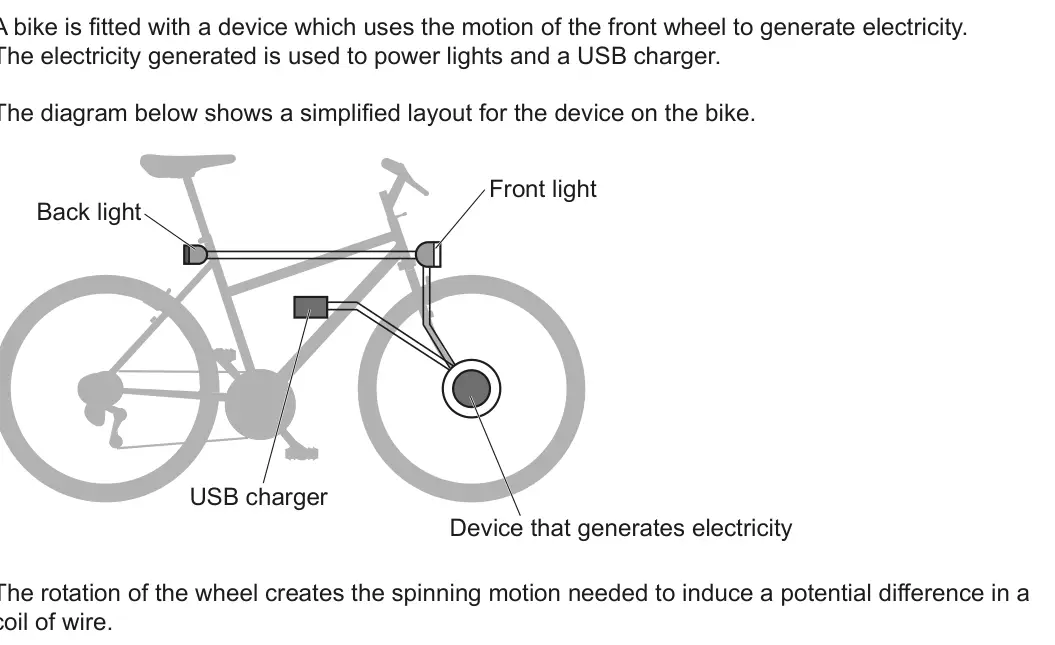
Q6(b)(i)
The whole paper ↗
Q6(b)(ii)
The whole paper ↗Q6(a)(ii)
The whole paper ↗
Q6(b)(i)
The whole paper ↗Q6(b)(ii)
The whole paper ↗Q1(a)(i)
The whole paper ↗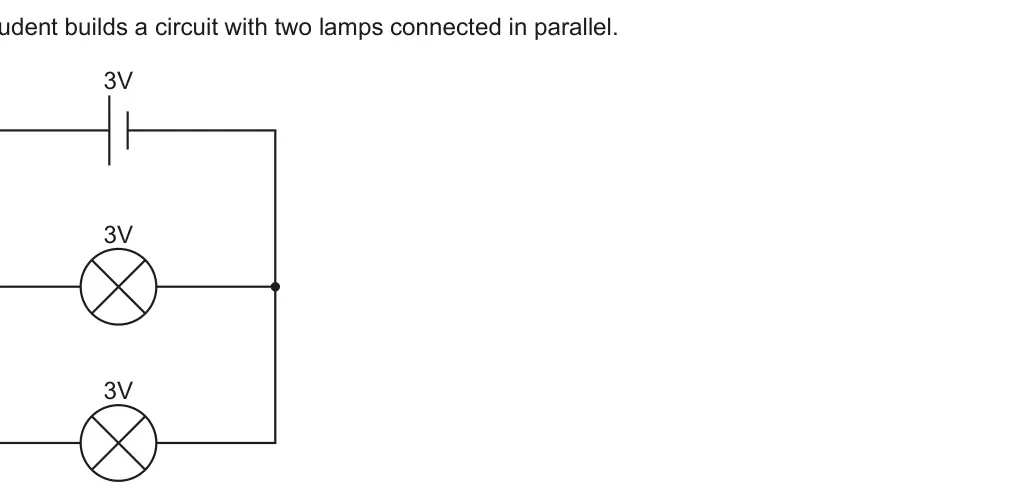
Q1(a)(ii)
The whole paper ↗Q1(b)
The whole paper ↗Q5(a)
The whole paper ↗
Q5(b)
The whole paper ↗Q3(a)
The whole paper ↗
Q3(c)
The whole paper ↗Q3(d)
The whole paper ↗Q8(b)(i)
The whole paper ↗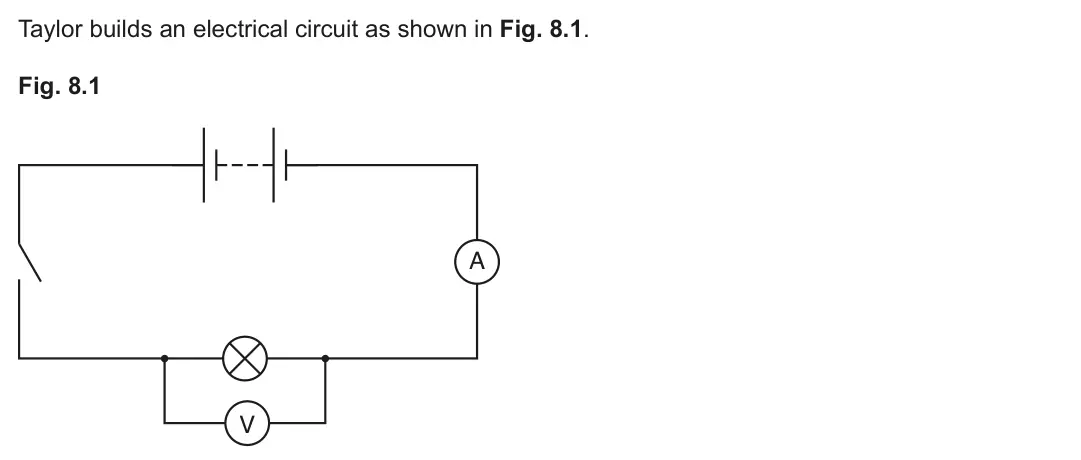
Q8(b)(ii)
The whole paper ↗Q8(c)(i)
The whole paper ↗Q8(c)(ii)
The whole paper ↗Q7(a)(iii)
The whole paper ↗Q11(c)(iii)
The whole paper ↗
All 40 questions on How do series and parallel circuits work?, as a list
- June 2025, Paper 1 Foundation, Q4(b)(ii) (1 mark): When the bike lights and USB charger are each operating at 5 V, what is the potential difference across the power supply from the device? Potential difference =
- June 2025, Paper 2 Foundation, Q6(b)(i) (2 marks): Which two statements about the parallel circuit in Fig. 6.2 are true? Tick (✓) two boxes. The current in R1 is bigger than R2. The potential difference across R
- June 2025, Paper 2 Foundation, Q6(b)(ii) (3 marks): Calculate the total current in the circuit in Fig. 6.2. • The potential difference across the cell is 3 V. • The total resistance in the circuit is 1.5 Ω. Use t
- June 2025, Paper 4 Higher, Q6(a)(ii) (4 marks): Show that the reading on the ammeter in the circuit in Fig. 6.1 is less than 0.25 A. • The potential difference across the battery is 12 V. • The resistance of
- June 2025, Paper 4 Higher, Q6(b)(i) (2 marks): Calculate the current in R1 in the circuit in Fig. 6.2. Current = A [2]
- June 2025, Paper 4 Higher, Q6(b)(ii) (2 marks): Explain why the reading on the ammeter in the parallel circuit in Fig. 6.2 is greater than the reading on the ammeter in the series circuit in Fig. 6.1. [2]
- June 2024, Paper 1 Foundation, Q1(a)(i) (1 mark): What feature of the circuit makes it a parallel circuit? Tick (3) one box. It has a 3 V cell. It has branches. It has two identical lamps. [1]
- June 2024, Paper 1 Foundation, Q1(a)(ii) (1 mark): A third lamp is now connected in parallel. What happens to the brightness of the original lamps? Tick (3) one box. Lamps get brighter. Lamps get dimmer. Lamps s
- June 2024, Paper 1 Foundation, Q1(b) (1 mark): The student now uses the same equipment to build a circuit with all three lamps in series. Which circuit diagram shows this circuit? Tick (3) one box. [1]
- June 2024, Paper 3 Higher, Q5(a) (2 marks): The student makes the circuits shown in the diagram. They observe the brightness of the lamps in each circuit and compare them by ranking them from brightest to
- June 2024, Paper 3 Higher, Q5(b) (3 marks): Explain how you expect the brightness to change as the number of lamps in the circuit increases. [3]
- June 2023, Paper 1 Foundation, Q3(a) (1 mark): Which statement is correct? Tick (3) one box. Current splits at branches in a parallel circuit. Potential difference across each component in a branch is the sa
- June 2023, Paper 1 Foundation, Q3(c) (2 marks): The student builds a second circuit as shown in Fig. 3.2. Fig. 3.2 2 Ω X Y 2 Ω Which two statements together explain why the overall resistance between points X
- June 2023, Paper 1 Foundation, Q3(d) (2 marks): Finally, the student builds the circuit shown in Fig. 3.3. The lamp lights up in darkness and does not shine in daylight. Fig. 3.3 Daylight Darkness 6 V 6 V 2 V
- June 2023, Paper 2 Foundation, Q8(b)(i) (2 marks): How do the readings on the ammeter and voltmeter change when the second lamp is added? Put a ring around the correct options. The reading on the ammeter increas
- June 2023, Paper 2 Foundation, Q8(b)(ii) (3 marks): Explain why the lamps are dimmer in Fig. 8.2 compared to the single lamp in Fig. 8.1. [3]
- June 2023, Paper 2 Foundation, Q8(c)(i) (1 mark): Draw a circuit diagram of two lamps in parallel that Taylor can use in his investigation. [1]
- June 2023, Paper 2 Foundation, Q8(c)(ii) (1 mark): What happens to the brightness of each lamp when a third lamp is added in parallel? Put a ring around the correct option. The brightness of each lamp increases
- June 2023, Paper 3 Higher, Q7(a)(iii) (2 marks): Each train runs from its own parallel loop of the circuit. One train draws a current of 200 A. Calculate the maximum number of trains that could operate from th
- June 2023, Paper 3 Higher, Q11(c)(iii) (3 marks): The LED has a resistance of 50 Ω. Calculate the total current flowing through the cell when both switches are closed. Use the equation: potential difference = c
- June 2022, Paper 2 Foundation, Q2(a) (1 mark): Which circuit will have the greatest current flowing through its wires? Tick (3) one box. A B C D [1]
- June 2022, Paper 2 Foundation, Q2(b)(i) (1 mark): Which two circuits will have the same current flowing through the resistors? Tick (3) two boxes. A B C D [1]
- June 2022, Paper 2 Foundation, Q2(b)(ii) (2 marks): Explain your answer to (b)(i). Use the equation: current = potential difference to help. resistance [2]
- June 2022, Paper 3 Higher, Q13(a) (1 mark): The switch is closed. Show that the potential difference across each LED is 3.5 V. [1]
- June 2022, Paper 3 Higher, Q13(c) (3 marks): Fig. 13.3 shows how the intensity of light from each LED is related to the current. 1.5 1 relative intensity 0.5 0 0 5 10 15 20 25 current (mA) Fig. 13.3 Layla
- November 2021, Paper 3 Higher, Q6(b)(i) (3 marks): Calculate the work done on an electron when it moves across a potential difference of 50 000 V. The charge on an electron is 1.6 × 10⁻¹⁹ C. Work done = J [3]
- November 2021, Paper 3 Higher, Q6(b)(ii) (1 mark): Suggest how the energy of the X-rays could be increased. [1]
- November 2020, Paper 4 Higher, Q5(d) (3 marks): Amaya wants to investigate the effect of adding another coil of wire connected in parallel. She sets up the circuit in Fig. 5.2. Fig. 5.2 Amaya The ammeter read
- June 2019, Paper 1 Foundation, Q1(c)(i) (2 marks): Who got the expected results? Amaya Li Explain your answer. [2]
- June 2019, Paper 1 Foundation, Q1(c)(ii) (1 mark): Amaya thinks her results are different to Li’s because something is wrong with the ammeters. Suggest how Amaya could check if there is something wrong with the
- June 2019, Paper 2 Foundation, Q7(b) (2 marks): Nina connects up the following circuit using two identical filament lamps. A switch Fig. 7.2 The switch is currently open. Explain what happens to the ammeter r
- June 2019, Paper 3 Higher, Q6(a) (4 marks): The resistance of each bulb is 2800 Ω. Calculate the current in Circuit A. Give your answer to 2 significant figures. Current = A [4]
- June 2019, Paper 3 Higher, Q6(b)(i) (2 marks): Describe and explain how the brightness of the lamps in Circuit A compares to the brightness of the lamps in Circuit B. [2]
- June 2019, Paper 3 Higher, Q6(b)(ii) (1 mark): Justify which circuit is most suitable for use in the torch. [1]
- June 2018, Paper 2 Foundation, Q8(b)(i) (3 marks): Calculate the current in the circuit. Current = A [3]
- June 2018, Paper 2 Foundation, Q8(b)(ii) (3 marks): Calculate the potential difference across the fixed 10 kΩ resistor when the illuminance is 30 lux. Potential difference = V [3]
- June 2018, Paper 2 Foundation, Q8(b)(iii) (3 marks): Describe, without any calculations, how the potential difference across the fixed resistor will change when the illuminance increases from 30 lux to 100 lux. [3
- June 2018, Paper 4 Higher, Q1(b)(i) (3 marks): Calculate the current in the circuit. Current = A [3]
- June 2018, Paper 4 Higher, Q1(b)(ii) (3 marks): Calculate the potential difference across the fixed 10 kΩ resistor when the illuminance is 30 lux. Potential difference = V [3]
- June 2018, Paper 4 Higher, Q1(b)(iii) (3 marks): Describe, without any calculations, how the potential difference across the fixed resistor will change when the illuminance increases from 30 lux to 100 lux. [3
Questions, mark schemes and examiner’s reports are © OCR, from their published past papers. Plumi isn’t affiliated with any exam board. Want whole papers? Every OCR GCSE Physics B paper.
Rather write your answers by hand on iPad? Plumi marks them against the same mark schemes.