 plumi
What happens during photosynthesis?: OCR GCSE Biology B questions
Every OCR GCSE Biology B exam question on B3.1 What happens during photosynthesis?, 2018–2025, with its mark scheme and examiner’s report.
Paper
All papers
Exam
All years
Calculations
Q4(c)
The whole paper ↗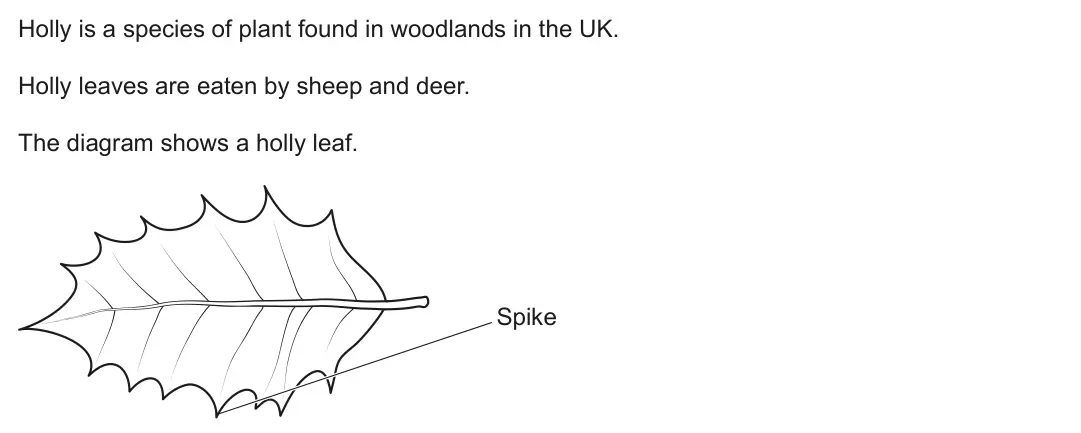
Q7(a)(i)
The whole paper ↗
Q9(c)
The whole paper ↗
Q2(c)
The whole paper ↗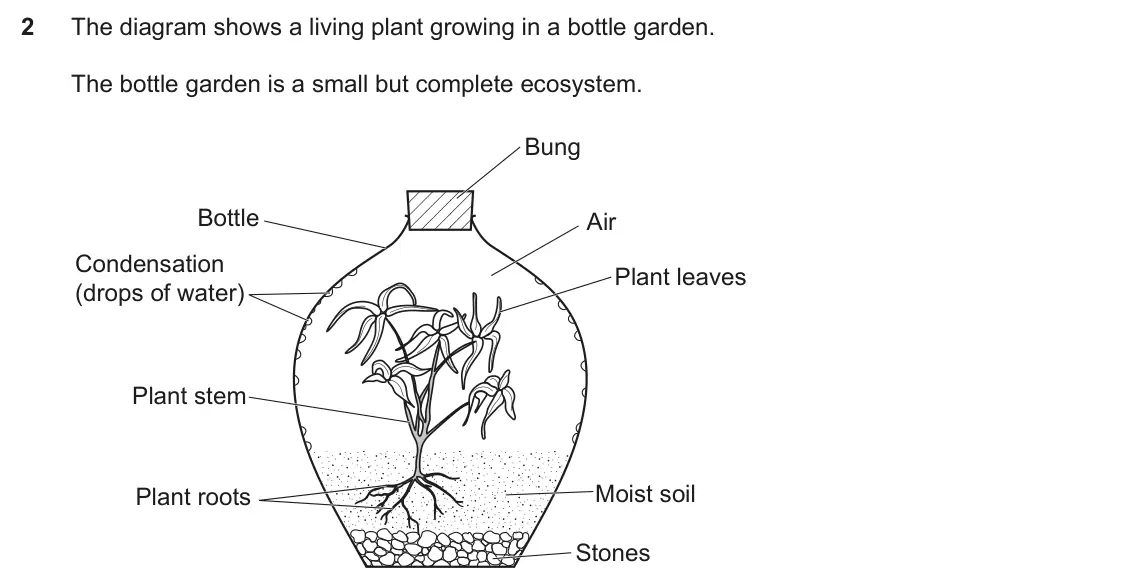
Q3(e)
The whole paper ↗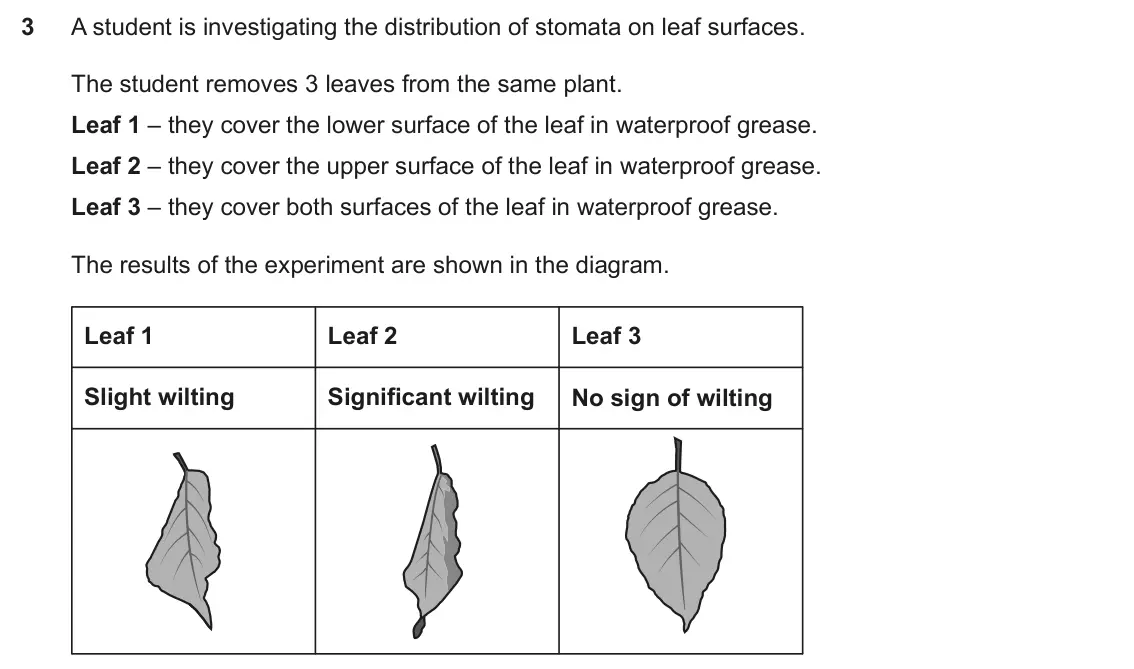
Q10(a)(i)
The whole paper ↗
Q10(a)(ii)
The whole paper ↗Q10(b)
The whole paper ↗Q1(a)(i)
The whole paper ↗
Q1(a)(ii)
The whole paper ↗Q1(b)
The whole paper ↗Q4(a)
The whole paper ↗Q4(b)
The whole paper ↗Q7(a)
The whole paper ↗
Q7(c)
The whole paper ↗Q11(c)
The whole paper ↗
Q2(a)
The whole paper ↗
Q2(c)
The whole paper ↗Q6(c)(i)
The whole paper ↗
Q6(c)(ii)
The whole paper ↗
All 90 questions on What happens during photosynthesis?, as a list
- June 2025, Paper 1 Foundation, Q4(c) (2 marks): Holly bushes do not lose their leaves in winter. The leaves stay green all year round. Explain how this is an advantage to the plant. [2]
- June 2025, Paper 1 Foundation, Q7(a)(i) (3 marks): Complete the sentences to explain why the organism was not decomposed. Use words from the list. active site breathe photosynthesise product respire substrate Th
- June 2025, Paper 2 Foundation, Q9(c) (1 mark): The bottle allows light to pass through it. Explain why this is essential for the plant to survive. [1]
- June 2025, Paper 4 Higher, Q2(c) (1 mark): The bottle allows light to pass through it. Explain why this is essential for the plant to survive. [1]
- June 2024, Paper 1 Foundation, Q3(e) (1 mark): Which process in plants uses water as a reactant? Tick (✓) one box. Photosynthesis Reproduction Respiration [1]
- June 2024, Paper 1 Foundation, Q10(a)(i) (3 marks): Fig. 10.1 shows the equipment the student sets up. Fig. 10.1 Table lamp Bubbles Pondweed Water Describe the method the student will use with the equipment in Fi
- June 2024, Paper 1 Foundation, Q10(a)(ii) (2 marks): Fig. 10.2 shows a different set of equipment that can be used. Fig. 10.2 A second student suggests that the equipment shown in Fig. 10.2 will improve the invest
- June 2024, Paper 1 Foundation, Q10(b) (1 mark): Fig. 10.3 shows the effect of changing the light intensity on the rate of photosynthesis. Fig. 10.3 B Rate of photosynthesis A Light intensity Which section or
- June 2024, Paper 3 Higher, Q1(a)(i) (3 marks): Fig. 1.1 shows the equipment the student sets up. Fig. 1.1 Table lamp Bubbles Pondweed Water Describe the method the student will use with the equipment in Fig.
- June 2024, Paper 3 Higher, Q1(a)(ii) (2 marks): Fig. 1.2 shows a different set of equipment that can be used. Fig. 1.2 A second student suggests that the equipment shown in Fig. 1.2 will improve the investiga
- June 2024, Paper 3 Higher, Q1(b) (1 mark): Fig. 1.3 shows the effect of changing the light intensity on the rate of photosynthesis. Fig. 1.3 B Rate of photosynthesis A Light intensity Which section or se
- June 2023, Paper 1 Foundation, Q4(a) (4 marks): Complete the sentences to describe the process of photosynthesis. Use words from the list. carbon dioxide chloroplast glucose hydrogen oxygen water In the first
- June 2023, Paper 1 Foundation, Q4(b) (1 mark): The glucose produced by plants can be stored as a large carbohydrate. What is the name of this carbohydrate? Tick (3) one box. Fat Glycerol Protein Starch [1]
- June 2023, Paper 2 Foundation, Q7(a) (1 mark): Complete the sentences about the processes that take place in chloroplasts and mitochondria. Use words from the list. cellular respiration meiosis photosynthesi
- June 2023, Paper 2 Foundation, Q7(c) (6 marks): Plant cells in the leaf of a tree contain chloroplasts and mitochondria. (c)* There are two trees growing next to a building. • Tree A is growing on the sunny s
- June 2023, Paper 3 Higher, Q11(c) (2 marks): Explain why photosynthetic organisms are the source of all biomass on Earth. [2]
- June 2023, Paper 4 Higher, Q2(a) (1 mark): Complete the sentences about the processes that take place in chloroplasts and mitochondria. Use words from the list. cellular respiration meiosis photosynthesi
- June 2023, Paper 4 Higher, Q2(c) (6 marks): Plant cells in the leaf of a tree contain chloroplasts and mitochondria. (c)* There are two trees growing next to a building. • Tree A is growing on the sunny s
- June 2023, Paper 4 Higher, Q6(c)(i) (2 marks): The scientist plans to control the temperature of the solutions by leaving them in the same room. Describe a better way to control the temperature of each solut
- June 2023, Paper 4 Higher, Q6(c)(ii) (2 marks): The scientist makes sure that: • the same type of enzyme is taken from each soil sample • the same concentration of enzyme is used in each solution • the same s
- June 2023, Paper 4 Higher, Q6(d) (1 mark): What was the optimum pH for the enzyme from sample A? Optimum pH = [1]
- June 2023, Paper 4 Higher, Q6(e)(i) (1 mark): What was the maximum rate of reaction for the enzyme from sample B? Maximum rate of reaction = arbitrary units [1]
- June 2023, Paper 4 Higher, Q6(e)(ii) (4 marks): Describe and explain the general trend in the results for the enzyme from sample B. [4]
- June 2023, Paper 4 Higher, Q6(f) (3 marks): The scientist thinks a mutation must have happened in the fungi in the soil in sample C. Describe how this mutation could have caused the results for sample C.
- June 2023, Paper 4 Higher, Q6(g) (2 marks): The scientist concludes that the enzyme works best in alkaline soil. Give evidence for and against the scientist’s conclusion. For Against [2]
- June 2022, Paper 1 Foundation, Q13(b) (1 mark): Which process reacts water with carbon dioxide in plant cells? Tick (3) one box. Active transport Cellular respiration Photosynthesis Transpiration [1]
- June 2022, Paper 2 Foundation, Q4(b) (4 marks): The cells that make up the cutting’s leaves contain chloroplasts and mitochondria. Explain how chloroplasts and mitochondria enable the cutting to grow. Chlorop
- June 2022, Paper 3 Higher, Q2(b) (1 mark): Which process reacts water with carbon dioxide in plant cells? Tick (v) one box. Active transport Cellular respiration Photosynthesis Transpiration [1]
- June 2022, Paper 3 Higher, Q10(a) (3 marks): Use ideas of the lock and key model to describe how the enzymes break down different biological molecules found in the prey so they can be absorbed. [3]
- June 2022, Paper 3 Higher, Q10(b) (2 marks): Explain why several types of enzymes are secreted by the plant. [2]
- June 2022, Paper 4 Higher, Q2(a) (2 marks): The sea slugs eat algae. The slugs take chloroplasts from the algae cells. The chloroplasts stay inside the slugs and continue to work. Suggest why it is an adv
- June 2022, Paper 4 Higher, Q5(a)(i) (1 mark): State the name of the reagent used to test for starch. [1]
- June 2022, Paper 4 Higher, Q5(a)(ii) (2 marks): Describe a conclusion that can be made from the result of test 2 for plant B. [2]
- June 2022, Paper 4 Higher, Q5(a)(iii) (3 marks): Predict the result of test 2 for plant A. Explain your prediction. Prediction Explanation [3]
- June 2022, Paper 4 Higher, Q5(a)(iv) (2 marks): Stores of starch can be broken down to make glucose. Suggest how this helps to explain the result of test 1 for plant A. [2]
- June 2022, Paper 4 Higher, Q5(a)(v) (2 marks): Suggest why it is helpful to keep the three plants in the dark for two days at the start of the experiment (step 1). [2]
- June 2022, Paper 4 Higher, Q5(a)(vi) (2 marks): Sam predicts that test 2 for plant C would show no starch was present. However, the test shows that starch is present. Describe and explain one improvement to t
- June 2022, Paper 4 Higher, Q5(b)(i) (1 mark): At which time point were the concentrations of oxygen and carbon dioxide exactly the same? Time point [1]
- June 2022, Paper 4 Higher, Q5(b)(ii) (1 mark): Between which two time points is the line for oxygen represented by the equation y = mx + c? Time points and [1]
- June 2022, Paper 4 Higher, Q5(b)(iii) (6 marks): Photosynthesis takes place in plants. (iii)* A student concludes that time point D is sunset. Describe and explain how Fig. 5.3 supports the student’s conclusio
- November 2021, Paper 1 Foundation, Q5(a) (1 mark): Which reagent would be used to test for starch? Tick (3) one box. Benedict’s Biuret Iodine [1]
- November 2021, Paper 1 Foundation, Q5(b) (1 mark): A positive test for starch results in the reagent turning black/blue. Shade the leaf in Fig. 5.2 to show the area that would turn black/blue. Fig. 5.2 [1]
- November 2021, Paper 1 Foundation, Q5(c) (2 marks): Complete the sentences to explain why the student placed the plant in the dark for a day, in Step 1 of their method. Put a ring around the correct answers. The
- November 2021, Paper 1 Foundation, Q5(d) (1 mark): The student was investigating only one factor that is required in photosynthesis. Which one factor was being investigated? [1]
- November 2021, Paper 1 Foundation, Q9(a)(i) (2 marks): Amir uses a beaker to measure out the hydrogen peroxide solution. Suggest one piece of equipment that Amir could use instead of a beaker and why this would impr
- November 2021, Paper 1 Foundation, Q9(a)(ii) (2 marks): Describe how Amir could use the equipment in Fig. 9.1 to investigate the effect of enzyme concentration on the rate of this reaction. [2]
- November 2021, Paper 1 Foundation, Q9(b) (2 marks): Temperature is one variable that needs to be controlled in this experiment. State two other variables that would need to be controlled. Variable 1 Variable 2 [2
- November 2021, Paper 1 Foundation, Q9(c)(i) (1 mark): What is the optimum temperature for catalase? °C [1]
- November 2021, Paper 1 Foundation, Q9(c)(ii) (1 mark): How could this investigation be improved to find a more accurate optimum temperature? [1]
- November 2021, Paper 1 Foundation, Q9(d) (1 mark): Enzyme molecules start to become denatured at temperatures above the optimum temperature. What was the lowest temperature at which all of the catalase molecules
- November 2021, Paper 2 Foundation, Q6(a)(ii) (3 marks): Photosynthesis took place in the two plants. Fig. 6.2 shows a summary of photosynthesis. Light Oxygen Water Photosynthesis Glucose Carbon dioxide Fig. 6.2 The s
- November 2021, Paper 2 Foundation, Q6(c)(iii) (2 marks): Jamal suggests a conclusion for the class experiment. Jamal The plant gained all of that mass because it took in soil. Explain why Jamal is wrong. Use data from
- November 2021, Paper 2 Foundation, Q6(c)(iv) (2 marks): Sundip suggests a different conclusion. Sundip The plant’s mass increased because it took in carbon dioxide as well as water. Suggest why Sundip’s conclusion is
- November 2021, Paper 3 Higher, Q10(a) (3 marks): Describe how body temperature affects the rate of reactions catalysed by enzymes. [3]
- November 2021, Paper 3 Higher, Q10(b) (2 marks): The graph shows the effect of temperature on the rate of reaction for the enzyme catalase. 4 3 Rate of reaction (arbitrary units 2 / second) 1 0 0 10 20 30 40 T
- November 2021, Paper 3 Higher, Q13(a) (2 marks): Write the balanced symbol equation for photosynthesis. + + [2]
- November 2021, Paper 3 Higher, Q13(b) (2 marks): A student investigates the effect of light intensity on the rate of photosynthesis. They set up a test tube containing pond weed in water at different distances
- November 2021, Paper 3 Higher, Q13(c) (4 marks): The graph shows how different factors affect the rate of photosynthesis. C 30 °C Rate of photosynthesis 20 °C B (arbitrary units) A Light intensity (arbitrary u
- November 2021, Paper 4 Higher, Q7(e)(i) (3 marks): Explain why the rate shown in Fig. 7.3 was highest at the optimum temperature of approximately 23.5 °C but was lower at temperatures below and above the optimum
- November 2020, Paper 3 Higher, Q7(b)(ii) (3 marks): It has been suggested that if you put the onions in freezing cold water or hot water before cutting the onion, it may reduce the quantity of substance B that ca
- November 2020, Paper 3 Higher, Q8(a)(i) (3 marks): Which three conclusions can be drawn from the graph? Tick (✓) three boxes. All plant types can photosynthesise over the same range of temperatures. For all plan
- November 2020, Paper 3 Higher, Q8(a)(ii) (2 marks): Explain why temperature affects the rate of photosynthesis. [2]
- November 2020, Paper 3 Higher, Q8(b) (4 marks): Describe the two main stages of photosynthesis and the role of chloroplasts in this process. [4]
- June 2019, Paper 1 Foundation, Q6(b)(i) (1 mark): Over which period of time did the plant photosynthesise? From to [1]
- June 2019, Paper 1 Foundation, Q6(b)(ii) (1 mark): During which period of time was the rate of photosynthesis greater than the rate of respiration? From to [1]
- June 2019, Paper 1 Foundation, Q6(b)(iii) (1 mark): A ‘compensation point’ is a point where the rate of photosynthesis is the same as the rate of respiration. On the graph place an X to show a compensation point.
- June 2019, Paper 1 Foundation, Q7(d)(i) (3 marks): Use the ‘Lock and Key’ model to describe how the enzyme converts the sucrose into two separate sugars. [3]
- June 2019, Paper 1 Foundation, Q7(d)(ii) (2 marks): A student investigates the effect of temperature on the rate of the reaction catalysed by the enzyme invertase. What effect will increasing the temperature have
- June 2019, Paper 2 Foundation, Q2(d) (2 marks): The students conclude that the plant is a real living plant. Use evidence from the students’ investigations to support this conclusion. [2]
- June 2019, Paper 2 Foundation, Q6(b) (2 marks): Temperature is the variable that Eve will change. Write down one variable that Eve should control and describe how she could control it. [2]
- June 2019, Paper 2 Foundation, Q6(c)(i) (2 marks): Eve decides to repeat the experiment at 45 °C so that she can take new measurements at this temperature. Use evidence from Fig. 6.2 to justify Eve’s decision. [
- June 2019, Paper 2 Foundation, Q6(c)(ii) (2 marks): Here are Eve’s new measurements. Volume of gas collected (mm3) Temperature (°C) Repeat 1 Repeat 2 Repeat 3 45 354 360 351 Use Eve’s new measurements to complete
- June 2019, Paper 2 Foundation, Q6(d) (3 marks): Describe the trend in the data shown in the graph in Fig. 6.3. Use data from Fig. 6.3 to support your answer. [3]
- June 2019, Paper 2 Foundation, Q6(e) (2 marks): The volume of gas collected changed as the temperature changed. Calculate the change in volume per degree between 35 °C and 40 °C. Change in volume per degree =
- June 2019, Paper 4 Higher, Q1(a) (1 mark): Put one tick in each row of the table to show the function of each plant structure. Function Transports Carries out the Transports Plant structure sugars made b
- June 2019, Paper 4 Higher, Q1(b) (2 marks): Temperature is the variable that Eve will change. Write down one variable that Eve should control and describe how she could control it. [2]
- June 2019, Paper 4 Higher, Q1(c)(i) (2 marks): Eve decides to repeat the experiment at 45 °C so that she can take new measurements at this temperature. Use evidence from Fig. 1.2 to justify Eve’s decision. [
- June 2019, Paper 4 Higher, Q1(c)(ii) (2 marks): Here are Eve’s new measurements. Volume of gas collected (mm3) Temperature (°C) Repeat 1 Repeat 2 Repeat 3 45 354 360 351 Use Eve’s new measurements to complete
- June 2019, Paper 4 Higher, Q1(d) (3 marks): Describe the trend in the data shown in the graph in Fig. 1.3. Use data from Fig. 1.3 to support your answer. [3]
- June 2019, Paper 4 Higher, Q1(e) (2 marks): The volume of gas collected changed as the temperature changed. Calculate the change in volume per degree between 35 °C and 40 °C. Change in volume per degree =
- June 2019, Paper 4 Higher, Q7(a)(i) (3 marks): Use the graph to explain why it is important for the human body to maintain a constant internal temperature of 37 °C. [3]
- June 2019, Paper 4 Higher, Q7(a)(ii) (2 marks): Scientists have found single-celled organisms called thermophiles living around hot vents on the sea floor. Thermophiles cannot control their temperature. The c
- June 2019, Paper 4 Higher, Q7(b) (4 marks): Scientists have been studying two different enzymes in invertebrates. • Both enzymes break down the same substrate. • The shape of the active site of each enzym
- June 2018, Paper 1 Foundation, Q8(b)(i) (1 mark): In which cell structure does photosynthesis take place? [1]
- June 2018, Paper 1 Foundation, Q8(b)(ii) (1 mark): Many factors can limit the rate of photosynthesis. Which factor will not limit the rate of photosynthesis in the algae? Put a ring around the correct answer. ca
- June 2018, Paper 2 Foundation, Q4(a)(i) (1 mark): Which statement about enzymes is true? Tick (✓) one box. An enzyme blocks a chemical reaction. An enzyme recognizes many different substrates. An enzyme speeds
- June 2018, Paper 2 Foundation, Q4(a)(ii) (1 mark): Warfarin blocks the active site of the blood clotting enzyme. The diagram represents a molecule of warfarin. part of molecule that fits into enzyme’s active sit
- June 2018, Paper 3 Higher, Q1(b)(i) (1 mark): In which cell structure does photosynthesis take place? [1]
- June 2018, Paper 3 Higher, Q1(b)(ii) (1 mark): Many factors can limit the rate of photosynthesis. Which factor will not limit the rate of photosynthesis in the algae? Put a ring around the correct answer. ca
- June 2018, Paper 4 Higher, Q2(d)(ii) (3 marks): Eve repeats experiment 3, but this time she boils the amylase before using it. Write a testable prediction for this repeat of experiment 3. Explain the science
Questions, mark schemes and examiner’s reports are © OCR, from their published past papers. Plumi isn’t affiliated with any exam board. Want whole papers? Every OCR GCSE Biology B paper.
Rather write your answers by hand on iPad? Plumi marks them against the same mark schemes.