 plumi
How do producers get the substances they need?: OCR GCSE Biology B questions
Every OCR GCSE Biology B exam question on B3.2 How do producers get the substances they need?, 2018–2025, with its mark scheme and examiner’s report.
Paper
All papers
Exam
All years
Calculations
Q4(d)
The whole paper ↗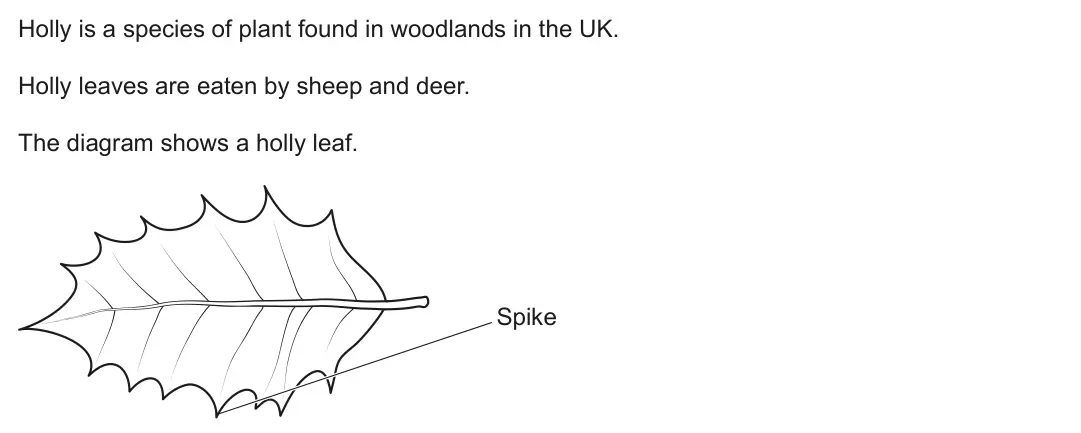
Q4(e)
The whole paper ↗
Q4(f)
The whole paper ↗Q4(a)
The whole paper ↗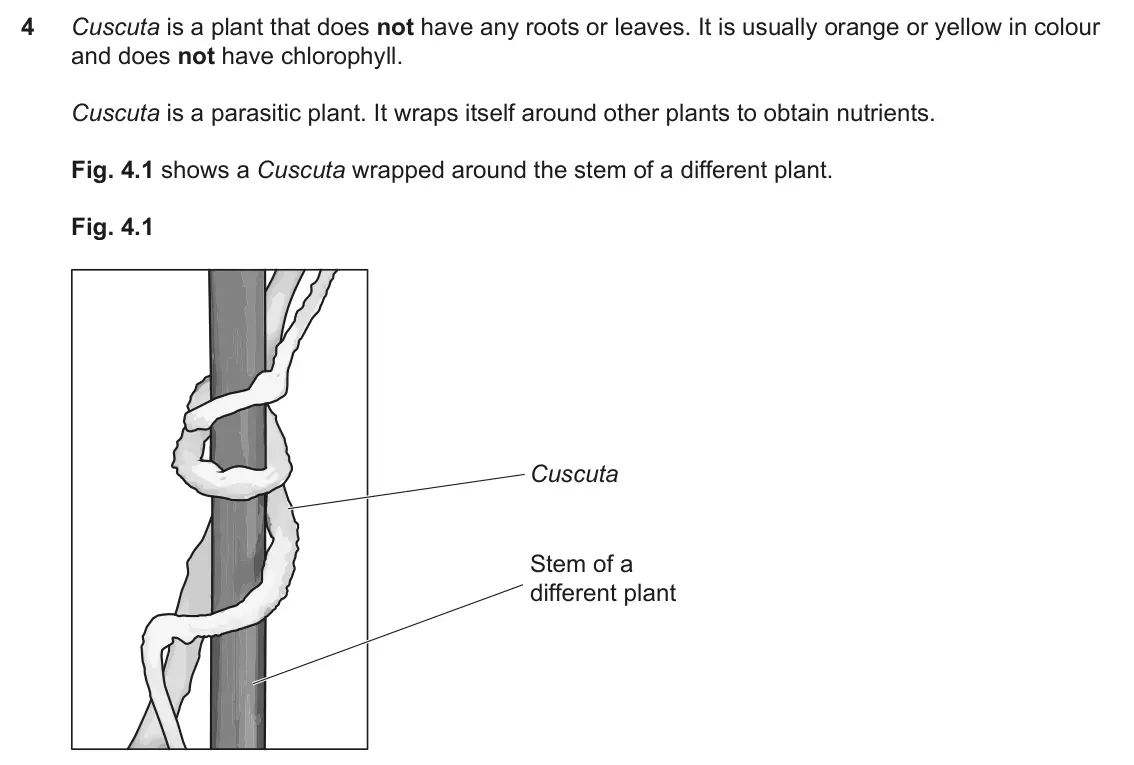
Q4(b)
The whole paper ↗Q4(c)
The whole paper ↗Q4(d)(i)
The whole paper ↗Q4(d)(ii)
The whole paper ↗Q4(e)
The whole paper ↗Q5(b)(i)
The whole paper ↗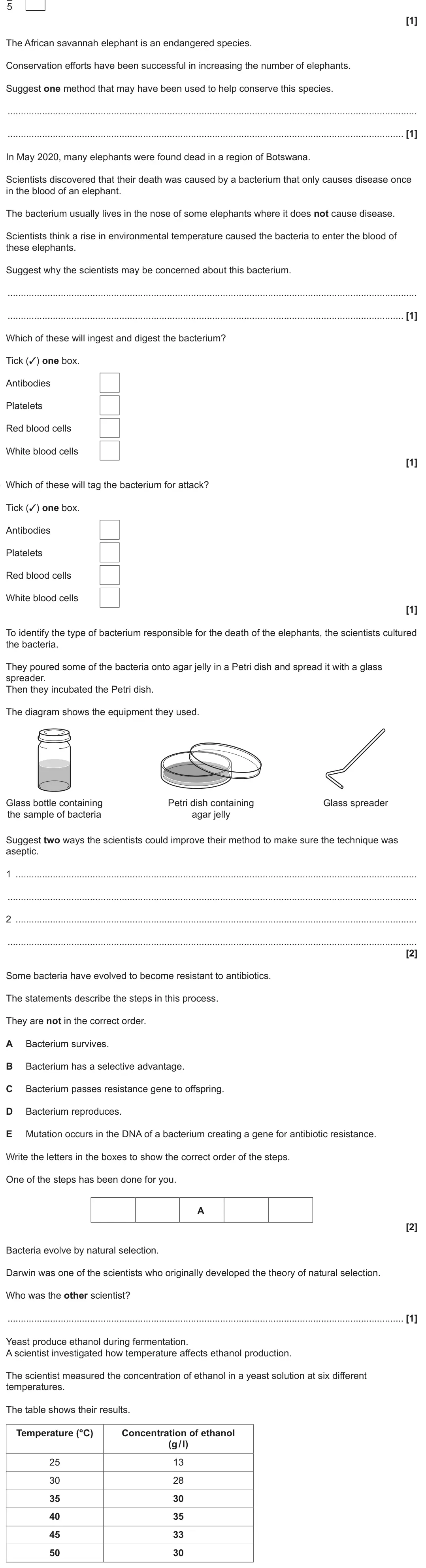
Q4(c)(ii)
The whole paper ↗
Q4(e)
The whole paper ↗Q4(f)
The whole paper ↗Q6(c)
The whole paper ↗
Q9(c)(ii)
The whole paper ↗
Q3(a)
The whole paper ↗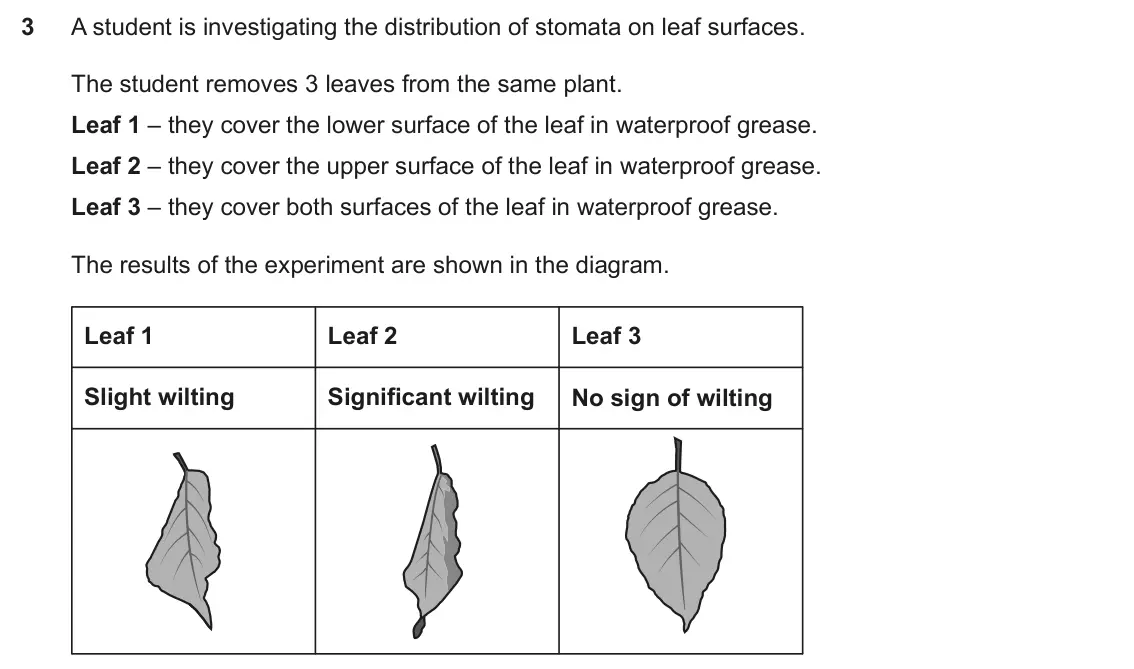
Q3(b)
The whole paper ↗Q3(c)
The whole paper ↗Q3(d)
The whole paper ↗Q3(f)
The whole paper ↗
All 109 questions on How do producers get the substances they need?, as a list
- June 2025, Paper 1 Foundation, Q4(d) (1 mark): Which vessel in the holly plant transports water and mineral ions to the leaf? Tick (✓) one box. Artery Capillary Phloem Xylem [1]
- June 2025, Paper 2 Foundation, Q4(e) (1 mark): The student produces estimates of the total number of stomata present on the top side and underside of five leaves from the same plant. The table shows their re
- June 2025, Paper 2 Foundation, Q4(f) (1 mark): Fig. 4.4 shows one of the stomata observed with a more powerful microscope. Fig. 4.4 A B C D Which part is a guard cell? Tick (3) one box. A B C D [1]
- June 2025, Paper 3 Higher, Q4(a) (1 mark): Explain why Cuscuta attaches to the xylem of the plant it wraps around. [1]
- June 2025, Paper 3 Higher, Q4(b) (3 marks): Explain why Cuscuta tries to attach to the phloem of the plant it wraps around. [3]
- June 2025, Paper 3 Higher, Q4(c) (1 mark): Plants with leaves lose water from their leaves by transpiration. Name the structure that allows water to move out of leaves, into the air. [1]
- June 2025, Paper 3 Higher, Q4(d)(i) (1 mark): Name the apparatus shown in Fig. 4.2. [1]
- June 2025, Paper 3 Higher, Q4(d)(ii) (2 marks): Which two measurements need to be taken to determine the rate of water uptake from the cut shoot? 1 2 [2]
- June 2025, Paper 3 Higher, Q4(e) (2 marks): Which of these environmental factors will result in a low transpiration rate and which will result in a high transpiration rate? Tick (✓) one box in each row. L
- June 2025, Paper 3 Higher, Q5(b)(i) (1 mark): Which of these describes how a plant absorbs the nitrates from the soil? Tick (✓) one box. Active transport Diffusion Osmosis Translocation [1]
- June 2025, Paper 4 Higher, Q4(c)(ii) (3 marks): The student counts 243 stomata in Fig. 4.2. The stomatal density is the number of stomata per mm2 of leaf. Calculate the stomatal density of the piece of leaf i
- June 2025, Paper 4 Higher, Q4(e) (2 marks): Light causes stomata to open. Explain why it is an advantage for the plant that its stomata open in the light. [2]
- June 2025, Paper 4 Higher, Q4(f) (1 mark): Suggest one advantage to the plant that its stomata close when it gets dark, rather than staying open all night. [1]
- June 2025, Paper 4 Higher, Q6(c) (2 marks): Crown gall disease kills plants because it damages phloem and xylem tissue. Complete the table to show what is transported in each type of tissue. Put one or mo
- June 2025, Paper 4 Higher, Q9(c)(ii) (4 marks): Microalgae are single-cellular organisms. Scientists predict the microalgae will die out if the two lakes join. Explain why the scientists have made this predic
- June 2024, Paper 1 Foundation, Q3(a) (1 mark): Which conclusion can be made from the results of the investigation? Tick (✓) one box. There are no stomata on the lower surface of the leaf. There are less stom
- June 2024, Paper 1 Foundation, Q3(b) (2 marks): Explain why leaf 3 did not wilt. [2]
- June 2024, Paper 1 Foundation, Q3(c) (2 marks): Describe a control experiment you could perform alongside this experiment. Method Expected result [2]
- June 2024, Paper 1 Foundation, Q3(d) (2 marks): Which statements about stomata are true and which are false? Tick (✓) one box in each row. True False Mineral ions move into the leaf via the stomata. Stomata a
- June 2024, Paper 1 Foundation, Q3(f) (1 mark): Which structure transports water up the plant? [1]
- June 2024, Paper 2 Foundation, Q6(a) (2 marks): Draw a line from each substance to its use in plants. Substance Use Carbon dioxide Cellular respiration Nitrogen Making proteins (from nitrate mineral ions) Oxy
- June 2024, Paper 2 Foundation, Q6(b)(i) (1 mark): Which term best describes the cell membrane of the root hair cell? Tick (✓) one box. Fully-permeable Non-permeable Partially-permeable [1]
- June 2024, Paper 2 Foundation, Q6(b)(ii) (2 marks): The shape of the root hair cell from the plant extends out into the soil. Explain why this shape is helpful to the plant after the student waters it. [2]
- June 2024, Paper 2 Foundation, Q6(b)(iii) (4 marks): The plant takes in water for photosynthesis. Complete the sentences to explain how water is taken into the root hair cell. Use words from the list. active trans
- June 2024, Paper 2 Foundation, Q6(b)(iv) (3 marks): ATP is made during cellular respiration. ATP is used to move nitrate mineral ions from the fertiliser mixture through the cell membrane into the root hair cell.
- June 2024, Paper 3 Higher, Q4(a) (2 marks): Explain why applying waterproof grease to both sides of the leaf prevented wilting. [2]
- June 2024, Paper 3 Higher, Q4(b) (2 marks): The student looks at the results and writes this conclusion: ‘Stomata are located on both surfaces of the leaf, but there are more stomata on the lower surface
- June 2024, Paper 3 Higher, Q4(c) (1 mark): Which structure brings water to the leaf from the roots? [1]
- June 2024, Paper 4 Higher, Q7(a) (3 marks): Complete the table to describe the substances taken into a plant and the processes they are used for. Substance taken in Process it is used for in a plant Water
- June 2024, Paper 4 Higher, Q7(b)(i) (2 marks): Calculate the percentage increase in mass of the plant. Assume that its mass increased by 5 g. Percentage increase in mass = % [2]
- June 2024, Paper 4 Higher, Q7(b)(ii) (2 marks): The actual mass of the plant in the evening is 51 g. Suggest why the mass of the plant only increased by 1 g even though it took up 5 g of water. [2]
- June 2024, Paper 4 Higher, Q7(d) (1 mark): Plants take in nitrate and water through the cell membrane of root hair cells. The diagram shows one root hair cell. Which statement about the cell membrane of
- June 2024, Paper 4 Higher, Q7(e)(i) (3 marks): What will happen to the amount of nitrate taken into this root hair cell? Explain your answer. [3]
- June 2024, Paper 4 Higher, Q7(e)(ii) (2 marks): What will happen to the amount of water taken into this root hair cell? Explain your answer. [2]
- June 2023, Paper 2 Foundation, Q6(a) (1 mark): Draw lines to connect the description of each tissue with its correct name. One has been done for you. Description Name Tissue A Capillary transports water from
- June 2023, Paper 3 Higher, Q9(a) (2 marks): Plot the data for plant B on the graph. [2]
- June 2023, Paper 3 Higher, Q9(b) (2 marks): Calculate the rate of water loss for plant A. Rate of water loss cm3 / min [2]
- June 2023, Paper 3 Higher, Q9(c) (1 mark): What conclusion can be made from the data? [1]
- June 2023, Paper 3 Higher, Q9(d) (2 marks): Explain why an increase in temperature will increase the transpiration rate for both species of plant. [2]
- June 2023, Paper 4 Higher, Q1(a) (1 mark): Draw lines to connect the description of each tissue with its correct name. One has been done for you. Description Name Tissue A Capillary transports water from
- June 2022, Paper 1 Foundation, Q10(a) (3 marks): Put sentences A to E in the correct order to describe how Kai can use the equipment in the diagram to measure transpiration rate. One has been done for you. A C
- June 2022, Paper 1 Foundation, Q10(b) (3 marks): Kai thinks temperature affects the rate of transpiration. Describe how Kai could use the equipment in the diagram to investigate the effect of temperature on th
- June 2022, Paper 1 Foundation, Q10(c) (1 mark): Name the vessel that transports sugars in plants. [1]
- June 2022, Paper 1 Foundation, Q13(c) (1 mark): Name the vessel in a plant that transports water up the stem. [1]
- June 2022, Paper 2 Foundation, Q4(a) (4 marks): The cutting takes in substances from its surroundings to stay alive. Complete the table to describe the substances taken into the cutting and what they are used
- June 2022, Paper 3 Higher, Q2(c) (1 mark): Name the vessel in a plant that transports water up the stem. • [1]
- June 2022, Paper 3 Higher, Q6(a) (2 marks): Describe how Kai can use the potometer he has set up to investigate the rate of transpiration in a plant. [2]
- June 2022, Paper 3 Higher, Q6(b) (3 marks): Kai wants to compare the rate of transpiration in cut shoots from two species of plant. He uses the potometer to investigate one of the species, and then repeat
- June 2022, Paper 3 Higher, Q6(c) (3 marks): Kai finds that the rate of transpiration is different for the two species. He thinks this could be due to a difference in the number of stomata on the leaves of
- June 2022, Paper 4 Higher, Q6(a) (1 mark): Which statement explains why the cell membrane of the root hair cell is described as “partially permeable”? Tick (3) one box. Both water molecules and nitrate i
- June 2022, Paper 4 Higher, Q6(b) (3 marks): Explain how water molecules are absorbed into the root hair cell from wet soil. [3]
- June 2022, Paper 4 Higher, Q6(c) (3 marks): Explain how nitrate ions are absorbed into the root hair cell from the soil. [3]
- June 2022, Paper 4 Higher, Q6(d) (2 marks): Explain why the structure of cell A means it is better than cell B at absorbing substances from the soil. [2]
- November 2021, Paper 1 Foundation, Q10(b) (1 mark): Plants obtain important substances from their environment. Which list of elements must plants obtain from the environment? Tick (3) one box. Carbon, hydrogen, a
- November 2021, Paper 2 Foundation, Q6(a)(i) (2 marks): Identify two other factors that the scientist should have tried to keep the same for both plants. 1. 2. [2]
- November 2021, Paper 2 Foundation, Q6(a)(ii) (3 marks): Photosynthesis took place in the two plants. Fig. 6.2 shows a summary of photosynthesis. Light Oxygen Water Photosynthesis Glucose Carbon dioxide Fig. 6.2 The s
- November 2021, Paper 2 Foundation, Q6(b)(i) (2 marks): Water was added to the soil in the pot several times each week. The total amount of water added to the soil in each 7-day week was 280 ml. Calculate the rate at
- November 2021, Paper 2 Foundation, Q6(b)(ii) (1 mark): The rate at which water is added to the soil is not an accurate measurement of the rate at which the plant takes up the water. Which piece of apparatus could be
- November 2021, Paper 2 Foundation, Q6(c)(i) (1 mark): What was the mass of the pot and soil at the end of the year, using Fig. 6.4? Mass = g [1]
- November 2021, Paper 2 Foundation, Q6(c)(ii) (2 marks): The mass of the plant was 30g at the start of the year. The mass of the plant was 156 g at the end of the year. Calculate the percentage change in the mass of t
- November 2021, Paper 2 Foundation, Q8(b)(i) (6 marks): Substances move into and out of plant cells. A student investigated how the mass of raw pieces of potato is affected by soaking them in water containing differe
- November 2021, Paper 2 Foundation, Q8(b)(ii) (2 marks): Complete the graph by adding the missing axis name and plotting the missing results. [2]
- November 2021, Paper 2 Foundation, Q8(b)(iii) (4 marks): Describe and explain the results of the investigation. Use data from the graph to support your answer. [4]
- November 2021, Paper 2 Foundation, Q8(b)(iv) (2 marks): Estimate the concentration of sugar inside the potato cells, using the graph. Use the equation: concentration = mass volume Give your answer in g / cm3. Concent
- November 2021, Paper 3 Higher, Q1(b) (1 mark): Plants obtain important substances from their environment. Which list of elements must plants obtain from the environment? Tick (3) one box. Carbon, hydrogen, a
- November 2021, Paper 4 Higher, Q1(b)(i) (6 marks): Substances move into and out of plant cells. A student investigated how the mass of raw pieces of potato is affected by soaking them in water containing differe
- November 2021, Paper 4 Higher, Q1(b)(ii) (2 marks): Complete the graph by adding the missing axis name and plotting the missing results. [2]
- November 2021, Paper 4 Higher, Q1(b)(iii) (4 marks): Describe and explain the results of the investigation. Use data from the graph to support your answer. [4]
- November 2021, Paper 4 Higher, Q1(b)(iv) (2 marks): Estimate the concentration of sugar inside the potato cells, using the graph. Use the equation: concentration = mass volume Give your answer in g / cm3. Concent
- November 2020, Paper 1 Foundation, Q4(c)(ii) (2 marks): Which two statements, when taken together, explain why plants that grow in waterlogged soil may obtain fewer nutrients from the soil? Tick (✓) two boxes. Active
- November 2020, Paper 1 Foundation, Q9(a) (5 marks): Draw a line to connect each diagram to the name of the structure and its role in the plant. Diagram Name of the structure Role in the plant Absorbs water and Xy
- November 2020, Paper 2 Foundation, Q5(a)(i) (1 mark): What is the name of the tissue in the tree that the mistletoe takes sugars from? •[1]
- November 2020, Paper 2 Foundation, Q5(a)(ii) (1 mark): Process A transports sugars into the tissue in the tree. What is the name of process A? Put a (ring) around the correct answer. translocation transpiration [1]
- November 2020, Paper 2 Foundation, Q5(a)(iii) (1 mark): Process B transports water into the tissue in the tree. What is the name of process B? Put a (ring) around the correct answer. translocation transpiration [1] a
- November 2020, Paper 2 Foundation, Q5(b)(i) (1 mark): What is the name of the tissue in the tree that the mistletoe takes water from? • [1]
- November 2020, Paper 2 Foundation, Q5(b)(ii) (4 marks): Explain why water moves through this tissue from the roots to the leaves in a normal tree. . [4]
- November 2020, Paper 3 Higher, Q7(b)(i) (1 mark): Suggest which type of cell absorbs sulfate mineral ions from the soil. [1]
- November 2020, Paper 4 Higher, Q4(a)(i) (1 mark): What is the name of the tissue in the tree that the mistletoe takes water from? [1]
- November 2020, Paper 4 Higher, Q4(a)(ii) (4 marks): Explain why water moves through this tissue from the roots to the leaves in a normal tree. [4]
- November 2020, Paper 4 Higher, Q4(a)(iii) (1 mark): Suggest one other substance that the mistletoe could take from this tissue in the tree. [1]
- November 2020, Paper 4 Higher, Q4(b)(i) (4 marks): Process A and process B move substances into the phloem tube. Describe process A and process B. In your answer you should include: • the names of the processes
- November 2020, Paper 4 Higher, Q4(b)(ii) (3 marks): Explain how sugars are moved along a phloem tube. [3]
- November 2020, Paper 4 Higher, Q4(b)(iii) (2 marks): The phloem tube is made of living cells, but these cells do not have any mitochondria. Explain why they depend on the companion cells, which do have mitochondri
- June 2019, Paper 1 Foundation, Q6(a) (2 marks): Carbon dioxide and water are needed by plant cells for photosynthesis. These substances need to be transported into the cells. Draw a line from each substance t
- June 2019, Paper 1 Foundation, Q6(c) (3 marks): Plants need magnesium to make chlorophyll. One of Amy’s plants is not getting enough magnesium from the soil. It is shorter than the other plants. Explain why n
- June 2019, Paper 2 Foundation, Q6(a) (1 mark): Put one tick in each row of the table to show the function of each plant structure. Function Transports Carries out the Transports Plant structure sugars made b
- June 2019, Paper 3 Higher, Q4(b)(i) (1 mark): Put a ring around the letter, A, B, C, D or E, in the diagram which shows the process of [1] transpiration.
- June 2019, Paper 3 Higher, Q4(b)(ii) (1 mark): Describe the effect deforestation will have on the amount of transpiration. [1]
- June 2019, Paper 4 Higher, Q4(a)(i) (1 mark): Complete the labelling of the photograph. [1]
- June 2019, Paper 4 Higher, Q4(b)(iv) (2 marks): Suggest why the density of stomata in this field of view may not be the same as the density of stomata over the whole leaf surface. [2]
- June 2019, Paper 4 Higher, Q4(c) (4 marks): Explain the advantages and disadvantages for a plant of opening its stomata. [4]
- June 2019, Paper 4 Higher, Q7(a)(iii) (3 marks): The seawater around the vent has a very high concentration of salt. Describe and explain how this could affect the single-celled thermophiles. [3]
- June 2018, Paper 2 Foundation, Q5(a) (2 marks): Explain why nitrate ions are essential for plant growth and survival. [2]
- June 2018, Paper 2 Foundation, Q5(b)(i) (2 marks): State the names of structures A and B. A B [2]
- June 2018, Paper 2 Foundation, Q5(b)(ii) (2 marks): Explain the roles of A and B in transporting nitrate ions into the root hair cell. A B [2]
- June 2018, Paper 2 Foundation, Q5(b)(iii) (2 marks): The shape of the root hair cell is an adaptation. Explain how this adaptation helps the root hair cell to absorb nitrate ions more effectively. [2]
- June 2018, Paper 2 Foundation, Q5(c) (4 marks): The root hair cells also absorb water from the soil. Complete the sentences below to describe how water is transported through a plant. Choose the correct words
- June 2018, Paper 2 Foundation, Q5(d) (6 marks): Nina is learning about substances absorbed by plants. She finds out that plants absorb nitrate ions from the soil. (d)* Nina wants to investigate how changing t
- June 2018, Paper 3 Higher, Q4(d) (1 mark): State the function of stomata in plants. [1]
- June 2018, Paper 4 Higher, Q1(b)(i) (2 marks): State the names of structures A and B. A B [2]
- June 2018, Paper 4 Higher, Q1(b)(ii) (2 marks): Explain the roles of A and B in transporting nitrate ions into the root hair cell. A B [2]
- June 2018, Paper 4 Higher, Q1(b)(iii) (2 marks): The shape of the root hair cell is an adaptation. Explain how this adaptation helps the root hair cell to absorb nitrate ions more effectively. [2]
- June 2018, Paper 4 Higher, Q1(c) (4 marks): The root hair cells also absorb water from the soil. Complete the sentences below to describe how water is transported through a plant. Choose the correct words
- June 2018, Paper 4 Higher, Q1(d) (6 marks): Nina is learning about substances absorbed by plants. She finds out that plants absorb nitrate ions from the soil. (d)* Nina wants to investigate how changing t
- June 2018, Paper 4 Higher, Q2(a) (1 mark): What is the purpose of the thermometer? Tick (✓) one box. To control the temperature. To record the temperature. To measure the temperature. To stir the solutio
- June 2018, Paper 4 Higher, Q2(b) (1 mark): Eve wants to do each of her three experiments at exactly 30 °C. Describe how Eve could ensure the temperatures of the solutions in each experiment are kept at e
- June 2018, Paper 4 Higher, Q2(c) (2 marks): Describe how she could test each sample for the presence of glucose. [2]
- June 2018, Paper 4 Higher, Q2(d)(i) (4 marks): What conclusions can you make from Eve’s results? [4]
- June 2018, Paper 4 Higher, Q2(e) (4 marks): Eve sets up one more experiment as shown in Table 2.3. Experiment Solution inside the tube Solution outside the tube 4 starch + tap water tap water + iodine sol
Questions, mark schemes and examiner’s reports are © OCR, from their published past papers. Plumi isn’t affiliated with any exam board. Want whole papers? Every OCR GCSE Biology B paper.
Rather write your answers by hand on iPad? Plumi marks them against the same mark schemes.