 plumi
How are populations affected by conditions in an ecosystem?: OCR GCSE Biology B questions
Every OCR GCSE Biology B exam question on B3.4 How are populations affected by conditions in an ecosystem?, 2018–2025, with its mark scheme and examiner’s report.
Paper
All papers
Exam
All years
Calculations
Q2(b)(i)
The whole paper ↗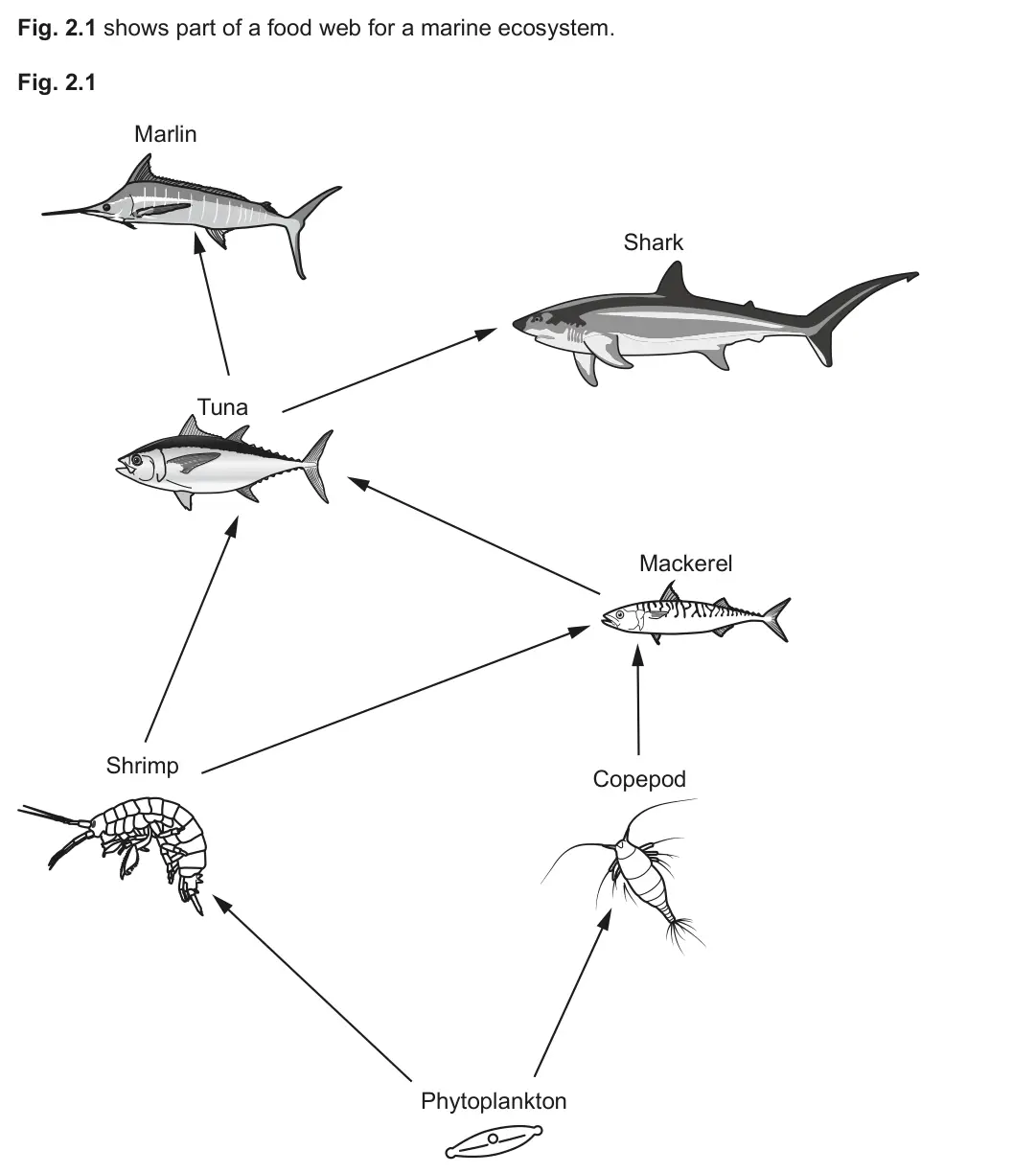
Q2(b)(ii)
The whole paper ↗Q4(a)(i)
The whole paper ↗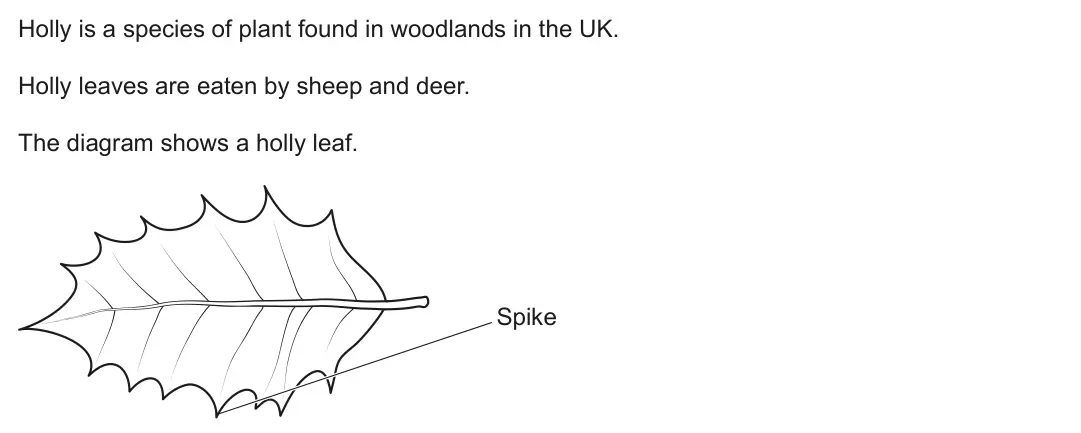
Q4(a)(ii)
The whole paper ↗Q4(b)(i)
The whole paper ↗Q4(b)(ii)
The whole paper ↗Q4(b)(iii)
The whole paper ↗Q9(a)
The whole paper ↗
Q4(d)(i)
The whole paper ↗
Q4(d)(ii)
The whole paper ↗Q4(d)(iii)
The whole paper ↗Q4(d)(iv)
The whole paper ↗Q9(a)
The whole paper ↗
Q9(b)
The whole paper ↗Q1(a)
The whole paper ↗
Q3(c)
The whole paper ↗
Q3(d)
The whole paper ↗Q2(a)
The whole paper ↗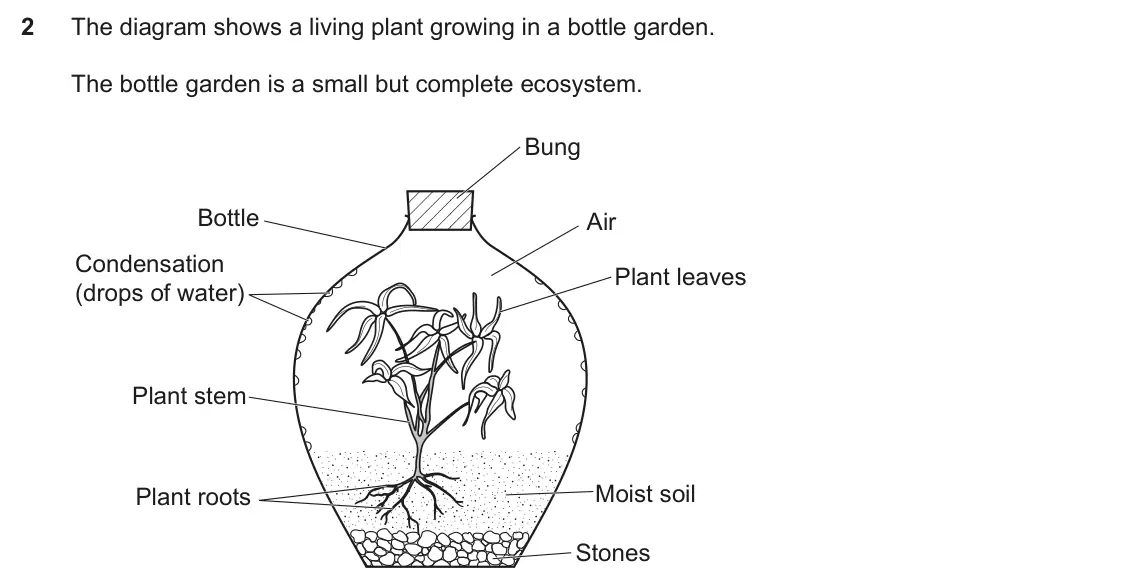
Q2(b)
The whole paper ↗Q4(c)(iii)
The whole paper ↗
All 80 questions on How are populations affected by conditions in an ecosystem?, as a list
- June 2025, Paper 1 Foundation, Q2(b)(i) (2 marks): Complete the food chain to show how the mercury that enters the body of a copepod can enter a tuna fish. Phytoplankton Copepod [2]
- June 2025, Paper 1 Foundation, Q2(b)(ii) (2 marks): Mackerel, marlin and tuna will accumulate different amounts of mercury in their bodies. Write these three fish in order from the one that contains the most merc
- June 2025, Paper 1 Foundation, Q4(a)(i) (3 marks): Calculate the mean number of spikes for the holly leaves shown in Table 4.1. Give your answer to the nearest whole number. Mean = [3]
- June 2025, Paper 1 Foundation, Q4(a)(ii) (1 mark): State the mode for the number of spikes on the holly leaves shown in Table 4.1. Mode = [1]
- June 2025, Paper 1 Foundation, Q4(b)(i) (1 mark): Describe the pattern shown by the results in Table 4.2. [1]
- June 2025, Paper 1 Foundation, Q4(b)(ii) (1 mark): Suggest an explanation for the pattern shown by the data in Table 4.2. [1]
- June 2025, Paper 1 Foundation, Q4(b)(iii) (1 mark): Describe how the student could investigate whether the results are repeatable. [1]
- June 2025, Paper 1 Foundation, Q9(a) (1 mark): 130 000 of these elephants live in Botswana, a country in southern Africa. Which of these is the closest approximation to the fraction of African savannah eleph
- June 2025, Paper 2 Foundation, Q4(d)(i) (2 marks): Calculate the area of the piece of leaf shown in Fig. 4.2. Area = mm2 [2]
- June 2025, Paper 2 Foundation, Q4(d)(ii) (1 mark): Fig. 4.3 shows the underside of the leaf on a grid. Each square of the grid measures 1 cm × 1 cm. Fig. 4.3 Estimate the surface area of the underside of the lea
- June 2025, Paper 2 Foundation, Q4(d)(iii) (2 marks): Describe how the student can produce an estimate of the total number of stomata on the underside of the leaf without counting all of them. [2]
- June 2025, Paper 2 Foundation, Q4(d)(iv) (1 mark): Explain one benefit of producing an estimate of the total number of stomata on a leaf rather than counting all of them. [1]
- June 2025, Paper 2 Foundation, Q9(a) (1 mark): Which part of the bottle garden ecosystem is biotic? Tick (3) one box. Condensation Plant Soil water Stones [1]
- June 2025, Paper 2 Foundation, Q9(b) (1 mark): Explain why the air in the bottle is an abiotic part of the ecosystem. [1]
- June 2025, Paper 3 Higher, Q1(a) (1 mark): 130 000 of these elephants live in Botswana, a country in southern Africa. Which of these is the closest approximation to the fraction of African savannah eleph
- June 2025, Paper 3 Higher, Q3(c) (1 mark): There is plenty of water and oxygen in the ocean so the shrimp do not need to compete for these. The shrimp do need to compete for food. State one other factor
- June 2025, Paper 3 Higher, Q3(d) (3 marks): Mercury is a heavy metal that can enter the water. People are advised not to eat large amounts of tuna due to the quantity of mercury found in these fish. Expla
- June 2025, Paper 4 Higher, Q2(a) (1 mark): Which part of the bottle garden ecosystem is biotic? Tick (3) one box. Condensation Plant Soil water Stones [1]
- June 2025, Paper 4 Higher, Q2(b) (1 mark): Explain why the air in the bottle is an abiotic part of the ecosystem. [1]
- June 2025, Paper 4 Higher, Q4(c)(iii) (2 marks): Describe how the student could produce an estimate of the total number of stomata on one side of the leaf. [2]
- June 2025, Paper 4 Higher, Q4(c)(iv) (1 mark): Suggest one benefit of producing an estimate of the total number of stomata rather than counting all of them. [1]
- June 2025, Paper 4 Higher, Q9(c)(ii) (4 marks): Microalgae are single-cellular organisms. Scientists predict the microalgae will die out if the two lakes join. Explain why the scientists have made this predic
- June 2024, Paper 1 Foundation, Q8(d) (1 mark): Squirrels that inhabit Canada are starting to emerge from hibernation early. These squirrels are producing sperm that cannot swim. What effect will this have on
- June 2024, Paper 2 Foundation, Q2(b)(i) (2 marks): Describe the change in hedgehog population size shown in the table. [2]
- June 2024, Paper 2 Foundation, Q2(b)(ii) (1 mark): Assume the trend in the change in population continues. Which of these is the best prediction of the hedgehog population in 2025? Put a ring around the correct
- June 2024, Paper 2 Foundation, Q2(b)(iii) (2 marks): In the countryside, hedgehogs live and hide from predators underneath hedges. Since 1955, many hedges have been removed by farmers. Explain how this could have
- June 2024, Paper 2 Foundation, Q2(c) (2 marks): People who live in some towns have created ‘hedgehog highways’. These are small holes in garden fences that hedgehogs can fit through, but foxes cannot. Suggest
- June 2024, Paper 2 Foundation, Q8(a) (6 marks): The diagram shows some different species of flowers that grow in a field. Crocus Snowdrop Daisy Grass A student wants to estimate the total number of snowdrops
- June 2024, Paper 2 Foundation, Q8(b) (2 marks): Use the student’s data to calculate the mean number of snowdrops per small square. Mean number of snowdrops per small square = [2]
- June 2024, Paper 2 Foundation, Q8(c) (2 marks): The area of the field is 600 m2. The area of each small square is 0.25 m2. Calculate the number of small squares that fit in the field. Number of small squares
- June 2024, Paper 2 Foundation, Q8(d) (1 mark): Estimate the total number of snowdrops in the field. Use the equation: total number mean number of snowdrops number of small squares of snowdrops = × per small
- June 2024, Paper 2 Foundation, Q8(e) (1 mark): Suggest one reason why we can only estimate the number of snowdrops in the field from the student’s data. [1]
- June 2024, Paper 2 Foundation, Q8(f) (1 mark): The student thinks their estimate is not very close to the true number of snowdrops in the field. Suggest one way to improve the data collection to get a better
- June 2024, Paper 4 Higher, Q2(a) (6 marks): The diagram shows some different species of flowers that grow in a field. Crocus Snowdrop Daisy Grass A student wants to estimate the total number of snowdrops
- June 2024, Paper 4 Higher, Q2(b) (2 marks): Use the student’s data to calculate the mean number of snowdrops per small square. Mean number of snowdrops per small square = [2]
- June 2024, Paper 4 Higher, Q2(c) (2 marks): The area of the field is 600 m2. The area of each small square is 0.25 m2. Calculate the number of small squares that fit in the field. Number of small squares
- June 2024, Paper 4 Higher, Q2(d) (1 mark): Estimate the total number of snowdrops in the field. Use the equation: total number mean number of snowdrops number of small squares of snowdrops = × per small
- June 2024, Paper 4 Higher, Q2(e) (1 mark): Suggest one reason why we can only estimate the number of snowdrops in the field from the student’s data. [1]
- June 2024, Paper 4 Higher, Q2(f) (1 mark): The student thinks their estimate is not very close to the true number of snowdrops in the field. Suggest one way to improve the data collection to get a better
- June 2023, Paper 2 Foundation, Q5(a)(ii) (2 marks): Humans are chopping down trees in which the swordbill hummingbird lives. This could cause a large decrease in the size of the swordbill population. Explain how
- June 2022, Paper 1 Foundation, Q5(a) (1 mark): Describe the overall trend in the data from 2003 to 2013. [1]
- June 2022, Paper 1 Foundation, Q5(b) (1 mark): Which of the following could be a reason for the change in breeding pair numbers? Tick (3) one box. There are no predators. There is a more favourable climate.
- June 2022, Paper 1 Foundation, Q5(c)(i) (2 marks): What percentage of burrows had puffin chicks that hatched? Percentage = % [2]
- June 2022, Paper 1 Foundation, Q5(c)(ii) (1 mark): Use the data in the pie chart to calculate how many chicks would survive if there were 40 000 breeding pairs of puffins. Put a ring around the correct answer. 2
- June 2022, Paper 1 Foundation, Q8(a)(i) (2 marks): Describe the trend shown by the data in Fig. 8.2. [2]
- June 2022, Paper 1 Foundation, Q8(a)(ii) (2 marks): Coral reef is a habitat for many populations of fish. Suggest how a population of fish may be affected by the trend shown in the graph. Give a reason for your s
- June 2022, Paper 1 Foundation, Q8(a)(iii) (2 marks): The loss of live coral can be a result of an increase in water temperature. Predict what will happen to this coral reef in the future. Give a reason for your an
- June 2022, Paper 4 Higher, Q3(a) (1 mark): The number of Gentoo penguins on the islands is decreasing. Suggest one factor that could have caused the decrease in the number of Gentoo penguins. [1]
- November 2021, Paper 2 Foundation, Q2(b)(i) (2 marks): The mice that were brought to the island were a new predator for the albatross. The new predator has caused the size of the albatross population to decrease. De
- November 2021, Paper 2 Foundation, Q2(b)(iii) (2 marks): The table shows how many albatross were counted on the island in five squares measuring 1 km2 each, in 2020. Square 1 2 3 4 5 Number of albatross 32 64 50 79 60
- November 2021, Paper 2 Foundation, Q2(b)(iv) (2 marks): Scientists have estimated that: In 1980, the mean number of albatross per km2 of the island was 1429. • In 2000, the mean number of albatross per km2 of the isl
- November 2020, Paper 1 Foundation, Q9(c)(i) (1 mark): Count how many stomata can be seen in the field of view. • [1] Number of stomata =
- November 2020, Paper 1 Foundation, Q9(c)(ii) (1 mark): The area covered by the field of view is approximately 1 mm2. The total area of the underside of the leaf is 60mm2. Estimate how many stomata there will be on t
- November 2020, Paper 1 Foundation, Q9(c)(iii) (2 marks): Sarah does not think that her sample was representative of the whole leaf. Suggest how Sarah could improve her method. [2]
- November 2020, Paper 1 Foundation, Q9(c)(iv) (1 mark): If the sample taken was not representative of the leaf, what impact would this have on Sarah's estimate? [1]
- November 2020, Paper 1 Foundation, Q11(a) (1 mark): Explain why scientists can only estimate how many humpback whales there are. [1]
- November 2020, Paper 1 Foundation, Q11(c) (2 marks): Current estimates of population size suggest that the number of humpback whales may not be increasing. Suggest two possible reasons for this. 1 2 [2]
- November 2020, Paper 1 Foundation, Q11(e) (3 marks): Whales migrate each year to breeding grounds. On average, the distance travelled is 5000 km and they travel at an average speed of 1.6 km per hour. Calculate ho
- November 2020, Paper 3 Higher, Q2(a) (1 mark): Explain why scientists can only estimate how many humpback whales there are. [1]
- November 2020, Paper 3 Higher, Q2(c) (2 marks): Current estimates of population size suggest that the number of humpback whales may not be increasing. Suggest two possible reasons for this. 1 2 [2]
- November 2020, Paper 3 Higher, Q2(e) (3 marks): Whales migrate each year to breeding grounds. On average, the distance travelled is 5000 km and they travel at an average speed of 1.6 km per hour. Calculate ho
- June 2019, Paper 1 Foundation, Q5(b)(i) (1 mark): The PCBs increased in concentration in the bodies of organisms higher up the food chain. Which word describes this process? Put a ring around the correct answer
- June 2019, Paper 2 Foundation, Q3(b)(iv) (4 marks): Plastic litter in the sea breaks down into very small pieces of plastic. Fish cannot tell the difference between very small pieces of plastic, phytoplankton and
- June 2019, Paper 2 Foundation, Q3(b)(v) (2 marks): Humans eat fish caught from the North Sea. Explain why very small pieces of plastic in the North Sea could be dangerous for humans. [2]
- June 2019, Paper 3 Higher, Q9(b)(i) (3 marks): Use your knowledge of food chains to explain how the PCBs bioaccumulated. [3]
- June 2019, Paper 3 Higher, Q9(b)(ii) (1 mark): Scientists have worked out that the quantity of PCBs required to damage marine mammal health is 9 mg / kg. The dead killer whale’s blubber (fat) was analysed. T
- June 2019, Paper 3 Higher, Q9(b)(iii) (2 marks): Whale calves feed on their mother’s milk for 11 months. The milk is high in fat. Suggest why scientists are concerned about the effect of PCBs on the whale popu
- June 2019, Paper 4 Higher, Q3(c) (3 marks): Explain why plastic litter in the sea could cause a decrease in the numbers of fish. [3]
- June 2019, Paper 4 Higher, Q3(d)(i) (4 marks): Some people think we should put the bacteria in the North Sea to break down plastic litter. Suggest and explain how this could put the North Sea ecosystem at ev
- June 2018, Paper 1 Foundation, Q8(c)(ii) (2 marks): The length of the marine iguana is determined by measuring the distance from the snout to the end of the tail. Below is a drawing of a marine iguana. snout tail
- June 2018, Paper 1 Foundation, Q8(c)(iii) (1 mark): Some marine iguanas can shrink by up to 20% of their original length. Calculate the length of this marine iguana after maximum shrinkage. Length after maximum s
- June 2018, Paper 1 Foundation, Q8(c)(iv) (2 marks): What can be concluded from the data? Tick (3) two boxes. The marine iguanas that decreased in size the least survived longer. The change in body length made no
- June 2018, Paper 1 Foundation, Q9(a) (4 marks): Describe a method the student could use to determine the population size of woodlice. [4]
- June 2018, Paper 1 Foundation, Q9(b) (2 marks): Woodlice are often found under logs and bark where it is damp. Suggest why woodlice prefer damp places. [2]
- June 2018, Paper 2 Foundation, Q2(d)(ii) (2 marks): Write down two ways in which use of neonics could have caused a decrease in the numbers of birds. 1 2 [2]
- June 2018, Paper 3 Higher, Q1(c)(ii) (2 marks): The length of the marine iguana is determined by measuring the distance from the snout to the end of the tail. Below is a drawing of a marine iguana. snout tail
- June 2018, Paper 3 Higher, Q1(c)(iii) (1 mark): Some marine iguanas can shrink by up to 20% of their original length. Calculate the length of this marine iguana after maximum shrinkage. Length after maximum s
- June 2018, Paper 3 Higher, Q1(c)(iv) (2 marks): What can be concluded from the data? Tick (3) two boxes. The marine iguanas that decreased in size the least survived longer. The change in body length made no
- June 2018, Paper 3 Higher, Q2(a) (4 marks): Describe a method the student could use to determine the population size of woodlice. [4]
- June 2018, Paper 3 Higher, Q2(b) (2 marks): Woodlice are often found under logs and bark where it is damp. Suggest why woodlice prefer damp places. [2]
Questions, mark schemes and examiner’s reports are © OCR, from their published past papers. Plumi isn’t affiliated with any exam board. Want whole papers? Every OCR GCSE Biology B paper.
Rather write your answers by hand on iPad? Plumi marks them against the same mark schemes.