 plumi
What happens during cellular respiration?: OCR GCSE Biology B questions
Every OCR GCSE Biology B exam question on B4.1 What happens during cellular respiration?, 2018–2025, with its mark scheme and examiner’s report.
Paper
All papers
Exam
All years
Calculations
Q10(a)(i)
The whole paper ↗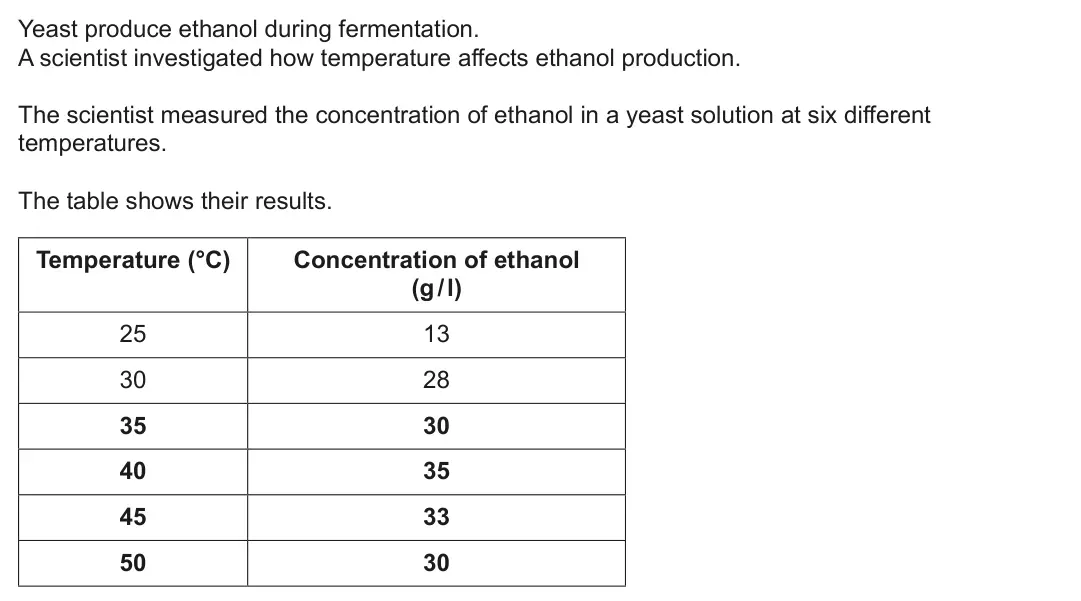
Q10(a)(ii)
The whole paper ↗Q10(b)
The whole paper ↗Q10(c)
The whole paper ↗Q10(d)
The whole paper ↗Q2(a)(i)
The whole paper ↗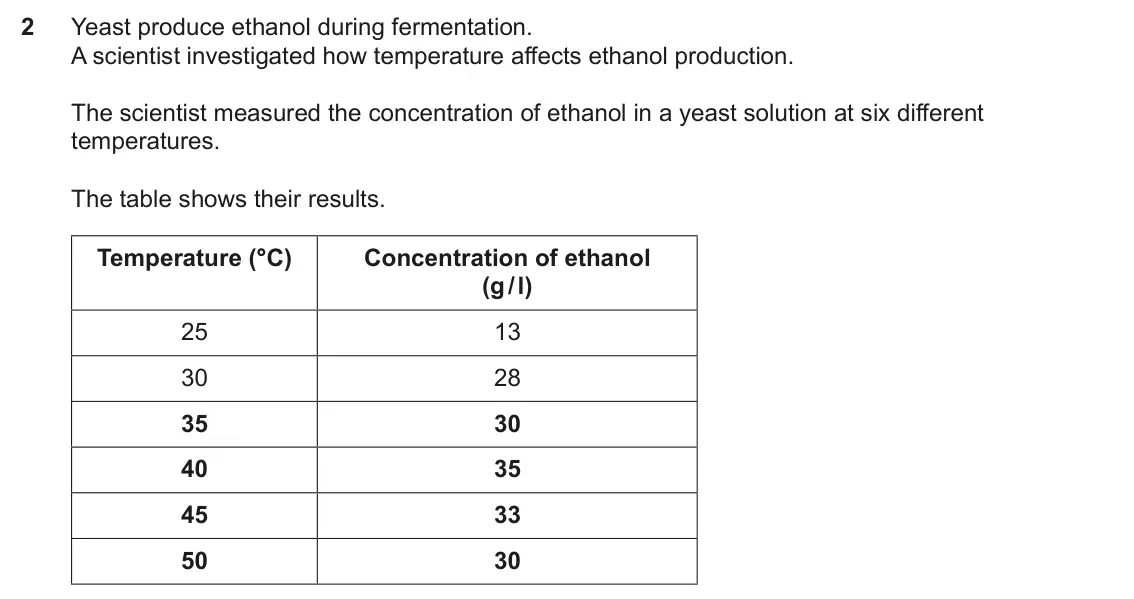
Q2(a)(ii)
The whole paper ↗Q2(b)
The whole paper ↗Q2(c)
The whole paper ↗Q2(d)
The whole paper ↗Q8(b)
The whole paper ↗Q6(b)(iv)
The whole paper ↗
Q7(a)
The whole paper ↗
Q7(b)
The whole paper ↗Q1(a)
The whole paper ↗
Q1(b)
The whole paper ↗Q11(a)(i)
The whole paper ↗Q11(a)(ii)
The whole paper ↗Q11(b)(i)
The whole paper ↗Q2(b)(i)
The whole paper ↗
All 67 questions on What happens during cellular respiration?, as a list
- June 2025, Paper 1 Foundation, Q10(a)(i) (1 mark): Plot the results from the table on the graph. Two points have been plotted for you. 40 35 30 25 Concentration of 20 ethanol (g / l) 15 10 5 0 20 25 30 35 40 45
- June 2025, Paper 1 Foundation, Q10(a)(ii) (1 mark): Draw a curve of best fit on the graph. [1]
- June 2025, Paper 1 Foundation, Q10(b) (2 marks): State two conclusions that can be made from these data. 1 2 [2]
- June 2025, Paper 1 Foundation, Q10(c) (1 mark): Fermentation is another name for anaerobic respiration in yeast. Complete the equation for anaerobic respiration in yeast. sugar ethanol + [1]
- June 2025, Paper 1 Foundation, Q10(d) (3 marks): The diagram shows the equipment used to investigate the effect of different sugars (sucrose, glucose and galactose) on the rate of respiration in yeast. Deliver
- June 2025, Paper 3 Higher, Q2(a)(i) (1 mark): Plot the results from the table on the graph. Two points have been plotted for you. 40 35 30 25 Concentration of 20 ethanol (g / l) 15 10 5 0 20 25 30 35 40 45
- June 2025, Paper 3 Higher, Q2(a)(ii) (1 mark): Draw a curve of best fit on the graph. [1]
- June 2025, Paper 3 Higher, Q2(b) (2 marks): State two conclusions that can be made from these data. 1 2 [2]
- June 2025, Paper 3 Higher, Q2(c) (1 mark): Fermentation is another name for anaerobic respiration in yeast. Complete the equation for anaerobic respiration in yeast. sugar ethanol + [1]
- June 2025, Paper 3 Higher, Q2(d) (3 marks): The diagram shows the equipment used to investigate the effect of different sugars (sucrose, glucose and galactose) on the rate of respiration in yeast. Deliver
- June 2024, Paper 1 Foundation, Q8(b) (2 marks): Sperm cells are adapted to allow them to swim. Suggest why sperm cells need a lot of mitochondria. [2]
- June 2024, Paper 2 Foundation, Q6(b)(iv) (3 marks): ATP is made during cellular respiration. ATP is used to move nitrate mineral ions from the fertiliser mixture through the cell membrane into the root hair cell.
- June 2024, Paper 2 Foundation, Q7(a) (4 marks): Put one tick (✓) in each row of the table to describe aerobic and anaerobic respiration in animal cells such as human body cells. Both Neither Only Only aerobic
- June 2024, Paper 2 Foundation, Q7(b) (1 mark): Complete the sentence about ATP production in respiration. Use words from the list. more than less than equal to The amount of ATP produced per molecule of reac
- June 2024, Paper 4 Higher, Q1(a) (4 marks): Put one tick (✓) in each row of the table to describe aerobic and anaerobic respiration in animal cells such as human body cells. Both Neither Only Only aerobic
- June 2024, Paper 4 Higher, Q1(b) (1 mark): Complete the sentence about ATP production in respiration. Use words from the list. more than less than equal to The amount of ATP produced per molecule of reac
- June 2023, Paper 1 Foundation, Q11(a)(i) (3 marks): Complete the table to compare cellular aerobic and anaerobic respiration in humans. Tick (3) the correct boxes in each row. It requires It requires It produces
- June 2023, Paper 1 Foundation, Q11(a)(ii) (1 mark): Which statement about respiration is correct? Tick (3) one box. Aerobic respiration produces more ATP than anaerobic respiration. Anaerobic respiration produces
- June 2023, Paper 1 Foundation, Q11(b)(i) (2 marks): Suggest why heart muscle cells need so many mitochondria. [2]
- June 2023, Paper 2 Foundation, Q2(b)(i) (3 marks): The student is wrong. Explain how the student’s body cells use sugar and fatty acids. [3]
- June 2023, Paper 2 Foundation, Q7(a) (1 mark): Complete the sentences about the processes that take place in chloroplasts and mitochondria. Use words from the list. cellular respiration meiosis photosynthesi
- June 2023, Paper 2 Foundation, Q7(b) (1 mark): The process of cellular respiration takes place continuously in plant cells. Explain why it has to take place continuously. [1]
- June 2023, Paper 3 Higher, Q1(a)(i) (3 marks): Complete the table to compare cellular aerobic and anaerobic respiration in humans. Tick (3) the correct boxes in each row. It requires It requires It produces
- June 2023, Paper 3 Higher, Q1(a)(ii) (1 mark): Which statement about respiration is correct? Tick (3) one box. Aerobic respiration produces more ATP than anaerobic respiration. Anaerobic respiration produces
- June 2023, Paper 3 Higher, Q1(b)(i) (2 marks): Suggest why heart muscle cells need so many mitochondria. [2]
- June 2023, Paper 4 Higher, Q2(a) (1 mark): Complete the sentences about the processes that take place in chloroplasts and mitochondria. Use words from the list. cellular respiration meiosis photosynthesi
- June 2023, Paper 4 Higher, Q2(b) (1 mark): The process of cellular respiration takes place continuously in plant cells. Explain why it has to take place continuously. [1]
- June 2022, Paper 1 Foundation, Q3(a) (1 mark): Which statement describes the process of cellular respiration? Tick (3) one box. It is a photosynthetic reaction. It is an endothermic reaction. It is an exothe
- June 2022, Paper 1 Foundation, Q3(b) (1 mark): Which type of cellular respiration produces ethanol? Tick (3) one box. Aerobic respiration in animal cells Aerobic respiration in plant cells Anaerobic respirat
- June 2022, Paper 1 Foundation, Q3(c) (2 marks): ATP is a product of cellular respiration. Complete the table about ATP. Tick (3) one box in each column. Active transport Diffusion Muscle contraction Does not
- June 2022, Paper 2 Foundation, Q4(b) (4 marks): The cells that make up the cutting’s leaves contain chloroplasts and mitochondria. Explain how chloroplasts and mitochondria enable the cutting to grow. Chlorop
- June 2022, Paper 3 Higher, Q10(d) (2 marks): Venus fly traps use the glucose produced in photosynthesis for aerobic cellular respiration. Give the balanced symbol equation for aerobic cellular respiration.
- June 2022, Paper 4 Higher, Q5(b)(iii) (6 marks): Photosynthesis takes place in plants. (iii)* A student concludes that time point D is sunset. Describe and explain how Fig. 5.3 supports the student’s conclusio
- November 2021, Paper 1 Foundation, Q2(d) (1 mark): Some bacteria can respire anaerobically. Which statement about anaerobic respiration in bacteria is correct? Tick (3) one box. It does not use glucose It does n
- November 2021, Paper 4 Higher, Q5(d) (3 marks): Complete the sentences to explain the results in period B in Fig. 5.2. Beth’s muscles were contracting more during period B. This requires more from a process c
- November 2020, Paper 1 Foundation, Q4(c)(i) (1 mark): Some plants grow in waterlogged soil. What type of respiration will take place in root cells growing in waterlogged soil? [1]
- November 2020, Paper 2 Foundation, Q8(i) (3 marks): Calculate the rate of anaerobic respiration in the yeast with glucose solution between 150 seconds and 250 seconds. Give the appropriate units in your answer. R
- November 2020, Paper 2 Foundation, Q8(a) (1 mark): Beth starts by measuring out 30 cm3 of glucose solution using a measuring cylinder. Fig. 8.1 shows four attempts she made at doing this. HMHE A D Fig. 8.1 In wh
- November 2020, Paper 2 Foundation, Q8(b) (3 marks): Beth sets up her materials and apparatus as shown in Fig. 8.2. Anaerobic cellular respiration takes place in the yeast. This makes a gas. Beth wants to collect
- November 2020, Paper 2 Foundation, Q8(c) (2 marks): Beth collects some of the gas made by the anaerobic cellular respiration. She tests the gas by putting a glowing splint into it. Table 8.1 describes the results
- November 2020, Paper 2 Foundation, Q8(d) (1 mark): Beth noticed that the reading on the thermometer increased during the experiment. The temperature in the room did not increase. Explain why the glucose solution
- November 2020, Paper 2 Foundation, Q8(e) (2 marks): Using the water bath at room temperature will help Jamal to compare his results from the glucose and sucrose solutions more fairly. Suggest two reasons why. 1 2
- November 2020, Paper 2 Foundation, Q8(f) (1 mark): The final measurements for the yeast with the sucrose solution are shown in Table 8.2. Volume of gas Time (s) (cm3) 400 42 450 45 Table 8.2 Plot the final measu
- November 2020, Paper 2 Foundation, Q8(g) (1 mark): What volume of gas is collected from the yeast with the sucrose solution after 275 seconds? Volume = cm3 [1]
- November 2020, Paper 2 Foundation, Q8(h) (2 marks): How long did it take for the yeast to use all of the glucose from the glucose solution? Explain your answer. Time s Explanation [2]
- November 2020, Paper 2 Foundation, Q8(j) (2 marks): Jamal concludes that the rate of anaerobic cellular respiration is faster when yeast is in glucose solution. Describe two pieces of evidence from the graph in F
- November 2020, Paper 3 Higher, Q6(b)(iii) (1 mark): Human heart muscle contracts on average 80 times per minute. Suggest why heart muscle cells contain a large number of mitochondria. [1]
- November 2020, Paper 3 Higher, Q6(c) (2 marks): A human liver has a mass of approximately 1.3 kg. Hepatocytes are one type of cell found in the liver. They make up approximately 75% of the liver mass. It is e
- November 2020, Paper 4 Higher, Q1(i) (3 marks): Calculate the rate of anaerobic respiration in the yeast with glucose solution between 150 seconds and 250 seconds. Give the appropriate units in your answer. R
- November 2020, Paper 4 Higher, Q1(a) (1 mark): Beth starts by measuring out 30 cm3 of glucose solution using a measuring cylinder. Fig. 1.1 shows four attempts she made at doing this. 30 30 30 30 A B C D Fig
- November 2020, Paper 4 Higher, Q1(b) (3 marks): Beth sets up her materials and apparatus as shown in Fig. 1.2. Anaerobic cellular respiration takes place in the yeast. This makes a gas. Beth wants to collect
- November 2020, Paper 4 Higher, Q1(c) (2 marks): Beth collects some of the gas made by the anaerobic cellular respiration. She tests the gas by putting a glowing splint into it. Table 1.1 describes the results
- November 2020, Paper 4 Higher, Q1(d) (1 mark): Beth noticed that the reading on the thermometer increased during the experiment. The temperature in the room did not increase. Explain why the glucose solution
- November 2020, Paper 4 Higher, Q1(e) (2 marks): Using the water bath at room temperature will help Jamal to compare his results from the glucose and sucrose more fairly. Suggest two reasons why. 1 2 [2] Jamal
- November 2020, Paper 4 Higher, Q1(f) (1 mark): The final measurements for the yeast with the sucrose solution are shown in Table 1.2. Volume of gas Time (s) (cm3) 400 42 450 45 Table 1.2 Plot the final measu
- November 2020, Paper 4 Higher, Q1(g) (1 mark): What volume of gas is collected from the yeast with the sucrose solution after 275 seconds? Volume = cm3 [1]
- November 2020, Paper 4 Higher, Q1(h) (2 marks): How long did it take for the yeast to use all of the glucose from the glucose solution? Explain your answer. Time s Explanation [2]
- November 2020, Paper 4 Higher, Q1(j) (2 marks): Jamal concludes that the rate of anaerobic cellular respiration is faster when yeast is in glucose solution. Describe two pieces of evidence from the graph in F
- November 2020, Paper 4 Higher, Q4(b)(iii) (2 marks): The phloem tube is made of living cells, but these cells do not have any mitochondria. Explain why they depend on the companion cells, which do have mitochondri
- June 2019, Paper 1 Foundation, Q2(a) (2 marks): In which two parts of a cell does cellular respiration take place? Tick (3) two boxes. Cell wall Chloroplast Cytoplasm Mitochondria Nucleus [2]
- June 2019, Paper 1 Foundation, Q2(b) (1 mark): Cellular respiration is described as an exothermic process. What is an exothermic process? [1]
- June 2019, Paper 1 Foundation, Q2(c) (3 marks): Which of the following statements are true for anaerobic respiration in animal cells? Tick (3) true or false for each statement. Statement about anaerobic respi
- June 2019, Paper 3 Higher, Q3(a)(i) (1 mark): Identify the mistake in the annotation by drawing a ring around it. [1]
- June 2019, Paper 3 Higher, Q3(a)(ii) (1 mark): Write a correction for the student’s mistake. [1]
- June 2019, Paper 3 Higher, Q3(b) (3 marks): Describe the similarities and differences between anaerobic respiration in animal cells and yeast cells. [3]
- June 2019, Paper 3 Higher, Q3(c) (2 marks): Write down two uses of the ATP produced during aerobic respiration in the human body. 1 2 [2]
- June 2018, Paper 4 Higher, Q5(a) (2 marks): Many of these responses involve muscles as effectors. Muscles are made of cells. Explain why muscle cells have more mitochondria than most other types of cell i
Questions, mark schemes and examiner’s reports are © OCR, from their published past papers. Plumi isn’t affiliated with any exam board. Want whole papers? Every OCR GCSE Biology B paper.
Rather write your answers by hand on iPad? Plumi marks them against the same mark schemes.