 plumi
How are organisms in an ecosystem interdependent?: OCR GCSE Biology B questions
Every OCR GCSE Biology B exam question on B3.3 How are organisms in an ecosystem interdependent?, 2018–2025, with its mark scheme and examiner’s report.
Paper
All papers
Exam
All years
Calculations
Q2(a)
The whole paper ↗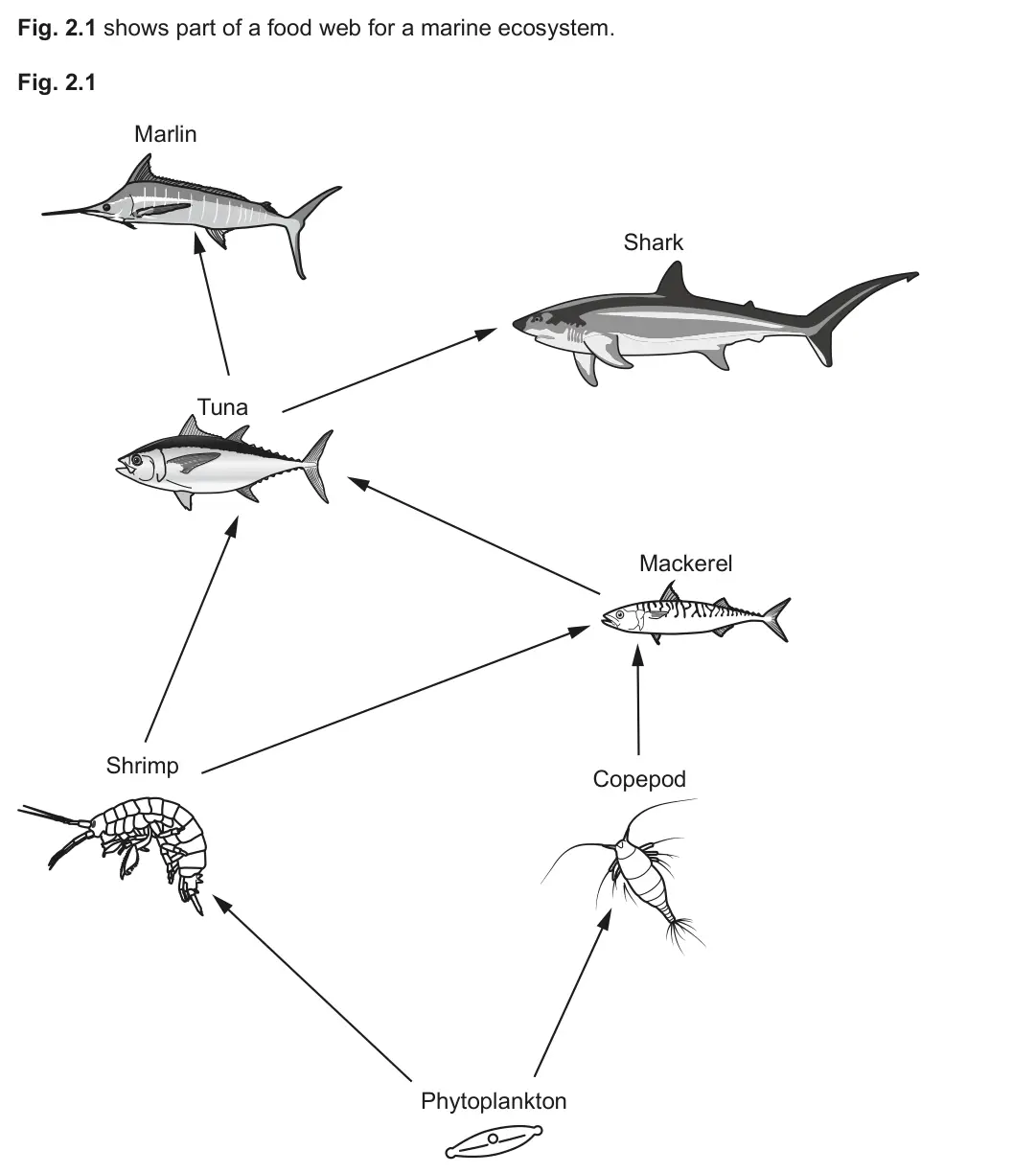
Q7(a)(ii)
The whole paper ↗
Q6(a)
The whole paper ↗
Q6(b)
The whole paper ↗Q9(d)
The whole paper ↗
Q3(a)
The whole paper ↗
Q3(b)
The whole paper ↗Q5(b)(ii)
The whole paper ↗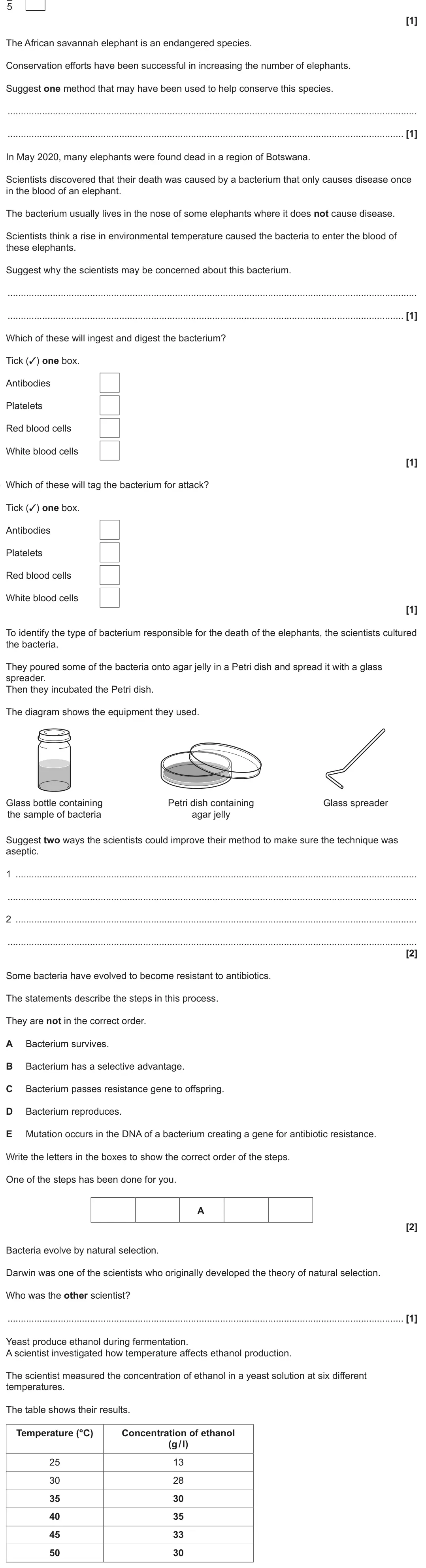
Q5(b)(iii)
The whole paper ↗Q5(c)
The whole paper ↗Q2(d)
The whole paper ↗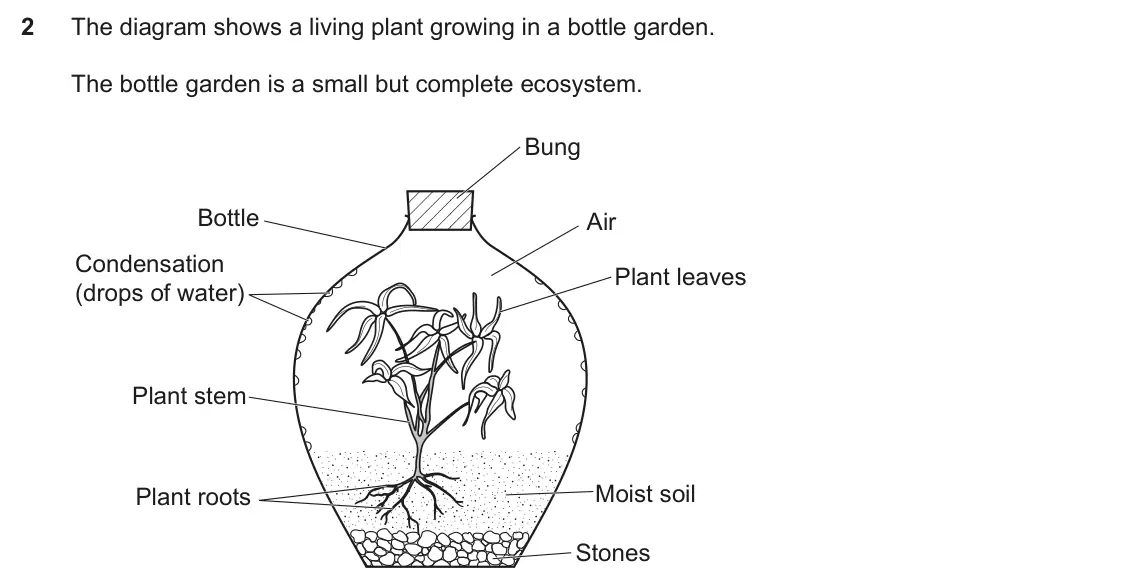
Q9(c)(i)
The whole paper ↗
Q11(a)
The whole paper ↗
Q11(b)
The whole paper ↗Q11(c)
The whole paper ↗Q11(d)(i)
The whole paper ↗Q11(d)(ii)
The whole paper ↗Q2(a)(i)
The whole paper ↗
Q2(a)(ii)
The whole paper ↗Q2(a)(iii)
The whole paper ↗
All 101 questions on How are organisms in an ecosystem interdependent?, as a list
- June 2025, Paper 1 Foundation, Q2(a) (3 marks): Complete the sentences to describe the organisms in Fig. 2.1. Use words from the list. copepod mackerel primary consumers producers secondary consumers tuna Phy
- June 2025, Paper 1 Foundation, Q7(a)(ii) (1 mark): Enzymes are proteins. Which small molecules are used to make proteins? Tick (✓) one box. Amino acids Fatty acids Glucose Glycerol [1]
- June 2025, Paper 2 Foundation, Q6(a) (1 mark): What is the role of an ash tree in a food chain? Tick (3) one box. Herbivore Primary consumer Predator Producer [1]
- June 2025, Paper 2 Foundation, Q6(b) (2 marks): Describe two ways animals can be affected if an ash tree is removed from the ecosystem it was growing in. 1 2 [2]
- June 2025, Paper 2 Foundation, Q9(d) (6 marks): The diagram shows a living plant growing in a bottle garden. The bottle garden is a small but complete ecosystem. Bung Bottle Air Condensation Plant leaves (dro
- June 2025, Paper 3 Higher, Q3(a) (1 mark): Name an organism in Fig. 3.1 that feeds at two different trophic levels. [1]
- June 2025, Paper 3 Higher, Q3(b) (2 marks): Explain the possible impact on the population of copepods if the population of shrimp decreased. [2]
- June 2025, Paper 3 Higher, Q5(b)(ii) (2 marks): Tick (✓) one box in each row to show whether each of these molecules are made using nitrogen, phosphates, both or neither. Only Only Both Neither nitrogen phosp
- June 2025, Paper 3 Higher, Q5(b)(iii) (2 marks): Temperature affects the rate of decomposition. Sketch a line on the graph to show how temperature affects the rate of decomposition. Rate of decomposition Tempe
- June 2025, Paper 3 Higher, Q5(c) (3 marks): An organism was found preserved in some wetlands. The organism stopped living over 2000 years ago but had not been decomposed by microorganisms. The wetlands th
- June 2025, Paper 4 Higher, Q2(d) (6 marks): The diagram shows a living plant growing in a bottle garden. The bottle garden is a small but complete ecosystem. Bung Bottle Air Condensation Plant leaves (dro
- June 2025, Paper 4 Higher, Q9(c)(i) (2 marks): Explain why the crocodiles in Lake A would become endangered if the microalgae died out. Use information from Table 9.2. [2]
- June 2024, Paper 1 Foundation, Q11(a) (1 mark): What does each picture in the food web represent? Tick (✓) one box. A community A population An individual [1]
- June 2024, Paper 1 Foundation, Q11(b) (3 marks): Complete each sentence by writing in the correct number. There are producers in the food web. There are herbivores in the food web. The arctic fox is in trophic
- June 2024, Paper 1 Foundation, Q11(c) (3 marks): A lemming has a mass of 82 g. An arctic fox eats the lemming, but only consumes 75 g of the lemming. Calculate the percentage mass the arctic fox has consumed.
- June 2024, Paper 1 Foundation, Q11(d)(i) (1 mark): Eggs contain protein. Which reagent is used to test for protein? [1]
- June 2024, Paper 1 Foundation, Q11(d)(ii) (2 marks): The yolk of the egg contains lipids. Put a ring around the two components that make up a lipid. amino acids fatty acids glucose glycerol [2]
- June 2024, Paper 2 Foundation, Q2(a)(i) (1 mark): Which organism in the food chain is a producer? [1]
- June 2024, Paper 2 Foundation, Q2(a)(ii) (1 mark): Which organism in the food chain is a primary consumer? [1]
- June 2024, Paper 2 Foundation, Q2(a)(iii) (3 marks): Foxes can be considered pests and are sometimes killed by humans. Explain why killing foxes could cause the size of the slug population to decrease. [3]
- June 2024, Paper 2 Foundation, Q5(a) (2 marks): The population of the world is 8 billion people. 3.2 billion people eat food made from wheat as a major part of their diet. What percentage of the world’s popul
- June 2024, Paper 3 Higher, Q2(a) (1 mark): What does each picture in the food web represent? Tick (✓) one box. A community A population An individual [1]
- June 2024, Paper 3 Higher, Q2(b) (3 marks): Complete each sentence by writing in the correct number. There are producers in the food web. There are herbivores in the food web. The arctic fox is in trophic
- June 2024, Paper 3 Higher, Q2(c) (3 marks): A lemming has a mass of 82 g. An arctic fox eats the lemming, but only consumes 75 g of the lemming. Calculate the percentage mass the arctic fox has consumed.
- June 2024, Paper 3 Higher, Q2(d)(i) (1 mark): Eggs contain protein. Which reagent is used to test for protein? [1]
- June 2024, Paper 3 Higher, Q2(d)(ii) (2 marks): The yolk of the egg contains lipids. Put a ring around the two components that make up a lipid. amino acids fatty acids glucose glycerol [2]
- June 2024, Paper 4 Higher, Q4(a) (1 mark): Which organism is the source of biomass for all other organisms in the food chain? [1]
- June 2024, Paper 4 Higher, Q4(b) (2 marks): Explain why phytoplankton are producers. Use evidence from Fig. 4.1. [2]
- June 2024, Paper 4 Higher, Q4(c) (2 marks): Explain why zooplankton are not producers. Use evidence from Fig. 4.1. [2]
- June 2024, Paper 4 Higher, Q4(d) (2 marks): Which statements about the food chain in Fig. 4.1 are true and which are false? Tick (✓) one box in each row. True False Fig. 4.1 shows how many individuals are
- June 2024, Paper 4 Higher, Q4(e)(i) (3 marks): Calculate the percentage of the phytoplankton biomass that is transferred to the large fish. Give your answer to 1 significant figure. Percentage = % [3]
- June 2024, Paper 4 Higher, Q4(e)(ii) (6 marks): Fig. 4.1 shows a complete food chain for a small pond. Fig. 4.1 phytoplankton zooplankton small fish large fish (ii)* Explain: • reasons for the trend in the bi
- June 2024, Paper 4 Higher, Q7(c)(i) (1 mark): Where do plants get nitrate from? Tick (✓) one box. Air Carbohydrates Mineral ions The Sun [1]
- June 2024, Paper 4 Higher, Q7(c)(ii) (2 marks): Draw lines to connect each substance to what the substance is used to make in a plant. Substance Used to make Oxygen Nitrate Proteins Nucleotides Phosphate Wate
- June 2023, Paper 1 Foundation, Q5(a)(i) (2 marks): Explain why photosynthesis in producers is important for consumers. [2]
- June 2023, Paper 1 Foundation, Q5(a)(ii) (2 marks): Explain why cellular respiration in consumers is important for producers. [2]
- June 2023, Paper 1 Foundation, Q5(b) (2 marks): Some trees lose their leaves in autumn. These leaves fall to the ground and decay. A student investigates the rate of decay of leaves. The table shows the resul
- June 2023, Paper 1 Foundation, Q7(c)(iii) (2 marks): Botox is a protein. Describe a test you could use to show that Botox is a protein. [2]
- June 2023, Paper 2 Foundation, Q5(a)(iii) (3 marks): When swordbill hummingbirds feed on the nectar, they transfer pollen between passionflowers. The pollen contains the male gametes of the passionflowers. Explain
- June 2023, Paper 3 Higher, Q6(d) (3 marks): When a horse eats grass, not all of the biomass that makes up the grass becomes part of the horse’s biomass. Explain this statement. [3]
- June 2023, Paper 3 Higher, Q8(d) (2 marks): Some hormones are made from proteins, others are made from lipids. Complete the sentences to describe how to test for the presence of proteins, and for lipids.
- June 2023, Paper 3 Higher, Q11(a) (2 marks): Describe the differences between the organisms found at trophic level 2 and trophic level 3 in the food web. [2]
- June 2023, Paper 3 Higher, Q11(b) (3 marks): A pyramid of biomass is shown. The bars are drawn to the same scale. Calculate the percentage efficiency of biomass transfer between primary consumers and secon
- June 2023, Paper 3 Higher, Q11(c) (2 marks): Explain why photosynthetic organisms are the source of all biomass on Earth. [2]
- June 2023, Paper 3 Higher, Q11(d) (1 mark): Name two substances that cycle through the biotic and abiotic components of an ecosystem. 1 2 [1]
- June 2023, Paper 4 Higher, Q6(b) (2 marks): Fungi release digestive enzymes into the soil. Explain why these enzymes are helpful to organisms other than the fungi. [2]
- June 2022, Paper 1 Foundation, Q5(d) (2 marks): Puffins eat a diet high in protein. Draw one line to connect the reagent used to test for protein and the colour of a positive test. Reagent used to test for pr
- June 2022, Paper 1 Foundation, Q8(b) (1 mark): Coral are animals. They benefit from having photosynthesising algae living inside them. Suggest one substance the algae provide the coral with. [1]
- June 2022, Paper 2 Foundation, Q2(a) (4 marks): Complete the sentences to describe the organisms in the food web. Use the phrases in the list. a community a population an ecosystem an individual One rabbit is
- June 2022, Paper 2 Foundation, Q2(b) (1 mark): State one example of an organism in the first trophic level of the woodland food web. [1]
- June 2022, Paper 2 Foundation, Q2(c) (1 mark): State one example of a producer in the woodland food web. [1]
- June 2022, Paper 2 Foundation, Q2(d) (1 mark): How many trophic levels does the longest food chain in the woodland food web have? Number of trophic levels [1]
- June 2022, Paper 2 Foundation, Q2(e) (1 mark): State one example of an organism that is in more than one trophic level in the woodland food web. [1]
- June 2022, Paper 3 Higher, Q8(b) (1 mark): Fish form a large part of the diet of Icelandic people. Some fish contain high levels of oils. Oils are fats. What are the two components that make up a fat? 1
- June 2022, Paper 3 Higher, Q10(c) (2 marks): The Venus fly trap evolved to live in damp soil that is low in nitrogen and phosphorus. Complete the sentences describing why plants require nitrogen and phosph
- November 2021, Paper 1 Foundation, Q10(a) (2 marks): Plants and animals use small organic molecules to make larger organic molecules. Draw lines to connect the small organic molecules with the large organic molecu
- November 2021, Paper 1 Foundation, Q12(a) (1 mark): Which organism in the food chain would you place in bar A of the pyramid of biomass? [1]
- November 2021, Paper 1 Foundation, Q12(b) (3 marks): Describe the general change in biomass that occurs between the trophic levels shown in the pyramid and give two reasons for this change. [3]
- November 2021, Paper 1 Foundation, Q12(c) (3 marks): The percentage efficiency of the biomass transfer between trophic levels can be calculated using the efficiency equation: average biomass in higher trophic leve
- November 2021, Paper 2 Foundation, Q2(a) (2 marks): Fish and squid are eaten by the albatross. Albatross chicks are eaten by large mice. Draw a food web for this community of organisms. [2]
- November 2021, Paper 3 Higher, Q1(a) (2 marks): Plants and animals use small organic molecules to make larger organic molecules. Draw lines to connect the small organic molecules with the large organic molecu
- November 2021, Paper 3 Higher, Q3(a) (1 mark): Which organism in the food chain would you place in bar A of the pyramid of biomass? [1]
- November 2021, Paper 3 Higher, Q3(b) (3 marks): Describe the general change in biomass that occurs between the trophic levels shown in the pyramid and give two reasons for this change. [3]
- November 2021, Paper 3 Higher, Q3(c) (3 marks): The percentage efficiency of the biomass transfer between trophic levels can be calculated using the efficiency equation: average biomass in higher trophic leve
- November 2021, Paper 3 Higher, Q6(b)(i) (3 marks): Describe how Benedict’s reagent could be used to show that the amount of sugar in the milk of different species varies, and how the results would support the da
- November 2021, Paper 3 Higher, Q6(b)(ii) (1 mark): Name the reagent that would test for the presence of protein. [1]
- November 2021, Paper 4 Higher, Q7(a) (1 mark): To make good compost, the waste added to the bin should be 50% green (such as grass cuttings) and 50% brown (such as dead leaves). Today, Layla has added 1.1 kg
- November 2021, Paper 4 Higher, Q7(b) (2 marks): Layla adds waste plant material from the garden to the bin, where it will be broken down to make compost. She is worried that the compost bin might become full
- November 2021, Paper 4 Higher, Q7(c) (4 marks): Compost that is made in the bin can be added to the soil in the garden. Explain why it is useful to turn garden waste into compost that is added to the soil, ra
- November 2021, Paper 4 Higher, Q7(d)(ii) (2 marks): Explain why the wood will be broken down into compost more quickly if Layla chops it up into small pieces before putting it in the compost bin. [2]
- November 2021, Paper 4 Higher, Q7(e)(i) (3 marks): Explain why the rate shown in Fig. 7.3 was highest at the optimum temperature of approximately 23.5 °C but was lower at temperatures below and above the optimum
- November 2021, Paper 4 Higher, Q7(e)(ii) (1 mark): Which part of the line in Fig. 7.3 could be represented by the relationship y = mx + c? Tick (3) one box. The line between 5 °C and 15 °C. The line between 10 °
- November 2021, Paper 4 Higher, Q7(e)(iii) (2 marks): Calculate the change in the rate per °C between 10 °C and 20 °C, using Fig. 7.3. Change in rate = g / day per °C [2]
- November 2020, Paper 4 Higher, Q2(a) (2 marks): Milk can be tested for proteins by adding a reagent. Draw one line to connect the correct reagent with the correct result if proteins are present. Reagent Resul
- June 2019, Paper 1 Foundation, Q4(a)(i) (1 mark): Milk and meat contain protein. Which reagent would you use to test for protein? Tick (3) one box. Benedict’s Biuret Ethanol Iodine [1]
- June 2019, Paper 1 Foundation, Q5(a) (2 marks): If the population of killer whales decreased, what effect would this have on the population of sand eels? Explain your answer. [2]
- June 2019, Paper 1 Foundation, Q5(b)(ii) (2 marks): The dead killer whale’s body will be decomposed. Describe how this will happen and explain why it is important. [2]
- June 2019, Paper 1 Foundation, Q5(b)(iii) (2 marks): Decomposition is affected by temperature. Use words from the list to complete the sentences below. You may use each word once, more than once or not at all. ami
- June 2019, Paper 2 Foundation, Q2(b)(i) (4 marks): Write down two hazards in Ling’s method and suggest a way of reducing the risk from each hazard. hazard way of reducing risk hazard way of reducing risk [4]
- June 2019, Paper 2 Foundation, Q2(b)(ii) (1 mark): The colour change when iodine solution is added shows that the leaf contains starch. Describe this colour change. [1]
- June 2019, Paper 2 Foundation, Q3(b)(i) (2 marks): Add the following information to the food web above: • Phytoplankton are eaten by shellfish. [2] • Shellfish and fish are eaten by seagulls.
- June 2019, Paper 2 Foundation, Q3(b)(ii) (3 marks): Draw straight lines to join each part of an ecosystem to the correct example from the food web. Part of an ecosystem Example from the food web All the organisms
- June 2019, Paper 2 Foundation, Q3(b)(iii) (3 marks): Phytoplankton are producers. Zooplankton, fish, shellfish and seagulls are all consumers. Describe the differences between a producer and a consumer. [3]
- June 2019, Paper 3 Higher, Q8 (3 marks): Carbohydrates, lipids and proteins are large organic molecules. Complete the table to show which small organic molecules are used to make the large organic mole
- June 2019, Paper 3 Higher, Q9(a)(i) (2 marks): Use the food web to label this pyramid of biomass correctly. [2]
- June 2019, Paper 3 Higher, Q9(a)(ii) (2 marks): Describe how biomass is lost at each stage of a food chain. [2]
- June 2019, Paper 3 Higher, Q9(c) (2 marks): Explain what would happen to the dead whale’s body if it was left in the sea. [2]
- June 2019, Paper 4 Higher, Q3(a) (1 mark): What does the word “Fish” represent in the food web? Tick (✓) one box. An individual organism A population A producer A species [1]
- June 2019, Paper 4 Higher, Q3(b) (2 marks): Explain the difference between a community and an ecosystem using examples from the food web. [2] Plastic litter in the sea breaks down slowly into small pieces
- June 2018, Paper 1 Foundation, Q7(b)(i) (2 marks): Ben’s friend thinks he has made a mistake in his method. Describe the mistake Ben has made and how he should correct it. Mistake Correction [2]
- June 2018, Paper 1 Foundation, Q7(b)(ii) (1 mark): What change would Ben observe when using the correct method? Tick (3) one box. Colourless to cloudy white emulsion Light blue to lilac/purple Red-brown precipit
- June 2018, Paper 1 Foundation, Q8(c)(i) (2 marks): A weather event called El Niño occurs every three years. This causes the population of algae to decrease. Explain what effect this could have on the population
- June 2018, Paper 2 Foundation, Q2(c)(i) (2 marks): A food chain is one way of showing the feeding relationships in this ecosystem. A pyramid of biomass is another way. Complete the pyramid of biomass for this ec
- June 2018, Paper 2 Foundation, Q2(c)(ii) (2 marks): Calculate the efficiency of biomass transfer from the oilseed rape to the honey bees. Give your answer as a percentage. Efficiency = % [2]
- June 2018, Paper 2 Foundation, Q2(d)(i) (1 mark): To try to protect honey bees, the European Union banned the use of neonics on flowering crops. Suggest why the ban applied to flowering crops. [1]
- June 2018, Paper 3 Higher, Q1(c)(i) (2 marks): A weather event called El Niño occurs every three years. This causes the population of algae to decrease. Explain what effect this could have on the population
- June 2018, Paper 4 Higher, Q1(a) (2 marks): Explain why nitrate ions are essential for plant growth and survival. [2]
- June 2018, Paper 4 Higher, Q2(c) (2 marks): Describe how she could test each sample for the presence of glucose. [2]
- June 2018, Paper 4 Higher, Q3(a)(i) (3 marks): Write down the names of the processes that have been labelled 1, 2, 3 and 4 in the diagram. 1 2 3 4 [3]
- June 2018, Paper 4 Higher, Q3(a)(ii) (3 marks): Explain the roles of microorganisms in the ocean carbon cycle shown in the diagram. [3]
- June 2018, Paper 4 Higher, Q3(a)(iii) (2 marks): The processes shown in the diagram cycle carbon relatively quickly. Carbon in the ocean is also cycled back to the atmosphere very slowly via another set of pro
Questions, mark schemes and examiner’s reports are © OCR, from their published past papers. Plumi isn’t affiliated with any exam board. Want whole papers? Every OCR GCSE Biology B paper.
Rather write your answers by hand on iPad? Plumi marks them against the same mark schemes.