 plumi
Superposition and standing waves: OCR A‑Level Physics B questions
OCR A-Level Physics B past-paper questions on 4.1.1 Superposition and standing waves, 2016–2025, with mark schemes and examiner’s reports where available.
Paper
All papers
Exam
All years
Calculations
Q34(a)
The whole paper ↗Q37(a)
The whole paper ↗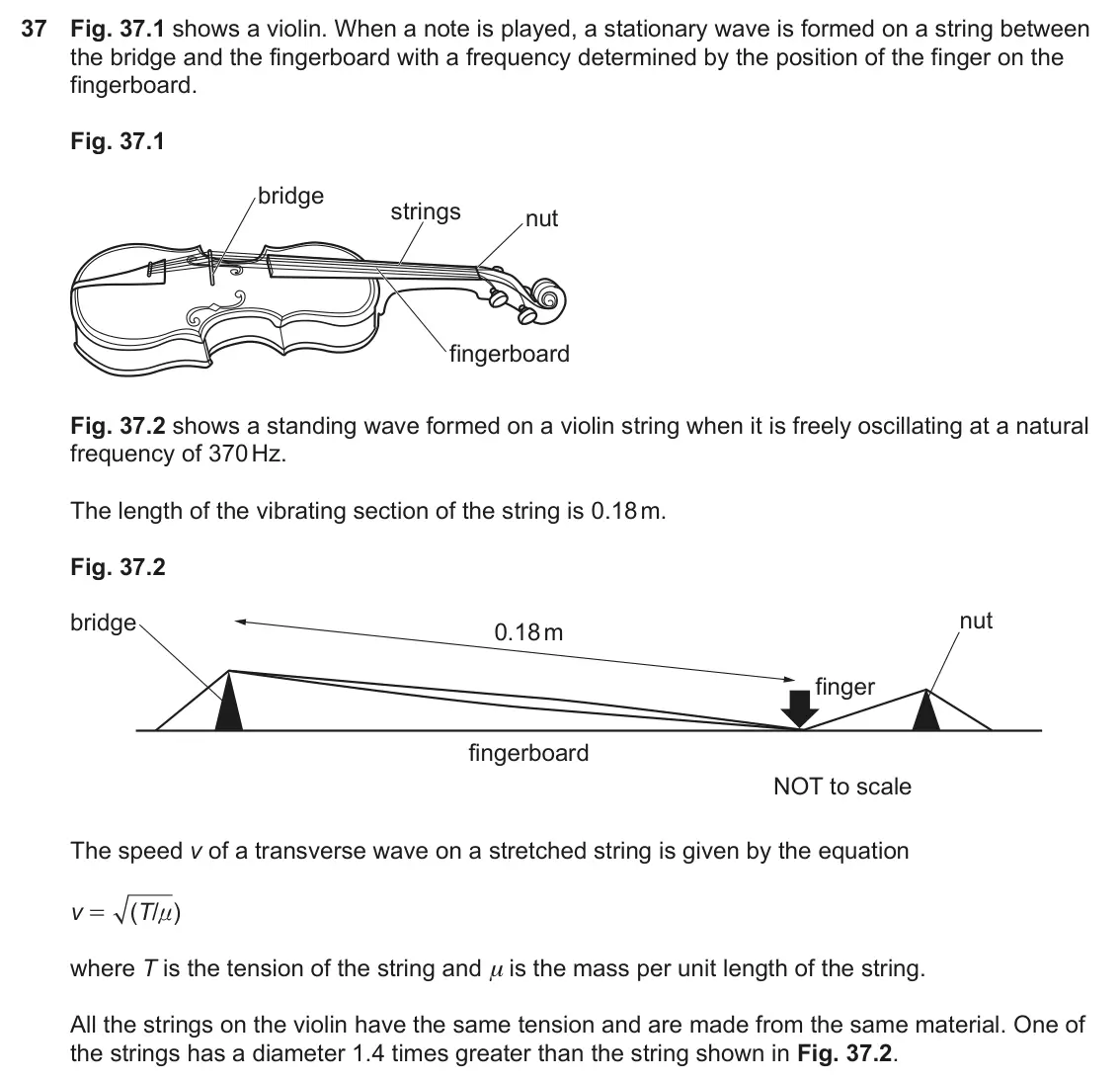
Q37(b)(i)
The whole paper ↗Q37(b)(ii)
The whole paper ↗Q37(b)(iii)
The whole paper ↗Q37(b)(iv)
The whole paper ↗- Your answer
Q23(a)
The whole paper ↗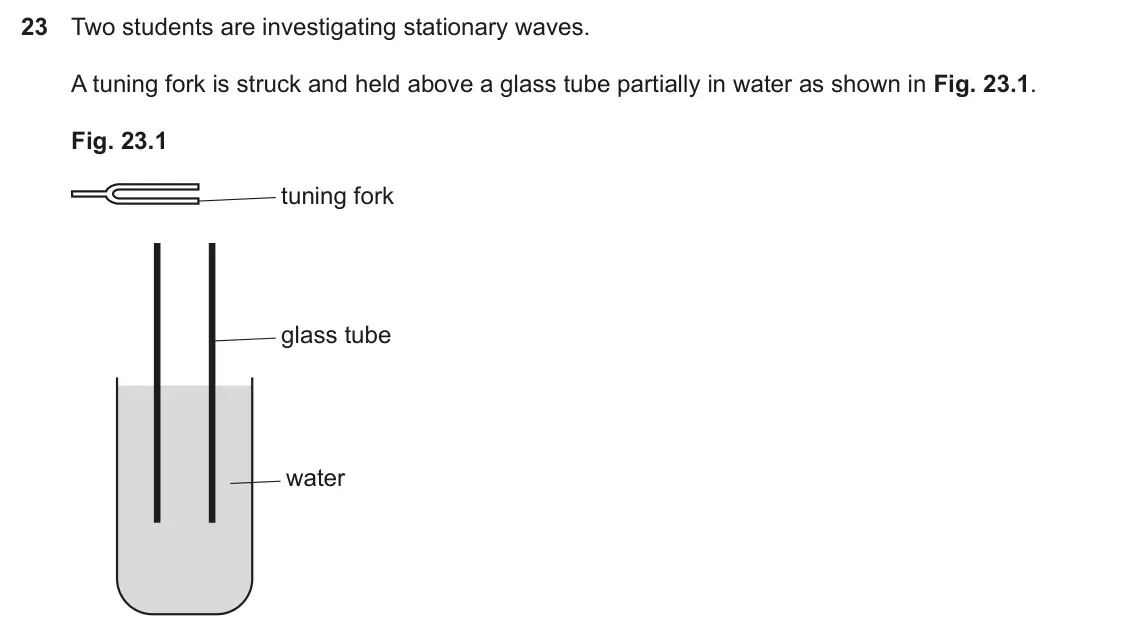
Q23(b)
The whole paper ↗Q23(c)
The whole paper ↗Q4(a)
The whole paper ↗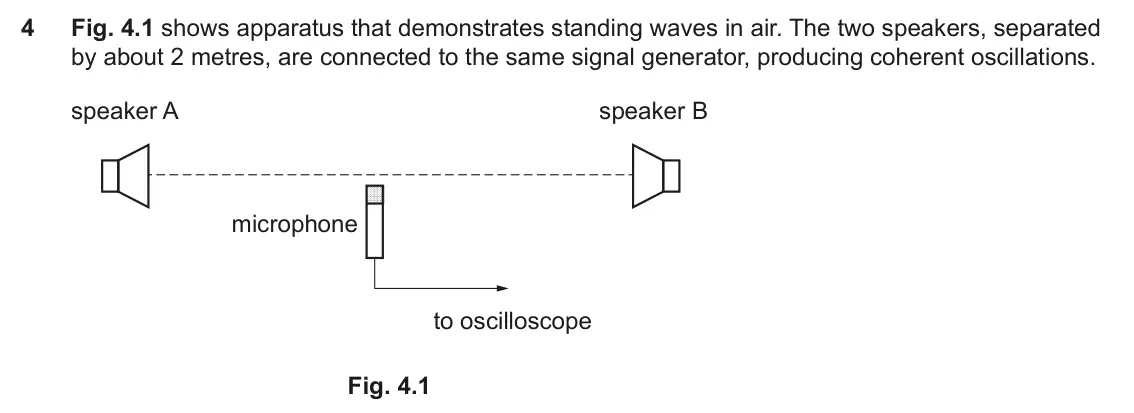
Q4(b)(i)
The whole paper ↗Q26(a)
The whole paper ↗
Q26(b)
The whole paper ↗Q26(c)
The whole paper ↗Q26(d)
The whole paper ↗Q4(b)(ii)
The whole paper ↗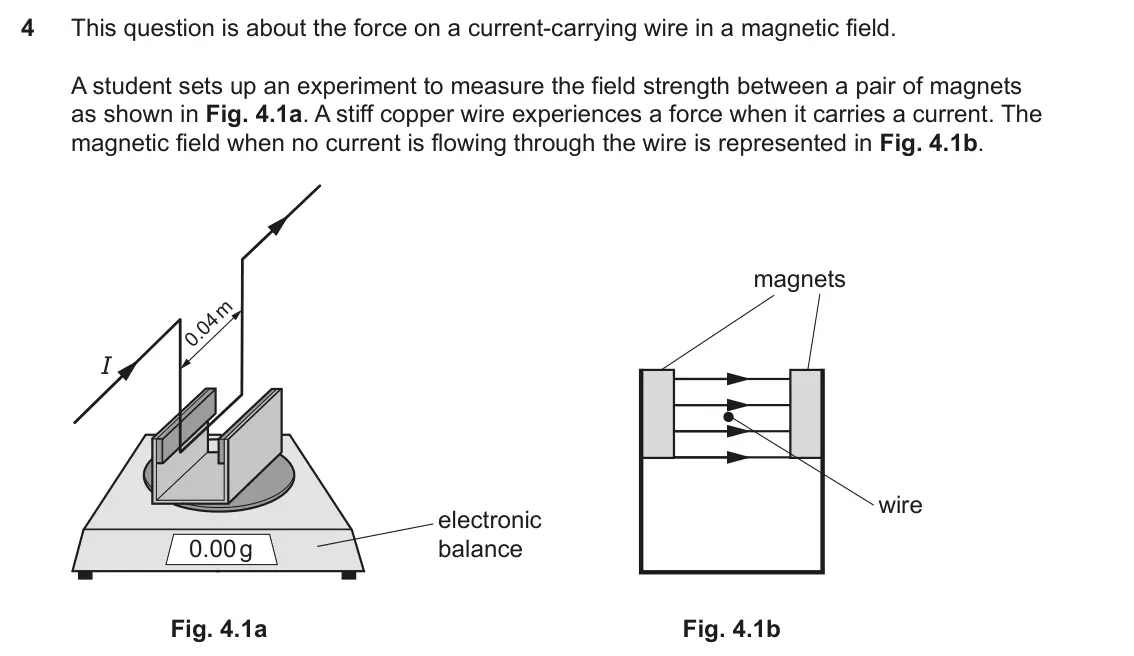
Q24(b)
The whole paper ↗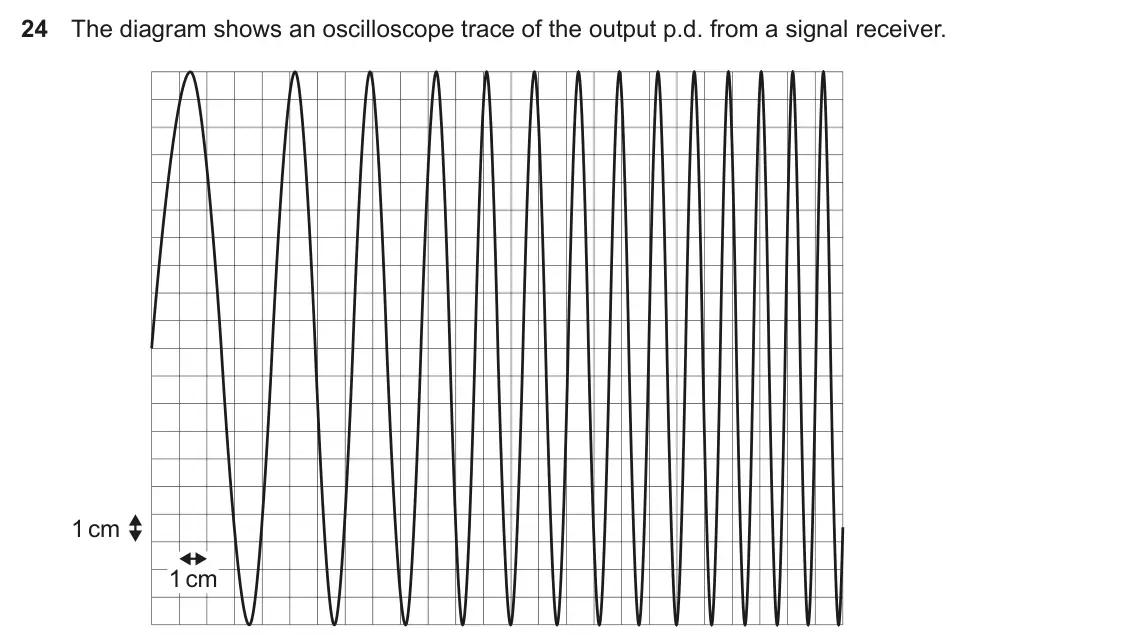
Q24(c)(i)
The whole paper ↗Q24(c)(ii)
The whole paper ↗
All 49 questions on Superposition and standing waves, as a list
- June 2024, Paper 1, Q34(a) (2 marks): Fig. 34.1 shows a dual-trace oscilloscope being used to display two electrical signals. The horizontal time-base of the oscilloscope is set at 50 ms per divisio
- June 2024, Paper 1, Q37(a) (3 marks): Calculate the length of this string when it oscillates with a natural frequency of 370 Hz. length = m [3]
- June 2024, Paper 1, Q37(b)(i) (3 marks): Fig. 37.3 shows apparatus used to determine the speed of sound in air. The wavelength of the sound = λ. Fig. 37.3 tuning fork clamped tube, open at each end L c
- June 2024, Paper 1, Q37(b)(ii) (2 marks): The gradient of the line = 4 v where v is the speed of sound in air. Use the graph to determine the speed of sound in air. v = m s–1 [2]
- June 2024, Paper 1, Q37(b)(iii) (3 marks): Explain why the gradient of the line = 4 v . [3]
- June 2024, Paper 1, Q37(b)(iv) (2 marks): Discuss the suggestion that using a loudspeaker above the tube connected to a signal generator will give a more reliable determination of the speed of sound tha
- June 2024, AS Paper 1, Q13 (1 mark): The diagram shows a sound wave displayed on an oscilloscope screen. The oscilloscope timebase is set to 1 ms / div. displacement time The frequency of the sound
- June 2024, AS Paper 1, Q23(a) (2 marks): Explain how stationary waves are formed in the tube. Do not include a description of the formation of nodes and antinodes. [2]
- June 2024, AS Paper 1, Q23(b) (1 mark): A tuning fork is placed above the opening of the tube. A loud sound is heard when 33 cm of the tube is above the water surface (Fig. 23.2a). The tube is pulled
- June 2024, AS Paper 1, Q23(c) (2 marks): The students use their measurements to calculate the speed of sound in air. They find it hard to agree the position where the loudest sound is heard. Suggest an
- June 2023, Paper 2, Q4(a) (3 marks): Explain how standing waves are set up in between the two speakers and how this is observed. [3]
- June 2023, Paper 2, Q4(b)(i) (1 mark): The signal generator vibrates the speakers at a frequency of 3.00 kHz. The microphone detects positions of minimum amplitude (nodes) separated by 5.60 cm. Calcu
- June 2023, AS Paper 1, Q26(a) (3 marks): Explain how this can result in a stationary wave on the string. You may use a diagram to explain your answer. [3] A student investigates the sound produced by a
- June 2023, AS Paper 1, Q26(b) (1 mark): State the amplitude of the electrical signal. amplitude = mV [1]
- June 2023, AS Paper 1, Q26(c) (3 marks): Determine the frequency of the signal. frequency = Hz [3] The shape of the signal is not a pure sine wave. This is because the sound produced by the string is n
- June 2023, AS Paper 1, Q26(d) (3 marks): The length of the string is L. Draw diagrams in the space below to show that the three longest wavelengths produced on the string are 2L, L and 2 3L. The fixed
- June 2022, Paper 2, Q4(b)(ii) (6 marks): This question is about the force on a current-carrying wire in a magnetic field. A student sets up an experiment to measure the field strength between a pair of
- June 2022, AS Paper 1, Q24(b) (1 mark): The voltage (y-) sensitivity of the oscilloscope is set to 25 mV cm–1. Calculate the amplitude of the signal. amplitude = mV [1]
- June 2022, AS Paper 1, Q24(c)(i) (2 marks): Estimate the frequency of the first cycle of the signal. frequency = Hz [2]
- June 2022, AS Paper 1, Q24(c)(ii) (1 mark): Describe how the frequency of the signal changes over time. [1]
- November 2021, AS Paper 1, Q16 (1 mark): In a standing wave, the distance between two adjacent nodes is A λ / 4 B λ / 2 C λ D 2λ Your answer [1]
- November 2021, AS Paper 2, Q8(a) (6 marks): A student is doing an experiment to determine the velocity of sound in air using a resonance tube as shown in Fig. 8.1. small loudspeaker connected to signal cl
- November 2021, AS Paper 2, Q8(b) (3 marks): The antinode at the top of the standing wave is not exactly at the end of the clamped tube. It is a distance C above it. C depends on the shape and diameter of
- November 2021, AS Paper 2, Q8(c)(iv) (4 marks): Draw appropriate straight lines on the graph and use these to find the value of the best- fit gradient and its uncertainty. From these values, obtain the speed
- November 2020, Paper 2, Q7(a) (1 mark): Use the graph to find the frequency of the first harmonic. frequency = Hz [1]
- November 2020, Paper 2, Q7(c)(i) (1 mark): State why the note produced by a flute will increase in frequency when the temperature of the air in the flute rises. [1]
- November 2020, Paper 2, Q7(c)(ii) (2 marks): A flute sounds a note frequency 440 Hz when the temperature of the air in the tube is 285 K. Calculate the temperature rise needed for the same length tube to p
- November 2020, Paper 3, Q3(a)(i) (4 marks): Explain how a standing wave is formed in the tube. [4]
- November 2020, Paper 3, Q3(a)(ii) (1 mark): The shortest height of the air column for maximum volume is recorded as L1. The air just above the tube is also vibrating and this extends the length of the sta
- November 2020, Paper 3, Q3(b)(i) (4 marks): The gradient of the line is 83 m s–1. Calculate the speed of sound in air. Calculate the percentage uncertainty in your result by taking a ‘worst-fit’ line from
- November 2020, Paper 3, Q3(b)(ii) (2 marks): The end correction is approximately equal to 0.3 D, where D is the diameter of the tube. What is the approximate diameter of the tube used in this experiment? D
- November 2020, AS Paper 1, Q15 (1 mark): Two waves travelling in opposite directions interfere to produce a standing wave. Nodes occur where the two waves meet with a phase difference of A 0 B π / 2 C
- June 2019, Paper 1, Q6 (1 mark): Which description of this wave is correct? A The wave is longitudinal, has a wavelength of 40 cm and is stationary. B The wave is transverse, has a wavelength o
- June 2019, Paper 1, Q7 (1 mark): The frequency of the wave shown in the diagram is 3.0 Hz. What is the wave speed on the string? A 1.2 m s−1 B 2.4 m s−1 C 3.8 m s−1 D 7.5 m s−1 [1] Your answer
- June 2019, AS Paper 1, Q20 (1 mark): The diagram shows an oscilloscope trace of the p.d. from a signal generator. The time base of the oscilloscope is set to 0.50 ms cm–1. 1 cm What is the frequenc
- June 2019, AS Paper 1, Q22(a) (1 mark): What, in terms of L, is the wavelength of the standing wave shown in Fig. 22.2? wavelength = [1]
- June 2019, AS Paper 1, Q22(b) (3 marks): An organ pipe like the one shown in Fig. 22.2 has length L = 61 cm. The speed of sound in air is 340 m s–1. Calculate the frequency of the vibration shown in Fi
- June 2019, AS Paper 1, Q22(c) (2 marks): Some organ pipes are closed at the top. This causes the top end to be a node instead of an antinode. Calculate the lowest frequency produced by a closed pipe wi
- June 2018, AS Paper 1, Q4 (1 mark): A student blows across the open top of an empty bottle. Which diagram represents a standing wave that can be produced in the air in the bottle? top of bottle bo
- June 2018, AS Paper 1, Q11 (1 mark): The oscilloscope trace shows the variation in p.d of a signal. The time base of the oscilloscope is set at 0.25 ms cm−1. 1 cm What is the frequency of the signa
- June 2018, AS Paper 2, Q7(a)(i) (2 marks): The length L = 0.980 m and the frequency f0 of the fundamental note produced by the thickest string is 41.2 Hz. Show that the waves travelling along the string
- June 2018, AS Paper 2, Q7(a)(ii) (4 marks): A player can produce a harmonic (a note of higher frequency) by touching the string lightly at a certain point to make the string vibrate with zero amplitude at
- June 2018, AS Paper 2, Q7(a)(iii) (3 marks): The fundamental frequency f0 of the note produced by a vibrating string of length L is given by the equation 1 T f = 0 2 L A t where T is the tension of the str
- June 2018, AS Paper 2, Q7(b)(i) (2 marks): Use the equation given in (a)(iii) to show that, for strings producing the same fundamental frequency f0, T A . t \ 2 L Show your working clearly and explain yo
- June 2018, AS Paper 2, Q7(b)(ii) (3 marks): The thickest string on the bass guitar is 0.86 m long and is at a tension of 190 N. You can assume that this string has the same mean density as a double bass s
- June 2017, Paper 2, Q1(a) (3 marks): Explain how standing waves are formed in air. [3]
- June 2017, Paper 2, Q1(b) (2 marks): Mark the antinodes and nodes on Fig. 1.2 for a note of twice the frequency of the note indicated in Fig. 1.1. Explain your answer. L Fig. 1.2 [2]
- June 2017, Paper 2, Q1(d) (3 marks): A flute of length L sounds a note of 262 Hz at a temperature of 293 K. Calculate the frequency of the note from the same length flute when the temperature of th
- June 2016, AS Paper 2, Q2(b) (3 marks): The reflector is now moved gradually towards the source and detector, in the direction shown by the arrow on the reflector in Fig. 2. At y1, the detector readin
Questions, mark schemes and examiner’s reports are © OCR, from their published past papers. Plumi isn’t affiliated with any exam board. Want whole papers? OCR A-Level Physics B past papers.
The Plumi iPad app also offers exam-style questions with AI feedback on your handwritten working.