 plumi
Photons and the photoelectric effect: OCR A‑Level Physics B questions
OCR A-Level Physics B past-paper questions on 4.1.4 Photons and the photoelectric effect, 2016–2025, with mark schemes and examiner’s reports where available.
Paper
All papers
Exam
All years
Calculations
- Your answer
Q25(b)
The whole paper ↗
Q25(c)(i)
The whole paper ↗Q25(c)(ii)
The whole paper ↗- Your answer
- Your answer
- Your answer
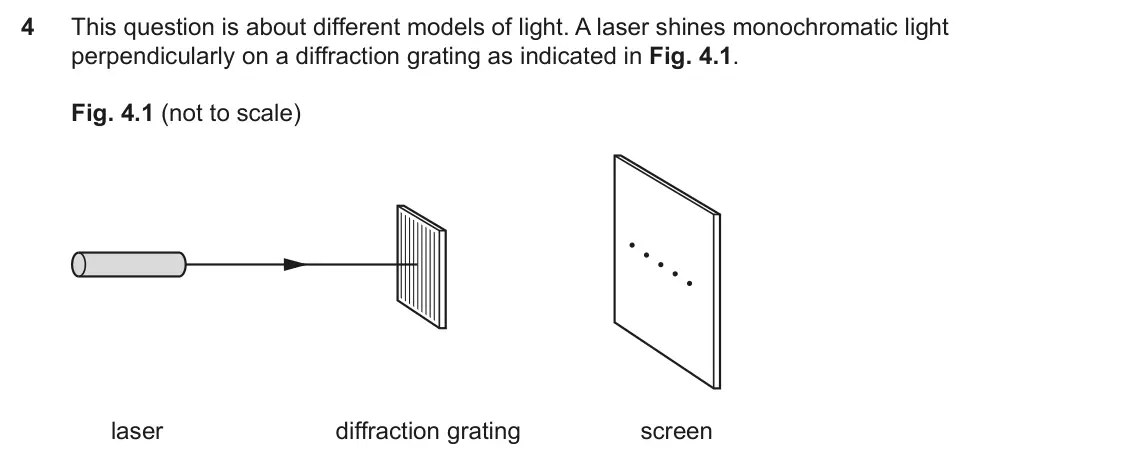
- Your answer
Q2(a)
The whole paper ↗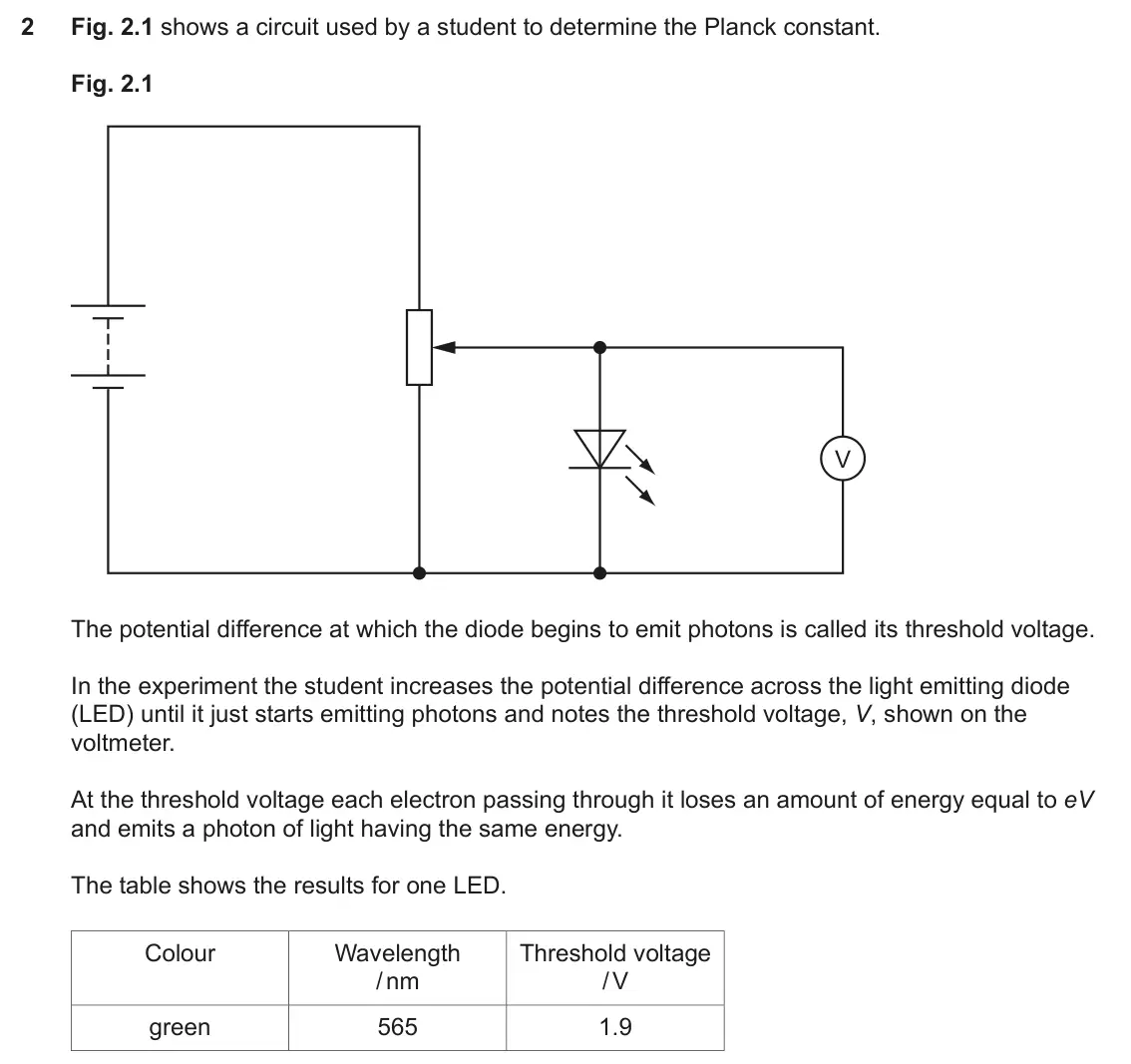
Q2(b)
The whole paper ↗Q40(c)(ii)
The whole paper ↗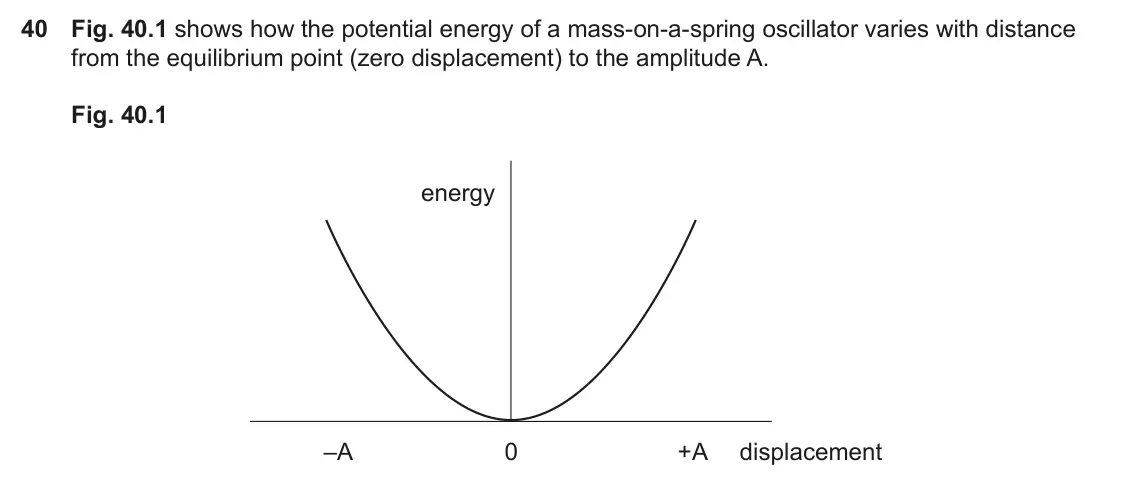
Q2(c)(i)
The whole paper ↗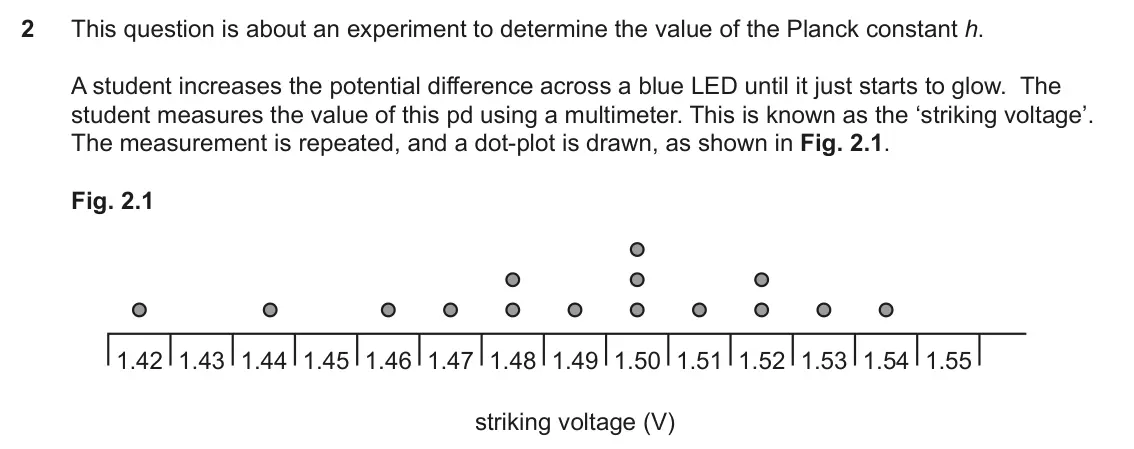
Q2(c)(ii)
The whole paper ↗- Your answer
Q2(a)
The whole paper ↗
Q2(b)
The whole paper ↗Q2(c)
The whole paper ↗
All 55 questions on Photons and the photoelectric effect, as a list
- June 2025, Paper 1, Q14 (1 mark): The diagram shows some of the energy levels in a hydrogen atom. n = 4 E4 = –0.85eV n = 3 E3 = –1.51eV n = 2 E2 = –3.40eV n = 1 E1 = –13.6eV Which electron trans
- June 2025, AS Paper 1, Q25(b) (2 marks): Explain how LEDs provide evidence that photons exchange energy in quanta. [2]
- June 2025, AS Paper 1, Q25(c)(i) (2 marks): Complete the table with the two missing values. [2]
- June 2025, AS Paper 1, Q25(c)(ii) (2 marks): Calculate a mean value for the Planck constant. Planck constant = × 10–34 J s [2]
- June 2024, Paper 1, Q11 (1 mark): A monochromatic beam of light is incident on a clean metal surface, and the frequency of the light is greater than the threshold frequency of the metal. What ha
- June 2024, Paper 1, Q12 (1 mark): The rest energy of an electron or positron is 0.511 MeV. When an electron and positron interact, they annihilate each other. What is the frequency of the two ph
- June 2024, Paper 1, Q15 (1 mark): What is the best estimate of the number of UVA photons incident on 1 cm2 of human skin each second? 4 × 10⁸ A 4 × 10¹¹ B 4 × 10¹² C 4 × 10¹⁵ D Your answer [1]
- June 2024, Paper 2, Q4(b)(iii) (2 marks): Ultraviolet light of the same wavelength from a point source is incident on a clean zinc surface. Electrons are ejected from the metal surface. Use the equation
- June 2024, Paper 2, Q4(b)(iv) (3 marks): Although the energy carried by a wave is proportional to the intensity of the source, it is observed that the maximum kinetic energy of the ejected electrons is
- June 2024, Paper 2, Q4(c) (4 marks): A student suggests the set-up shown in Fig. 4.2. Fig. 4.2 zinc surface positioned at third order maximum ultraviolet light grating source Electrons are ejected
- June 2024, AS Paper 1, Q14 (1 mark): Evidence that light energy is emitted as quanta comes from: A Electron diffraction B Millikan’s oil drop experiment C Partial reflection D Photoelectric effect
- June 2024, AS Paper 2, Q2(a) (2 marks): Use information from the table to calculate the Planck constant. Planck constant = J s [2]
- June 2024, AS Paper 2, Q2(b) (3 marks): State and explain how the experiment and apparatus could be modified to give a more accurate value of the Planck constant. [3]
- June 2023, Paper 1, Q40(c)(ii) (3 marks): The hydrogen chloride molecule only absorbs and emits photons of specific frequencies. Suggest and explain what this shows about the possible amplitudes of osci
- June 2023, Paper 3, Q2(c)(i) (2 marks): Show that the Planck constant, h = gradient × e c . [2]
- June 2023, Paper 3, Q2(c)(ii) (3 marks): The gradient of the line of best fit is 8.90 × 10⁻⁷ V m. Use this value to calculate a value of the Planck constant. Include a value for absolute uncertainty in
- June 2023, AS Paper 1, Q6 (1 mark): A single electron passes through a cell of emf 3 V, then through an LED where a single photon is emitted. 3 V The frequency, f, of the emitted photon can be exp
- June 2023, AS Paper 2, Q2(a) (2 marks): Calculate the work done by an electron in the LED as one photon of blue light is emitted. work done = J [2]
- June 2023, AS Paper 2, Q2(b) (2 marks): Explain why a p.d. of 2.60 V across the LED would not result in the emission of light. [2]
- June 2023, AS Paper 2, Q2(c) (2 marks): In use, the LED draws an electric current of 30 mA. Calculate the number of photons emitted each second, assuming that the energy efficiency of a blue LED is 93
- June 2022, Paper 1, Q30 (1 mark): The diagram shows some of the energy levels of a hydrogen atom. n = 4 E4 = –0.85 eV n = 3 E3 = –1.51 eV n = 2 E2 = –3.40 eV n = 1 E1 = –13.6 eV A photon of freq
- June 2022, Paper 2, Q8(a) (3 marks): Explain the mechanism that produces light from aurorae and calculate the energy associated with photons of the green light of wavelength 558 nm that is often se
- June 2022, AS Paper 1, Q13 (1 mark): The diagram shows the energy levels in an atom. 0 n = ∞ – 0.9 n = 5 – 1.4 n = 4 – 2.4 n = 3 E / 10–19J – 5.4 n = 2 – 21.7 n = 1 An electron absorbs a photon wit
- June 2022, AS Paper 1, Q26(a) (3 marks): Describe one other demonstration or effect that shows the quantum behaviour of light. Include a description of the evidence in your answer. [3] In a demonstrati
- June 2022, AS Paper 1, Q26(b) (3 marks): Calculate the Planck constant from these data. Work function of zinc = 6.9 × 10⁻¹⁹ J. Planck constant, h = J s [3]
- November 2021, AS Paper 2, Q5(a) (1 mark): Calculate the output power of the laser beam. power = W [1]
- November 2021, AS Paper 2, Q5(b) (2 marks): Calculate the wavelength of the emitted photon. wavelength = m [2]
- November 2020, Paper 2, Q3(a) (2 marks): Calculate the wavelength of the light released by the electron. wavelength = m [2]
- November 2020, Paper 2, Q3(b)(ii) (2 marks): Show that the Planck constant is related to the gradient of the graph by the equation h = gradient × e c where e is the charge on an electron and c is the veloc
- November 2020, Paper 2, Q3(b)(iii) (3 marks): Find a value of the Planck constant from your best-fit line on Fig. 3.2. Show all your working. Planck constant = J s [3]
- November 2020, AS Paper 1, Q6 (1 mark): The energy required for a single photon to free one electron from a metal surface with no resultant kinetic energy is called the A electron-volt. B Planck const
- November 2020, AS Paper 1, Q27(c) (1 mark): Convert 2.40 eV into joules. energy = J [1]
- November 2020, AS Paper 1, Q27(d) (3 marks): Show how the gradient can be used to determine a value for the Planck constant. Planck constant = Js [3]
- November 2020, AS Paper 1, Q27(f) (2 marks): Suggest and explain how the student could modify the equipment or procedure to help overcome this difficulty. [2]
- June 2019, Paper 1, Q40(a)(iii) (1 mark): Suggest a reason for this maximum rate in the case of the solar cell. [1]
- June 2019, AS Paper 1, Q9 (1 mark): The diagram shows the energy levels in an atom. 0 n = ∞ n = 5 –0.9 n = 4 –1.4 –2.4 n = 3 E / ×10–19J –5.4 n = 2 n = 1 –21.7 An electron moves from n = 3 to n =
- June 2019, AS Paper 1, Q12 (1 mark): A source emits ultraviolet light of wavelength 200 nm. The power emitted by the source is 100 mW. The number of photons emitted by the source in 1 s is of order
- June 2019, AS Paper 2, Q2(a) (3 marks): A typical rod cell can be activated (switched on) by a single photon. Show that the energy required to activate a rod cell detecting light at the wavelength to
- June 2019, AS Paper 2, Q2(b) (2 marks): The responses from neighbouring rod cells are added to send a signal to the brain. A constant light is seen coming from the direction viewed if at least twelve
- June 2018, Paper 1, Q35(c) (3 marks): The distance d between the walls of the box is about atomic size ≈ 0.10 nm. Calculate the frequency of the most energetic photon that this model atom could emit
- June 2018, Paper 2, Q7(a)(i) (2 marks): Use the graph in Fig. 7.1 to find the work function of the metal. work function = J [2]
- June 2018, Paper 2, Q7(a)(ii) (2 marks): Explain the meaning of the term work function and explain why Einstein’s equation gives the maximum kinetic energy of the electrons emitted for a particular fre
- June 2018, Paper 2, Q7(b) (2 marks): Add a second line to the graph of Fig. 7.1 for a metal surface with a work function which is double that of the work function for rubidium. [2]
- June 2018, AS Paper 1, Q6 (1 mark): Light can be modelled as a wave or as particles (photons). Which one of these phenomena can only be explained if light is made of photons? A diffraction B photo
- June 2018, AS Paper 1, Q13 (1 mark): The power of a beam of light is 3.5 mW. The wavelength is 445 nm. How many photons are emitted each second? 8 × 10¹⁵ A 8 × 10¹⁸ B 8 × 10²¹ C 8 × 1024 D Your ans
- June 2018, AS Paper 2, Q5(a) (2 marks): State why the spectrum of light emitted by excited atoms of this gas will contain exactly three different frequencies. [2]
- June 2018, AS Paper 2, Q5(b) (3 marks): In the spectrum of this gas, the longest wavelength of light emitted is 650 nm. Calculate the energy released by a falling electron and state the two levels bet
- June 2018, AS Paper 2, Q8(b) (6 marks): Two students, Alice and Bob, are using a diffraction grating to determine the wavelength of light emitted by a light-emitting diode (LED). Bob places a ruler a
- June 2017, AS Paper 2, Q5(a) (3 marks): Show that the laser emits about 4 × 10¹⁷ photons each second. c = 3.0 × 10⁸ m s−1 h = 6.6 × 10⁻³⁴ J s [3]
- June 2017, AS Paper 2, Q5(b) (1 mark): Show that the momentum p of each photon emitted by the laser is about 10−27 kg m s−1. [1]
- June 2016, AS Paper 1, Q8 (1 mark): In which region of the electromagnetic spectrum is radiation of wavelength 50 μm? A visible B infra-red C microwave D radio Your answer [1]
- June 2016, AS Paper 1, Q16 (1 mark): The graph below shows how the maximum kinetic energy E of electrons released from the surface of a potassium plate varies with frequency f of electromagnetic ra
- June 2016, AS Paper 2, Q4(a) (2 marks): The phosphor absorbs one blue photon for each photon that it emits. Explain why the light emitted by the phosphor cannot have a wavelength smaller than that of
- June 2016, AS Paper 2, Q4(c)(i) (2 marks): Each photon of blue light emitted by the LED is produced by an electron making a transition between two energy levels. Calculate the energy difference between t
- June 2016, AS Paper 2, Q4(c)(ii) (2 marks): Each photon of light emitted by the phosphor is also produced by an electron making a transition between two energy levels. State and explain one way in which t
Questions, mark schemes and examiner’s reports are © OCR, from their published past papers. Plumi isn’t affiliated with any exam board. Want whole papers? OCR A-Level Physics B past papers.
The Plumi iPad app also offers exam-style questions with AI feedback on your handwritten working.