 plumi
Electron diffraction and de Broglie: OCR A‑Level Physics B questions
OCR A-Level Physics B past-paper questions on 4.1.6 Electron diffraction and de Broglie, 2016–2025, with mark schemes and examiner’s reports where available.
Paper
All papers
Exam
All years
Calculations
- Your answer
Q5(c)
The whole paper ↗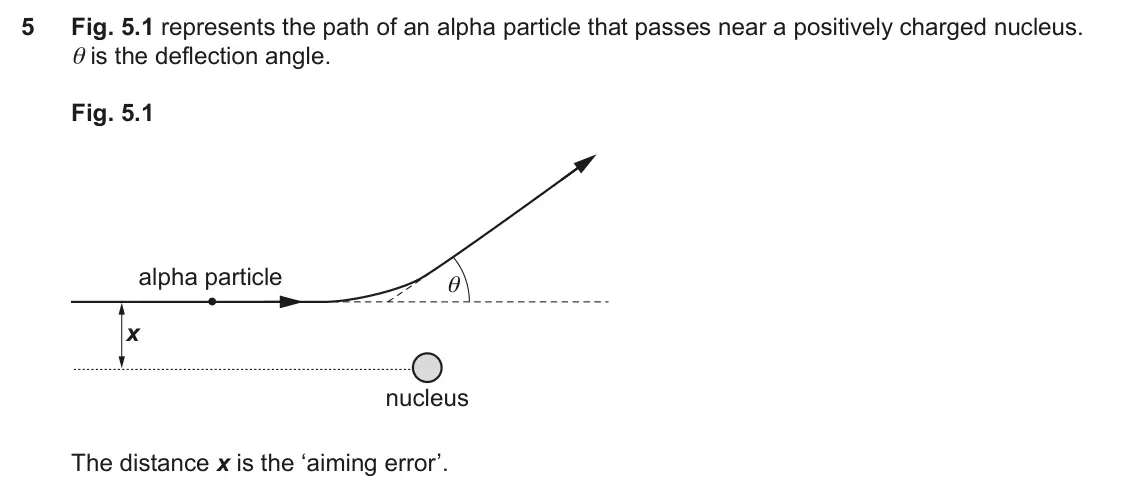
Q4(c)(i)
The whole paper ↗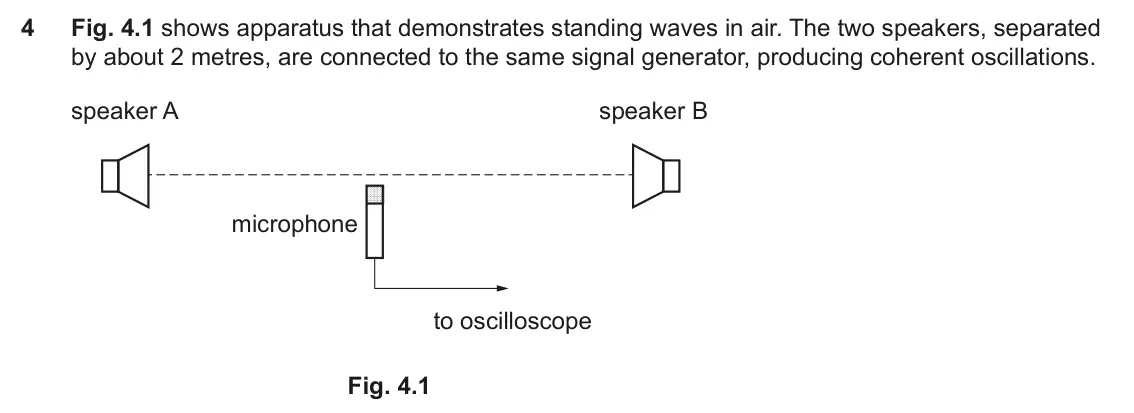
Q22(a)
The whole paper ↗
Q22(b)
The whole paper ↗Q40(a)
The whole paper ↗
Q40(c)(i)
The whole paper ↗Q26(c)
The whole paper ↗
- Your answer
- Your answer
Q23(a)
The whole paper ↗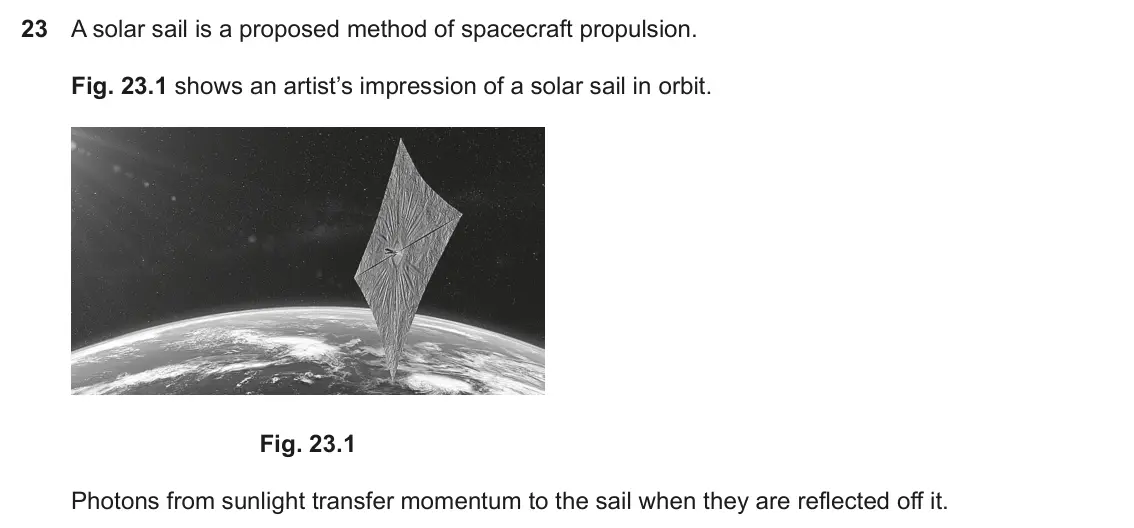
Q5(c)
The whole paper ↗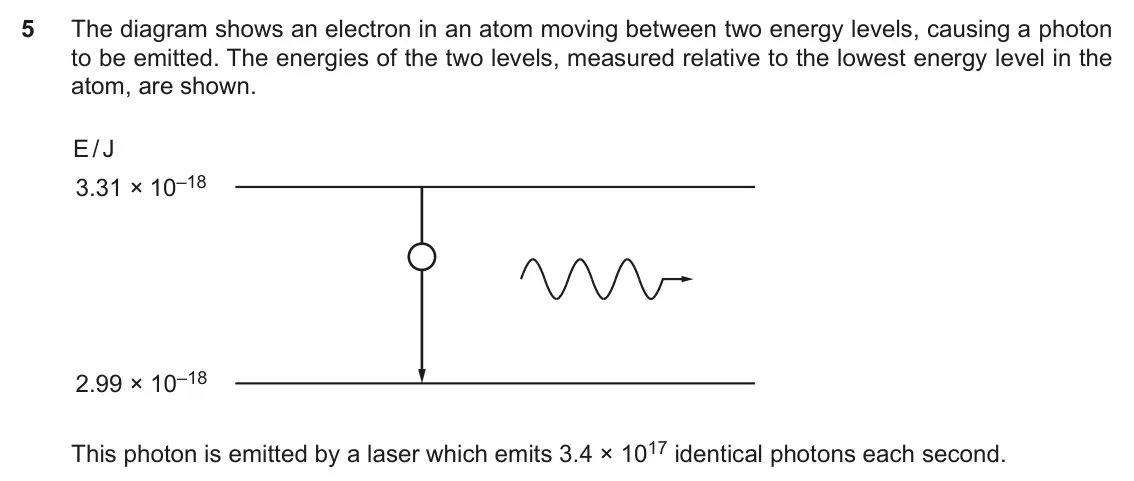
Q6(a)(i)
The whole paper ↗
Q6(a)(ii)
The whole paper ↗Q6(a)(iii)
The whole paper ↗Q6(b)(i)
The whole paper ↗Q6(b)(ii)
The whole paper ↗Q4(a)(iii)
The whole paper ↗
Q4(b)
The whole paper ↗Q4(c)
The whole paper ↗
All 29 questions on Electron diffraction and de Broglie, as a list
- June 2025, Paper 1, Q13 (1 mark): An electron travels in a straight line at non-relativistic speed. It has speed v, kinetic energy E, and wavelength λ. The kinetic energy of the electron is incr
- June 2024, Paper 2, Q5(c) (6 marks): Fig. 5.1 represents the path of an alpha particle that passes near a positively charged nucleus. θ is the deflection angle. Fig. 5.1 alpha particle θ x nucleus
- June 2023, Paper 2, Q4(c)(i) (1 mark): Show that the momentum of an electron in a box of length 2.4 × 10⁻¹⁰ m is about 1.4 × 10⁻²⁴ kg m s–1. [1]
- June 2023, AS Paper 1, Q22(a) (2 marks): Calculate the de Broglie wavelength of an electron travelling at 8.5 × 10⁶ m s–1. wavelength = m [2]
- June 2023, AS Paper 1, Q22(b) (2 marks): Explain why the pattern on the fluorescent screen has light and dark regions. You may draw a diagram to support your answer. [2]
- June 2022, Paper 1, Q40(a) (2 marks): Explain how this experiment demonstrates that electrons show wave-like and particle-like properties. [2]
- June 2022, Paper 1, Q40(c)(i) (3 marks): Calculate the de Broglie wavelength of the accelerated electron. Assume that the relativistic momentum of the electron accelerated through 50 kV is 1.2 × 10⁻²²
- June 2022, AS Paper 1, Q26(c) (2 marks): A diffraction pattern can be produced when a beam of electrons is passed through a crystal. Explain how the diffraction pattern provides evidence for the quantu
- November 2021, Paper 1, Q20 (1 mark): The hydrogen atom can be modelled as an electron standing wave. One simple version has one ‘loop’ of the standing wave fitting in the diameter of the atom, as s
- November 2021, AS Paper 1, Q5 (1 mark): A particle travels through a distance equal to its de Broglie wavelength. During this time, its phasor will rotate through an angle π A 2 B π 3π C 2 D 2π Your a
- November 2021, AS Paper 1, Q23(a) (2 marks): Show that the momentum of a photon of wavelength 560 nm is about 1.2 × 10⁻²⁷ N s. [2] This photon, of momentum p, is reflected from the sail as shown in Fig. 23
- November 2021, AS Paper 2, Q5(c) (2 marks): The laser beam strikes a black surface, and all the photons are absorbed. Calculate the force produced on the surface. force = N [2]
- November 2020, AS Paper 2, Q6(a)(i) (3 marks): Apply the principle of conservation of energy to show that the speed v of an electron accelerated through a p.d. V is given by 2 eV v = m where e and m are the
- November 2020, AS Paper 2, Q6(a)(ii) (2 marks): Show that the maximum speed that an electron can gain in the apparatus of Fig. 6.1 is about 4 × 10⁷ m s−1. [2]
- November 2020, AS Paper 2, Q6(a)(iii) (3 marks): Calculate the de Broglie wavelength λ of an electron travelling at the maximum speed and use the properties of the moving electron to state why this is the smal
- November 2020, AS Paper 2, Q6(b)(i) (4 marks): The p.d. applied to the electron gun in Fig. 6.1 is gradually increased from 0, and diffraction orders produced by the above grating are seen on the fluorescent
- November 2020, AS Paper 2, Q6(b)(ii) (3 marks): Other diffraction patterns, not shown in Fig. 6.3, are produced by the graphite lattice. These are given by atom alignments in directions different from the one
- June 2019, Paper 2, Q4(a)(iii) (1 mark): Calculate the de Broglie wavelength of the accelerated electron. wavelength = m [1]
- June 2019, Paper 2, Q4(b) (3 marks): Accelerated electrons can be diffracted by layers of graphite in a very similar way to light diffracted through a grating. When electrons are accelerated in a g
- June 2019, Paper 2, Q4(c) (6 marks): This question is about electrons showing wave-like properties. (c)* Explain how this demonstration shows that electrons can be considered as ‘quantum particles’
- June 2019, AS Paper 1, Q19 (1 mark): What is the de Broglie wavelength of an electron accelerated from rest through a p.d. of 0.90 kV? 4.1 × 10⁻¹¹ m A 5.8 × 10⁻¹¹ m B 1.4 × 10⁻⁹ m C 1.8 × 10⁻⁹ m D
- June 2018, Paper 2, Q5(b)(ii) (4 marks): Calculate the angle of the diffraction minimum for a beam of electrons accelerated through 1.5 × 10⁸ V scattered from a nucleus of diameter 3.0 × 10⁻¹⁴ m. For r
- June 2018, AS Paper 1, Q17 (1 mark): The de Broglie wavelength of an electron with kinetic energy 900 eV is 4.1 × 10⁻¹¹ m. What is the wavelength of an electron with kinetic energy 450 eV? 2.0 × 10
- June 2017, Paper 1, Q9 (1 mark): Electrons accelerated through a potential difference V pass through a thin layer of graphite. The beam forms a diffraction pattern of rings on a fluorescent scr
- June 2017, Paper 1, Q29 (1 mark): Which of the following statements about the α-particle and the β-particle is correct? A If both have the same kinetic energy, the speed of the β-particle is les
- June 2017, AS Paper 2, Q5(b) (1 mark): Show that the momentum p of each photon emitted by the laser is about 10−27 kg m s−1. [1]
- June 2016, AS Paper 1, Q27(b)(i) (1 mark): Describe evidence from Fig. 27 that indicates that free electrons trapped inside the ring of iron atoms have a wavelength. [1]
- June 2016, AS Paper 1, Q27(b)(ii) (2 marks): Using Fig. 27, make appropriate measurements to show that the wavelength of these free electrons is about 0.7 nm. [2]
- June 2016, AS Paper 1, Q27(b)(iii) (1 mark): Calculate the momentum of each electron. h = 6.6 × 10⁻³⁴ J s momentum = kg m s–1 [1]
Questions, mark schemes and examiner’s reports are © OCR, from their published past papers. Plumi isn’t affiliated with any exam board. Want whole papers? OCR A-Level Physics B past papers.
The Plumi iPad app also offers exam-style questions with AI feedback on your handwritten working.