 plumi
Forces and Newton's laws: OCR A‑Level Physics B questions
OCR A-Level Physics B past-paper questions on 4.2.5 Forces and Newton's laws, 2016–2025, with mark schemes and examiner’s reports where available.
Paper
All papers
Exam
All years
Calculations
Q1(b)
The whole paper ↗
Q1(d)(i)
The whole paper ↗Q1(d)(ii)
The whole paper ↗Q2(a)
The whole paper ↗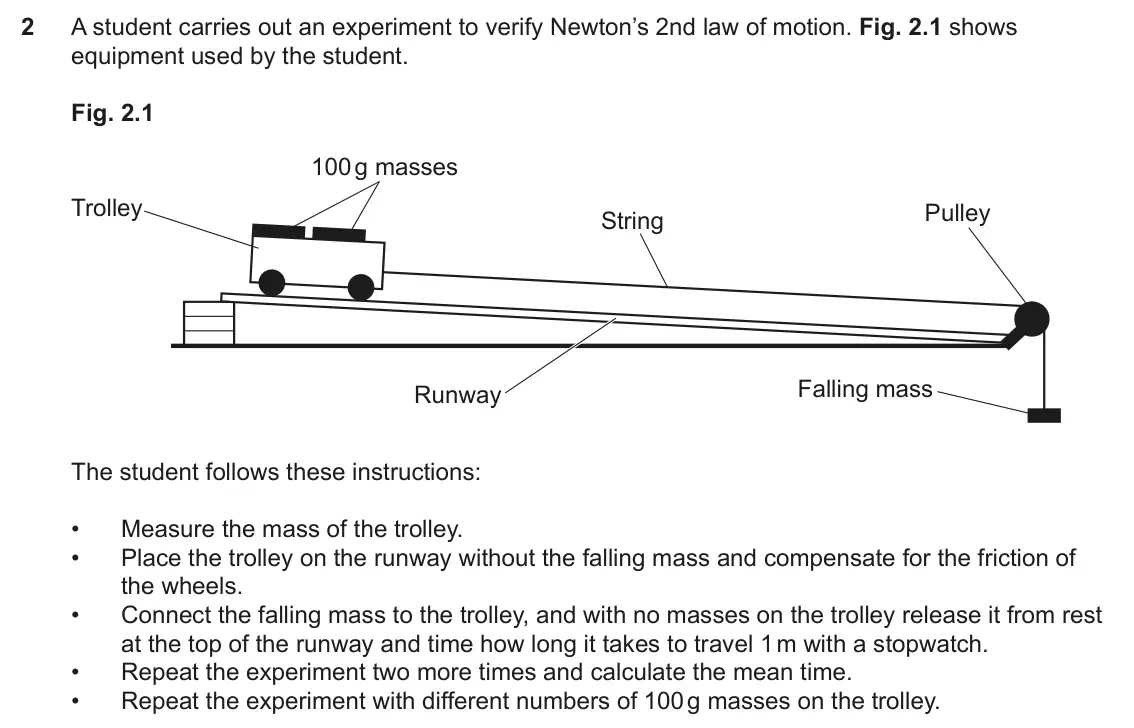
Q2(c)(i)
The whole paper ↗Q2(c)(ii)
The whole paper ↗Q7(a)(i)
The whole paper ↗
Q7(a)(ii)
The whole paper ↗Q7(a)(iii)
The whole paper ↗Q7(c)
The whole paper ↗- Your answer
- Your answer
Q1(a)(ii)
The whole paper ↗
Q1(c)
The whole paper ↗Q4(c)(ii)
The whole paper ↗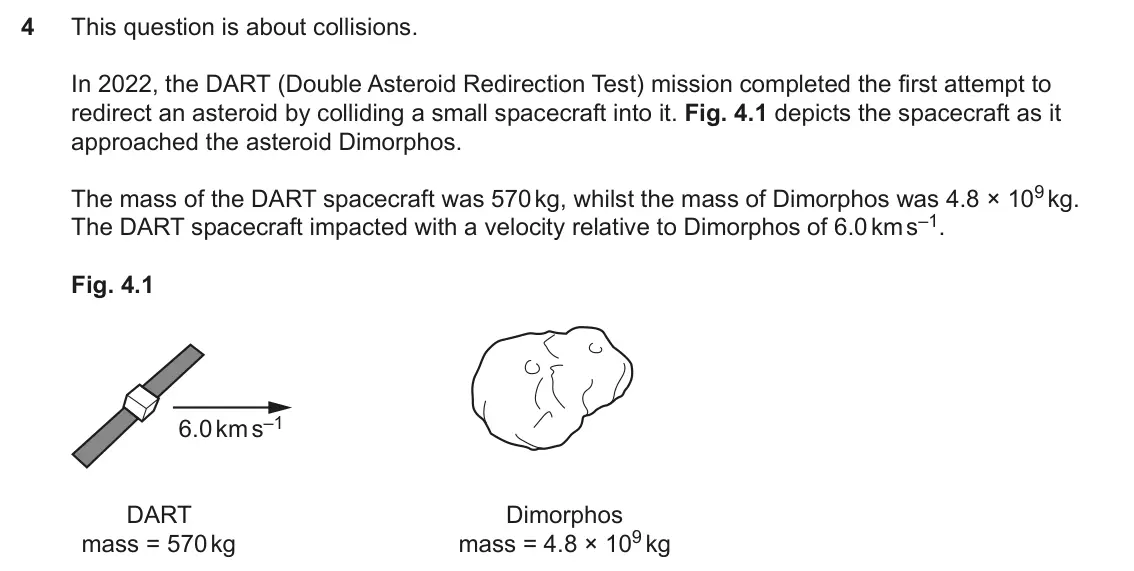
Q4(d)
The whole paper ↗Q4(e)
The whole paper ↗- Your answer
Q4(a)
The whole paper ↗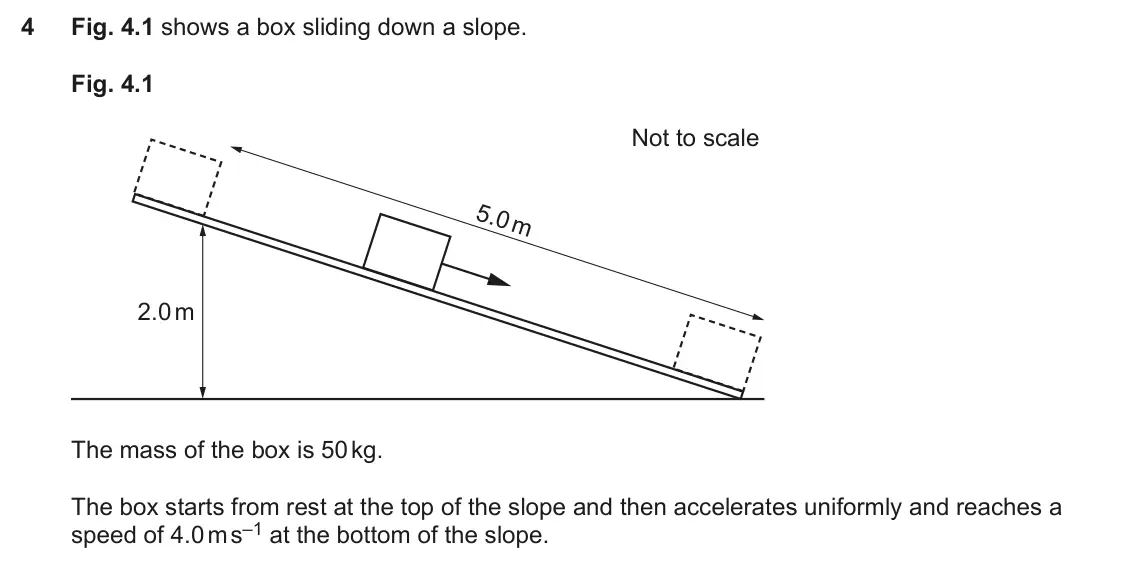
Q5(a)
The whole paper ↗
All 96 questions on Forces and Newton's laws, as a list
- June 2025, Paper 3, Q1(b) (3 marks): The cupcake case will accelerate from rest to reach terminal velocity at some point during its fall. The student is calculating the average velocity. Comment on
- June 2025, Paper 3, Q1(d)(i) (2 marks): Show that vt [2]
- June 2025, Paper 3, Q1(d)(ii) (6 marks): This question is about terminal velocity and drag for falling cupcake cases. (ii)* Calculate the values of average velocity squared in Table 1.3. Determine whet
- June 2025, AS Paper 2, Q2(a) (2 marks): Explain how the student compensates for the friction of the wheels. [2]
- June 2025, AS Paper 2, Q2(c)(i) (2 marks): Perform an arithmetical test to find if these results support Newton’s 2nd law of motion. Explain your conclusion. [2]
- June 2025, AS Paper 2, Q2(c)(ii) (2 marks): Describe a graph that the student could draw with these results and explain how the graph would show if the results agreed with Newton’s 2nd law of motion. [2]
- June 2025, AS Paper 2, Q7(a)(i) (3 marks): Calculate the speed of the exhaust gases from the rocket. speed = m s–1 [3]
- June 2025, AS Paper 2, Q7(a)(ii) (2 marks): Show that the acceleration immediately after the ignition of the fuel is about 4.2 m s–2. [2]
- June 2025, AS Paper 2, Q7(a)(iii) (2 marks): Explain why the acceleration of the rocket increases during the first three seconds after it is launched. [2]
- June 2025, AS Paper 2, Q7(c) (6 marks): A model rocket is propelled vertically upwards by a solid fuel rocket engine. Before it is launched the total mass of the rocket and the fuel is 0.500 kg. When
- June 2024, Paper 1, Q18 (1 mark): A car comes to rest after the brakes have been applied. The graph shows how the velocity of the car varies with time. 15 velocity / m s–1 0 20 0 time / s The ma
- June 2024, Paper 1, Q25 (1 mark): An object is submerged in water and has three vertical forces acting on it – its weight, drag and upthrust. upthrust weight + drag weight = 490 N and upthrust =
- June 2024, Paper 2, Q1(a)(ii) (1 mark): The combined weight of the parasailor and sail is 870 N. Calculate the vertical upwards force on the parasailor and sail. vertical upwards force = N [1]
- June 2024, Paper 2, Q1(c) (2 marks): The boat accelerates. State whether the tension in the rope will increase, decrease or remain at 550 N when the parasail is moving at a greater constant horizon
- June 2024, Paper 3, Q4(c)(ii) (3 marks): The graph suggests there is a drag or frictional force acting on the rider as it decelerates. Use the graph to estimate the magnitude of this force. magnitude o
- June 2024, Paper 3, Q4(d) (2 marks): The DART spacecraft did not have to contend with atmospheric drag. The student decides to investigate the effect of drag on velocity of the rider following a co
- June 2024, Paper 3, Q4(e) (6 marks): This question is about collisions. In 2022, the DART (Double Asteroid Redirection Test) mission completed the first attempt to redirect an asteroid by colliding
- June 2024, AS Paper 1, Q11 (1 mark): Newton’s Third Law refers to a pair of forces. What properties do those forces have? Magnitude Direction Acting On A Different Same One object B Different Same
- June 2024, AS Paper 2, Q4(a) (4 marks): Show that the frictional force acting on the box as it slides down the slope is about 120 N. [4]
- June 2024, AS Paper 2, Q5(a) (2 marks): Newton’s 2nd law can be expressed as F = Δ p Δ t . Explain the significance of the symbols Δ p and Δ t in this equation and show how this expression leads to th
- June 2024, AS Paper 2, Q7(a)(i) (4 marks): Use the graph to calculate the acceleration of the cone at 0.40 s. acceleration = m s–2 [4]
- June 2024, AS Paper 2, Q7(a)(ii) (3 marks): The student repeats the experiment with a 20 g mass placed in the cone. On Fig. 7.2 sketch a graph for the 2nd experiment and explain the shape of the graph you
- June 2024, AS Paper 2, Q7(b)(i) (2 marks): Show that the value of k for the ball is about 0.1 m–1. [2] 18 The student uses an computational model with a computer spreadsheet to model the change in veloci
- June 2024, AS Paper 2, Q7(b)(ii) (1 mark): Calculate the acceleration of the ball at 0.30 s. acceleration = m s–2 [1]
- June 2024, AS Paper 2, Q8(a) (3 marks): The 500 g trolley moves with constant velocity along the slope when the 50 g mass is removed. Calculate the component of the weight of the 500 g trolley that ac
- June 2024, AS Paper 2, Q8(b)(iii) (6 marks): A student investigates the effect of changing the mass of a trolley on its acceleration when the resultant force acting on it is constant. The trolley is placed
- June 2023, Paper 1, Q17 (1 mark): A cable supports a lift of mass 900 kg. At t = 0 s the lift is stationary. At t = 0.5 s the lift starts accelerating upwards at 2.0 ms–2 until t = 1.5 s when it
- June 2023, Paper 2, Q2(b) (2 marks): The wrapped t-shirt is accelerated by a release of compressed gas into the barrel of the cannon. The barrel is 1.4 m long as shown in Fig. 2.2. Calculate the av
- June 2023, Paper 2, Q2(c) (3 marks): The barrel has a uniform radius of 0.05 m. When the compressed gas is released the pressure on the left side of the T-shirt is 4.0 × 10⁴ Pa greater than atmosph
- June 2023, Paper 2, Q9(b)(ii) (2 marks): Calculate the magnitude of the force exerted on the surface. density of water = 1000 kg m–3 force = N [2]
- June 2023, Paper 2, Q9(b)(iv) (4 marks): Describe and explain how the design of the vane increases the power output of the Pelton turbine (see Fig. 7 in the article). [4]
- June 2023, AS Paper 1, Q27(a) (2 marks): Describe the vertical forces on the cone when at its ‘terminal velocity’. [2]
- June 2023, AS Paper 1, Q27(c) (2 marks): Explain why the instantaneous speed of the cone during its fall cannot be calculated using the equation: v2 = u2 + 2as. [2] The students form the hypothesis tha
- June 2023, AS Paper 2, Q3(b) (1 mark): Calculate the mean force exerted on glider B by glider A during the impact. mean force = N [1]
- June 2022, Paper 1, Q37(b)(i) (2 marks): Calculate the power required for the train to maintain a speed of 300 km / h against the drag force. power = W [2]
- June 2022, Paper 1, Q37(b)(ii) (6 marks): This question is about Japanese ‘Shinkansen’ or bullet trains such as the one shown in Fig. 37.1. Fig. 37.1 (ii)* The mass of the bullet train without passenger
- June 2022, Paper 2, Q1(a) (1 mark): Ignoring any upthrust forces, state why the drag force D must be equal and opposite to the weight W of the drop when it is falling at terminal velocity. [1]
- June 2022, Paper 2, Q1(b) (2 marks): The drag force is given by the equation D = 6πηairrv where r is the radius of the oil drop and v is the terminal velocity. The symbol ηair represents the viscos
- June 2022, Paper 2, Q4(a)(i) (2 marks): The reading on the electronic balance changes when the current in the wire changes. Explain why this is an example of Newton’s Third Law of motion. [2]
- June 2022, AS Paper 1, Q9 (1 mark): A large object falls vertically through the atmosphere. Which graph would be obtained by plotting: • velocity of the object on the y-axis • time on the x-axis?
- June 2022, AS Paper 1, Q22(a) (1 mark): What is the magnitude of the vertical component of the lift force, L? magnitude of L = N [1]
- June 2022, AS Paper 2, Q6(a)(i) (3 marks): Describe and explain the shape of the graph in Fig. 6.2. [3]
- June 2022, AS Paper 2, Q6(a)(ii) (2 marks): Use Fig. 6.2 to calculate g, the acceleration due to gravity on the surface of Mars. Mass of Perseverance rover = 1030 kg g = N kg–1 [2]
- November 2021, Paper 1, Q18 (1 mark): A metal spike of mass 2.8 kg is dropped onto level ground from a height of 4.0 m, measured from the point of the spike. It penetrates into the ground a distance
- November 2021, Paper 1, Q37(a) (1 mark): State what is meant by a friction compensated runway. [1]
- November 2021, Paper 1, Q37(c)(iii) (2 marks): Show that the force on the nozzle is about 700 N. Use 0.020 m3 s–1 is equivalent to 20 kg s–1 for water [2]
- November 2021, AS Paper 1, Q23(c) (2 marks): Explain why there is a force on the solar sail. [2]
- November 2021, AS Paper 2, Q5(c) (2 marks): The laser beam strikes a black surface, and all the photons are absorbed. Calculate the force produced on the surface. force = N [2]
- November 2021, AS Paper 2, Q6(a)(i) (3 marks): Use the data below to show that the downward thrust from the rocket at the moment of take-off is about 55 kN. Initial acceleration of ascent stage = 2.1 m s–2 M
- November 2021, AS Paper 2, Q6(a)(iii) (2 marks): As the rocket fired, 15 kg per second of exhaust gases were ejected each second. Use the answer to (i) to calculate the velocity of the exhaust gases leaving th
- November 2021, AS Paper 2, Q6(c)(i) (1 mark): The process used is to calculate each value of v from the one before. The mass m and resultant force F are constant throughout giving constant acceleration a =
- November 2021, AS Paper 2, Q6(c)(ii) (1 mark): If 50 kg of fuel is burnt each second, Table 6.1 becomes as follows. a / m s–2 v / m s–1 t / s m / kg F / N 0 1000 2000 2.0 0.0 2 900 2000 4.0 4 800 2000 6 700
- November 2021, AS Paper 2, Q6(c)(iv) (2 marks): Explain the effect of including the loss of mass in the calculations of velocity shown in Table 6.1 and Table 6.2 above. [2]
- November 2021, AS Paper 2, Q7(c) (6 marks): This question is about electric vehicles (EVs). heavy load electric car being charged fork-lift truck in use Fig. 7.1 (c)* Table 7.3 displays data for two diffe
- November 2020, Paper 1, Q27 (1 mark): At which point A, B, C or D does the rocket run out of fuel? Your answer [1]
- November 2020, Paper 1, Q28 (1 mark): At which point A, B, C or D does the rocket experience the greatest force of air resistance? Your answer [1] 17 The following information is for use in question
- November 2020, Paper 1, Q37(c) (6 marks): Fig. 37.1 shows how an approximation to a parabolic trajectory (x - y graph) can be built in steps for a projectile launched at 45°, undergoing constant downwar
- November 2020, Paper 2, Q5(a)(iii) (6 marks): A student uses the apparatus shown in Fig. 5.1 to investigate ‘bungee jumping’, a sport where players drop from a high point such as a bridge while attached to
- November 2020, AS Paper 1, Q25(c) (2 marks): Explain how we know this from the video frame images. [2]
- November 2020, AS Paper 1, Q25(d) (2 marks): Determine as precisely as possible a value for the terminal speed of the ball. terminal speed = m s−1 [2]
- November 2020, AS Paper 2, Q1(a) (3 marks): The electric motor provides an initial force of 260 kN. Use this value to calculate the minimum time taken for the train to reach its maximum speed, starting fr
- November 2020, AS Paper 2, Q1(b) (2 marks): Explain why the value calculated in (a), using a force of 260 kN, is a minimum time. [2]
- November 2020, AS Paper 2, Q7(a)(ii) (2 marks): The ball is stationary when the racket first hits it and the ball is in contact with the strings of the racket for 2.0 ms. Show that the mean force that the bal
- June 2019, AS Paper 1, Q5 (1 mark): A large object falls vertically through the atmosphere. Write down the letter of the graph that would be obtained by plotting: • velocity v of the object on the
- June 2019, AS Paper 2, Q5(a) (3 marks): Calculate the acceleration a of the trolley along the ramp. a = m s–2 [3]
- June 2019, AS Paper 2, Q7(a) (4 marks): Show that the upthrust U acting on a table-tennis ball in air of density 1.2 kg m–3 is less than 2% of the weight W of the ball. weight of table-tennis ball = 0
- June 2019, AS Paper 2, Q7(b) (3 marks): When the ball moves at a velocity v, it experiences a force D due to air drag given by D = ½ ρA Cd v 2 where ρ is the air density, A is the cross-sectional area
- June 2019, AS Paper 2, Q7(c)(ii) (1 mark): State how the graph shows that the ball has reached its terminal velocity within about 3 s of being released. [1]
- June 2019, AS Paper 2, Q7(d) (4 marks): Explain how the way in which a table-tennis ball falls would be different if it were dropped in an atmosphere of argon, which is denser and has a larger drag co
- June 2018, Paper 1, Q37(a)(ii) (3 marks): The total photon power of the radiation received from the Sun on a 1.0 m2 area of solar sail is P. 2 P Show that the thrust force T from photon reflection is gi
- June 2018, Paper 1, Q37(a)(iii) (2 marks): The total photon power density is 1400 W m−2. The 1.0 tonne spacecraft has a 106 m2 solar sail. Calculate the acceleration of the spacecraft. acceleration = m s
- June 2018, Paper 1, Q37(b)(iii) (2 marks): An ion drive with accelerating p.d. V = 2000 V must produce a thrust of 0.24 N. m D is less than 4 # 10−7 kg s−1. Show that the mass flow rate t D Q for 1H+ ion
- June 2018, Paper 2, Q4(a)(ii) (2 marks): Explain why two objects of different masses dropped from the top of the tower should accelerate at the same rate if air resistance is ignored. [2]
- June 2018, Paper 2, Q4(b)(ii) (6 marks): This question is about objects falling in a gravitational field. (ii)* Further iterations of the calculation produce the graph in Fig. 4.3. 60 s / m 50 40 30 20
- June 2018, Paper 3, Q3(a) (3 marks): Explain why the oil drop falls at constant velocity through the air. [3]
- June 2018, AS Paper 1, Q14 (1 mark): A ball of mass 0.12 kg falls vertically from rest and bounces. The collision with the ground is elastic, so kinetic energy is conserved. The duration of the col
- June 2018, AS Paper 1, Q26(a) (2 marks): One student has an incorrect interpretation of this diagram. This is an example of Newton’s Third Law – Action and reaction are equal and opposite. L and W are
- June 2018, AS Paper 1, Q26(b) (2 marks): The engines are stopped and the thrust T becomes zero. The aircraft continues flying. Explain, using Newton’s Laws, how the aircraft will move once the engines
- June 2018, AS Paper 1, Q26(c) (1 mark): The mass of the aircraft when its engines are stopped is 4.0 × 10⁵ kg and the drag D is 1.2 MN. Calculate the deceleration of the aircraft just after the engine
- June 2018, AS Paper 2, Q4(a) (2 marks): At the start, the gases are ejected at a rate of 47 g s–1 with a speed of 110 m s–1 relative to the rocket and the ground. Show that the rocket exerts a downwar
- June 2018, AS Paper 2, Q4(b) (2 marks): Calculate the initial upward acceleration of the rocket. g = 9.8 m s–2 acceleration = m s–2 [2]
- June 2018, AS Paper 2, Q4(c) (2 marks): Explain why this acceleration is correct only at the instant when the rocket engine starts. [2]
- June 2017, Paper 1, Q37(a) (2 marks): Fig. 37.2 shows the graph of velocity against time obtained by analysing the video recording. This method has an uncertainty of about ± 3% for velocity measurem
- June 2017, Paper 1, Q37(b) (2 marks): Describe the motion shown in the graph at time t = 0.5 s and explain it by reference to the forces acting on the ball bearing. [2]
- June 2017, Paper 1, Q37(c)(i) (2 marks): The investigation is extended to see how the terminal velocity vT varies with ball bearing diameter D. Identify and justify one other variable that you would co
- June 2017, Paper 2, Q3(b) (4 marks): A sail has an area 8.0 m2. A wind of velocity 18.0 m s–1 strikes the sail at 90° to the surface of the sail. It is assumed that the velocity of the wind falls t
- June 2017, AS Paper 1, Q10 (1 mark): The velocity-time graph represents the motion of a parachutist after her parachute opens, but before she reaches terminal velocity. velocity time During the tim
- June 2017, AS Paper 1, Q11 (1 mark): The graph represents the motion of a car stopping in an emergency. The driver takes a short time to react before applying the brakes. momentum P Q time Which st
- June 2017, AS Paper 2, Q5(c) (1 mark): The light from the laser strikes a surface which absorbs all light falling on it. Calculate the force F that the photons exert on this surface. F = N [1]
- June 2017, AS Paper 2, Q6(b) (3 marks): A real projectile such as a tennis ball is greatly affected by air resistance. State and explain how you would expect the R–i graph for such a projectile, also
- June 2016, AS Paper 1, Q9 (1 mark): The graph shows the resultant force on a football as it is kicked. force 0 0 time Which of the following graphs relating to this kick would have the same shape
- June 2016, AS Paper 1, Q25(a) (1 mark): Explain why the magnitude of T1 is 4600 N. [1]
- June 2016, AS Paper 1, Q26(b) (2 marks): Calculate the mean force acting between the lorry and truck during the collision which lasts 20 ms. mean force = N [2]
- June 2016, AS Paper 1, Q29(a)(iv) (2 marks): Suggest one systematic error that exists in this method of finding the terminal velocity, and how it affects the estimate. [2] Question 29 continues on page 26
- June 2016, AS Paper 1, Q29(b)(i) (2 marks): Use the data from the table or the graph to make a new estimate for the terminal velocity. The table has a blank column for you to use, if required. Make your m
- June 2016, AS Paper 1, Q29(b)(ii) (3 marks): Describe an experiment that could give the data in Fig. 29.3 and justify one way in which this method is better than that in (a). [3]
Questions, mark schemes and examiner’s reports are © OCR, from their published past papers. Plumi isn’t affiliated with any exam board. Want whole papers? OCR A-Level Physics B past papers.
The Plumi iPad app also offers exam-style questions with AI feedback on your handwritten working.