 plumi
Reaction mechanisms: OCR A‑Level Chemistry B questions
Every OCR A-Level Chemistry B exam question on OZ Reaction mechanisms (specification points OZ(l)–(q)), 2016–2025, with its mark scheme and examiner’s report.
Find questions2,049
Calculations

Q1(a)(ii)
The whole paper ↗
Q1(a)(v)
The whole paper ↗
Q1(b)(i)
The whole paper ↗
Q1(b)(ii)
The whole paper ↗

Q22(a)
The whole paper ↗
Q22(b)
The whole paper ↗


Q34(c)
The whole paper ↗
Q5(a)(i)
The whole paper ↗
Q5(a)(ii)
The whole paper ↗
Q5(a)(iii)
The whole paper ↗

Q23(d)(i)
The whole paper ↗
Q23(d)(ii)
The whole paper ↗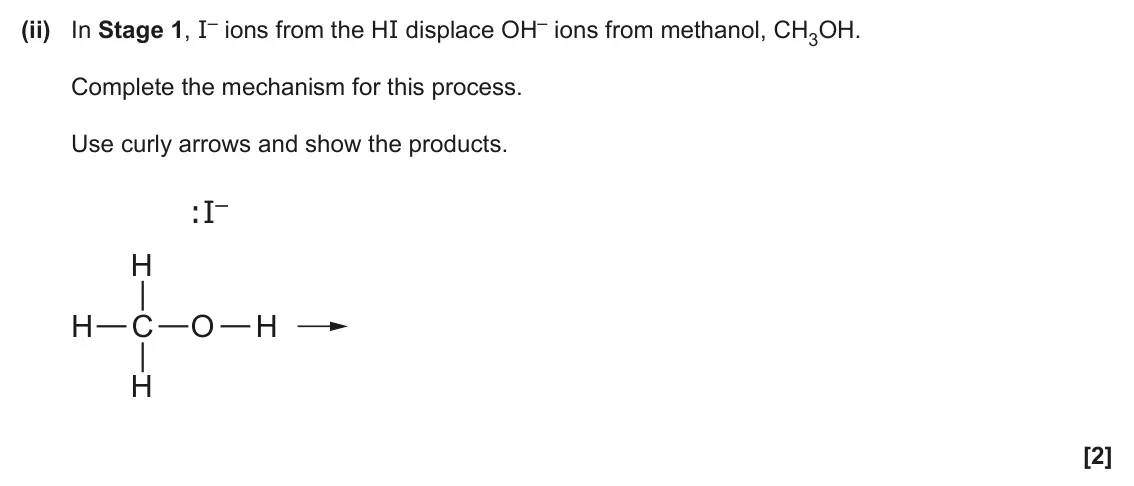
Q2(d)(i)
The whole paper ↗
All 86 questions on Reaction mechanisms, as a list
- June 2025, Paper 1, Q9 (1 mark): What is correct about chlorine radicals in the atmosphere? A They act as homogeneous catalysts that increase ozone depletion. B They are formed by heterolytic f
- June 2025, Paper 2, Q1(a)(ii) (2 marks): Draw ‘half curly arrows’ to show the mechanism of the homolytic fission of CH3Cl . Show the products of the reaction. H H C Cl H [2]
- June 2025, Paper 2, Q1(a)(v) (2 marks): Chlorine radicals catalyse the breakdown of ozone in the stratosphere. Write equations to show how this occurs and give the overall equation. Overall equation:
- June 2025, Paper 2, Q1(b)(i) (1 mark): Explain what is meant by the term nucleophile. [1]
- June 2025, Paper 2, Q1(b)(ii) (2 marks): Show the mechanism of Equation 1.1. Use curly arrows and show relevant lone pairs and the ionic products. H H C Cl H H N H H [2]
- June 2025, Paper 2, Q1(c) (2 marks): The reaction between a haloalkane and hydroxide ions is a nucleophilic substitution reaction. A student reacts 1-chlorobutane, 1-bromobutane and 1-iodobutane se
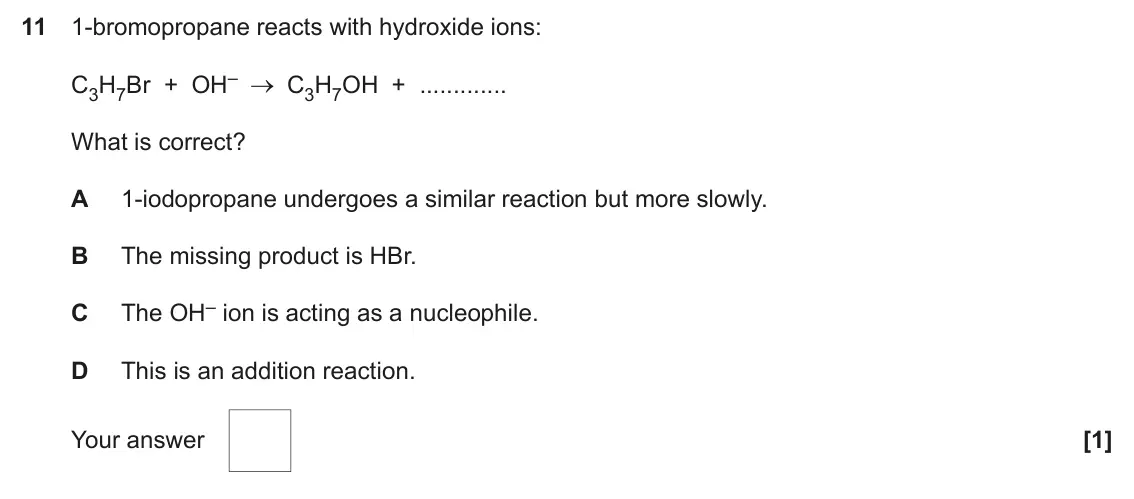
- June 2025, AS Paper 1, Q11 (1 mark): 1-bromopropane reacts with hydroxide ions: C3H7Br + OH– C3H7OH + What is correct? A 1-iodopropane undergoes a similar reaction but more slowly. B The missing pr
- June 2025, AS Paper 1, Q22(a) (3 marks): C2H5Cl can be made by reacting ethane with chlorine. Complete the stages for this process: Stage 1: Initiation Chlorine radicals are formed from chlorine molecu
- June 2025, AS Paper 1, Q22(b) (4 marks): C2H5Cl was once used as an aerosol propellant in spray cans. It is no longer used because it causes the breakdown of ozone in the stratosphere. Describe how C2H
- June 2024, Paper 1, Q20 (1 mark): A student is measuring the relative rates of reaction of 1-chlorobutane, 1-bromobutane and 1-iodobutane with aqueous silver nitrate. Which statement is correct?
- June 2024, Paper 1, Q25 (1 mark): Methane reacts with chlorine by a radical mechanism. There is an initiation reaction, two propagation reactions and various termination reactions. The overall e
- June 2024, Paper 1, Q34(c) (1 mark): The alcohol CH3CH2CH(OH)CH3 can be made by reacting CH3CH2CHBrCH3 with aqueous sodium hydroxide. Name the mechanism of this reaction. [1]
- June 2024, Paper 2, Q5(a)(i) (1 mark): Chlorine radicals are formed when CFCs are ‘shredded’ with ultraviolet radiation, as in: HF2C––Cl HF2C + Cl Draw ‘half curly arrows’ on the CFC structure above
- June 2024, Paper 2, Q5(a)(ii) (1 mark): State the type of bond breaking that occurs in (a)(i). Explain why you have chosen this answer. [1]
- June 2024, Paper 2, Q5(a)(iii) (2 marks): Write equations for two propagation reactions in which chlorine radicals catalyse the breakdown of ozone. Equation 1: Equation 2: [2]
- June 2024, Paper 2, Q5(d) (6 marks): This question concerns the Advance Notice Article ‘Reactive Oxygen Species’ that is included as an insert with this paper. (d)* Of the three reactive oxygen spe
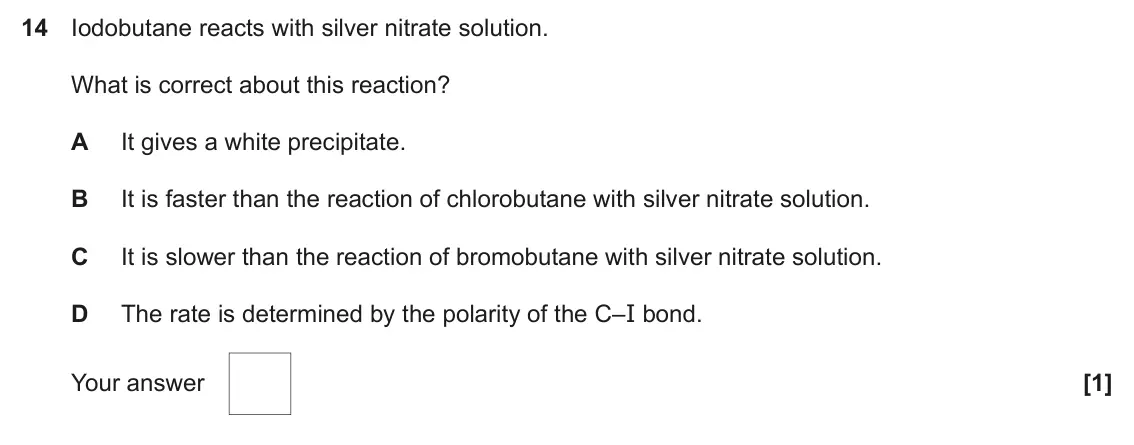
- June 2024, AS Paper 1, Q14 (1 mark): Iodobutane reacts with silver nitrate solution. What is correct about this reaction? A It gives a white precipitate. B It is faster than the reaction of chlorob
- June 2024, AS Paper 1, Q23(d)(i) (1 mark): What is a nucleophile? [1]
- June 2024, AS Paper 1, Q23(d)(ii) (2 marks): In Stage 1, I– ions from the HI displace OH– ions from methanol, CH3OH. Complete the mechanism for this process. Use curly arrows and show the products. :I– H H
- June 2024, AS Paper 2, Q2(d)(i) (1 mark): Add ‘half curly arrows’ to show how the bond breaks. F F C Cl Cl + F3C F [1]
- June 2024, AS Paper 2, Q2(d)(ii) (1 mark): Explain why the C–Cl bond breaks in this reaction rather than the C–F bond. [1]
- June 2024, AS Paper 2, Q2(d)(iii) (1 mark): Chlorine atoms in the stratosphere catalyse the conversion of ozone into oxygen. Complete the following two equations to show how this happens. Cl + O3 + O2 + C
- June 2023, Paper 2, Q4(d)(i) (1 mark): Name the mechanism of Reaction 1. [1]
- June 2023, Paper 2, Q4(d)(ii) (6 marks): 3-oxobutanoic acid is formed from carboxylic acids in the liver in the human body. It is then broken down to produce propanone and 3-hydroxybutanoic acid. CH3CO
- June 2023, Paper 3, Q1(d) (2 marks): Chlorine atoms also act as catalysts to remove ozone. The atoms can be formed by the reaction shown below. Cl 2 2Cl What conditions are needed for this reaction
- June 2023, Paper 3, Q1(e) (2 marks): By contrast, chloride ions react in a different way, for example in the reaction below. Mark ‘curly arrows’ on the diagram and give the other product. H O+ R C
- June 2023, AS Paper 1, Q22(a)(i) (1 mark): Draw a mechanism (including ‘half curly arrows’) to show how a chlorine molecule is split to produce chlorine radicals. [1]
- June 2023, AS Paper 1, Q22(a)(ii) (1 mark): Name the type of bond fission occurring in part (i). [1]
- June 2023, AS Paper 1, Q22(b)(i) (1 mark): Identify a termination reaction from Equation 22.1, Equation 22.2 and Equation 22.3. Explain your answer. Equation Explanation [1]
- June 2023, AS Paper 1, Q22(b)(ii) (5 marks): A student says: • The reactions shown in Equation 22.1 and Equation 22.2 work together to cause the breakdown of ozone by the equation shown below: 2O3 3O2 • Th
- June 2022, Paper 1, Q32(a) (3 marks): A student says that when CFCs decompose they release F atoms. This is because the C–F bond is more polar than the C–Cl bond and breaks more easily. Comment on t
- June 2022, Paper 1, Q32(c)(ii) (1 mark): The NO radical depletes ozone in a catalytic cycle. The first reaction in the cycle is shown below. Suggest an equation to complete the cycle. NO + O3 NO2 + O2
- June 2022, Paper 1, Q32(d)(i) (1 mark): Identify the compounds D and E. D is E is [1]
- June 2022, Paper 1, Q32(d)(ii) (3 marks): Use your knowledge of the stages of the mechanism of Reaction 32.1 to suggest equations showing how D and E are formed. [3]
- June 2022, Paper 3, Q1(d) (6 marks): This question is about haloalkanes and their reactivity. (d)* A student wishes to compare the relative reactivities of haloalkanes. The student investigates the
- June 2022, AS Paper 1, Q22(c)(i) (1 mark): Chlorine radicals catalyse the breakdown of ozone. The catalytic process can be shown by two equations. Write the equation for reaction 22.2. Cl + O3 Cl O + O2
- June 2022, AS Paper 1, Q22(c)(ii) (1 mark): Give the equation for a possible termination reaction to end this sequence. [1]
- June 2022, AS Paper 1, Q22(e) (4 marks): CH3CH2Cl reacts with hydroxide ions as shown in reaction 22.4. CH3CH2Cl + OH– CH3CH2OH + Cl – Reaction 22.4 Compare reactions 22.3, in part (d), and 22.4 in ter
- June 2022, AS Paper 2, Q2(c)(i) (1 mark): Give the overall equation for the reaction that occurs in the cycle. [1]
- November 2021, Paper 1, Q32(a) (2 marks): The first substance to be formed is chloroethane, C2H5Cl. The reaction occurs by a radical mechanism. In the initiation step, chlorine radicals are formed. Comp
- November 2021, Paper 1, Q32(b)(ii) (2 marks): Give two words that classify the reaction mechanism of the reaction in (i). [2]
- November 2021, Paper 1, Q32(c)(i) (1 mark): State the colours of the precipitates. Colour from chloroethane Colour from iodoethane [1]
- November 2021, Paper 1, Q32(c)(iii) (3 marks): A student predicts that C–Cl is more polar than C–I and therefore chloroethane will react faster than iodoethane. Comment on the student’s predictions. [3]
- November 2021, AS Paper 2, Q3(a) (1 mark): HCFCs can react in the troposphere with OH radicals. OH radicals are formed from water molecules in the stratosphere. What type of bond breaking occurs when OH
- November 2021, AS Paper 2, Q3(c)(i) (1 mark): CCl3F breaks down in the stratosphere by the reaction shown below. CCl3F CCl2F + Cl Chlorine radicals catalyse the breakdown of ozone in the stratosphere. Compl
- November 2021, AS Paper 2, Q3(e)(ii) (1 mark): Explain which of chloromethane and bromomethane would undergo hydrolysis more rapidly. [1]
- November 2021, AS Paper 2, Q3(e)(iii) (1 mark): Give two words that describe the mechanism of the hydrolysis reaction in (e)(i). [1]
- November 2021, AS Paper 2, Q3(g)(i) (2 marks): Use ‘curly arrows’ to complete the mechanism for the second stage of this reaction. H H H N+ H C H + : N H H H H [2]
- November 2021, AS Paper 2, Q3(g)(ii) (1 mark): This reaction also produces dimethylamine, (CH3)2NH, in a mixture of organic products. Use the mechanism for the first stage of the reaction to help you suggest
- November 2020, Paper 1, Q12 (1 mark): Which reaction involves heterolytic fission of halogen molecules? A The formation of chlorine radicals from chlorine molecules. B The electrophilic substitution
- November 2020, Paper 1, Q33(c)(ii) (1 mark): Cl CH2CH2Cl can be converted to HOCH2CH2OH by refluxing with sodium hydroxide solution. Name the mechanism for this reaction. [1]
- November 2020, AS Paper 1, Q21(c)(i) (1 mark): Write equation 21.3 in the box to show how chlorine atoms are regenerated. [1]
- November 2020, AS Paper 1, Q21(c)(ii) (1 mark): Write equation 21.4 in the box to show a possible termination reaction. [1]
- November 2020, AS Paper 1, Q21(c)(iii) (1 mark): Write the types of reaction in equations 21.2 and 21.3 in the empty boxes in the ‘Type’ column. [1]
- November 2020, AS Paper 1, Q21(d)(i) (1 mark): Use ‘half curly arrows’ to show how the bond breaks and describe the type of bond breaking process. C – Cl type of bond breaking process [1]
- November 2020, AS Paper 1, Q21(e)(i) (1 mark): What is meant by the term nucleophile? [1]
- November 2020, AS Paper 1, Q21(e)(ii) (2 marks): Draw the mechanism for the nucleophilic substitution of hydroxide ions on the C–Cl bond shown below. Use ‘curly arrows’ and full and partial charges. Show the p
- June 2019, Paper 1, Q11 (1 mark): The relative rates of hydrolysis of chloropropane and iodopropane are compared. Which statement is correct? A Chloropropane hydrolyses faster because the C–Cl b
- June 2019, Paper 1, Q33(b) (1 mark): The natural reactions involving ozone in the atmosphere are disrupted by the presence of chlorine radicals from CFCs, for example CCl2F2. Show, by means of curl
- June 2019, Paper 1, Q33(c) (2 marks): Some reactions involved in the depletion of ozone by CFCs are shown in the table below. Classify each of these reactions as initiation, propagation or terminati
- June 2019, Paper 2, Q4(a) (2 marks): A student says that oxides of nitrogen catalyse the breakdown of ozone in the stratosphere by the reactions shown below. NO2 + O3 → NO3 + O2 O3 + NO3 → NO2 + 2O
- June 2019, Paper 2, Q5(d) (1 mark): Fig. 2 in the Article shows the formation of naphthalene from benzene. Suggest the first step in the formation of a larger PAH from naphthalene. [1]
- June 2019, Paper 2, Q5(e)(i) (1 mark): Classify this reaction as initiation, propagation or termination with a reason. [1]
- June 2019, AS Paper 2, Q4(a)(ii) (2 marks): Correct the incorrect part of the statement, giving a reason for the correction. [2]
- June 2018, Paper 1, Q11 (1 mark): What is not correct for the reaction between aqueous OH– ions and bromoethane? A OH– ions behave as nucleophiles. B An alcohol is produced. C The reaction is fa
- June 2018, Paper 1, Q22 (1 mark): Which observation is correct? A A solution of bromine water forms a purple layer when hexane is added. B Aqueous silver nitrate forms a yellow precipitate when
- June 2018, Paper 1, Q34(b)(i) (1 mark): Explain why the reaction in equation 34.3 is classed as a propagation step. [1]
- June 2018, AS Paper 2, Q3(a)(i) (1 mark): Write an equation to show the effect of light on bromine in the initiation stage of this reaction. [1]
- June 2018, AS Paper 2, Q3(a)(ii) (2 marks): The initiation stage is followed by the propagation stage which involves two steps. The equation for the first propagation step is shown below. CH4 + Br • •CH3
- June 2018, AS Paper 2, Q3(a)(iii) (1 mark): Bromomethane can also be made by treating methanol with hydrogen bromide. Is this method or the reaction of methane and bromine preferable? Give a reason for yo
- June 2018, AS Paper 2, Q3(c)(i) (1 mark): The first step in the mechanism of the reaction of bromomethane with ammonia involves the following reaction. + + Br – CH3Br + NH3 CH3NH3 Draw a ‘curly arrow’ t
- June 2018, AS Paper 2, Q3(c)(ii) (1 mark): Name the mechanism for the reaction of bromomethane with ammonia. [1]
- June 2018, AS Paper 2, Q3(d)(i) (1 mark): Describe what the student would see as the reactions progress that would show that iodobutane reacts faster. [1]
- June 2018, AS Paper 2, Q3(d)(ii) (1 mark): Suggest why ethanol is used in the mixture. [1]
- June 2018, AS Paper 2, Q3(d)(iii) (3 marks): Use the following data to explain whether bond enthalpy or bond polarity is the more important in determining the order of the rate of hydrolysis of haloalkanes
- June 2018, AS Paper 2, Q3(g)(ii) (1 mark): The process by which Br reacts with ozone in the stratosphere is represented in the following equations. Br + O3 BrO + O2 Equation 3.1 BrO + O Br + O2 Equation
- June 2017, Paper 1, Q22 (1 mark): What describes the first step in the nucleophilic substitution reaction of ammonia with a haloalkane? A NH3 attacks the halogen atom. – attacks the carbon atom
- June 2017, Paper 1, Q31(d)(i) (2 marks): Complete the mechanism below to show the movement of electrons and name the type of bond fission. Cl –––– Cl 2Cl Type of bond fission [2]
- June 2017, Paper 1, Q31(d)(ii) (2 marks): Once the radicals have formed, they are highly reactive. Give the equations for two propagation steps that occur in the reaction of ethane with chlorine. [2]
- June 2017, AS Paper 1, Q9 (1 mark): CH3Cl can be converted to CH3NH2 in one step. What is correct about this process? A The reaction is substitution of Cl by NH3. B The product is an amide. +. C T
- June 2017, AS Paper 1, Q10 (1 mark): CH3Cl and CH3I both react with hydroxide ions. What is correct about these reactions? A CH3Cl reacts faster because the C–Cl bond is more polar than the C–I bon
- June 2017, AS Paper 2, Q1(f)(i) (1 mark): CCl F3 is one such CFC. Show the electron movements and give the products for the photodissociation of CCl F3. Cl F C F F [1]
- June 2017, AS Paper 2, Q1(g) (6 marks): It is known that some solid transition metal oxides can act as heterogeneous catalysts for this reaction. (g)* Both oxygen and chlorine atoms react with ozone i
- June 2016, AS Paper 1, Q6 (1 mark): The depletion of ozone is catalysed by chlorine radicals. Which of the following describes a termination step of the radical mechanism? Number of radicals Entha
- June 2016, AS Paper 1, Q24(a)(i) (5 marks): What is the meaning of the term radical? Explain how chlorine radicals are formed in the stratosphere, naming the type of bond breaking that occurs. [5]
- June 2016, AS Paper 1, Q24(a)(ii) (2 marks): Write two equations that show how chlorine radicals catalyse the breakdown of ozone and give the overall equation. Two equations: Overall equation: [2]
Questions, mark schemes and examiner’s reports are © OCR, from their published past papers. Plumi isn’t affiliated with any exam board. Want whole papers? Every OCR A-Level Chemistry B paper.
Rather write your answers by hand on iPad? Plumi marks them against the same mark schemes.