 plumi
Medicines and antibiotics: OCR A‑Level Biology A questions
OCR A-Level Biology A past-paper questions on 4.1.1.7 Medicines and antibiotics, 2016–2025, with mark schemes and examiner’s reports where available.
Paper
All papers
Exam
All years
Calculations
Q24(b)
The whole paper ↗
Q24(c)
The whole paper ↗Q24(d)
The whole paper ↗Q19(d)
The whole paper ↗
Q19(e)
The whole paper ↗- Your answer
Q24(a)(i)
The whole paper ↗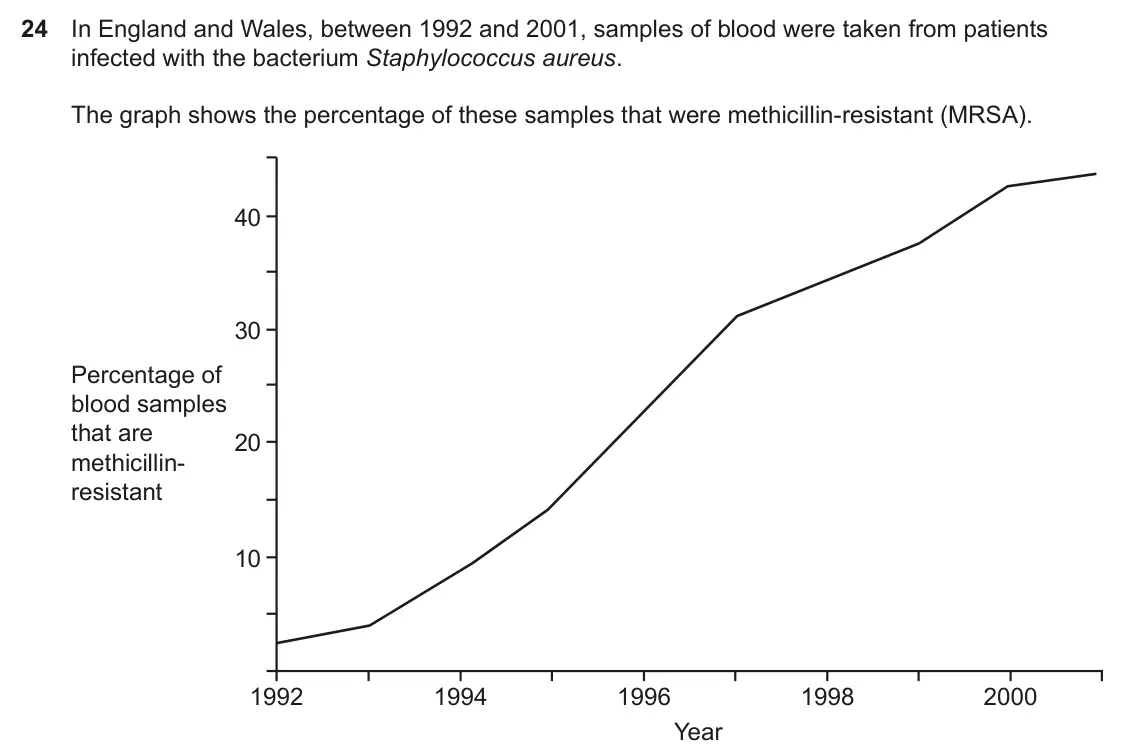
Q24(b)(ii)
The whole paper ↗Q24(c)
The whole paper ↗Q4(b)
The whole paper ↗- Your answer
Q1(b)(iv)
The whole paper ↗Q1(b)(v)
The whole paper ↗Q6(b)(i)
The whole paper ↗Q6(b)(ii)
The whole paper ↗Q6(b)(iii)
The whole paper ↗
All 16 questions on Medicines and antibiotics, as a list
- June 2024, AS Paper 1, Q24(b) (2 marks): The bacterium, Pseudomonas aeruginosa, does not have haemoglobin. P. aeruginosa is found in natural water sources. Infection by P. aeruginosa can cause the dise
- June 2024, AS Paper 1, Q24(c) (3 marks): The treatment for people in hospitals that have HAP due to P. aeruginosa is to give antibiotics. Some populations of P. aeruginosa have become resistant to spec
- June 2024, AS Paper 1, Q24(d) (1 mark): Scientists have suggested that personalised medicine may be used to help with the problem of antibiotic resistance. State what is meant by personalised medicine
- June 2023, Paper 2, Q19(d) (3 marks): Infectious disease caused by pathogenic bacteria can be treated using antibiotics. The first antibiotics became widely available in the middle of the 20th Centu
- June 2023, Paper 2, Q19(e) (2 marks): Plants and microorganisms have traditionally been used as sources of new medicines. Synthetic biology could play a major role in the development of new medicine
- June 2023, AS Paper 1, Q1 (1 mark): Which statement describes a problem that has resulted from the increased use of antibiotics? A Penicillin can no longer be used to treat infections. B Rates of
- November 2021, AS Paper 1, Q24(a)(i) (3 marks): Suggest explanations for the positive correlation in the data in the graph. [3]
- November 2021, AS Paper 1, Q24(b)(ii) (2 marks): Explain the importance of maintaining biodiversity for the discovery of new antibiotics like phazolicin. [2]
- November 2021, AS Paper 1, Q24(c) (2 marks): Advances in medical technology include the development of personalised medicines and synthetic biology. Explain what is meant by personalised medicine and synth
- November 2020, Paper 3, Q4(b) (2 marks): Vancomycin is an antibiotic that has been used to treat bacterial infections for many decades. Several strains of bacteria have evolved resistance to vancomycin
- June 2019, Paper 2, Q3 (1 mark): Biodiversity is important for the development of new medicines. Which of the following statements about the development of new medicines is incorrect? A Compute
- June 2018, AS Paper 2, Q1(b)(iv) (2 marks): Another protease enzyme is HIV1 protease, which is essential for the life cycle of the human immunodeficiency virus (HIV). Inhibition of this protease prevents
- June 2018, AS Paper 2, Q1(b)(v) (2 marks): A student looking at the data in Fig. 1.3 made the following conclusion: “The decrease in deaths from AIDS after 1995 is because of the use of saquinavir by HIV
- June 2016, AS Paper 2, Q6(b)(i) (2 marks): Calculate the percentage increase in the number of death certificates that mention MRSA from 1993 to the year when the numbers reach a peak. Show your working a
- June 2016, AS Paper 2, Q6(b)(ii) (2 marks): The proportion of death certificates that mention MRSA in 1993 is 12%. Compare this figure with the proportion of death certificates that mention MRSA in 2012.
- June 2016, AS Paper 2, Q6(b)(iii) (2 marks): What can you conclude from these data about the deaths involving S. aureus and MRSA since 2007? [2]
Questions, mark schemes and examiner’s reports are © OCR, from their published past papers. Plumi isn’t affiliated with any exam board. Want whole papers? OCR A-Level Biology A past papers, or our free OCR-style practice pack.
The Plumi iPad app also offers exam-style questions with AI feedback on your handwritten working.