 plumi
A‑Level Biology A practice pack, OCR-style
30 exam-style questions across Biological Processes, Biological Diversity and Unified Biology, climbing from easy to super hard, with a full mark scheme. Free to download, no sign-up.
- 30questions
- 373marks
- ~7hin 3 sittings
- H420OCR specification
You need a ruler (cm/mm) and a scientific or graphical calculator; any formulae and statistical tables you need are printed in the questions. OCR-style practice written by Plumi. Not produced or endorsed by OCR.
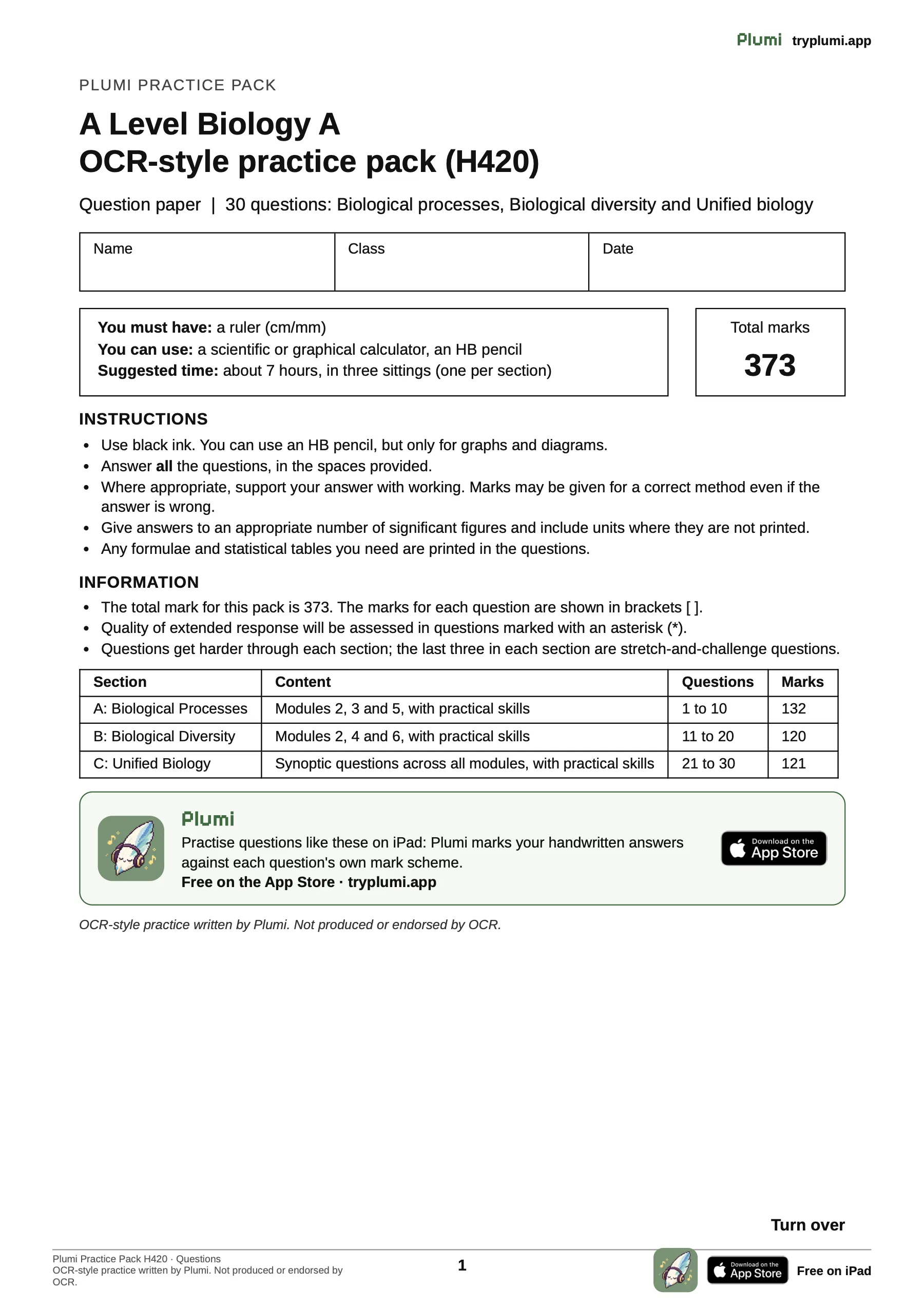
Every question, before you download.
Three sections, ten questions each. Each one starts with a warm-up and ends with three stretch-and-challenge questions.
- Section A · 132 marksBiological Processes
Modules 2, 3 and 5, with practical skills
- Section B · 120 marksBiological Diversity
Modules 2, 4 and 6, with practical skills
- Section C · 121 marksUnified Biology
Synoptic questions across all modules, with practical skills
All 30 questions
- Easy
- Medium
- Hard
- Super hard
| Q | Level | Topic | Marks |
|---|---|---|---|
| Section A: Biological Processes | |||
| 1 | Easy | Cell ultrastructure and magnification: a pancreatic acinar cell · 2.1.1 | 11 |
| 2 | Medium | Water potential: potato tissue in sucrose solutions · 2.1.5, 1.1.3, 1.1.1 | 10 |
| 3 | Medium | The cardiac cycle: pressure changes in the left side of the heart · 3.1.2 | 13 |
| 4 | Medium | Transport of oxygen: llama and human haemoglobin · 3.1.2 | 11 |
| 5 | Hard | Transpiration: measuring water uptake with a potometer · 3.1.3, 1.1.3, 1.1.4 | 15 |
| 6 | Hard | Nerve impulses: the squid giant axon · 5.1.3 | 15 |
| 7 | Hard | The kidney: reabsorption and a desert mammal · 5.1.2, 2.1.5 | 13 |
| 8 | Super hard | Photosynthesis: limiting factors and the Calvin cycle in Chlorella · 5.2.1 | 15 |
| 9 | Super hard | Respiration practical: oxygen uptake and RQ of castor bean seeds · 5.2.2, 1.1.1 | 15 |
| 10 | Super hard | Enzyme inhibition: treating ethylene glycol poisoning with ethanol · 2.1.4, 5.1.2 | 14 |
| Section B: Biological Diversity | |||
| 11 | Easy | Biological molecules: measuring glucose with a colorimeter · 2.1.2, 1.1.2 | 10 |
| 12 | Medium | Biodiversity: Simpson’s index in two meadows · 4.2.1 | 10 |
| 13 | Medium | The immune response: vaccination and antivenom · 4.1.1 | 11 |
| 14 | Medium | Sex linkage: tortoiseshell cats · 6.1.2 | 10 |
| 15 | Hard | Epistasis and the chi-squared test: fruit colour in summer squash · 6.1.2 | 13 |
| 16 | Hard | Variation and the t-test: limpet shells on a rocky shore · 4.2.2, 1.1.3, 1.1.4 | 13 |
| 17 | Hard | Natural selection and Hardy-Weinberg: warfarin resistance in rats · 6.1.2, 4.2.2 | 11 |
| 18 | Super hard | PCR and DNA profiling: finding the father of a kākāpō chick · 6.1.3, 6.1.2 | 14 |
| 19 | Super hard | Succession on sand dunes: planning, choosing and using a statistical test · 6.3.1, 4.2.1, 1.1.1, 1.1.3 | 15 |
| 20 | Super hard | Gene regulation: diauxic growth of E. coli and the lac operon · 6.1.1, 6.2.1 | 13 |
| Section C: Unified Biology | |||
| 21 | Easy | Practical skills: chromatography of photosynthetic pigments · 2.1.2, 5.2.1, 1.1.2 | 8 |
| 22 | Medium | Cell division: mitotic index in an onion root tip · 2.1.6, 2.1.1 | 12 |
| 23 | Medium | Ecosystems: energy transfer and the nitrogen cycle · 6.3.1 | 13 |
| 24 | Medium | Protein synthesis and gene mutation · 2.1.3, 6.1.1 | 11 |
| 25 | Hard | Ectotherms and enzymes: temperature control in a desert lizard · 5.1.1, 2.1.4 | 14 |
| 26 | Hard | Plant hormones: gibberellin and dwarf peas · 5.1.5, 4.2.2, 6.1.1, 1.1.4 | 11 |
| 27 | Hard | Blood glucose: identifying type 1 and type 2 diabetes · 5.1.4, 2.1.5 | 13 |
| 28 | Super hard | Cystic fibrosis: inheritance, membranes and gas exchange · 6.1.2, 6.1.1, 2.1.5, 3.1.1, 6.1.3 | 13 |
| 29 | Super hard | Speciation: cichlid fish in a crater lake · 4.2.2, 6.1.2, 6.1.3 | 12 |
| 30 | Super hard | Photosynthesis, respiration and temperature: coral bleaching · 5.2.1, 2.1.4, 6.3.1 | 14 |
| Total | 373 | ||
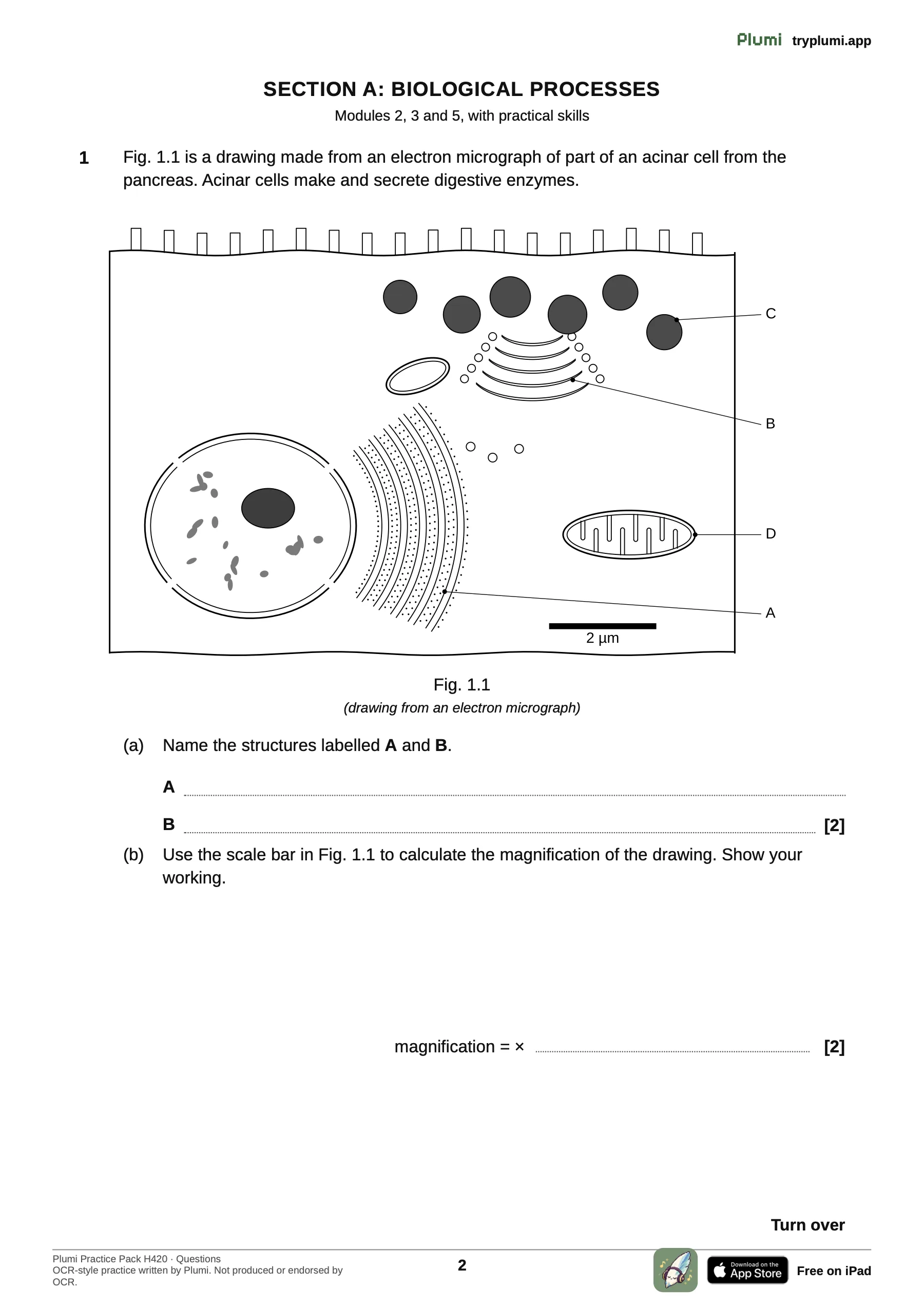
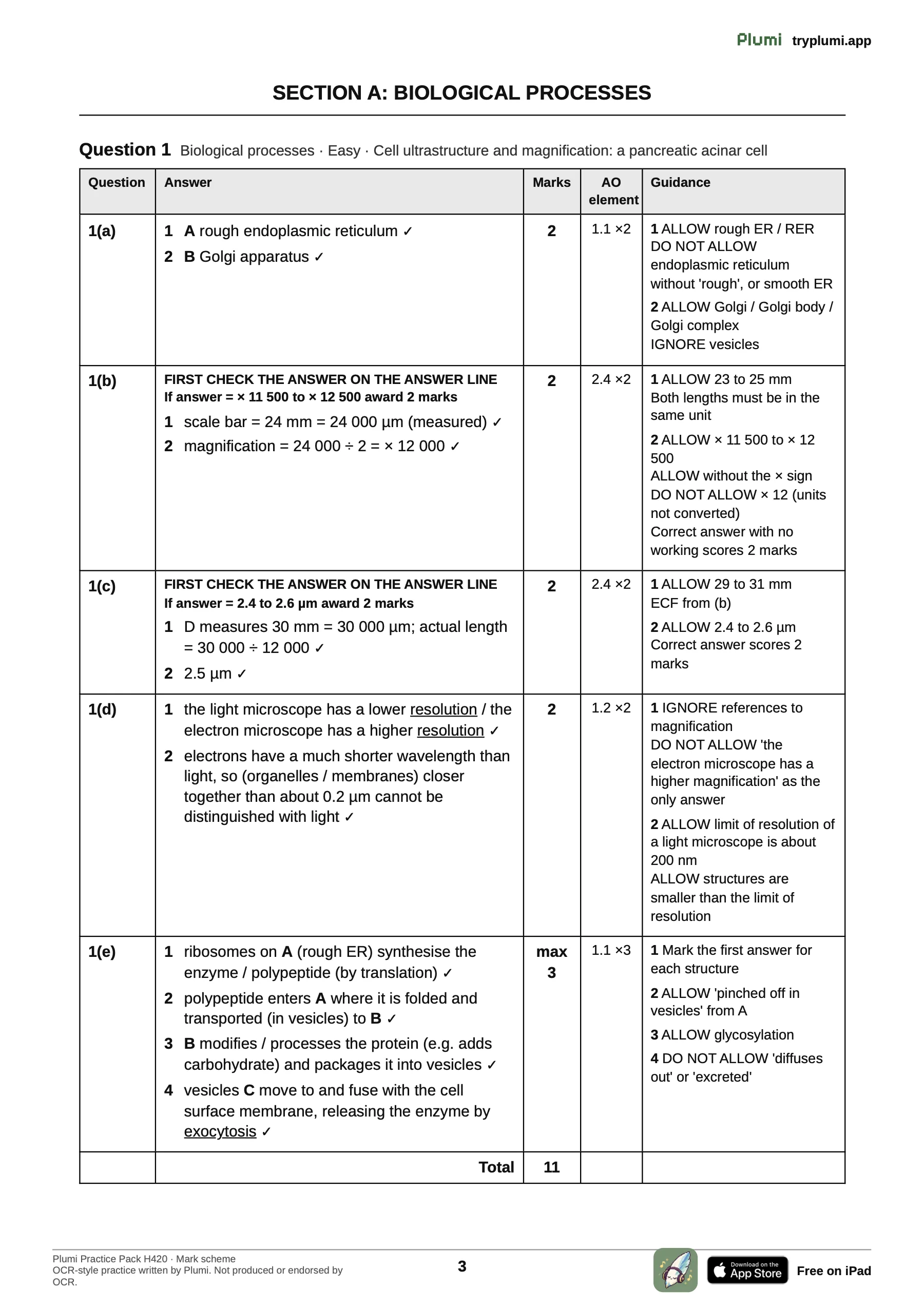
Set out like the real thing.
Every numerical answer, statistic, critical value and genetic ratio in the mark scheme follows from the values printed on the question paper.
How a Plumi pack compares
What you get in a Plumi pack, beside what a typical paid practice pack gives you.
- Every answer checked twice
Each numerical answer in the mark schemes was re-checked, not just worked out and trusted. Each pack says how, on its page.
- Mark schemes like the real ones
M1, A1 and B1 marks, what to allow, error carried forward, and a note on the slip most students make.
- Easy to super hard
Each section climbs from a warm-up to three stretch-and-challenge questions, like the end of a real paper.
| What you get | Plumi pack | Typical paid pack |
|---|---|---|
| Price | Free, no sign-up | Usually paid |
| Questions | 30, across every part of the course | Often one paper’s worth |
| Mark scheme | Every mark, with what to allow and error carried forward | Often answers only |
| Common slips | A note on each question saying where marks are lost | Rarely |
| Answers re-checked | Every numerical answer | Rarely |
| Difficulty | Labelled Easy to Super hard, question by question | Rarely labelled |
More practice
Questions
Are these real past papers?
No. Plumi wrote every question in the style of the board’s papers, to its specification, with a mark scheme in the board’s style. They are not produced or endorsed by the exam board. For the board’s own papers, see our past papers pages.
Are they really free?
Yes. Download the questions and the mark scheme, print them or write on them on a tablet. There is nothing to sign up for.
How should I use a pack?
Sit one section at a time, timed and by hand. Mark it with the scheme, read the note on each question you dropped, and come back to those a week later. Each section takes about two to three hours.
Can Plumi mark my answers?
On iPad, yes: Plumi marks handwritten answers to questions like these against each question’s own mark scheme. The packs themselves are for marking by hand, and the scheme tells you everything you need.