 plumi
Biological membranes: OCR A‑Level Biology A questions
Every OCR A-Level Biology A exam question on 2.1.5 Biological membranes, 2016–2025, with its mark scheme and examiner’s report.
Find questions1,984
Calculations

Q5(a)
The whole paper ↗
Q5(b)
The whole paper ↗
Q5(c)
The whole paper ↗
Q5(d)
The whole paper ↗


Q24(b)(i)
The whole paper ↗
Q24(b)(ii)
The whole paper ↗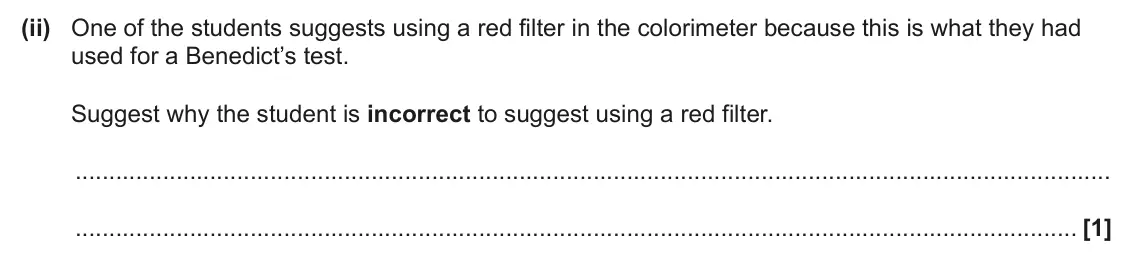
Q24(b)(iii)
The whole paper ↗
Q2(a)(i)
The whole paper ↗
Q2(a)(ii)
The whole paper ↗
Q2(a)(iii)
The whole paper ↗
Q2(b)
The whole paper ↗
Q2(c)
The whole paper ↗
Q2(d)
The whole paper ↗

Q21(c)(iii)
The whole paper ↗
All 110 questions on Biological membranes, as a list
- June 2025, Paper 2, Q6 (1 mark): Some students are conducting an osmosis investigation using cylinders of potato. They cut cylinders of potato 50 mm long using the ruler shown in the diagram. 0
- June 2025, Paper 3, Q5(a) (1 mark): The student makes sucrose solutions of different concentrations by diluting a stock solution. State a piece of equipment, with a higher resolution than a measur
- June 2025, Paper 3, Q5(b) (1 mark): The student controls temperature and the time that the pepper pieces are in the sucrose solution. State one other variable that the student should control durin
- June 2025, Paper 3, Q5(c) (1 mark): The student calculates the change in mass of each piece of pepper during the experiment and converts these values to percentage change in mass. Explain why the
- June 2025, Paper 3, Q5(d) (2 marks): The graph shows the results of the experiment. 15 10 Percentage change in mass 5 0 0.0 0.1 0.2 0.3 0.4 0.5 0.6 0.7 0.8 Sucrose concentration (mol dm–3) Use the
- June 2025, AS Paper 1, Q6 (1 mark): Which component acts as a transport protein? Your answer [1]
- June 2025, AS Paper 1, Q7 (1 mark): Which component is made in the smooth endoplasmic reticulum? Your answer [1]
- June 2025, AS Paper 1, Q8 (1 mark): Which option describes a role of membranes inside a cell? A The cell surface membrane acts as a barrier between the cell and its environment. B The inner membra
- June 2025, AS Paper 1, Q24(b)(i) (2 marks): State two variables that were not controlled in this experiment. 1 2 [2]
- June 2025, AS Paper 1, Q24(b)(ii) (1 mark): One of the students suggests using a red filter in the colorimeter because this is what they had used for a Benedict’s test. Suggest why the student is incorrec
- June 2025, AS Paper 1, Q24(b)(iii) (3 marks): Explain how the students can process their data to assess repeatability. [3]
- June 2025, AS Paper 2, Q2(a)(i) (2 marks): Identify the independent variable and the dependent variable in this experiment. Independent variable Dependent variable [2]
- June 2025, AS Paper 2, Q2(a)(ii) (2 marks): Suggest two improvements to this experiment to increase the accuracy of the results. Improvement 1 Improvement 2 [2]
- June 2025, AS Paper 2, Q2(a)(iii) (2 marks): Suggest a conclusion that can be drawn from the data in the table. You should give evidence to support your conclusion. [2]
- June 2025, AS Paper 2, Q2(b) (2 marks): State one similarity and one difference between simple diffusion and facilitated diffusion. Similarity Difference [2]
- June 2025, AS Paper 2, Q2(c) (3 marks): Using your knowledge of the phospholipid bilayer in plasma membranes, explain how an increase in temperature affects the permeability of the membrane. [3]
- June 2025, AS Paper 2, Q2(d) (2 marks): Exocytosis is an active process. Explain why ATP is needed for exocytosis. [2]
- June 2024, Paper 1, Q3 (1 mark): The diagram shows part of a plasma membrane. X How can molecule X be described? A It has a hydrophilic head and a hydrophobic tail. B It is formed when the glyc
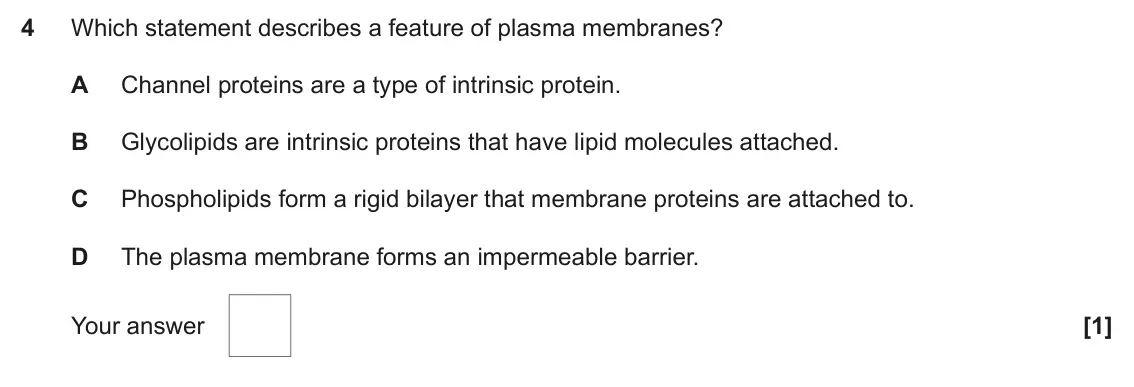
- June 2024, Paper 1, Q4 (1 mark): Which statement describes a feature of plasma membranes? A Channel proteins are a type of intrinsic protein. B Glycolipids are intrinsic proteins that have lipi
- June 2024, Paper 1, Q21(c)(iii) (2 marks): Suggest how hydrogen peroxide could affect the plasma membrane. [2]
- June 2024, Paper 1, Q22(a) (2 marks): The student controls the mass of beetroot in this investigation. Identify two other variables that the student should control in this investigation. 1 2 [2]
- June 2024, Paper 1, Q22(b)(i) (2 marks): Explain the shape of the graph. [2]
- June 2024, Paper 1, Q22(b)(ii) (2 marks): The student repeats the experiment at a temperature of 30 °C. Sketch the graph you expect the student to obtain. [2] Answer on the graph.
- June 2024, AS Paper 1, Q21(a) (2 marks): Explain the difference between the mean results obtained at the 0.0 mol dm–3 and 0.8 mol dm–3 sucrose concentrations. [2]
- June 2024, AS Paper 1, Q21(b) (3 marks): The students suggested that there was an anomaly in their results. Identify the anomalous result and explain how the anomalous result affects the precision of t
- June 2024, AS Paper 1, Q21(c) (2 marks): The students prepared the sucrose concentrations using a serial dilution technique. The students were provided with 10 cm3 of a 0.8 mol dm–3 sucrose concentrati
- June 2024, AS Paper 1, Q21(d) (2 marks): The students carried out a similar experiment with carrot tissue. Explain how the students could use their data to estimate whether sweet potato tissue or carro
- June 2024, AS Paper 2, Q3(a) (3 marks): The graph shows the rate of uptake of particles across a membrane by two different methods of diffusion. © biology.arizona.edu, The Biology Project Department o
- June 2024, AS Paper 2, Q3(b) (1 mark): Temperature and concentration are two factors that affect the rate of diffusion. State one other factor that affects the rate of diffusion. [1]
- June 2024, AS Paper 2, Q3(c)(i) (2 marks): Name two more pieces of apparatus they would need to make sure this is a controlled investigation. 1 2 [2]
- June 2024, AS Paper 2, Q3(c)(ii) (4 marks): Outline the method that the students would use to carry out an investigation into the effect of temperature on the diffusion rate in their model cells. [4]
- June 2024, AS Paper 2, Q3(d) (3 marks): The table below shows some results from a model cell investigation. Concentration of glucose found outside the Temperature (°C) dialysis tubing after two minute
- June 2024, AS Paper 2, Q5(c)(iii) (1 mark): The secretory vesicles remove proteins from the cell by a process called exocytosis. Explain why exocytosis is described as an active process. [1]
- June 2023, Paper 1, Q14 (1 mark): One student made the following observations: 1 Ethanol disrupts the cell membranes leading to increased permeability. 2 The permeability of the cell membranes i
- June 2023, Paper 1, Q15 (1 mark): The students were asked to decide whether the permeability of the membrane is significantly greater with 50% ethanol compared to 40% ethanol. Which statistical
- June 2023, Paper 1, Q20(c)(ii) (2 marks): PGE2 receptors are located on the cell surface membrane. State two functions of the cell surface membrane that are illustrated by the action of PGE2. 1 2 [2]
- June 2023, AS Paper 1, Q25(a) (2 marks): Describe two roles of a cell surface membrane. 1 2 [2]
- June 2023, AS Paper 1, Q25(b) (3 marks): The presence of cholesterol is one of several factors that affect membrane fluidity. A student examined two different cell surface membranes. One membrane had a
- June 2022, Paper 1, Q18(a)(i) (3 marks): Complete Table 18.1 to show how the student should prepare the solutions. Final concentration Volume of Volume of Final volume 1 mol dm–3 sucrose of solution di
- June 2022, Paper 1, Q18(a)(ii) (2 marks): The solution given to the student was prepared using 34.23 g of sucrose in 100 cm3 water. The sucrose was measured on an electronic balance using the following
- June 2022, Paper 1, Q18(b)(i) (1 mark): Identify the anomalous result. [1]
- June 2022, Paper 1, Q18(b)(ii) (2 marks): State one variable that should be controlled in this experiment and give a reason for your choice. Control variable Reason [2]
- June 2022, AS Paper 1, Q1 (1 mark): The graph below shows the results of an osmosis experiment investigating the effect of changing the concentration of sodium chloride (NaCl) on mass of potatoes.
- June 2022, AS Paper 2, Q1(a) (4 marks): A second group of students made improvements to this method. One of the improvements they made was to carry out two further trials at each temperature. Suggest
- June 2022, AS Paper 2, Q1(b) (1 mark): Name the independent variable in this investigation. [1]
- June 2022, AS Paper 2, Q1(c)(i) (3 marks): The table shows the results obtained by the second group of students. Absorbance (%) Temperature (°C) Trial 1 Trial 2 Trial 3 Mean 10 0 0 0 0.0 20 0 0 0 0.0 30
- June 2022, AS Paper 2, Q1(c)(ii) (6 marks): The cells in beetroot contain a red pigment called betalain. The plasma membrane of the beetroot cell is impermeable to betalain. A group of students set out to
- June 2022, AS Paper 2, Q1(d) (2 marks): In a second experiment, students followed the same method but used pieces of beetroot that had been frozen for several days and then defrosted. They were surpri
- June 2022, AS Paper 2, Q3(a)(ii) (2 marks): A common symptom of lactose intolerance in adults is the creation of extra fluid in the large intestine. Suggest why this occurs. [2]
- November 2021, Paper 2, Q18(a) (3 marks): Explain how the structure of phospholipid molecules allows for the formation of plasma membranes. [3]
- November 2021, Paper 2, Q18(b)(i) (4 marks): Present the students’ results in an appropriate table in the space below. [4]
- November 2021, Paper 2, Q18(b)(ii) (2 marks): The students concluded that the red pigment began to leak out of the beetroot cells at any pH below pH6. Suggest and explain why a low pH might cause the red pi
- November 2021, Paper 2, Q18(b)(iii) (2 marks): Outline how the students could modify their investigation to get a more accurate value for the pH at which the red pigment begins to leak out of the beetroot ce
- November 2021, AS Paper 1, Q19 (1 mark): The graph below shows readings from a colorimeter as pigment leaks out of beetroot membranes at different temperatures. P Absorbance (arbitrary units) Temperatu
- November 2020, Paper 1, Q16(b)(i) (4 marks): The student concluded that one substance entered the cells by simple diffusion and the other by active transport. Evaluate the student’s conclusion. [4]
- November 2020, Paper 1, Q16(b)(ii) (4 marks): The student then added 2,4-dinitrophenol (DNP) to the cells. DNP inhibits respiration. Predict the effect of DNP on the uptake of each substance and explain you
- November 2020, Paper 1, Q16(c) (4 marks): The student used a colorimeter to measure the concentration of each substance in the liquid surrounding the cells. The colorimeter had an analogue display. The
- November 2020, Paper 1, Q18(a) (2 marks): The structure of FURA-2 is shown below. COO– COO– CH3 N O O N O COO– COO– N O COO– Use the information in the figure to explain why FURA-2 is unable to cross ce
- November 2020, AS Paper 1, Q3 (1 mark): Which of the lines, A to D, in the graph below, represents the effect of increasing ethanol concentration on the permeability of the plasma membrane to sodium i
- November 2020, AS Paper 1, Q23(b) (2 marks): Explain the role of the membrane in the rough endoplasmic reticulum. [2]
- November 2020, AS Paper 2, Q5(a)(i) (1 mark): Suggest an improvement to the method that would allow the students to obtain more precise results. [1]
- November 2020, AS Paper 2, Q5(a)(ii) (1 mark): State one variable that should have been controlled during this experiment. [1]
- November 2020, AS Paper 2, Q5(b)(i) (2 marks): Before the students began their investigation they made a hypothesis. State the hypothesis the students would have made and state the scientific process that su
- November 2020, AS Paper 2, Q5(b)(ii) (2 marks): Justify whether the results from the investigation support your hypothesis given in part (b)(i). [2]
- November 2020, AS Paper 2, Q5(c) (2 marks): Describe how you would use the same equipment to test if the thickness of the exchange surface affects the diffusion rate. [2]
- June 2019, Paper 1, Q19(b) (2 marks): Some bodybuilders use anabolic steroids to increase their muscle mass. Suggest why anabolic steroids are effective when applied to the surface of the skin. [2]
- June 2019, Paper 2, Q16(a)(i) (2 marks): Define osmosis. [2]
- June 2019, Paper 2, Q16(a)(ii) (3 marks): Plants rely on osmosis for support. Explain the importance of osmosis in plant support. [3]
- June 2019, Paper 2, Q16(b)(i) (2 marks): The ruler used to measure the distance along the capillary tube was accurate to the nearest 0.5 mm. Calculate the percentage uncertainty of the measurement. unc
- June 2019, Paper 2, Q16(b)(ii) (2 marks): What conclusions can be drawn about the composition of solutions X and Y? [2]
- June 2019, Paper 2, Q16(c)(i) (2 marks): Explain why it was necessary to calculate percentage change in
- June 2019, Paper 2, Q16(c)(ii) (2 marks): The students identified replicate 3 of the potato in 0.7 mol dm–3 sucrose as anomalous. Suggest a practical error by the students that might have caused this re
- June 2019, Paper 2, Q16(c)(iii) (3 marks): Use Table 16 to identify which plant cells contained the highest concentration of sucrose. Justify your conclusion. [3]
- June 2019, AS Paper 1, Q1 (1 mark): The diagram below shows one method of transport across a cell membrane. outside cell inside cell Which of the following options, A to D, is the name of this met
- June 2019, AS Paper 1, Q2 (1 mark): The diagram below shows the structure of a plasma membrane. A C B D Which label, A to D, indicates the component of the membrane that can affect its fluidity? Y
- June 2019, AS Paper 1, Q3 (1 mark): This diagram shows the transport of two molecules across a plasma membrane. tissue fluid Z cytoplasm Y Which row, A to D, correctly identifies the molecule bein
- June 2019, AS Paper 1, Q21(a) (3 marks): In the space below, present the student’s results in an appropriate format. [3]
- June 2019, AS Paper 1, Q21(b)(i) (2 marks): Explain how the treatment results in the difference in the final lengths of rod A and rod E. [2]
- June 2019, AS Paper 1, Q21(b)(ii) (2 marks): Explain how the treatment results in the difference in the final lengths of rod D and rod F. [2]
- June 2019, AS Paper 1, Q21(c) (1 mark): State how the student could reduce the uncertainty of their data. [1]
- June 2019, AS Paper 2, Q5(a) (2 marks): Explain why Paramecium needs to expel water when in fresh water. [2]
- June 2019, AS Paper 2, Q5(b)(i) (2 marks): Calculate the percentage decrease in the mean number of contractions as the concentration of sodium chloride solution increases from 0.00 mol dm−3 to 0.15 mol d
- June 2019, AS Paper 2, Q5(b)(ii) (2 marks): Explain why there is a decrease in the activity of the contractile vacuole as the concentration of sodium chloride increases. [2]
- June 2019, AS Paper 2, Q5(b)(iii) (3 marks): The cytoplasm of Paramecium contains salt crystals. These salt crystals can be used to alter the water potential of the cytoplasm. Suggest and explain how the w
- June 2019, AS Paper 2, Q5(b)(iv) (2 marks): The experiment described in Table 5 was extended to find out the effect of reducing the dissolved oxygen concentration on the mean number of contractions at eac
- June 2018, Paper 1, Q17(c)(i) (2 marks): State and explain how one property of region A in Fig. 17.2 contributes to the stability of the plasma membrane. [2]
- June 2018, Paper 1, Q17(c)(ii) (2 marks): There are differences between the plasma membrane and membranes within cells. Outline the role of membranes within cells. [2]
- June 2018, Paper 1, Q20(a)(i) (3 marks): Each step in the student’s method relies on certain assumptions. For each assumption listed below, select the numbered step from the student’s method that relie
- June 2018, Paper 1, Q20(a)(ii) (2 marks): The student kept the ethanol solutions at a constant temperature. State two other variables which need to be controlled in this investigation to ensure the data
- June 2018, Paper 1, Q20(b)(i) (3 marks): Make three criticisms of the way the student has displayed these results. 1 2 3 [3]
- June 2018, Paper 1, Q20(b)(ii) (2 marks): Explain how carrying out replicates would improve this investigation. [2]
- June 2018, AS Paper 1, Q5 (1 mark): The graph shows the rate of movement of four different substances across a membrane. A B C rate of movement across membrane D concentration difference across me
- June 2018, AS Paper 1, Q17 (1 mark): Swiss chard is a leafy green vegetable related to spinach. Some varieties have yellow stalks that have vacuoles containing yellow betaxanthin pigments. The grap
- June 2018, AS Paper 1, Q18 (1 mark): An investigation into how a change in sodium chloride concentration effects osmosis in potato cells concluded that the isotonic point of the potato was 0.25 M.
- June 2018, AS Paper 1, Q22(d) (2 marks): Phospholipid molecules also contain fatty acids. Explain how the fatty acids in phospholipids allow the formation of membranes. [2]
- June 2017, Paper 2, Q1 (1 mark): Membranes are found within and surrounding cells. Which of the statements, A to D, is not a role of membranes in cells? A acts as a barrier between areas B cell
- June 2017, Paper 2, Q11 (1 mark): The diagram below shows part of a plasma membrane. 1 2 3 Which of the label lines points to a structure that could contain a sulfur atom? A 1, 2 and 3 B Only 1
- June 2017, Paper 2, Q20(b)(ii) (2 marks): E. coli usually grows in conditions where the extracellular concentration of lactose is low. In such conditions lactose does not easily cross the bacterial cell
- June 2017, AS Paper 1, Q18 (1 mark): Which option, A to D, describes the role of cholesterol in cell surface membranes in the human body? A Cholesterol binds to phospholipid phosphate heads, increa
- June 2017, AS Paper 1, Q23(a) (2 marks): How does the fluid mosaic model describe the structure of plasma membranes? [2]
- June 2017, AS Paper 1, Q23(b)(i) (2 marks): Explain why progesterone can move across membranes. [2]
- June 2017, AS Paper 1, Q23(b)(ii) (1 mark): Name one other molecule that can cross plasma membranes. [1]
- June 2017, AS Paper 1, Q23(c)(i) (1 mark): State how the structure of the cell surface membrane allows potassium ions to enter or leave a cell. [1]
- June 2017, AS Paper 1, Q23(d)(i) (3 marks): Using the Student’s t-test formula below, calculate the value of t between the data for 50 °C and 60 °C. x x - A B where: x is the mean t = 2 2 S is the standar
- June 2017, AS Paper 1, Q23(d)(ii) (2 marks): The critical value for t at the significance level of 5%, with 18 degrees of freedom, is 2.10. Use the value of t that you calculated in part (i) to explain whe
- June 2017, AS Paper 1, Q23(e) (3 marks): The students plotted the data onto a graph, shown in Fig. 23. The effect of temperature on beetroot membrane permeability 0.50 0.45 0.40 0.35 0.30 absorbance 0.
- June 2016, AS Paper 1, Q16 (1 mark): A group of students were investigating the diffusion of molecules across membranes using a ‘model cell’, as shown below. ‘model cell’ ‘extracellular fluid’ ‘cyt
- June 2016, AS Paper 1, Q21(a)(i) (2 marks): State two details of the procedure that must be followed to obtain valid results. 1 2 [2]
- June 2016, AS Paper 1, Q21(a)(ii) (3 marks): Explain how a student could use the data in Table 21.2 to determine the water potential of the potato tuber tissue. [3]
- June 2016, AS Paper 1, Q21(b)(ii) (1 mark): What will be found at W in the immersed cell? [1]
Questions, mark schemes and examiner’s reports are © OCR, from their published past papers. Plumi isn’t affiliated with any exam board. Want whole papers? Every OCR A-Level Biology A paper, or our free OCR-style practice pack.
Rather write your answers by hand on iPad? Plumi marks them against the same mark schemes.