Reliability: Eduqas A‑Level Psychology questions
Eduqas A-Level Psychology past-paper questions on Reliability, 2017–2025, with mark schemes and examiner’s reports where available.
Paper
All papers
Exam
All years
Calculations
Loading the full question list…
Q9(c)
The whole paper ↗Q12(b)
The whole paper ↗Q11(b)
The whole paper ↗Q4(a)
The whole paper ↗Q4(b)
The whole paper ↗Q9(d)(i)
The whole paper ↗Q9(d)(ii)
The whole paper ↗Q7(c)
The whole paper ↗Q3(a)
The whole paper ↗Q3(b)
The whole paper ↗Q3(c)
The whole paper ↗Q8(b)
The whole paper ↗Q9(c)(i)
The whole paper ↗Q9(c)(ii)
The whole paper ↗

All 14 questions on Reliability, as a list
- June 2025, Component 2, Q9(c) (4 marks): (c) Explain one issue of reliability which you considered in your quasi-experiment and how you dealt with the issue. [4]
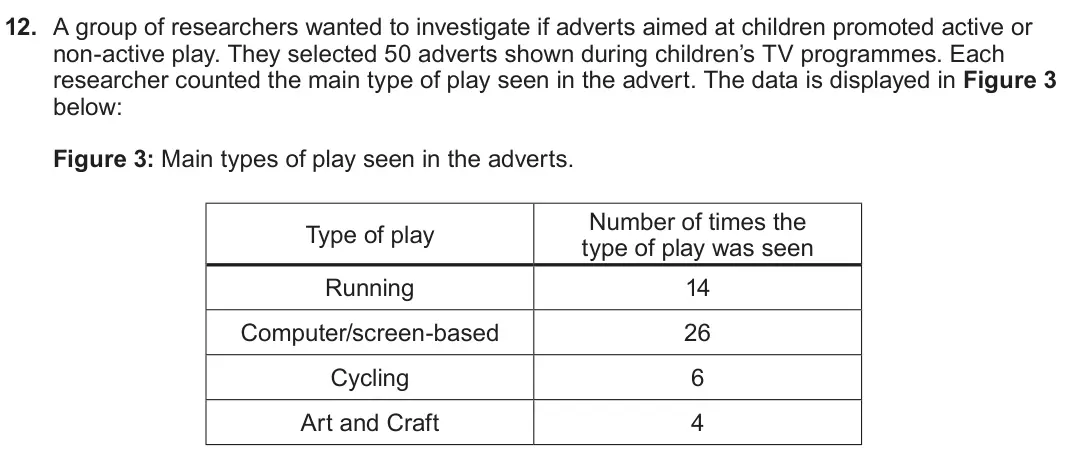
- June 2025, Component 2, Q12(b) (4 marks): (b) Explain one issue of reliability with this investigation and how the researcher could have assessed the issue. [4]
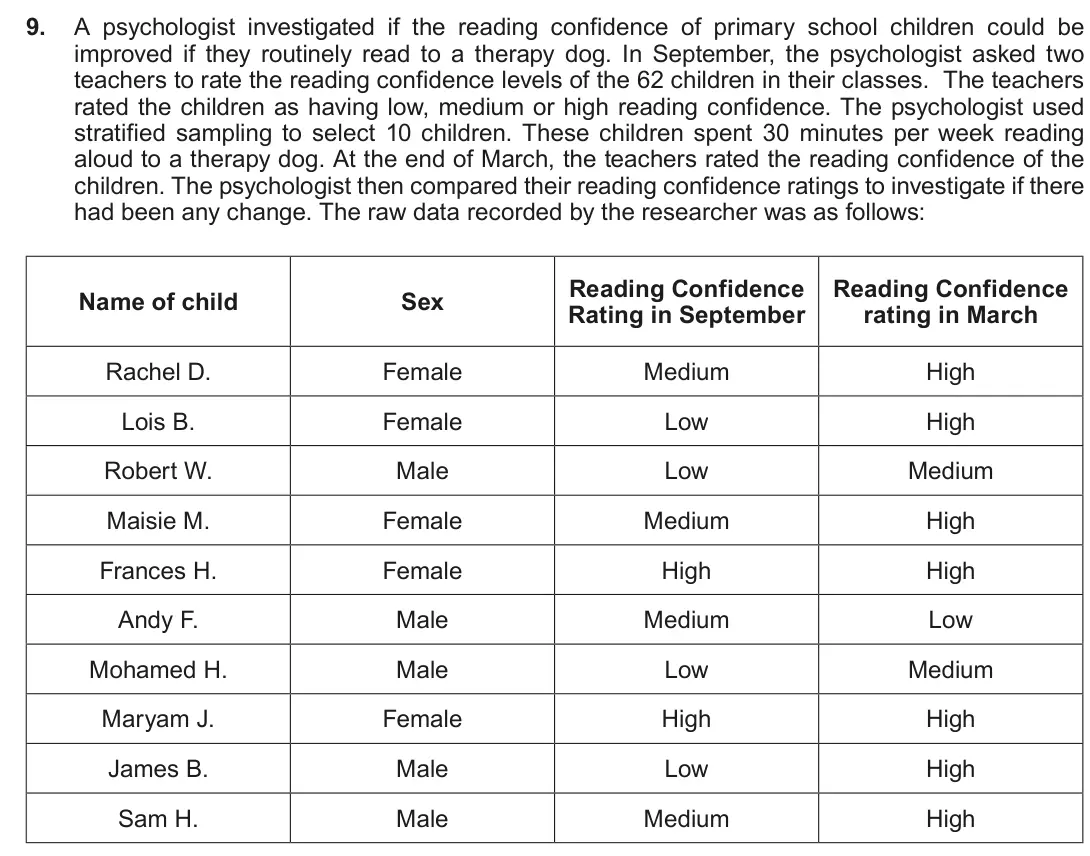
- June 2024, Component 2, Q11(b) (4 marks): (b) Explain one issue of reliability with this research and how the researcher could have dealt with the issue. [4]
- June 2023, Component 2, Q4(a) (2 marks): (a) ‘Test-retest reliability’. [2]
- June 2023, Component 2, Q4(b) (2 marks): (b) ‘Split-half reliability’. [2]
- June 2023, Component 2, Q9(d)(i) (2 marks): (d) (i) Explain one issue of reliability in your content analysis. [2]
- June 2023, Component 2, Q9(d)(ii) (2 marks): (ii) Explain how you dealt with the issue of reliability identified in (d)(i). [2]
- Autumn 2021, Component 2, Q7(c) (2 marks): (c) Explain one issue of internal reliability that you considered in your questionnaire study. [2]
- Autumn 2020, Component 2, Q3(a) (2 marks): (a) Test re-test reliability [2]
- Autumn 2020, Component 2, Q3(b) (2 marks): (b) Inter-rater reliability [2]
- Autumn 2020, Component 2, Q3(c) (2 marks): (c) Split-half reliability [2]
- June 2018, Component 2, Q8(b) (4 marks): (b) With reference to your own correlational research, explain the way you dealt with reliability. [4]
- June 2017, Component 2, Q9(c)(i) (2 marks): (c) (i) Describe one issue of internal reliability that may have occurred in this research. [2]
- June 2017, Component 2, Q9(c)(ii) (3 marks): (ii) Explain how this issue of reliability, identified in (c) (i) could be assessed. [3]
Questions, mark schemes and examiner’s reports are © WJEC Eduqas, from their published past papers. Plumi isn’t affiliated with any exam board. Want whole papers? Eduqas A-Level Psychology past papers.
The Plumi iPad app also offers exam-style questions with AI feedback on your handwritten working.

![Original question 9(c): (c) Explain one issue of reliability which you considered in your quasi-experiment and how you dealt with the issue. [4]](https://pub-e8a9dbab8e2a4d089f52b2a45e0d0b50.r2.dev/bank/a290u20-jun25-09-c-qp.webp?v=1)

![Original question 12(b): (b) Explain one issue of reliability with this investigation and how the researcher could have assessed the issue. [4]](https://pub-e8a9dbab8e2a4d089f52b2a45e0d0b50.r2.dev/bank/a290u20-jun25-12-b-qp.webp?v=1)

![Original question 11(b): (b) Explain one issue of reliability with this research and how the researcher could have dealt with the issue. [4]](https://pub-e8a9dbab8e2a4d089f52b2a45e0d0b50.r2.dev/bank/a290u20-jun24-11-b-qp.webp?v=1)

![Original question 4(a): (a) ‘Test-retest reliability’. [2]](https://pub-e8a9dbab8e2a4d089f52b2a45e0d0b50.r2.dev/bank/a290u20-jun23-04-a-qp.webp?v=1)
![Original question 4(b): (b) ‘Split-half reliability’. [2]](https://pub-e8a9dbab8e2a4d089f52b2a45e0d0b50.r2.dev/bank/a290u20-jun23-04-b-qp.webp?v=1)

![Original question 9(d)(i): (d) (i) Explain one issue of reliability in your content analysis. [2]](https://pub-e8a9dbab8e2a4d089f52b2a45e0d0b50.r2.dev/bank/a290u20-jun23-09-di-qp.webp?v=1)
![Original question 9(d)(ii): (ii) Explain how you dealt with the issue of reliability identified in (d)(i). [2]](https://pub-e8a9dbab8e2a4d089f52b2a45e0d0b50.r2.dev/bank/a290u20-jun23-09-dii-qp.webp?v=1)

![Original question 7(c): (c) Explain one issue of internal reliability that you considered in your questionnaire study. [2]](https://pub-e8a9dbab8e2a4d089f52b2a45e0d0b50.r2.dev/bank/a290u20-oct21-07-c-qp.webp?v=1)

![Original question 3(a): (a) Test re-test reliability [2]](https://pub-e8a9dbab8e2a4d089f52b2a45e0d0b50.r2.dev/bank/a290u20-oct20-03-a-qp.webp?v=1)
![Original question 3(b): (b) Inter-rater reliability [2]](https://pub-e8a9dbab8e2a4d089f52b2a45e0d0b50.r2.dev/bank/a290u20-oct20-03-b-qp.webp?v=1)
![Original question 3(c): (c) Split-half reliability [2]](https://pub-e8a9dbab8e2a4d089f52b2a45e0d0b50.r2.dev/bank/a290u20-oct20-03-c-qp.webp?v=1)

![Original question 8(b): (b) With reference to your own correlational research, explain the way you dealt with reliability. [4]](https://pub-e8a9dbab8e2a4d089f52b2a45e0d0b50.r2.dev/bank/a290u20-jun18-08-b-qp.webp?v=1)

![Original question 9(c)(i): (c) (i) Describe one issue of internal reliability that may have occurred in this research. [2]](https://pub-e8a9dbab8e2a4d089f52b2a45e0d0b50.r2.dev/bank/a290u20-jun17-09-ci-qp.webp?v=1)
![Original question 9(c)(ii): (ii) Explain how this issue of reliability, identified in (c) (i) could be assessed. [3]](https://pub-e8a9dbab8e2a4d089f52b2a45e0d0b50.r2.dev/bank/a290u20-jun17-09-cii-qp.webp?v=1)