 plumi
Chemistry of the p-block: Eduqas A‑Level Chemistry questions
Every Eduqas A-Level Chemistry exam question on PI2.1 Chemistry of the p-block, 2016–2025, with its mark scheme and examiner’s report.
Find questions1,513
Calculations
Q5(a)
The whole paper ↗
Q5(b)
The whole paper ↗
Q10(c)(ii)
The whole paper ↗

Q10(c)(i)
The whole paper ↗
Q10(c)(ii)
The whole paper ↗
Q14(c)(i)
The whole paper ↗
Q8(b)
The whole paper ↗
Q5(f)(i)
The whole paper ↗
Q12(c)(ii)
The whole paper ↗
Q12(e)(ii)
The whole paper ↗
Q11(b)(iv)
The whole paper ↗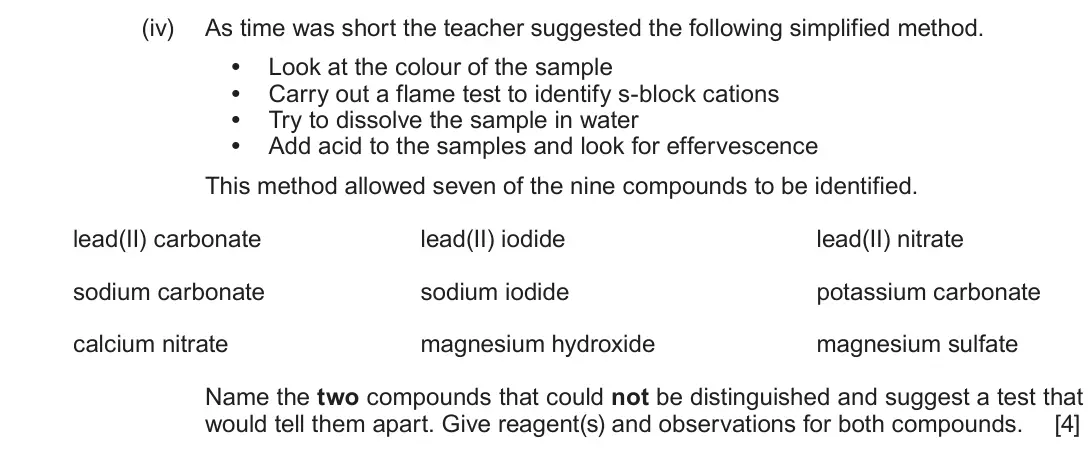
Q11(d)(i)
The whole paper ↗
Q11(d)(iii)
The whole paper ↗
All 16 questions on Chemistry of the p-block, as a list
- June 2025, Component 1, Q5(a) (1 mark): Write an equation for a reaction that shows that carbon dioxide is an acidic oxide. [1]
- June 2025, Component 1, Q5(b) (1 mark): State what is meant by the term amphoteric. [1]
- June 2025, Component 1, Q10(c)(ii) (1 mark): State why lead is the only Group 4 element that is most stable in the +2 oxidation state in its compounds. [1]
- June 2024, Component 1, Q3 (2 marks): Nitrogen and phosphorus can both form chlorides of formula XCl3 but only phosphorus can form a chloride of formula XCl5. Explain why PCl5 exists but NCl5 does n
- June 2024, Component 1, Q10(c)(i) (3 marks): Aluminium hydroxide is an amphoteric compound. Describe reactions that would show this amphoteric behaviour, including all relevant equations. [3]
- June 2024, Component 1, Q10(c)(ii) (3 marks): Explain why aluminium chloride molecules, AlCl3, form dimers of formula Al2Cl6. You may include a diagram as part of your answer. [3]
- June 2024, Component 1, Q14(c)(i) (2 marks): State what is observed when aqueous lead(II) nitrate is added to solution J. Give an ionic equation for the reaction. [2]
- Autumn 2021, Component 1, Q8(b) (1 mark): Sulfur is able to form a range of fluorides including SF2 and SF6 but oxygen can only form fluorides containing two fluorine atoms. Give a reason for this diffe
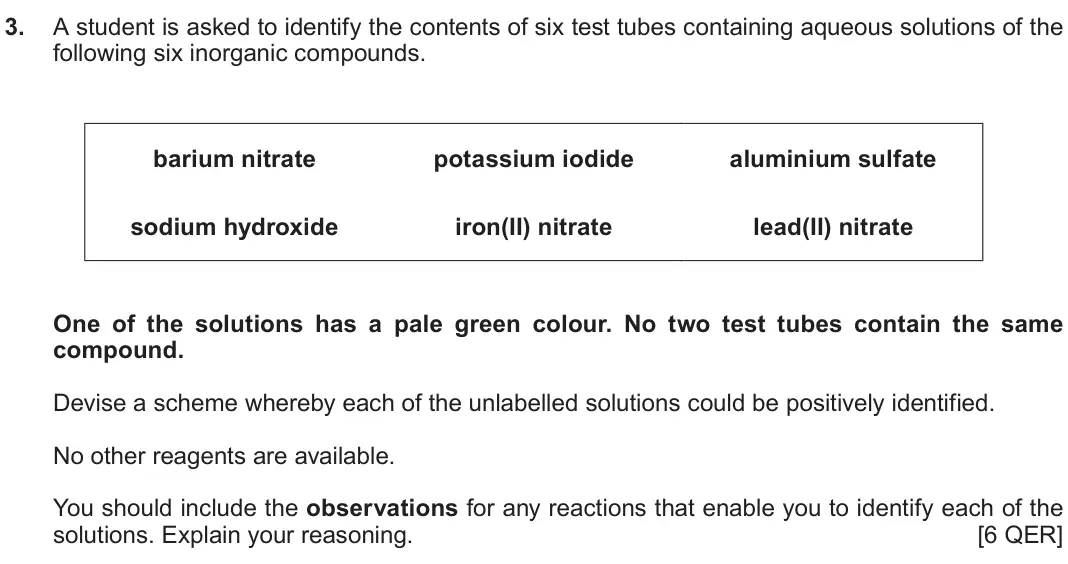
- Autumn 2021, Component 3, Q3 (6 marks): A student is asked to identify the contents of six test tubes containing aqueous solutions of the following six inorganic compounds. barium nitrate potassium io
- Autumn 2021, Component 3, Q5(f)(i) (1 mark): mean volume of sodium thiosulfate used was 21.95 cm3. (f) The thermal decomposition of lead(IV) oxide at 600 °C produces lead(II) oxide and oxygen. (i) Give the
- Autumn 2020, Component 1, Q12(c)(ii) (2 marks): Explain why carbon monoxide is a reducing agent whilst the corresponding oxide of lead, PbO, is not. [2]
- June 2019, Component 1, Q12(e)(ii) (2 marks): Explain why the molecule AlCl3 often forms dimers. [2]
- June 2018, Component 1, Q11(b)(iv) (4 marks): As time was short the teacher suggested the following simplified method. • Look at the colour of the sample • Carry out a flame test to identify s-block cations
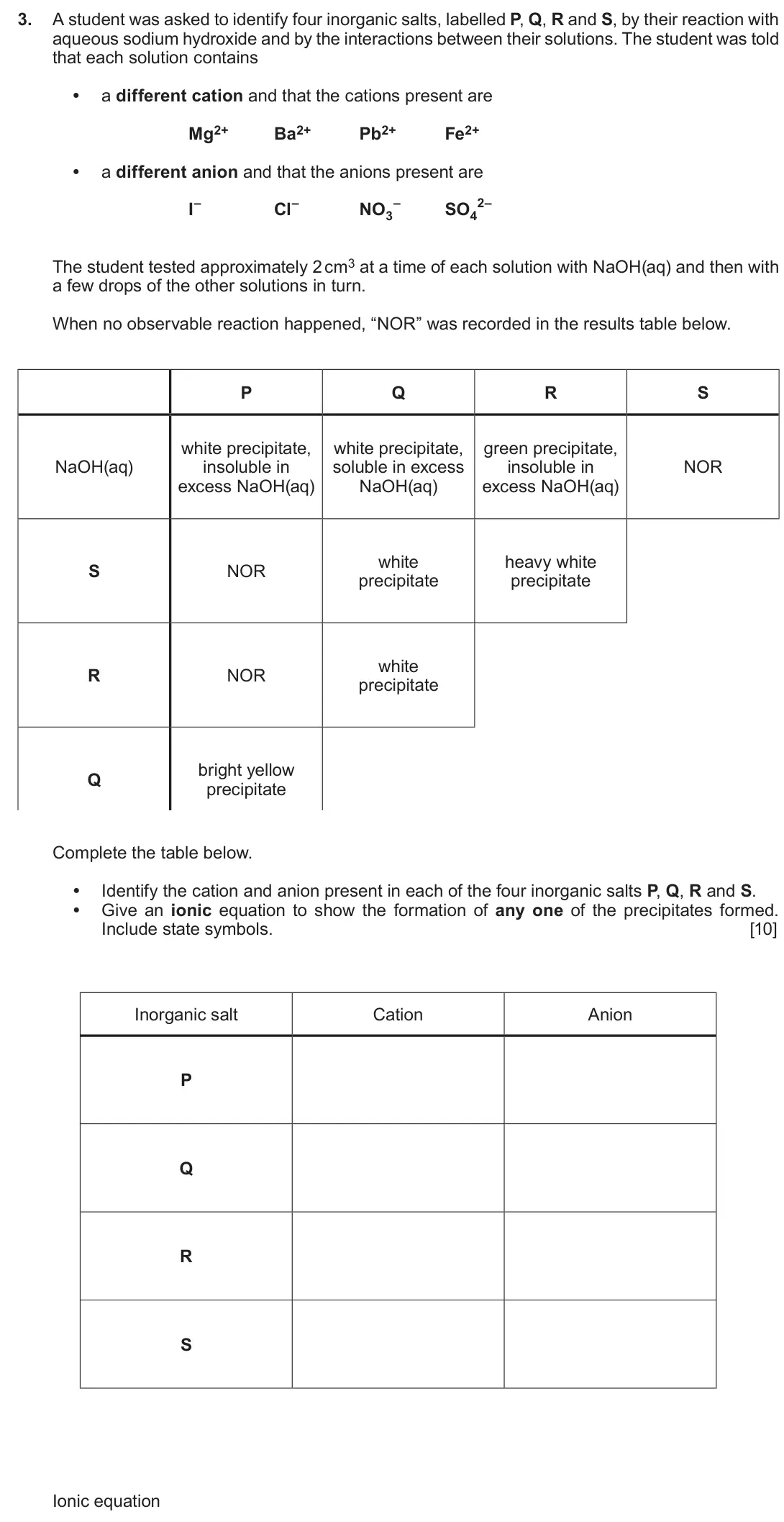
- June 2018, Component 3, Q3 (10 marks): A student was asked to identify four inorganic salts, labelled P, Q, R and S, by their reaction with aqueous sodium hydroxide and by the interactions between th
- June 2017, Component 1, Q11(d)(i) (2 marks): Explain why phosphorus can form two chlorides (PCl3 and PCl5) but nitrogen can only form one chloride (NCl3). [2]
- June 2017, Component 1, Q11(d)(iii) (2 marks): Explain why silicon can form only one chloride (SiCl4) but lead can form two chlorides (PbCl2 and PbCl4). [2]
Questions, mark schemes and examiner’s reports are © WJEC Eduqas, from their published past papers. Plumi isn’t affiliated with any exam board. Want whole papers? Every Eduqas A-Level Chemistry paper.
Rather write your answers by hand on iPad? Plumi marks them against the same mark schemes.