 plumi
Redox and standard electrode potential: Eduqas A‑Level Chemistry questions
Every Eduqas A-Level Chemistry exam question on PI1.1 Redox and standard electrode potential, 2016–2025, with its mark scheme and examiner’s report.
Find questions1,513
Calculations
Q12(d)(ii)
The whole paper ↗
Q12(d)(v)
The whole paper ↗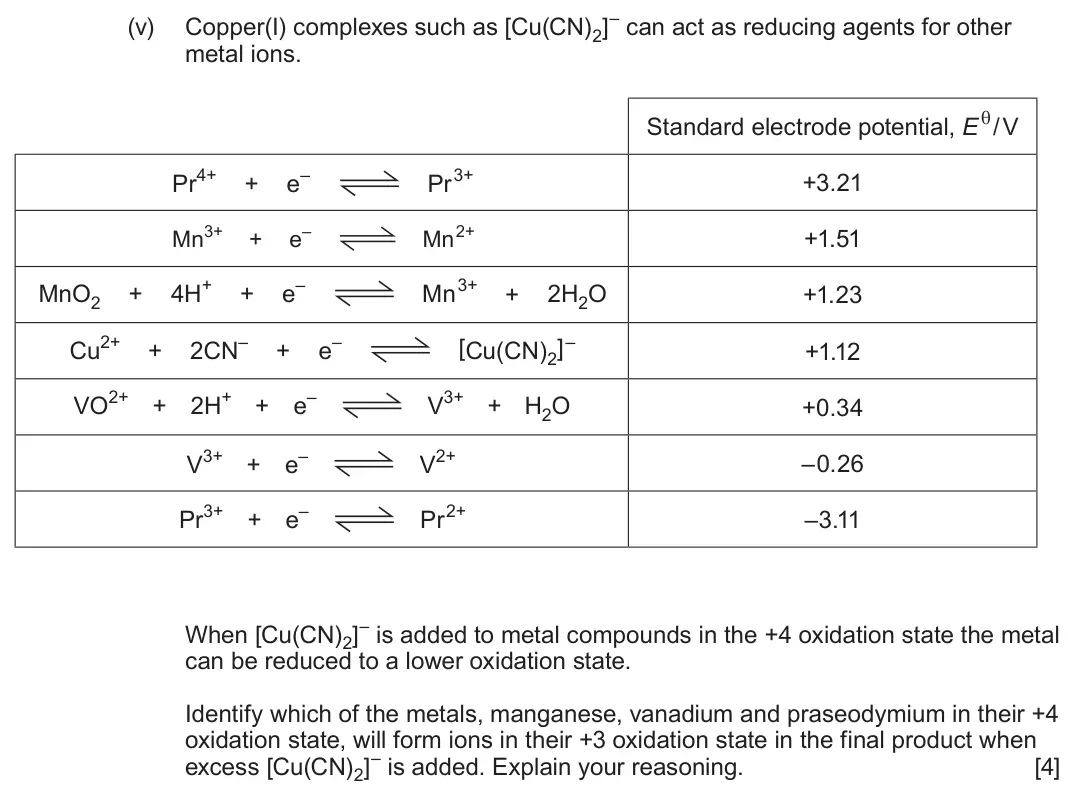
Q9(c)(ii)
The whole paper ↗
Q11(b)(i)
The whole paper ↗
Q11(b)(ii)
The whole paper ↗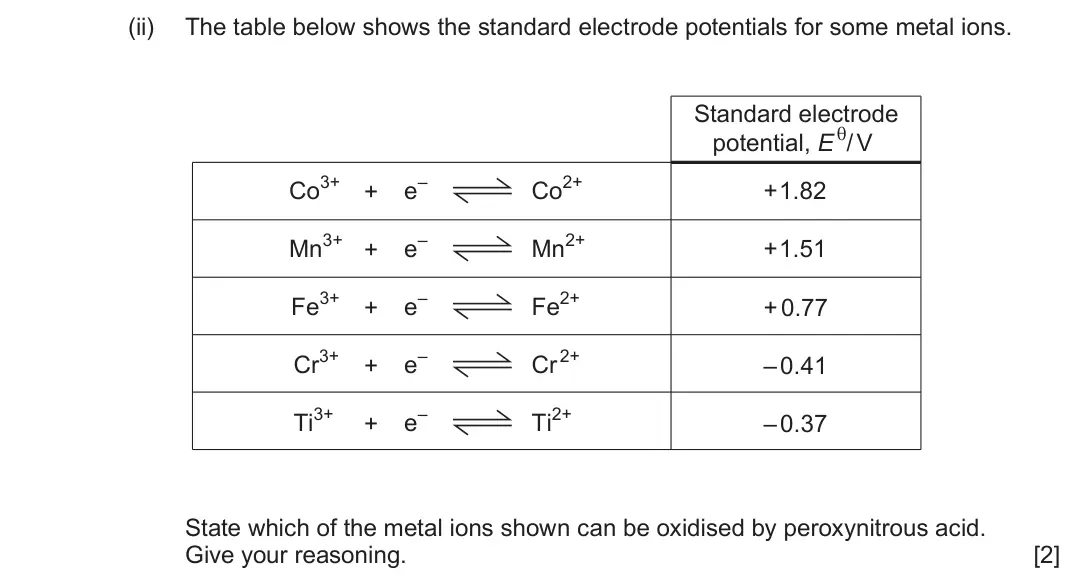
Q12(e)(i)
The whole paper ↗
Q2(b)(i)
The whole paper ↗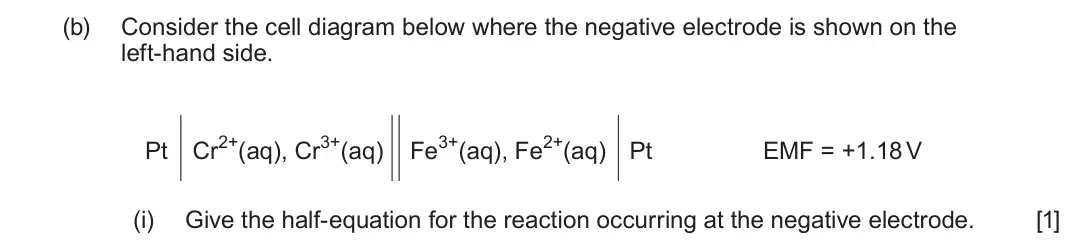
Q2(b)(ii)
The whole paper ↗
Q2(b)(iii)
The whole paper ↗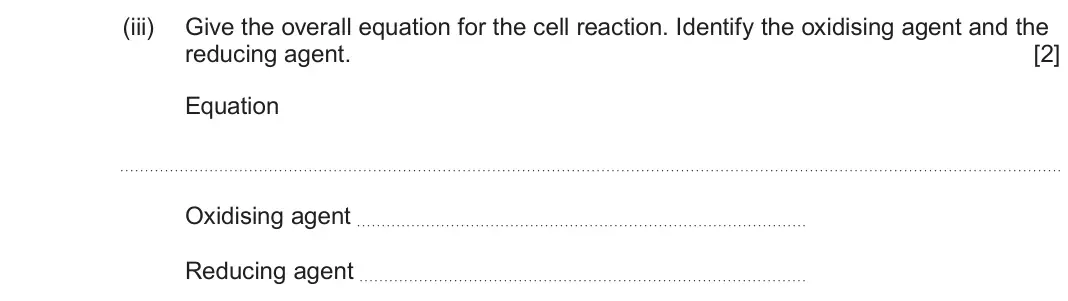
Q2(b)(iv)
The whole paper ↗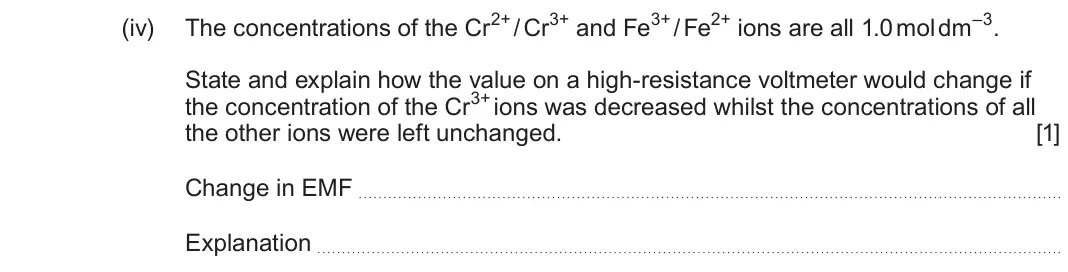
Q11(e)
The whole paper ↗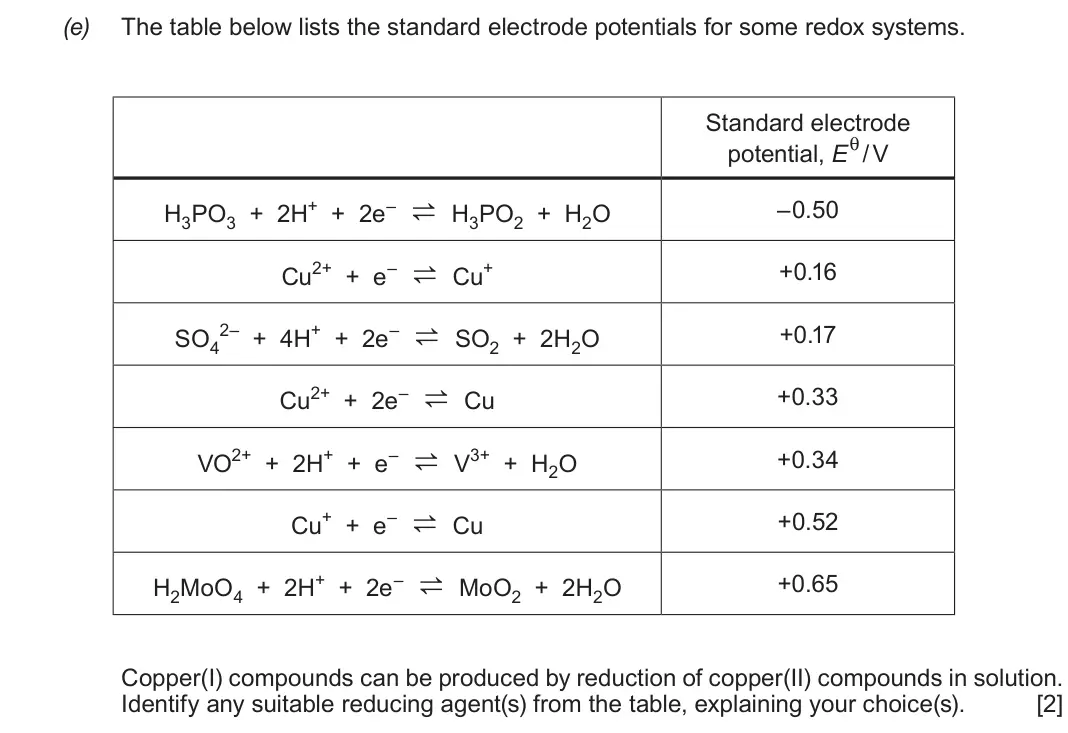
Q12(a)(iii)
The whole paper ↗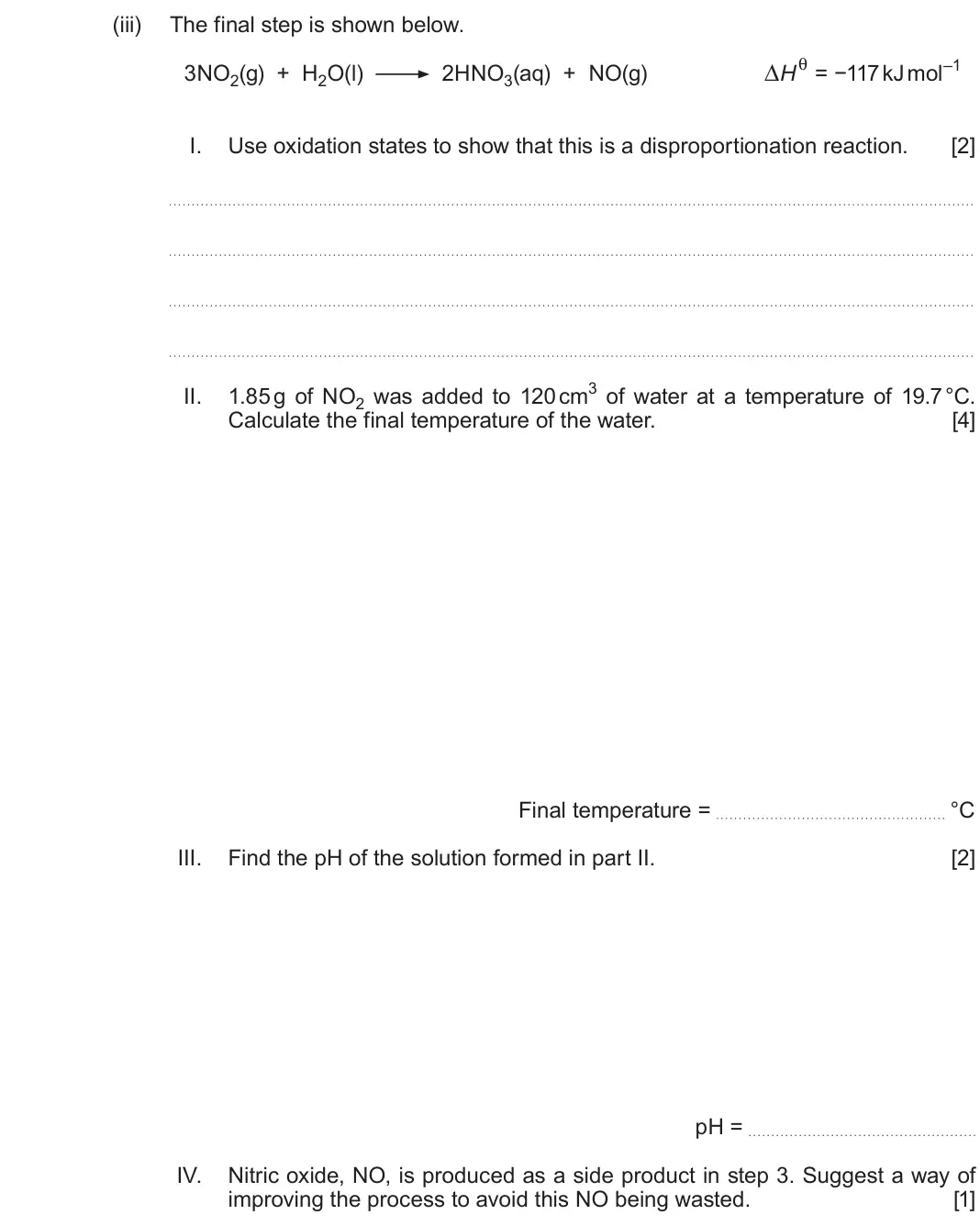
Q11(a)
The whole paper ↗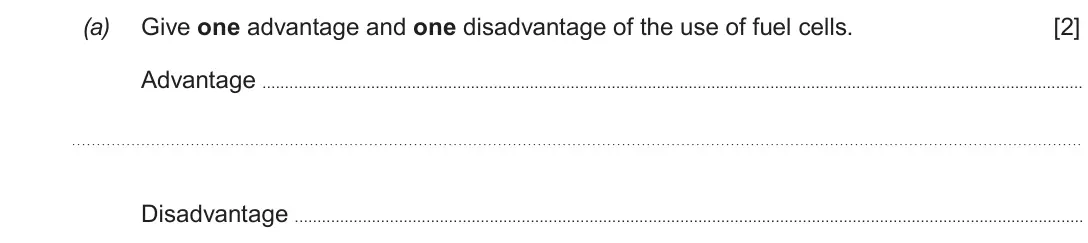
Q12(c)(i)
The whole paper ↗
Q13(b)(iv)
The whole paper ↗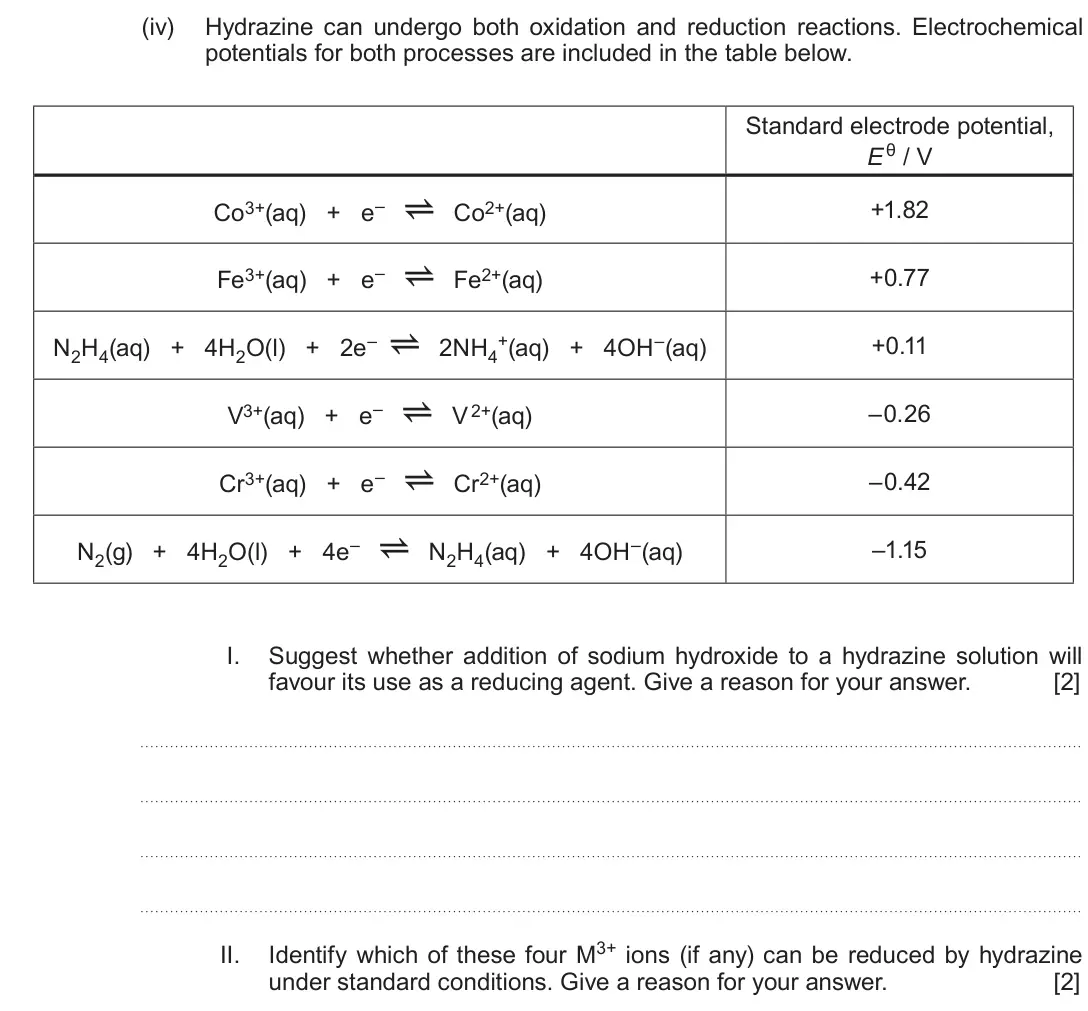
Q7(b)
The whole paper ↗

Q11(d)(ii)
The whole paper ↗
All 31 questions on Redox and standard electrode potential, as a list
- June 2025, Component 1, Q12(d)(ii) (1 mark): Suitable ligands must be chosen for the reaction to prevent the copper(I) ions precipitating as Cu2O(s) or undergoing disproportionation. State what is meant by
- June 2025, Component 1, Q12(d)(v) (4 marks): Copper(I) complexes such as [Cu(CN)2]– can act as reducing agents for other metal ions. Standard electrode potential, E θ / V Pr4+ + e– Pr3+ +3.21 Mn3+ + e– Mn2
- June 2024, Component 1, Q9(c)(ii) (1 mark): Give the oxidation state of the chlorine atom in this molecule. [1]
- June 2024, Component 1, Q11(b)(i) (2 marks): State what is meant by the term standard electrode potential. [2]
- June 2024, Component 1, Q11(b)(ii) (2 marks): The table below shows the standard electrode potentials for some metal ions. Standard electrode potential, E θ/ V Co3+ + e– Co2+ +1.82 Mn3+ + e– Mn2+ +1.51 Fe3+
- June 2024, Component 1, Q12(e)(i) (1 mark): Identify the oxidation state of the iron in chukanovite. Give a reason for your answer. [1]
- June 2024, Component 3, Q2(b)(i) (1 mark): Give the half-equation for the reaction occurring at the negative electrode. [1]
- June 2024, Component 3, Q2(b)(ii) (1 mark): Give the observation at the positive electrode after the cell has been connected for a period of time. [1]
- June 2024, Component 3, Q2(b)(iii) (2 marks): Give the overall equation for the cell reaction. Identify the oxidising agent and the reducing agent. [2] Equation Oxidising agent Reducing agent
- June 2024, Component 3, Q2(b)(iv) (1 mark): The concentrations of the Cr2+ / Cr3+ and Fe3+ / Fe2+ ions are all 1.0 mol dm–3 State and explain how the value on a high-resistance voltmeter would change if t
- Autumn 2021, Component 1, Q11(e) (2 marks): The table below lists the standard electrode potentials for some redox systems. Standard electrode potential, Eθ / V H3PO3 + 2H+ + 2e– s H3PO2 + H2O –0.50 Cu2+
- Autumn 2021, Component 1, Q12(a)(iii) (9 marks): The final step is shown below. 2HNO3(aq) + NO(g) ΔHθ = −117 kJ mol–1 3NO2(g) + H2O(l) I. Use oxidation states to show that this is a disproportionation reaction
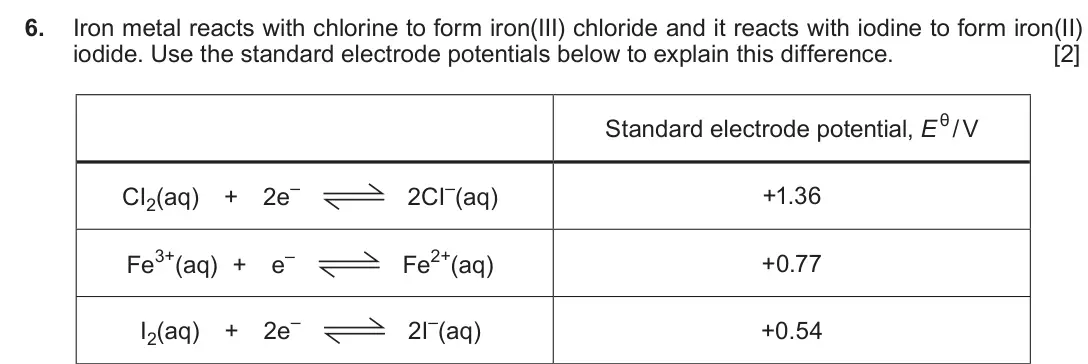
- Autumn 2020, Component 1, Q6 (2 marks): Iron metal reacts with chlorine to form iron(III) chloride and it reacts with iodine to form iron(II) iodide. Use the standard electrode potentials below to exp
- Autumn 2020, Component 1, Q11(a) (2 marks): Give one advantage and one disadvantage of the use of fuel cells. [2] Advantage Disadvantage
- Autumn 2020, Component 1, Q12(c)(i) (1 mark): State what is meant by a reducing agent. [1]
- June 2019, Component 1, Q13(b)(iv) (4 marks): Hydrazine can undergo both oxidation and reduction reactions. Electrochemical potentials for both processes are included in the table below. Standard electrode
- June 2018, Component 1, Q7(b) (2 marks): Use oxidation states to explain why this is a disproportionation reaction. [2]
- June 2018, Component 1, Q8 (2 marks): Standard electrode potentials are measured by comparison with the standard hydrogen electrode. Describe the standard hydrogen electrode. You may include a diagr
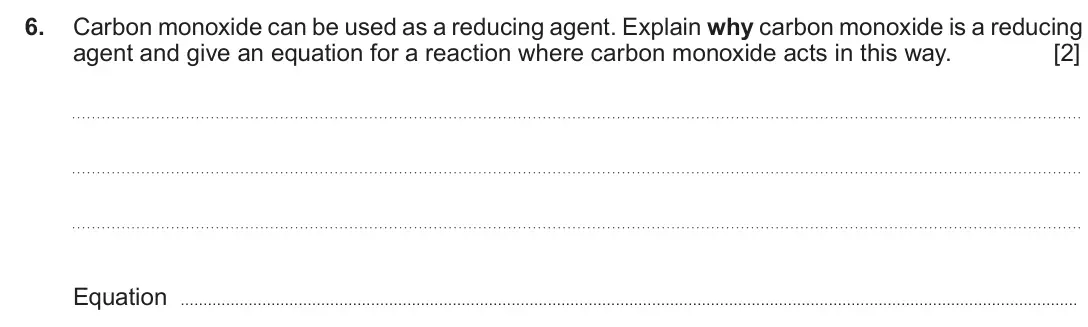
- June 2017, Component 1, Q6 (2 marks): Carbon monoxide can be used as a reducing agent. Explain why carbon monoxide is a reducing agent and give an equation for a reaction where carbon monoxide acts
- June 2017, Component 1, Q11(d)(ii) (2 marks): Sodium can also form an oxide with formula Na2O2. Deduce the oxidation state of the oxygen in this compound, and use it to show that its reaction with water is
- June 2017, Component 1, Q14(a)(i) (1 mark): State the function of the salt bridge. [1]
- June 2017, Component 1, Q14(a)(ii) (3 marks): Draw a labelled diagram of the standard hydrogen electrode. [3]
- June 2017, Component 1, Q14(a)(iii) (1 mark): When measuring the standard electrode potential for the Zn2+(aq) │ Zn(s) system a piece of zinc metal is placed in an aqueous solution containing Zn2+(aq). Expl
- June 2017, Component 1, Q14(b)(i) (1 mark): Give the formula of the strongest reducing agent in the table. [1]
- June 2017, Component 1, Q14(b)(ii) (2 marks): Calculate the EMF of the cell formed when the Br2(l) │ Br −(aq) half-cell is connected to the Zn2+(aq) │ Zn(s) half-cell. [2] EMF = V
- June 2017, Component 1, Q14(b)(iii) (6 marks): Use the values in the table to explain why the reaction between gaseous iodine and heated iron wire produces iron(II) iodide whilst chlorine gas and iron wire p
- June 2017, Component 1, Q15(a) (3 marks): A lithium ion battery can sustain a current over an extended period of time so that a total charge of 1.2 × 10⁴ C has flowed. Calculate the mass of lithium that
- June 2017, Component 3, Q3(a) (1 mark): Suggest how the student made the salt bridge. [1]
- June 2017, Component 3, Q3(b) (2 marks): Write an equation for the overall cell reaction and calculate the standard cell potential for this cell. [2] Standard cell potential = V
- June 2017, Component 3, Q3(c) (2 marks): Describe one observation the student would have made in each half-cell after the cell had been connected for a period of time. [2] Half-cell A Half-cell B
- June 2017, Component 3, Q3(d) (1 mark): The student measured the cell potential and found that it was different from the value calculated in (b). Suggest a reason for this. [1]
Questions, mark schemes and examiner’s reports are © WJEC Eduqas, from their published past papers. Plumi isn’t affiliated with any exam board. Want whole papers? Every Eduqas A-Level Chemistry paper.
Rather write your answers by hand on iPad? Plumi marks them against the same mark schemes.